Close Menu
TechCentralTechCentral

    Subscribe to the newsletter

    Get the best South African technology news and analysis delivered to your e-mail inbox every morning.

    Facebook X (Twitter) YouTube LinkedIn
    WhatsApp Facebook X (Twitter) LinkedIn YouTube
    TechCentralTechCentral
    • News
      Why Telkom is pouring capex into IT - Serame Taukobong

      Why Telkom is pouring capital spending into IT

      2 June 2026
      Telkom's data growth story still has years to run: CEO

      Telkom’s data growth story still has years to run: CEO

      2 June 2026
      Reserve Bank draws a line on inflation - Lesetja Kganyago. Siphiwe Sibeko/Reuters

      Reserve Bank draws a line on inflation

      2 June 2026

      Clashing judgments leave South Africa’s crypto law unsettled

      2 June 2026
      Telkom's four-year SIU standoff awaits a final ruling

      Telkom’s four-year SIU standoff awaits a final ruling

      2 June 2026
    • World
      Astronomers discover exoplanets with magnetic fields

      Strange winds reveal magnetic fields on distant ‘hot Jupiters’

      2 June 2026
      Nvidia's first CPUs to debut in Windows laptops this week

      Nvidia CPUs to debut in Windows laptops this week

      31 May 2026
      Watch: Bezos rocket erupts in fireball during ground test

      Watch: Bezos rocket erupts in fireball during ground test

      29 May 2026
      AI boom hands Samsung chip workers life-changing bonuses

      AI boom hands Samsung chip workers life-changing bonuses

      27 May 2026
      Luce lit: Ferrari unveils its first electric car

      Luce lit: Ferrari unveils its first electric car

      26 May 2026
    • In-depth
      Alfa's electric rebel - Alfa Romeo Junior Elettrica Veloce

      Alfa’s electric rebel

      29 April 2026
      Africa switches on as Europe dims the lights

      Africa switches on as Europe dims the lights

      9 April 2026
      The biggest untapped EV market on Earth is hiding in plain sight

      The biggest untapped EV market on Earth is hiding in plain sight

      1 April 2026
      AI, cybersecurity power standout year for Datatec - Jens Montanana

      The R16-billion tech giant hiding in plain sight

      26 March 2026
      The last generation of coders

      The last generation of coders

      18 February 2026
    • TCS
      TCS | Charge's R1.8-billion bet on an off-grid EV future - Charge chairman Joubert Roux

      TCS | Charge’s R1.8-billion bet on an off-grid EV future

      18 May 2026
      TCS+ | The Up&Up Group on the hidden cost of AI - Jason Harrison

      TCS+ | The Up&Up Group on the hidden cost of AI

      13 May 2026
      Michael Rossouw

      TCS+ | The retirement decision most South Africans get wrong

      6 May 2026
      TCS | The Cape Town start-up listening for TB with AI - Braden van Breda

      TCS | The Cape Town start-up listening for TB with AI

      4 May 2026

      TCS+ | ‘The ISP for ISPs’: Vox’s shift to wholesale aggregator

      20 April 2026
    • Opinion
      Treasury's crypto crackdown is a betrayal of Mandela's promise - Duncan McLeod

      Treasury’s crypto crackdown is a betrayal of Mandela’s promise

      22 May 2026
      South Africa is sleepwalking into another AI policy failure - Celeste Labuschagne

      South Africa is sleepwalking into another AI policy failure

      20 May 2026
      AI won't fix your culture - it will expose it - Jackie Kennedy

      AI won’t fix your culture – it will expose it

      19 May 2026
      Treasury's crypto crackdown is a betrayal of Mandela's promise - Duncan McLeod

      Free calls, dead voice and Shameel Joosub’s Spanish ghost

      22 April 2026
      The conflict of interest at the heart of PayShap's slow adoption - Cheslyn Jacobs

      The conflict of interest at the heart of PayShap’s slow adoption

      26 March 2026
    • Company Hubs
      • 1Stream
      • Africa Data Centres
      • AfriGIS
      • Altron Digital Business
      • Altron Document Solutions
      • Altron Group
      • Arctic Wolf
      • Ascent Technology
      • AvertITD
      • BBD
      • Braintree
      • CallMiner
      • CambriLearn
      • CM Telecom
      • Contactable
      • CYBER1 Solutions
      • Digicloud Africa
      • Digimune
      • Domains.co.za
      • ESET
      • Euphoria Telecom
      • HOSTAFRICA
      • Incredible Business
      • iONLINE
      • IQbusiness
      • Iris Network Systems
      • Kaspersky
      • LSD Open
      • Mitel
      • NEC XON
      • Netstar
      • Network Platforms
      • Next DLP
      • Ovations
      • Paracon
      • Paratus
      • Q-KON
      • SevenC
      • SkyWire
      • Solid8 Technologies
      • Telit Cinterion
      • Telviva
      • Tenable
      • Vertiv
      • Videri Digital
      • Vodacom Business
      • Wipro
      • Workday
      • XLink
    • Sections
      • AI and machine learning
      • Banking
      • Broadcasting and Media
      • Cloud services
      • Contact centres and CX
      • Cryptocurrencies
      • Education and skills
      • Electronics and hardware
      • Energy and sustainability
      • Enterprise software
      • Financial services
      • HealthTech
      • Information security
      • Internet and connectivity
      • Internet of Things
      • Investment
      • IT services
      • Lifestyle
      • Motoring
      • Policy and regulation
      • Public sector
      • Retail and e-commerce
      • Satellite communications
      • Science
      • SMEs and start-ups
      • Social media
      • Talent and leadership
      • Telecoms
    • Events
    • Advertise
    TechCentralTechCentral
    Home » Editor's pick » What commercial aircraft will look like in 2050

    What commercial aircraft will look like in 2050

    By The Conversation7 November 2014
    Twitter LinkedIn Facebook WhatsApp Email Telegram Copy Link
    News Alerts
    WhatsApp

    beoing-nasa-640

    The aircraft industry is expecting a seven-fold increase in air traffic by 2050, and a four-fold increase in greenhouse gas emissions unless fundamental changes are made. But just how “fundamental” will those changes need to be and what will be their effect on the aircraft we use?

    The crucial next step towards ensuring the aircraft industry becomes greener is the full electrification of commercial aircraft. That’s zero CO2 and NOx emissions, with energy sourced from power stations that are themselves sustainably fuelled. The main technological barrier that must be overcome is the energy density of batteries, a measure of how much power can be generated from a battery of a certain weight.

    Tesla CEO Elon Musk has said that once batteries are capable of producing 400Wh/kg, with a ratio of power cell to overall mass of between 0,7 and 0,8, an electrical transcontinental aircraft becomes “compelling”.

    Elon Musk on electric aircraft (via YouTube):

    Given that practical lithium-ion batteries were capable of achieving energy-densities of 113Wh/kg in 1994, 202Wh/kg in 2004, and are now capable of approximately 300Wh/kg, it’s reasonable to assume that they will hit 400Wh/kg in the coming decade.

    Another aspect is the exponential fall in the cost of solar panels, which have already become the cheapest form of power in most US states. The expected 70% reduction in cost of lithium-ion batteries by 2025, and the rapid rise seen in the cost of kerosene-based jet fuel means that there will be a large and growing disparity in the costs of running aircraft that will greatly favour electrification. As is often the case, the reasons that will slow transition are not technological, but are rooted in the economic and political inertia against overturning the status quo.

    VoltAir, all-electric aircraft concept (image: Eads)

    Considering the average service-life of passenger and freight aircraft are around 21 and 33 years respectively, even if all new aircraft manufactured from tomorrow were fully electric, the transition away from fossil-fuelled aircraft would take two to three decades.

    In the meantime, biofuel offers carbon emissions reductions of between 36% and 85%, with the variability depending on the type of land used to grow the fuel crops. As switching from one fuel to another is relatively straightforward, this is a low-hanging fruit worth pursuing before completely phasing out combustion engines.

    Even though a biofuel-kerosene jet fuel blend was certified in 2009, the aircraft industry is in no hurry to implement change. There are minor technological hurdles and issues around scaling up biofuel production to industrial levels, but the main constraint is price — parity with fossil fuels is still 10 years away.

    The adoption of any new aircraft technology — from research, to design sketches, to testing and full integration — is typically a decade-long process. Given that the combustion engine will be phased out by mid-century, it would seem to make more economic and environmental sense to innovate in other areas: airframe design, materials research, electric propulsion design and air traffic control.

    Bringing aircraft to life
    We are living in a world of exponential change in technology. We need to step out of our linear day-to-day thinking to fully conceive and make use of what we have to shape the future.

    In terms of the cost of computational power, computer technology is advancing more each hour today than it did in its entire first 90 years. With this in mind we can project that the equivalent of a US$1 000 computer today will by 2023 be more powerful than the potential brainpower of a human and, by 2045, will surpass the brainpower equivalent to all human brains combined.

    The miniaturisation of digital electronics over the past half century has followed a similar exponential trend, with the size of transistor gates reducing from approximately 1 000nm in 1970 to 23nm today. With the advent of transistors made of graphene showing great promise, this is expected to fall further to about 7nm by 2025. By comparison, a human red blood cell is approximately 6 200nm to 8 200nm wide.

    Putting together this increase in computational power and decrease in circuit size, and adding in the progress made with 3D printing, at some point in the next decade we will be able to produce integrated computers powerful enough to control an aircraft at the equivalent of the cellular level in near real-time — wireless interlinking of nano-scale digital devices.

    Using a biologically inspired digital “nervous system” with receptors arranged over the aircraft sensing forces, temperatures, and airflow states could drastically improve the energy efficiency of aircraft, when coupled to software and hardware mechanisms to control or even change the shape of the aircraft in response.

    Chopping the tail
    Once electric aircraft are established, the next step will be to integrate a gimballed propulsion system, one that can provide thrust in any direction. This will remove the need for the elevators, rudders, and tailplane control surfaces that current designs require, but which add significant mass and drag.

    Skeleton of trailing edge of wing morphing wind-tunnel demonstrator concept (image: Ash Dove-Jay, University of Bristol)

    The wings we are already designing are near their peak in terms of aerodynamic efficiency, but they still do no justice to what nature has achieved in birds. Aircraft design templates are a century old — constrained by the limitations of the day then, but technology has since moved on. We no longer need to build wings as rigid structures with discrete control surfaces, but can turn to the natural world for inspiration. As Richard Feynman said: “I think nature’s imagination is so much greater than man’s, she’s never going to let us relax.”

    Bio-inspired aircraft concept, sporting adaptive and morphing skins and structures (image: Nasa Dryden Flight Research Centre)

    Industry’s outlook of the future
    The aircraft industry has not been idle, of course. Here are some of their designs on the drawing board:

    E-Thrust Project (Eads)
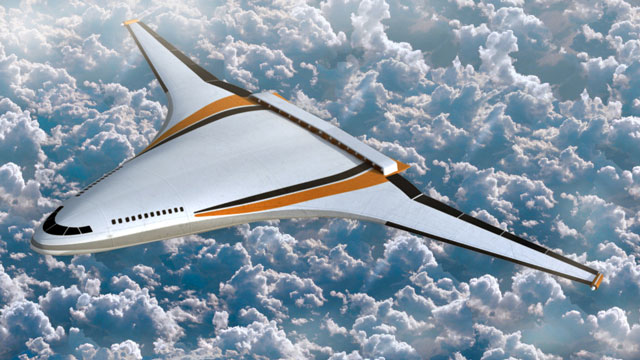
    Blended Wing Body (Boeing and Nasa)
    Airbus 2050 concept plane
    Electric aircraft (Nasa)
    Prandtl Plane air freighter (University of Pisa)
    • The ConversationAsh Dove-Jaym is PhD researcher in aerospace engineering at the University of Bristol
    • This article was originally published on The Conversation

    Follow TechCentral on Google News Add TechCentral as your preferred source on Google


    Ash Dove-Jaym Boeing Eads Nasa
    WhatsApp YouTube
    Share. Facebook Twitter LinkedIn WhatsApp Telegram Email Copy Link
    Previous ArticleSony Xperia Z3 Compact review: size matters
    Next Article No rolling blackouts this weekend

    Related Posts

    More organic compounds detected on Mars - Nasa Curiosity rover

    More organic compounds detected on Mars

    21 April 2026

    The cameras behind Artemis II’s stunning lunar images

    15 April 2026
    Epic, must-watch 4K footage of the Artemis II launch

    Epic, must-watch 4K footage of the Artemis II launch

    12 April 2026
    Company News
    The hidden infrastructure behind AI - Open Access Data Centres OADC

    The hidden infrastructure behind AI

    2 June 2026
    Addressing the 57% blind spot: Kaspersky on measuring SOC effectiveness

    Addressing the 57% blind spot: Kaspersky on measuring SOC effectiveness

    2 June 2026
    Strike48 report: security leaders wary of AI agents - Maidar Secure

    Strike48 report: security leaders wary of AI agents

    2 June 2026
    Opinion
    Treasury's crypto crackdown is a betrayal of Mandela's promise - Duncan McLeod

    Treasury’s crypto crackdown is a betrayal of Mandela’s promise

    22 May 2026
    South Africa is sleepwalking into another AI policy failure - Celeste Labuschagne

    South Africa is sleepwalking into another AI policy failure

    20 May 2026
    AI won't fix your culture - it will expose it - Jackie Kennedy

    AI won’t fix your culture – it will expose it

    19 May 2026

    Subscribe to Updates

    Get the best South African technology news and analysis delivered to your e-mail inbox every morning.

    Latest Posts
    Why Telkom is pouring capex into IT - Serame Taukobong

    Why Telkom is pouring capital spending into IT

    2 June 2026
    Telkom's data growth story still has years to run: CEO

    Telkom’s data growth story still has years to run: CEO

    2 June 2026
    Reserve Bank draws a line on inflation - Lesetja Kganyago. Siphiwe Sibeko/Reuters

    Reserve Bank draws a line on inflation

    2 June 2026
    Astronomers discover exoplanets with magnetic fields

    Strange winds reveal magnetic fields on distant ‘hot Jupiters’

    2 June 2026
    © 2009 - 2026 NewsCentral Media
    • Cookie policy (ZA)
    • TechCentral – privacy and Popia

    Type above and press Enter to search. Press Esc to cancel.

    Manage consent

    TechCentral uses cookies to enhance its offerings. Consenting to these technologies allows us to serve you better. Not consenting or withdrawing consent may adversely affect certain features and functions of the website.

    Functional Always active
    The technical storage or access is strictly necessary for the legitimate purpose of enabling the use of a specific service explicitly requested by the subscriber or user, or for the sole purpose of carrying out the transmission of a communication over an electronic communications network.
    Preferences
    The technical storage or access is necessary for the legitimate purpose of storing preferences that are not requested by the subscriber or user.
    Statistics
    The technical storage or access that is used exclusively for statistical purposes. The technical storage or access that is used exclusively for anonymous statistical purposes. Without a subpoena, voluntary compliance on the part of your Internet Service Provider, or additional records from a third party, information stored or retrieved for this purpose alone cannot usually be used to identify you.
    Marketing
    The technical storage or access is required to create user profiles to send advertising, or to track the user on a website or across several websites for similar marketing purposes.
    • Manage options
    • Manage services
    • Manage {vendor_count} vendors
    • Read more about these purposes
    View preferences
    • {title}
    • {title}
    • {title}