
Close Menu
TechCentralTechCentral

    Subscribe to the newsletter

    Get the best South African technology news and analysis delivered to your e-mail inbox every morning.

    Facebook X (Twitter) YouTube LinkedIn
    WhatsApp Facebook X (Twitter) LinkedIn YouTube
    TechCentralTechCentral
    • News
      AI is squeezing Google's search growth - and its cash

      AI is squeezing Google’s search growth – and its cash

      29 October 2026
      South Africa's 3G networks could go dark within two years - Dejan Kastelic

      South Africa’s 3G networks could go dark within two years

      28 October 2026
      Vodacom books R23-billion Safaricom gain as court fight rages

      Vodacom books R23-billion Safaricom gain as court fight rages

      28 October 2026
      Canal+ takes a knife to DStv prices

      Canal+ takes a knife to DStv prices

      28 October 2026
      South Africa risks return to money-laundering grey list - Busi Mavuso

      South Africa risks return to money-laundering grey list

      28 October 2026
    • World
      Anthropic's IPO stands alone

      Anthropic’s IPO stands alone

      23 October 2026
      PHP flaws trigger global scramble as hackers pounce

      PHP flaws trigger global scramble as hackers pounce

      22 October 2026
      OpenAI turns the tables on Apple in trade secrets fight

      OpenAI turns the tables on Apple in trade secrets fight

      15 October 2026
      Google's Gemini 4 Argon is finally here

      Google’s Gemini 4 Argon is finally here

      14 October 2026
      Apple's new HomeView smart home hub

      Apple takes another shot at the smart home

      13 October 2026
    • In-depth
      Why investors are souring on Netflix

      Why investors are souring on Netflix

      22 October 2026

      10 days that changed the course of AI

      21 September 2026
      Meta to the AI industry: slow down without us - Mark Zuckerberg

      Meta to the AI industry: slow down without us

      16 September 2026
      Google DeepMind CEO Demis Hassabis. Image: John Sears

      The plan to stop AI from breaking the world

      16 July 2026
      The internet has a Strait of Hormuz problem

      The internet has a Strait of Hormuz problem

      15 July 2026
    • TCS
      TCS+ | Vox on AI, data rules and omnichannel communication for SMEs

      TCS+ | Vox on AI, data rules and omnichannel communication for SMEs

      26 October 2026
      TCS | The Cape Town firm quietly connecting Eskom, Pep and 6 000 ATMs - Réan van Niekerk, Metacom

      TCS | The Cape Town firm quietly connecting Eskom, Pep and 6 000 ATMs

      23 October 2026
      TCS+ | Boards are underestimating the cost of a cyberattack, says Arctic Wolf - Jason Oehley and Andre Den Hond

      TCS+ | Boards are underestimating the cost of a cyberattack, says Arctic Wolf

      22 October 2026
      W&W | LDV's Gerhard Moolman on electric bakkies, fleet orders and 'school fees'

      W&W | LDV’s Gerhard Moolman on electric bakkies and fleets

      9 October 2026
      TCS | Frogfoot sees bigger fibre deals coming - TechCentral Show guests Abraham van der Merwe and Shane Chorley

      TCS | Frogfoot sees bigger fibre deals coming

      8 October 2026
    • Opinion
      AI's boardroom honeymoon is over - Gary Stocks

      AI’s boardroom honeymoon is over

      22 October 2026
      Before South Africa licenses Starlink, it should look at Ukraine - Duncan McLeod

      Before South Africa licenses Starlink, it should look at Ukraine

      21 October 2026
      Nonkqubela Thathakahle Jordan-Dyani

      Why cybersecurity is now a national security issue for South Africa

      15 October 2026
      When a machine can choose, who does it become? Fanie van Rooyen

      When a machine can choose, who does it become?

      9 October 2026
      Let South Africans jailbreak their way to digital sovereignty - Dirk de Vos

      Let South Africans jailbreak their way to digital sovereignty

      5 October 2026
    • Company News
      • 1Stream
      • Africa Data Centres
      • AfriGIS
      • Altron Digital Business
      • Altron Document Solutions
      • Altron Group
      • Arctic Wolf
      • Ascent Technology
      • AvertITD
      • BBD
      • Braintree
      • CallMiner
      • CambriLearn
      • CM.com
      • Contactable
      • CYBER1 Solutions
      • Digicloud Africa
      • Digimune
      • Domains.co.za
      • ESET
      • Euphoria Telecom
      • HOSTAFRICA
      • Incredible Business
      • iONLINE
      • IQbusiness
      • Iris Network Systems
      • Kaspersky
      • LSD Open
      • Mitel
      • NEC XON
      • Netstar
      • Network Platforms
      • Next DLP
      • Ovations
      • Paracon
      • Paratus
      • Publishared
      • Q-KON
      • SevenC
      • SkyWire
      • Solid8 Technologies
      • Telit Cinterion
      • Telviva
      • Tenable
      • Vertiv
      • Videri Digital
      • Vodacom Business
      • Vox
      • Wipro
      • Workday
      • XLink
    • Sections
      • AI and machine learning
      • Banking
      • Broadcasting and media
      • Cloud services
      • Contact centres and CX
      • Cryptocurrencies
      • Education and skills
      • Electronics and hardware
      • Energy and sustainability
      • Enterprise software
      • Fintech and payments
      • HealthTech
      • Information security
      • Internet and connectivity
      • Internet of things
      • Investment
      • IT services
      • Lifestyle
      • Policy and regulation
      • Public sector
      • Retail and e-commerce
      • Satellite communications
      • Science
      • SMEs and start-ups
      • Social media
      • Talent and leadership
      • Telecoms
      • Watts & Wheels
    • Events
    • Advertise
    TechCentralTechCentral
    Home » Opinion » Toby Shapshak » Why Huawei is the next Samsung

    Why Huawei is the next Samsung

    By Toby Shapshak15 August 2013
    Twitter LinkedIn Facebook WhatsApp Email Telegram Copy Link
    Get breaking news on WhatsApp

    Toby-Shapshak-180Rarely are the kings of one era the kings of the next. Just as Nokia and BlackBerry were the kings of the pre-smartphone era, so they were eclipsed by Apple and its fast-follower, Samsung. The same is true of Palm, which reigned in the preceding age of the personal digital assistant.

    But just as Nokia, which at one point sold two out of every three cellphones and had 60% market share, and BlackBerry, which had some 40% of the market share for smartphones, ultimately misjudged the next revolution, so it seems will Apple and Samsung.

    Nokia and BlackBerry’s declining years were characterised by trivial, incremental upgrades that were punted as significant, but which were ultimately inconsequential. The companies’ technologies had plateaued and no amount of spin could sell it otherwise. Consumers voted with their wallets.

    These same signs of decay are emerging at Apple and Samsung. The iPhone 5 and Galaxy S4 were minor upgrades. The “institutional arrogance”, as one analyst put it, which plagued the previous kings, now characterises Apple and Samsung. That kind of holier-than-thou attitude can kill a business — just look at the stagnation at Microsoft and Yahoo.

    At the once-mighty Apple, the Steve Jobs-inspired run is over. We might as well admit it. Even the beautifully designed new Mac Pro feels a little ho-hum.

    At Samsung, the decade spent fighting to be “number one” in every category has paid off. Its television sets lead the market, and it sells more smartphones and just plain old phones than Nokia.

    And yet, like all the once high-flying PC makers selling Windows computers, Samsung is as tied to Google, with Android, as Dell or Hewlett-Packard were to Microsoft. Samsung is great with the hardware but weak on software, where it leans on Android.

    And both Samsung — which sells half of all smartphones and one in four feature phones — and Apple face pressure because their primary markets for smartphones, in the developed world, are saturated. Despite projecting record sales, Samsung’s share price fell as investors were beset by this very fear.

    The next behemoth waiting in the wings, ladies and gentlemen, is China’s Huawei.

    You might say, not entirely incorrectly, that Huawei is simply cloning Samsung’s strategy of cloning Apple.

    To put it another way — perhaps unfairly to Huawei — if Apple and Samsung are the Ferraris and Lamborghinis of smartphones, then Huawei is the Toyota. And most of the world drives Toyotas — especially in the developing world, including Africa, where all the growth in smartphones is expected to come from.

    Just look at Huawei’s new super-slim Ascend P6. At just 6,18mm, it is the latest claimant to the “thinnest smartphone in the world” title. Launched on 18 June, it is a wonder of a smartphone, with all the usual trimmings you’d expect, except two: its price, an estimated R5 000 to R6 000 where such handsets are easily R8 000 or more, and the 5 megapixel front-facing camera. The P6 is a Lexus priced as a Toyota.
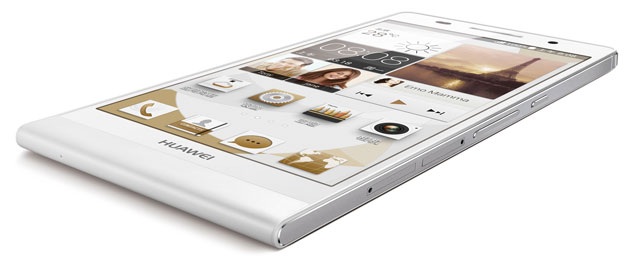
    Huawei's super-thin Ascend P6 smartphone
    Huawei’s super-thin Ascend P6 smartphone

    The price is key. Apple, Samsung, Sony, BlackBerry and Nokia are forced to charge high prices for their high-margin smartphones. Huawei’s core business is selling the actual networks they run on. And those 3G dongles we all use in our laptops.

    Unlike the current kings, which need to protect both their market share and margins, Huawei has nothing to lose and everything to gain. It will make smartphones cheaper, which will appeal to price-conscious emerging-market consumers, and that’s where the growth is going to come from in the next decade.

    Describing it as “the most fantastic partner” and “the most extraordinary engineering organisation”, Carphone Warehouse founder and chairman Charles Dunstone said at the P6 launch: “I think Huawei are going to be a very, very big player in the smartphone market.”

    • Toby Shapshak is editor of Stuff magazine. This column was first published in Financial Mail

    Add TechCentral as a preferred source on GoogleFollow TechCentral on Google NewsGet breaking news on WhatsApp


    BlackBerry Google Huawei Nokia Samsung Toby Shapshak
    WhatsApp YouTube
    Share. Facebook Twitter LinkedIn WhatsApp Telegram Email Copy Link
    Previous ArticleMTN share breaches R200
    Next Article What’s next from Sony

    Related Posts

    AI is squeezing Google's search growth - and its cash

    AI is squeezing Google’s search growth – and its cash

    29 October 2026
    The hidden cost of owning a folding phone

    The hidden cost of owning a folding phone

    28 October 2026
    Alleged Israeli spy company heavily targeted Starlink users

    How online ads were used to hunt Starlink users

    28 October 2026
    Company News

    The key to AI search visibility is human attention: media agency Connect

    28 October 2026
    Why customers still feel unheard when automation works exactly as designed - CallMiner

    Why customers still feel unheard when automation works exactly as designed

    28 October 2026
    Telviva earns ISO/IEC 27001:2022 certification for information security - Antony Russell

    Telviva earns ISO/IEC 27001:2022 certification for information security

    27 October 2026
    Opinion
    AI's boardroom honeymoon is over - Gary Stocks

    AI’s boardroom honeymoon is over

    22 October 2026
    Before South Africa licenses Starlink, it should look at Ukraine - Duncan McLeod

    Before South Africa licenses Starlink, it should look at Ukraine

    21 October 2026
    Nonkqubela Thathakahle Jordan-Dyani

    Why cybersecurity is now a national security issue for South Africa

    15 October 2026

    Subscribe to Updates

    Get the best South African technology news and analysis delivered to your e-mail inbox every morning.

    Latest Posts
    AI is squeezing Google's search growth - and its cash

    AI is squeezing Google’s search growth – and its cash

    29 October 2026
    South Africa's 3G networks could go dark within two years - Dejan Kastelic

    South Africa’s 3G networks could go dark within two years

    28 October 2026
    Vodacom books R23-billion Safaricom gain as court fight rages

    Vodacom books R23-billion Safaricom gain as court fight rages

    28 October 2026
    Canal+ takes a knife to DStv prices

    Canal+ takes a knife to DStv prices

    28 October 2026
    © 2009 - 2026 NewsCentral Media
    Built and maintained by Chronon
    • Cookie policy (ZA)
    • TechCentral – privacy and Popia

    Type above and press Enter to search. Press Esc to cancel.

    Manage consent

    TechCentral uses cookies to enhance its offerings. Consenting to these technologies allows us to serve you better. Not consenting or withdrawing consent may adversely affect certain features and functions of the website.

    Functional Always active
    The technical storage or access is strictly necessary for the legitimate purpose of enabling the use of a specific service explicitly requested by the subscriber or user, or for the sole purpose of carrying out the transmission of a communication over an electronic communications network.
    Preferences
    The technical storage or access is necessary for the legitimate purpose of storing preferences that are not requested by the subscriber or user.
    Statistics
    The technical storage or access that is used exclusively for statistical purposes. The technical storage or access that is used exclusively for anonymous statistical purposes. Without a subpoena, voluntary compliance on the part of your Internet Service Provider, or additional records from a third party, information stored or retrieved for this purpose alone cannot usually be used to identify you.
    Marketing
    The technical storage or access is required to create user profiles to send advertising, or to track the user on a website or across several websites for similar marketing purposes.
    • Manage options
    • Manage services
    • Manage {vendor_count} vendors
    • Read more about these purposes
    View preferences
    • {title}
    • {title}
    • {title}
    🇿🇦 Sign up to the TechCentral newsletter