Close Menu
TechCentralTechCentral

    Subscribe to the newsletter

    Get the best South African technology news and analysis delivered to your e-mail inbox every morning.

    Facebook X (Twitter) YouTube LinkedIn
    WhatsApp Facebook X (Twitter) LinkedIn YouTube
    TechCentralTechCentral
    • News
      Netflix, Warner Bros talks raise fresh headaches for MultiChoice

      Netflix, Warner Bros talks raise fresh headaches for MultiChoice

      5 December 2025
      Big Microsoft 365 price increases coming next year

      Big Microsoft price increases coming next year

      5 December 2025
      Vodacom to take control of Safaricom in R36-billion deal - Shameel Joosub

      Vodacom to take control of Safaricom in R36-billion deal

      4 December 2025
      Black Friday goes digital in South Africa as online spending surges to record high

      Black Friday goes digital in South Africa as online spending surges to record high

      4 December 2025
      BYD takes direct aim at Toyota with launch of sub-R500 000 Sealion 5 PHEV

      BYD takes direct aim at Toyota with launch of sub-R500 000 Sealion 5 PHEV

      4 December 2025
    • World
      Amazon and Google launch multi-cloud service for faster connectivity

      Amazon and Google launch multi-cloud service for faster connectivity

      1 December 2025
      Google makes final court plea to stop US breakup

      Google makes final court plea to stop US breakup

      21 November 2025
      Bezos unveils monster rocket: New Glenn 9x4 set to dwarf Saturn V

      Bezos unveils monster rocket: New Glenn 9×4 set to dwarf Saturn V

      21 November 2025
      Tech shares turbocharged by Nvidia's stellar earnings

      Tech shares turbocharged by stellar Nvidia earnings

      20 November 2025
      Config file blamed for Cloudflare meltdown that disrupted the web

      Config file blamed for Cloudflare meltdown that disrupted the web

      19 November 2025
    • In-depth
      Jensen Huang Nvidia

      So, will China really win the AI race?

      14 November 2025
      Valve's Linux console takes aim at Microsoft's gaming empire

      Valve’s Linux console takes aim at Microsoft’s gaming empire

      13 November 2025
      iOCO's extraordinary comeback plan - Rhys Summerton

      iOCO’s extraordinary comeback plan

      28 October 2025
      Why smart glasses keep failing - no, it's not the tech - Mark Zuckerberg

      Why smart glasses keep failing – it’s not the tech

      19 October 2025
      BYD to blanket South Africa with megawatt-scale EV charging network - Stella Li

      BYD to blanket South Africa with megawatt-scale EV charging network

      16 October 2025
    • TCS
      TCS+ | How Cloud on Demand helps partners thrive in the AWS ecosystem - Odwa Ndyaluvane and Xenia Rhode

      TCS+ | How Cloud On Demand helps partners thrive in the AWS ecosystem

      4 December 2025
      TCS | MTN Group CEO Ralph Mupita on competition, AI and the future of mobile

      TCS | Ralph Mupita on competition, AI and the future of mobile

      28 November 2025
      TCS | Dominic Cull on fixing South Africa's ICT policy bottlenecks

      TCS | Dominic Cull on fixing South Africa’s ICT policy bottlenecks

      21 November 2025
      TCS | BMW CEO Peter van Binsbergen on the future of South Africa's automotive industry

      TCS | BMW CEO Peter van Binsbergen on the future of South Africa’s automotive industry

      6 November 2025
      TCS | Why Altron is building an AI factory - Bongani Andy Mabaso

      TCS | Why Altron is building an AI factory in Johannesburg

      28 October 2025
    • Opinion
      Your data, your hardware: the DIY AI revolution is coming - Duncan McLeod

      Your data, your hardware: the DIY AI revolution is coming

      20 November 2025
      Zero Carbon Charge founder Joubert Roux

      The energy revolution South Africa can’t afford to miss

      20 November 2025
      It's time for a new approach to government IT spend in South Africa - Richard Firth

      It’s time for a new approach to government IT spend in South Africa

      19 November 2025
      How South Africa's broken Rica system fuels murder and mayhem - Farhad Khan

      How South Africa’s broken Rica system fuels murder and mayhem

      10 November 2025
      South Africa's AI data centre boom risks overloading a fragile grid - Paul Colmer

      South Africa’s AI data centre boom risks overloading a fragile grid

      30 October 2025
    • Company Hubs
      • Africa Data Centres
      • AfriGIS
      • Altron Digital Business
      • Altron Document Solutions
      • Altron Group
      • Arctic Wolf
      • AvertITD
      • Braintree
      • CallMiner
      • CambriLearn
      • CYBER1 Solutions
      • Digicloud Africa
      • Digimune
      • Domains.co.za
      • ESET
      • Euphoria Telecom
      • Incredible Business
      • iONLINE
      • IQbusiness
      • Iris Network Systems
      • LSD Open
      • NEC XON
      • Netstar
      • Network Platforms
      • Next DLP
      • Ovations
      • Paracon
      • Paratus
      • Q-KON
      • SevenC
      • SkyWire
      • Solid8 Technologies
      • Telit Cinterion
      • Tenable
      • Vertiv
      • Videri Digital
      • Vodacom Business
      • Wipro
      • Workday
      • XLink
    • Sections
      • AI and machine learning
      • Banking
      • Broadcasting and Media
      • Cloud services
      • Contact centres and CX
      • Cryptocurrencies
      • Education and skills
      • Electronics and hardware
      • Energy and sustainability
      • Enterprise software
      • Financial services
      • Information security
      • Internet and connectivity
      • Internet of Things
      • Investment
      • IT services
      • Lifestyle
      • Motoring
      • Public sector
      • Retail and e-commerce
      • Satellite communications
      • Science
      • SMEs and start-ups
      • Social media
      • Talent and leadership
      • Telecoms
    • Events
    • Advertise
    TechCentralTechCentral
    Home » Editor's pick » Why the SKA is the ultimate in big data

    Why the SKA is the ultimate in big data

    By The Conversation25 November 2014
    Twitter LinkedIn Facebook WhatsApp Email Telegram Copy Link
    News Alerts
    WhatsApp
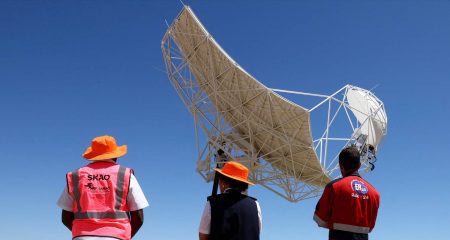
    Construction on the SKA Karoo site (image: SKA South Africa)
    Construction on the SKA Karoo site (image: SKA South Africa)

    Telescopes have come a long way since the days when they were all about lone astronomers watching the night sky through their upstairs windows. Today, teams of astrophysicists build and use much more modern instruments, not only to observe light visible to our eyes, but also radio emissions from the universe.

    Radio telescopes used to use large single dishes to pick up these emissions, but have since graduated to arrays of antennae. These act as one dish over much a wider area and make it possible to receive signals from further away. We refer to them as radio-interferometric arrays because they study the interference of radio waves between pairs of antennae.

    Radio interferometry was developed by the English scientists Antony Hewish and Martin Ryle, who received the Nobel prize in 1974 for using such telescopes to discover pulsars — highly magnetised rotating neutron stars. Pulsars rotate with extreme stability, making them the most precise clocks in the universe.

    In 1993, the American astrophysicists Russell Hulse and Joseph Taylor demonstrated the importance of pulsars in understanding our universe by discovering them in a gravitationally coupled pair known as a binary system. This provided the first indirect evidence for gravitational waves, which are an essential unproven part of Einstein’s theory of general relativity.

    There have been numerous arrays of radio telescopes developed since the 1970s. The state of the art includes the Low-Frequency Array (Lofar) in western Europe, the Murchison Widefield Array (MWA) in western Australia and the Atacama Large Millimetre Array (Alma) in Chile. These are all just coming online and are regarded as a major step forward in our ability to understand the universe.
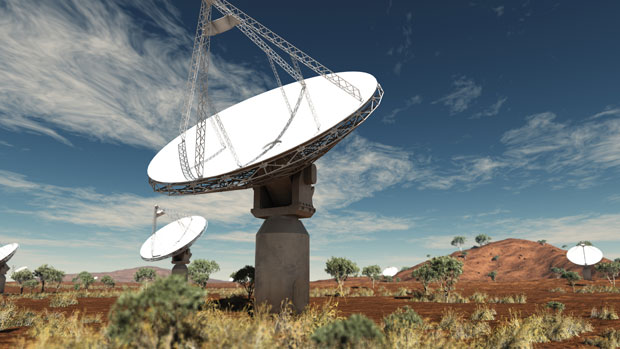
    Artist's impression of SKA dishes (image: SKA Organisation/Swinburne Astronomy Productions)
    Artist’s impression of SKA dishes (image: SKA Organisation/Swinburne Astronomy Productions)

    Yet they will be soon followed by the Square Kilometre Array (SKA), which will be made up of an unprecedented number of antennae spread across two continents for the first time (Australia and Africa). The SKA will see the radio sky with unprecedented sensitivity and resolution, enabling us to pick up extremely small and faint objects and probe the more distant universe. It is due to come online around 2023.

    It is already the case that interferometric data holds only partial information and does not provide immediately recognisable visual images. This is because the antenna array cannot be dense enough to cover each and every position on the ground. To convert the information into images, complex mathematical algorithms are already used.

    To add to this existing complexity, the SKA will record unprecedented volumes of data. To put it in perspective, astronomers anticipate that it will produce as much as 10 times the data as global Internet traffic. Radio astronomical imaging therefore urgently needs to be reinvented in this ultra-precision and big data context.

    This is where we come in. We have recently received funding to develop new ways to acquire data with radio telescopes using a recent theory called compressed sensing.

    This theory enables us to build up whole pictures with far more fragmented data than before, ensuring that each data point contains the maximum amount of information. We will also design image-recovery algorithms that are scalable to the SKA’s big data regime and can reconstruct ultra-high resolution images of the distant universe.

    ET, Einstein and the dark universe
    This forthcoming radio telescope throws up numerous exciting possibilities. It will be able to observe the formation of Earth-like planets in other galaxies, and detect possible signals sent by extraterrestrial intelligence. It will also be able to detect amino acids and carbon biomolecules, which are key building blocks for organic life.

    The SKA has the potential to produce new pulsar discoveries. It should be sensitive enough to allow tens of thousands of pulsars to be detected, with very good chances of finding one orbiting a black hole for the first time. This would allow us to test Einstein’s theories about what happens in the unexplored strong gravity regime around black holes. We might also be able to directly observe gravitational waves for the first time by monitoring the change of distance between pulsars as waves pass by.

    The coming leap forward in radio telescopes will also help us to understand the origins of the universe. Although we can infer the existence of the epoch when the first stars formed from our general understanding of the universe and other observations, we have never observed it directly.

    SKA-280

    Direct observations of hydrogen emission from this period would tell us a lot about how the first stars formed, and also about cosmology in general, including our understanding of the very first moments following the Big Bang. The Lofar and MWA telescopes will look for this very weak signal. But if they are able to detect it, it would only be in a statistical sense. The SKA will be the first telescope capable of producing images of this epoch when the first stars formed.

    Another science goal of the SKA is to develop a deeper understanding of dark energy and dark matter. One way of doing this is to study the distortion of the light from background galaxies by intervening matter as it travels towards us.

    In modern cosmology this effect, called weak lensing, has typically been studied with optical telescopes. Yet there is a lot to be gained from similar studies using radio wavelengths. Very high resolution is required, however, so it can’t be done with existing radio telescopes. The SKA will open up this new area, potentially uncovering a deeper understanding of the nature of dark energy and dark matter.

    In short, we could be on the verge of a great leap forward in our understanding of the universe. If so, the new theory of compressed sensing could play an essential role in recovering images from tiny fragments of information far in the distant universe.

    Beyond this, compressed sensing has a wide range of other applications. For instance we will transfer our techniques from astronomical to biomedical imaging, using compressed sensing to tackle the challenges of fast high-resolution magnetic resonance imaging. This is likely to give researchers a much more detailed understanding of neuronal pathways in the human brain.

    • The ConversationJason McEwen is assistant professor at University College London
    • This article was originally published on The Conversation


    Jason McEwan SKA Square Kilometre Array
    Subscribe to TechCentral Subscribe to TechCentral
    Share. Facebook Twitter LinkedIn WhatsApp Telegram Email Copy Link
    Previous ArticleIt will be a very techie Christmas
    Next Article Chip cards don’t solve SA’s fraud problem

    Related Posts

    SA scientists want Musk’s Starlink out of their space

    SA scientists want Musk’s Starlink out of their space

    2 June 2025
    Astronomy Olympics is being hosted in Africa for the first time

    Astronomy Olympics is being hosted in Africa for the first time

    7 August 2024
    SKA-MPI, the Max Planck Society funded prototype dish, being assembled at the South African site. Credit: Nasief Manie/Sarao

    Canada to invest R3.7-billion in SKA telescope project

    5 June 2024
    Company News
    Beat the summer heat with Samsung's WindFree air conditioners

    Beat the summer heat with Samsung’s WindFree air conditioners

    5 December 2025
    AI is not a technology problem - iqbusiness

    AI is not a technology problem – iqbusiness

    5 December 2025
    Telcos are sitting on a data gold mine - but few know what do with it - Phillip du Plessis

    Telcos are sitting on a data gold mine – but few know what do with it

    4 December 2025
    Opinion
    Your data, your hardware: the DIY AI revolution is coming - Duncan McLeod

    Your data, your hardware: the DIY AI revolution is coming

    20 November 2025
    Zero Carbon Charge founder Joubert Roux

    The energy revolution South Africa can’t afford to miss

    20 November 2025
    It's time for a new approach to government IT spend in South Africa - Richard Firth

    It’s time for a new approach to government IT spend in South Africa

    19 November 2025

    Subscribe to Updates

    Get the best South African technology news and analysis delivered to your e-mail inbox every morning.

    Latest Posts
    Beat the summer heat with Samsung's WindFree air conditioners

    Beat the summer heat with Samsung’s WindFree air conditioners

    5 December 2025
    Netflix, Warner Bros talks raise fresh headaches for MultiChoice

    Netflix, Warner Bros talks raise fresh headaches for MultiChoice

    5 December 2025
    Big Microsoft 365 price increases coming next year

    Big Microsoft price increases coming next year

    5 December 2025
    AI is not a technology problem - iqbusiness

    AI is not a technology problem – iqbusiness

    5 December 2025
    © 2009 - 2025 NewsCentral Media
    • Cookie policy (ZA)
    • TechCentral – privacy and Popia

    Type above and press Enter to search. Press Esc to cancel.

    Manage consent

    TechCentral uses cookies to enhance its offerings. Consenting to these technologies allows us to serve you better. Not consenting or withdrawing consent may adversely affect certain features and functions of the website.

    Functional Always active
    The technical storage or access is strictly necessary for the legitimate purpose of enabling the use of a specific service explicitly requested by the subscriber or user, or for the sole purpose of carrying out the transmission of a communication over an electronic communications network.
    Preferences
    The technical storage or access is necessary for the legitimate purpose of storing preferences that are not requested by the subscriber or user.
    Statistics
    The technical storage or access that is used exclusively for statistical purposes. The technical storage or access that is used exclusively for anonymous statistical purposes. Without a subpoena, voluntary compliance on the part of your Internet Service Provider, or additional records from a third party, information stored or retrieved for this purpose alone cannot usually be used to identify you.
    Marketing
    The technical storage or access is required to create user profiles to send advertising, or to track the user on a website or across several websites for similar marketing purposes.
    • Manage options
    • Manage services
    • Manage {vendor_count} vendors
    • Read more about these purposes
    View preferences
    • {title}
    • {title}
    • {title}