
Close Menu
TechCentralTechCentral

    Subscribe to the newsletter

    Get the best South African technology news and analysis delivered to your e-mail inbox every morning.

    Facebook X (Twitter) YouTube LinkedIn
    WhatsApp Facebook X (Twitter) LinkedIn YouTube
    TechCentralTechCentral
    • News
      TCS | Werner Lindemann on how AI is rewriting the infosec rulebook

      TCS | Werner Lindemann on how AI is rewriting the infosec rulebook

      15 April 2026
      Draft AI policy: South Africa 'too dependent' on US, China

      Draft AI policy: South Africa ‘too dependent’ on US, China

      15 April 2026
      R85-million for SA start-up reinventing the stethoscope with AI

      R85-million for SA start-up reinventing the stethoscope with AI

      15 April 2026
      The end of load shedding hasn't fixed South Africa's power problem

      The end of load shedding hasn’t fixed South Africa’s power problem

      15 April 2026
      Amazon ramps up satellite war with $11.6-billion Globalstar buy

      Amazon ramps up satellite war with $11.6-billion Globalstar buy

      15 April 2026
    • World
      Google poised to lose ad crown to Meta

      Google poised to lose ad crown to Meta

      14 April 2026
      Grand Theft Data - hackers hit Rockstar Games - Grand Theft Auto

      Grand Theft Data – hackers hit Rockstar Games

      14 April 2026
      UK PM Keir Starmer declares war on doomscrolling

      UK PM Keir Starmer declares war on doomscrolling

      13 April 2026
      Big Tech is going nuclear

      Big Tech is going nuclear

      10 April 2026
      Software rout deepens as AI fears grip investors

      Software rout deepens as AI fears grip investors

      10 April 2026
    • In-depth
      Africa switches on as Europe dims the lights

      Africa switches on as Europe dims the lights

      9 April 2026
      The biggest untapped EV market on Earth is hiding in plain sight

      The biggest untapped EV market on Earth is hiding in plain sight

      1 April 2026
      The R18-billion tech giant hiding in plain sight - Jens Montanana

      The R16-billion tech giant hiding in plain sight

      26 March 2026
      The last generation of coders

      The last generation of coders

      18 February 2026
      Sentech is in dire straits

      Sentech is in dire straits

      10 February 2026
    • TCS
      TCS | Donovan Marsh on AI and the future of filmmaking

      TCS | Donovan Marsh on AI and the future of filmmaking

      7 April 2026
      TCS+ | Vodacom Business moves to crack the SME tech gap - Andrew Fulton, Sannesh Beharie

      TCS+ | Vodacom Business moves to crack the SME tech gap

      7 April 2026
      TCS | MTN's Divysh Joshi on the strategy behind Pi - Divyesh Joshi

      TCS | MTN’s Divyesh Joshi on the strategy behind Pi

      1 April 2026
      Anoosh Rooplal

      TCS | Anoosh Rooplal on the Post Office’s last stand

      27 March 2026
      Meet the CIO | HealthBridge CTO Anton Fatti on the future of digital health

      Meet the CIO | Healthbridge CTO Anton Fatti on the future of digital health

      23 March 2026
    • Opinion
      The conflict of interest at the heart of PayShap's slow adoption - Cheslyn Jacobs

      The conflict of interest at the heart of PayShap’s slow adoption

      26 March 2026
      South Africa's energy future hinges on getting wheeling right - Aishah Gire

      South Africa’s energy future hinges on getting wheeling right

      10 March 2026
      Hold the doom: the case for a South African comeback - Duncan McLeod

      Apple just dropped a bomb on the Windows world

      5 March 2026
      R230-million in the bag for Endeavor's third Harvest Fund - Alison Collier

      VC’s centre of gravity is shifting – and South Africa is in the frame

      3 March 2026
      Hold the doom: the case for a South African comeback - Duncan McLeod

      Hold the doom: the case for a South African comeback

      26 February 2026
    • Company Hubs
      • 1Stream
      • Africa Data Centres
      • AfriGIS
      • Altron Digital Business
      • Altron Document Solutions
      • Altron Group
      • Arctic Wolf
      • Ascent Technology
      • AvertITD
      • BBD
      • Braintree
      • CallMiner
      • CambriLearn
      • CYBER1 Solutions
      • Digicloud Africa
      • Digimune
      • Domains.co.za
      • ESET
      • Euphoria Telecom
      • HOSTAFRICA
      • Incredible Business
      • iONLINE
      • IQbusiness
      • Iris Network Systems
      • Kaspersky
      • LSD Open
      • Mitel
      • NEC XON
      • Netstar
      • Network Platforms
      • Next DLP
      • Ovations
      • Paracon
      • Paratus
      • Q-KON
      • SevenC
      • SkyWire
      • Solid8 Technologies
      • Telit Cinterion
      • Telviva
      • Tenable
      • Vertiv
      • Videri Digital
      • Vodacom Business
      • Wipro
      • Workday
      • XLink
    • Sections
      • AI and machine learning
      • Banking
      • Broadcasting and Media
      • Cloud services
      • Contact centres and CX
      • Cryptocurrencies
      • Education and skills
      • Electronics and hardware
      • Energy and sustainability
      • Enterprise software
      • Financial services
      • HealthTech
      • Information security
      • Internet and connectivity
      • Internet of Things
      • Investment
      • IT services
      • Lifestyle
      • Motoring
      • Policy and regulation
      • Public sector
      • Retail and e-commerce
      • Satellite communications
      • Science
      • SMEs and start-ups
      • Social media
      • Talent and leadership
      • Telecoms
    • Events
    • Advertise
    TechCentralTechCentral
    Home » Sections » Talent and leadership » The 1940s visionary who imagined the Information Age

    The 1940s visionary who imagined the Information Age

    Many years ago, long before the internet, an American engineer, Vannevar Bush, was trying to solve a problem.
    By The Conversation14 July 2025
    Twitter LinkedIn Facebook WhatsApp Email Telegram Copy Link
    News Alerts
    WhatsApp
    The 1940s visionary who imagined the Information Age - Vannevar Bush
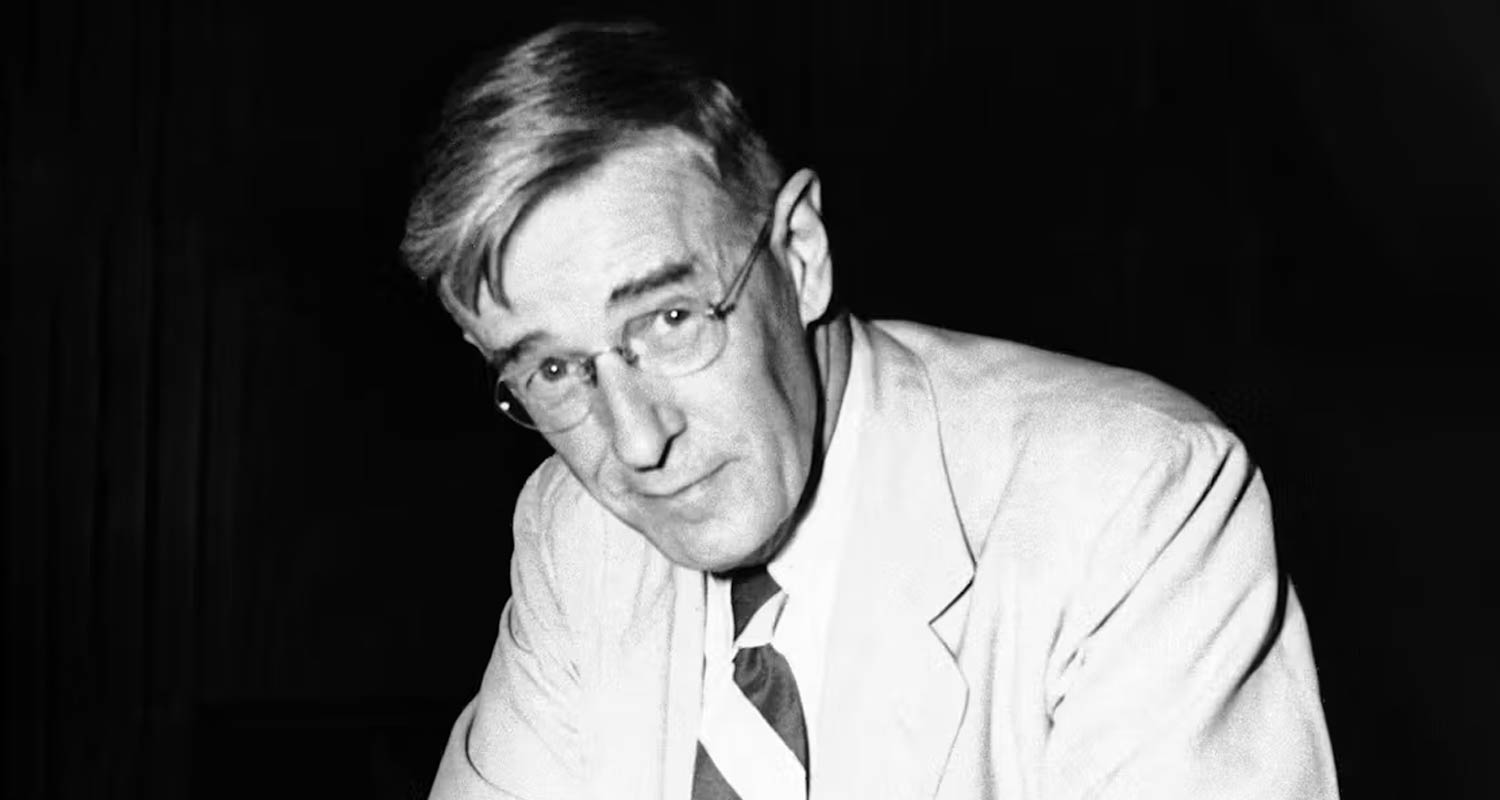
    Vannevar Bush, author of the influential 1945 essay, As We May Think. Image: Associated Press

    Many years ago, long before the internet or artificial intelligence, an American engineer called Vannevar Bush was trying to solve a problem. He could see how difficult it had become for professionals to research anything, and saw the potential for a better way.

    This was in the 1940s, when anyone looking for articles, books or other scientific records had to go to a library and search through an index. This meant drawers upon drawers filled with index cards, typically sorted by author, title or subject.

    When you had found what you were looking for, creating copies or excerpts was a tedious, manual task. You would have to be very organised in keeping your own records. And woe betide anyone who was working across more than one discipline. Since every book could physically only be in one place, they all had to be filed solely under a primary subject. So, an article on cave art couldn’t be in both art and archaeology, and researchers would often waste extra time trying to find the right location.

    Most importantly, Bush’s memex was to include a form of associative indexing for tying two items together

    This had always been a challenge, but an explosion in research publications in that era had made it far worse than before. As Bush wrote in an influential essay, As We May Think, in The Atlantic in July 1945: “There is a growing mountain of research. But there is increased evidence that we are being bogged down today as specialisation extends. The investigator is staggered by the findings and conclusions of thousands of other workers – conclusions which he cannot find time to grasp, much less to remember, as they appear.”

    Bush was dean of the school of engineering at MIT (the Massachusetts Institute of Technology) and president of the Carnegie Institute. During World War 2, he had been the director of the Office of Scientific Research and Development, coordinating the activities of some 6 000 scientists working relentlessly to give their country a technological advantage. He could see that science was being drastically slowed down by the research process and proposed a solution that he called the “memex”.

    The memex

    The memex was to be a personal device built into a desk that required little physical space. It would rely heavily on microfilm for data storage, a new technology at the time. The memex would use this to store large numbers of documents in a greatly compressed format that could be projected onto translucent screens.

    Most importantly, Bush’s memex was to include a form of associative indexing for tying two items together. The user would be able to use a keyboard to click on a code number alongside a document to jump to an associated document or view them simultaneously – without needing to sift through an index.

    Read: A brief history of AI: how we got here; where we’re going

    Bush acknowledged in his essay that this kind of keyboard click-through wasn’t yet technologically feasible. Yet he believed it would be soon, pointing to existing systems for handling data such as punched cards as potential forerunners.

    He envisaged that a user would create the connections between items as they developed their personal research library, creating chains of microfilm frames in which the same document or extract could be part of multiple trails at the same time.
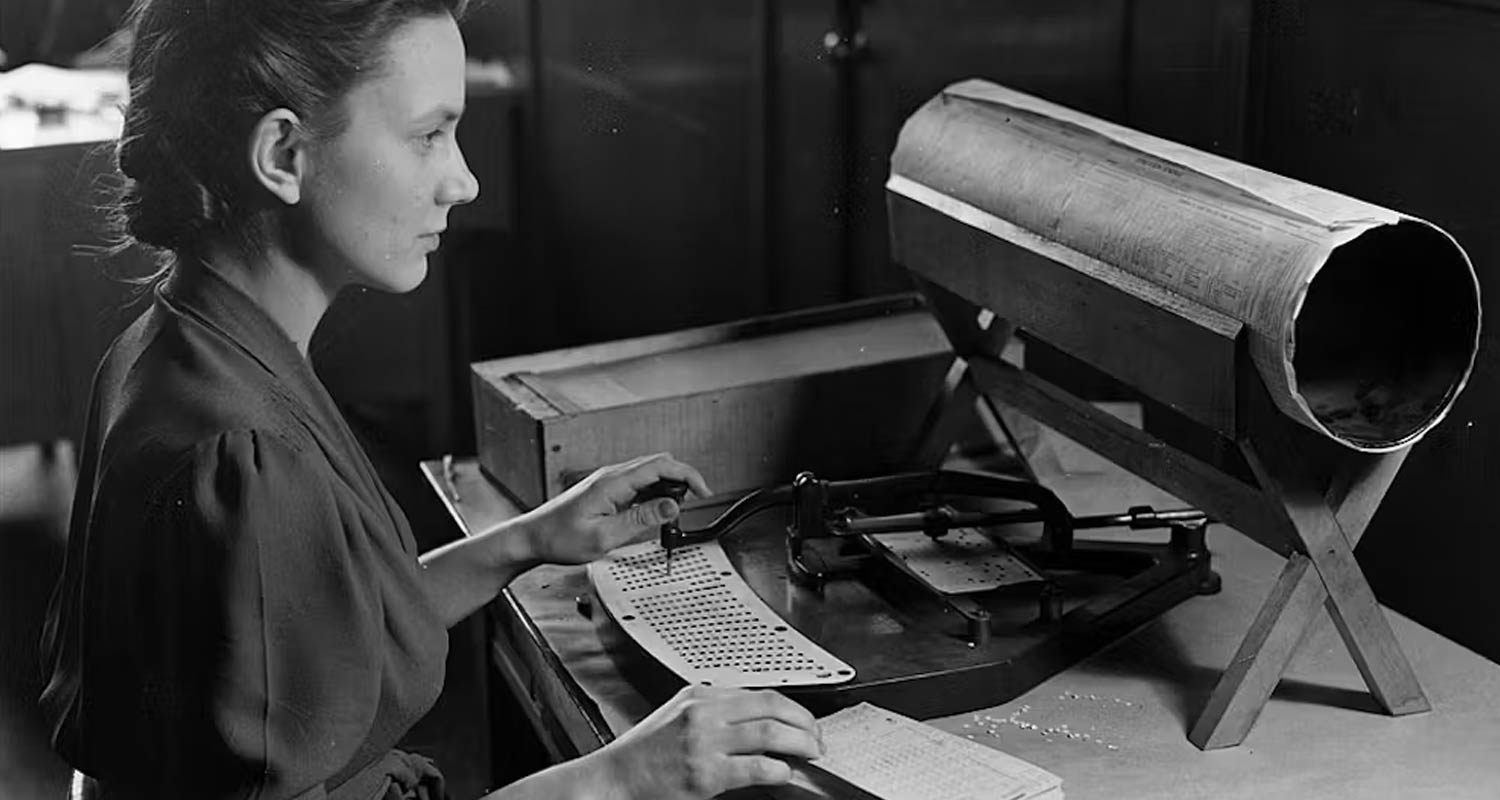
    Punched cards were an early way of storing digital information. Wikimedia, CC BY-SA
    Punched cards were an early way of storing digital information. Wikimedia, CC BY-SA

    New additions could be inserted either by photographing them on to microfilm or by purchasing a microfilm of an existing document. Indeed, a user would be able to augment their memex with vast reference texts. “New forms of encyclopaedias will appear,” said Bush, “ready-made with a mesh of associative trails running through them, ready to be dropped into the memex.” Fascinatingly, this isn’t far from today’s Wikipedia.

    Where it led

    Bush thought the memex would help researchers to think in a more natural, associative way that would be reflected in their records. He is thought to have inspired the American inventors Ted Nelson and Douglas Engelbart, who in the 1960s independently developed hypertext systems, in which documents contained hyperlinks that could directly access other documents. These became the foundation of the world wide web as we know it.

    Beyond the practicalities of having easy access to so much information, Bush believed that the added value in the memex lay in making it easier for users to manipulate ideas and spark new ones. His essay drew a distinction between repetitive and creative thought, and foresaw that there would soon be new “powerful mechanical aids” to help with the repetitive variety.

    Bush did not sound overly optimistic when he revisited his own vision in his 1970 book Pieces of the Action

    He was perhaps mostly thinking about mathematics, but he left the door open to other thought processes. And 80 years later, with AI in our pockets, we’re automating far more thinking than was ever possible with a calculator.

    If this sounds like a happy ending, Bush did not sound overly optimistic when he revisited his own vision in his 1970 book Pieces of the Action. In the intervening 25 years, he had witnessed technological advances in areas like computing that were bringing the memex closer to reality.

    Yet Bush felt that the technology had largely missed the philosophical intent of his vision – to enhance human reasoning and creativity: “In 1945, I dreamed of machines that would think with us. Now, I see machines that think for us – or worse, control us.”

    Bush would die just four years later at the age of 84, but these concerns still feel strikingly relevant today. While it’s great that we do not need to search for a book by flipping through index cards in chests of drawers, we might feel more uneasy about machines doing most of the thinking for us.

    The future

    Is this technology enhancing and sharpening our skills, or is it making us lazy? No doubt everyone is different, but the danger is that whatever skills we leave to the machines, we eventually lose, and younger generations may not even get the opportunity to learn them in the first place.

    The lesson from As We May Think is that a purely technical solution like the memex is not enough. Technology still needs to be human-centred, underpinned by a philosophical vision. As we contemplate a great automation in human thinking in the years ahead, the challenge is to somehow protect our creativity and reasoning at the same time.The Conversation

    Get breaking news from TechCentral on WhatsApp. Sign up here.

    • The author, Martin Rudorfer, is lecturer in computer science, Aston University
    • This article is republished from The Conversation under a Creative Commons licence. Read the original article

    Don’t miss:

    From clay tablets to ChatGPT: a brief history of human knowledge

    Follow TechCentral on Google News Add TechCentral as your preferred source on Google


    Martin Rudorfer memex Vannevar Bush
    WhatsApp YouTube
    Share. Facebook Twitter LinkedIn WhatsApp Telegram Email Copy Link
    Previous ArticleMicrosoft South Africa to get new MD as Lillian Barnard moves to regional role
    Next Article Legislative overhaul on the cards for South Africa’s ICT sector
    Company News
    New man to accelerate wholesale connectivity in the DRC - Gaetan Soltesz, FAST Congo

    New man to accelerate wholesale connectivity in the DRC

    15 April 2026
    Avast Business and Avert IT Distribution rewrite the SMB cybersecurity playbook

    Avast Business and Avert IT Distribution rewrite the SMB cybersecurity playbook

    15 April 2026
    The hidden risk in South Africa's payment infrastructure - AfriGIS

    The hidden risk in South Africa’s payment infrastructure

    14 April 2026
    Opinion
    The conflict of interest at the heart of PayShap's slow adoption - Cheslyn Jacobs

    The conflict of interest at the heart of PayShap’s slow adoption

    26 March 2026
    South Africa's energy future hinges on getting wheeling right - Aishah Gire

    South Africa’s energy future hinges on getting wheeling right

    10 March 2026
    Hold the doom: the case for a South African comeback - Duncan McLeod

    Apple just dropped a bomb on the Windows world

    5 March 2026

    Subscribe to Updates

    Get the best South African technology news and analysis delivered to your e-mail inbox every morning.

    Latest Posts
    TCS | Werner Lindemann on how AI is rewriting the infosec rulebook

    TCS | Werner Lindemann on how AI is rewriting the infosec rulebook

    15 April 2026
    Draft AI policy: South Africa 'too dependent' on US, China

    Draft AI policy: South Africa ‘too dependent’ on US, China

    15 April 2026
    R85-million for SA start-up reinventing the stethoscope with AI

    R85-million for SA start-up reinventing the stethoscope with AI

    15 April 2026
    The end of load shedding hasn't fixed South Africa's power problem

    The end of load shedding hasn’t fixed South Africa’s power problem

    15 April 2026
    © 2009 - 2026 NewsCentral Media
    • Cookie policy (ZA)
    • TechCentral – privacy and Popia

    Type above and press Enter to search. Press Esc to cancel.

    Manage consent

    TechCentral uses cookies to enhance its offerings. Consenting to these technologies allows us to serve you better. Not consenting or withdrawing consent may adversely affect certain features and functions of the website.

    Functional Always active
    The technical storage or access is strictly necessary for the legitimate purpose of enabling the use of a specific service explicitly requested by the subscriber or user, or for the sole purpose of carrying out the transmission of a communication over an electronic communications network.
    Preferences
    The technical storage or access is necessary for the legitimate purpose of storing preferences that are not requested by the subscriber or user.
    Statistics
    The technical storage or access that is used exclusively for statistical purposes. The technical storage or access that is used exclusively for anonymous statistical purposes. Without a subpoena, voluntary compliance on the part of your Internet Service Provider, or additional records from a third party, information stored or retrieved for this purpose alone cannot usually be used to identify you.
    Marketing
    The technical storage or access is required to create user profiles to send advertising, or to track the user on a website or across several websites for similar marketing purposes.
    • Manage options
    • Manage services
    • Manage {vendor_count} vendors
    • Read more about these purposes
    View preferences
    • {title}
    • {title}
    • {title}

