
Close Menu
TechCentralTechCentral

    Subscribe to the newsletter

    Get the best South African technology news and analysis delivered to your e-mail inbox every morning.

    Facebook X (Twitter) YouTube LinkedIn
    WhatsApp Facebook X (Twitter) LinkedIn YouTube
    TechCentralTechCentral
    • News
      Three years in, PayShap pivots to merchants

      Three years in, PayShap pivots to merchants

      21 May 2026
      Two telcos, $1-trillion and two very different fintech bets - Vodacom and MTN

      Two telcos, $1-trillion and two very different fintech bets

      21 May 2026
      There's an oddity hiding in South Africa's EV market

      There’s an oddity hiding in South Africa’s EV market

      21 May 2026
      Rica blindspot exposed

      Rica blindspot exposed

      21 May 2026
      Nvidia does it again - Jensen Juang

      Nvidia does it again

      21 May 2026
    • World
      SpaceX's record-setting IPO is here

      SpaceX’s record-setting IPO is here

      21 May 2026
      Vatican confronts the age of artificial intelligence. Edgar Beltrán/The Pillar 

      Vatican confronts the age of artificial intelligence

      19 May 2026
      The walkout that could hit every laptop and AI server - Samsung

      The walkout that could hit every laptop and AI server

      18 May 2026
      Pop star sues Samsung for $15-million - Dua Lipa

      Pop star sues Samsung for $15-million

      11 May 2026
      OpenAI's new audio APIs aim for conversational voice agents

      OpenAI’s new audio APIs aim for conversational voice agents

      8 May 2026
    • In-depth
      Alfa's electric rebel - Alfa Romeo Junior Elettrica Veloce

      Alfa’s electric rebel

      29 April 2026
      Africa switches on as Europe dims the lights

      Africa switches on as Europe dims the lights

      9 April 2026
      The biggest untapped EV market on Earth is hiding in plain sight

      The biggest untapped EV market on Earth is hiding in plain sight

      1 April 2026
      Datatec is firing on all cylinders - Jens Montanana

      The R16-billion tech giant hiding in plain sight

      26 March 2026
      The last generation of coders

      The last generation of coders

      18 February 2026
    • TCS
      TCS+ | The Up&Up Group on the hidden cost of AI - Jason Harrison

      TCS+ | The Up&Up Group on the hidden cost of AI

      13 May 2026
      Michael Rossouw

      TCS+ | The retirement decision most South Africans get wrong

      6 May 2026
      TCS | The Cape Town start-up listening for TB with AI - Braden van Breda

      TCS | The Cape Town start-up listening for TB with AI

      4 May 2026

      TCS+ | ‘The ISP for ISPs’: Vox’s shift to wholesale aggregator

      20 April 2026
      TCS | Werner Lindemann on how AI is rewriting the infosec rulebook

      TCS | Werner Lindemann on how AI is rewriting the infosec rulebook

      15 April 2026
    • Opinion
      AI won't fix your culture - it will expose it - Jackie Kennedy

      AI won’t fix your culture – it will expose it

      19 May 2026
      Free calls, dead voice and Shameel Joosub's Spanish ghost - Duncan McLeod

      Free calls, dead voice and Shameel Joosub’s Spanish ghost

      22 April 2026
      The conflict of interest at the heart of PayShap's slow adoption - Cheslyn Jacobs

      The conflict of interest at the heart of PayShap’s slow adoption

      26 March 2026
      South Africa's energy future hinges on getting wheeling right - Aishah Gire

      South Africa’s energy future hinges on getting wheeling right

      10 March 2026
      Free calls, dead voice and Shameel Joosub's Spanish ghost - Duncan McLeod

      Apple just dropped a bomb on the Windows world

      5 March 2026
    • Company Hubs
      • 1Stream
      • Africa Data Centres
      • AfriGIS
      • Altron Digital Business
      • Altron Document Solutions
      • Altron Group
      • Arctic Wolf
      • Ascent Technology
      • AvertITD
      • BBD
      • Braintree
      • CallMiner
      • CambriLearn
      • CM Telecom
      • Contactable
      • CYBER1 Solutions
      • Digicloud Africa
      • Digimune
      • Domains.co.za
      • ESET
      • Euphoria Telecom
      • HOSTAFRICA
      • Incredible Business
      • iONLINE
      • IQbusiness
      • Iris Network Systems
      • Kaspersky
      • LSD Open
      • Mitel
      • NEC XON
      • Netstar
      • Network Platforms
      • Next DLP
      • Ovations
      • Paracon
      • Paratus
      • Q-KON
      • SevenC
      • SkyWire
      • Solid8 Technologies
      • Telit Cinterion
      • Telviva
      • Tenable
      • Vertiv
      • Videri Digital
      • Vodacom Business
      • Wipro
      • Workday
      • XLink
    • Sections
      • AI and machine learning
      • Banking
      • Broadcasting and Media
      • Cloud services
      • Contact centres and CX
      • Cryptocurrencies
      • Education and skills
      • Electronics and hardware
      • Energy and sustainability
      • Enterprise software
      • Financial services
      • HealthTech
      • Information security
      • Internet and connectivity
      • Internet of Things
      • Investment
      • IT services
      • Lifestyle
      • Motoring
      • Policy and regulation
      • Public sector
      • Retail and e-commerce
      • Satellite communications
      • Science
      • SMEs and start-ups
      • Social media
      • Talent and leadership
      • Telecoms
    • Events
    • Advertise
    TechCentralTechCentral
    Home » News » 7 major tech advances we’re likely to see in 2025

    7 major tech advances we’re likely to see in 2025

    What can we expect in 2025 from the world of technology? Here are seven developments to look out for.
    By The Conversation8 January 2025
    Twitter LinkedIn Facebook WhatsApp Email Telegram Copy Link
    News Alerts
    WhatsApp

    7 major tech advances we're likely to see in 2025In the grand scheme of things, 45 years is not a long time. Back in 1980, it would take me three weeks to run a computer program, written in the programming language Cobol, that worked using punched cards. Each card represented one line of code and it required multiple re-punches to correct errors. Eventually, I would have a working program that did something useful.

    How times have quickly changed in technology – now, my mobile phone has vast processing capability compared to the machine that processed that Cobol program. With the help of artificial intelligence tools, that same phone is able to instantly translate between languages on a live call, among many other features.

    With eye-catching announcements being made all the time, what can we expect in 2025 from the world of technology? Here are seven developments to look out for.

    1. AI agents come into their own

    Unsurprisingly, we’re likely to see further important developments in AI. One area that’s likely to take off is the use of AI agents. These are intelligent programs that are given objectives by humans and work out the best ways to achieve those objectives. Agents can write computer code, which could have a big impact on the way that tech companies work and could allow people without advanced coding skills to develop programs, apps or games.

    You could also see car plants with no people, running with robots operated by AI agents. In theory, mortgage applications could be assessed and approved by agent technology. Individual apps on a smartphone could be replaced by an agent interface that performs multiple tasks for the user.

    A combination of agent technology with robotics could be revolutionary. We are reaching a point where robots don’t just emulate the tasks of humans but are reasoning and answering to us directly.

    One candidate for hosting AI agent technology is Optimus, a humanoid robot built by Tesla. Elon Musk has said that the electric car maker will start using Optimus for tasks within the company from 2025. He added that the automaton could be ready for sale to other businesses by 2026.

    Agents are tailor-made for industry tasks such as project management. The consulting firm Gartner suggests that by 2030, some 80% of project management tasks will be run by AI.

    2. Customisation, with help from AI

    In education, the focus has traditionally been on linear programmes of study, with pre-determined entry and exit points lasting a number of years. Imagine a course of study that is uniquely tailored to individual students based on their experience, skills and abilities. Bespoke degree programmes centred on the student are already being explored in the US with AI.

    These are not just bespoke with regards to the content and curriculum, but also in recognising the special needs of the student or indeed how the learner may feel at any one time. This can include AI that adjusts the learning activity and study based on how much sleep you had last night, which is linked to smartwatch data.

    Education isn’t the only area where AI could help with customisation. The management consultancy Accenture suggests that private companies will be able to train their own, custom large language models, the technology behind AI chatbots such as ChatGPT. These could be trained with data specific to particular business areas, making them more effective for those firms. But these companies would have to use billions of pieces of data. We’ll see progress towards this objective in 2025.

    Small language models (SLMs) are being developed to perform precise tasks more efficiently. They don’t need to be trained on as much data and require less computing power. This means they can be used more easily on so-called “edge devices” – smartphones, tablets and laptops – without relying on computing resources hosted in the cloud.
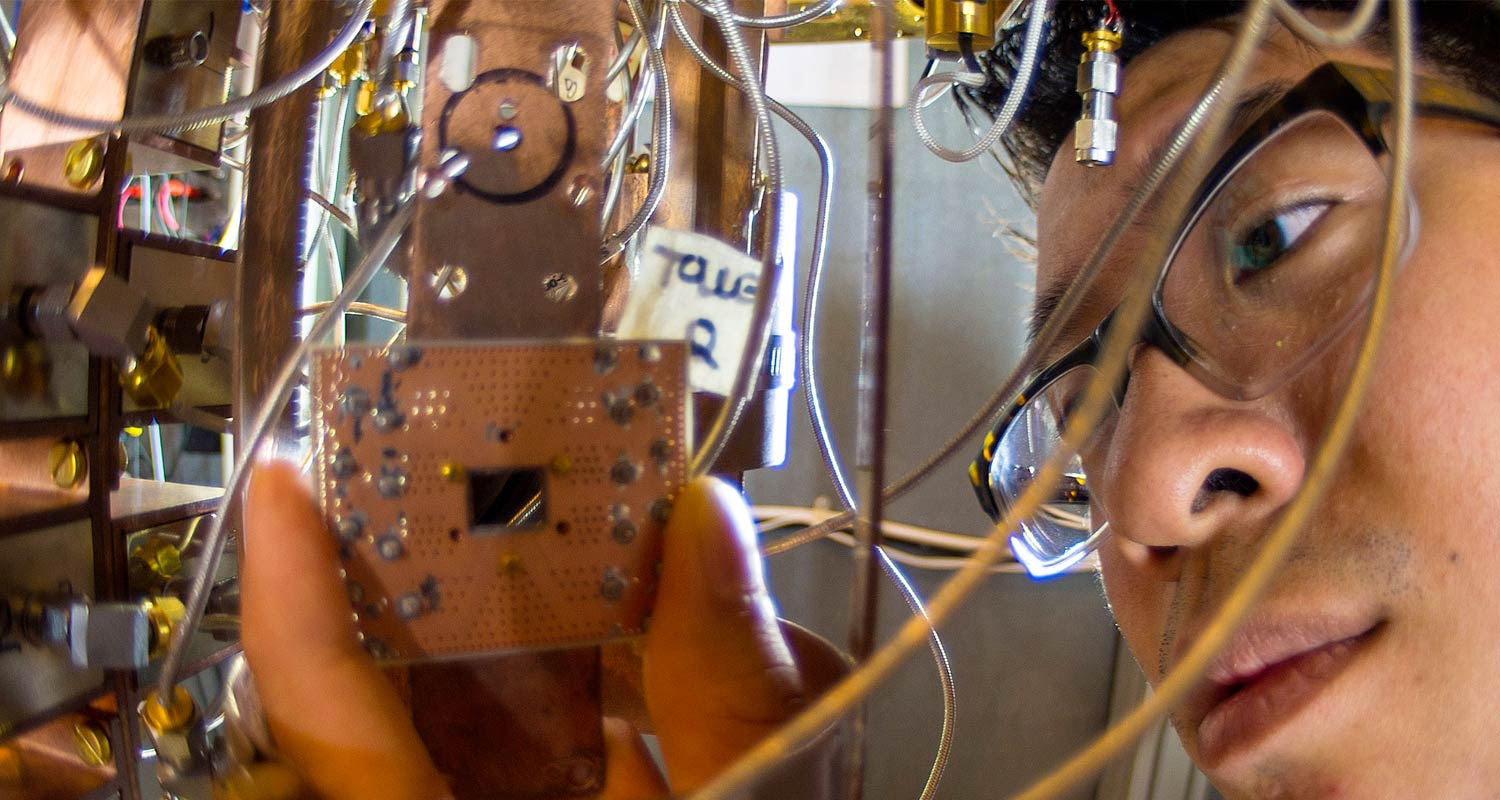
    IBM Research scientist Jerry Chow conducts a quantum computing experiment at IBM’s Thomas J Watson Research Centre

    3. Towards practical quantum computers

    Developments in quantum computing could lead to machines that can solve complex tasks that are beyond the capability of most classical computers. Researchers have moved away from trying to break records for the number of basic processing units, called qubits, and towards correcting the errors that quantum computers are currently prone to. This is a step towards practical quantum computers that have some useful advantage over classical machines.

    4. Blending physical and virtual worlds

    Augmented reality, virtual reality and mixed reality could be used more widely. Virtual reality immerses users in a computer-generated world. Augmented reality superimposes computer-generated elements onto the real world, while the latter remains visible. Mixed reality refers to a set of immersive technologies including augmented reality, that provide different “blends” of physical and virtual worlds.

    There are already a number of head-mounted devices that can support these technologies. These include Apple’s Vision Pro and Meta’s Quest headset. In 2025, we’re likely to see new products and refinements from the likes of Meta, Apple and others.

    5. Benefits of blockchain

    Blockchain technology, which allows records to be stored across a network of computers, is set to affect supply chains and different sectors from healthcare to finance. Blockchain increases transparency and traceability, allowing for the tracking of products from origin to consumer, it also offers enhanced security and improved efficiency with automated processes.

    Patient data in healthcare could be made more secure with blockchain technology. The exchange of data could become seamless and medical supplies could be tracked. Financial transactions could be made more robust, faster and cheaper, and there would be a greater degree of financial inclusion. This would provide access to a wider group who may not have had banking or lending services before.

    6. The dawn of 6G communications

    We will enjoy faster connectivity, with the introduction of 6G wireless communication networks. The process of standardising 6G technology will begin in 2025. Clear 6G global standards and compatibility between networks is vital for the technology’s success.

    Tesla Cybercab

    7. More advanced self-driving technology

    Self-driving vehicles are also set to see a number of advancements. Self-driving cars are classified into six levels, according to their autonomy – from 0 (fully manual) to 5 (fully autonomous). Current self-driving taxis deployed in US cities such as San Francisco are at level 4 (high driving automation).

    They can handle most driving tasks without human input but with some restrictions. In 2025, we’re likely to see progress towards level 5. This is classified as full autonomy, and describes vehicles that operate without any human intervention. Mercedes will increase the speed of its Drive Pilot self-driving system in 2025 and Tesla is developing its own Robotaxi, which should be available “before 2027”, according to Elon Musk.

    We can expect technology to be able to achieve tasks that used to be the exclusive domain of humans. It will be able to complete work tasks and report back. This will lead to efficiencies and big changes to work. We’ll also see technology that enhances our leisure time and quality of life.The Conversation

    • The author, Lewis Endlar, is programme director MSc project management and lecturer in business, Keele Business School, Keele University
    • This article is republished from The Conversation under a Creative Commons licence. Read the original article

    Get breaking news from TechCentral on WhatsApp. Sign up here

    Don’t miss:

    The rand was a global leader in 2024 – with more good news expected this year

    Follow TechCentral on Google News Add TechCentral as your preferred source on Google


    WhatsApp YouTube
    Share. Facebook Twitter LinkedIn WhatsApp Telegram Email Copy Link
    Previous ArticleLonely people have high levels of harmful proteins – new research
    Next Article Mystery surrounds Nvidia’s plan for new CPU built with MediaTek

    Related Posts

    Three years in, PayShap pivots to merchants

    Three years in, PayShap pivots to merchants

    21 May 2026
    Two telcos, $1-trillion and two very different fintech bets - Vodacom and MTN

    Two telcos, $1-trillion and two very different fintech bets

    21 May 2026
    There's an oddity hiding in South Africa's EV market

    There’s an oddity hiding in South Africa’s EV market

    21 May 2026
    Company News
    South Africa's operators can fix Rica - and win big doing it - Contactable

    South Africa’s operators can fix Rica – and win big doing it

    21 May 2026
    Check Point swaps static rules for agentic AI - Jonathan Zanger

    Check Point swaps static rules for agentic AI

    21 May 2026
    Anatomy of a reset: why the helpdesk is now the breach - Specops Software

    Anatomy of a reset: why the helpdesk is now the breach

    21 May 2026
    Opinion
    AI won't fix your culture - it will expose it - Jackie Kennedy

    AI won’t fix your culture – it will expose it

    19 May 2026
    Free calls, dead voice and Shameel Joosub's Spanish ghost - Duncan McLeod

    Free calls, dead voice and Shameel Joosub’s Spanish ghost

    22 April 2026
    The conflict of interest at the heart of PayShap's slow adoption - Cheslyn Jacobs

    The conflict of interest at the heart of PayShap’s slow adoption

    26 March 2026

    Subscribe to Updates

    Get the best South African technology news and analysis delivered to your e-mail inbox every morning.

    Latest Posts
    Three years in, PayShap pivots to merchants

    Three years in, PayShap pivots to merchants

    21 May 2026
    Two telcos, $1-trillion and two very different fintech bets - Vodacom and MTN

    Two telcos, $1-trillion and two very different fintech bets

    21 May 2026
    There's an oddity hiding in South Africa's EV market

    There’s an oddity hiding in South Africa’s EV market

    21 May 2026
    Rica blindspot exposed

    Rica blindspot exposed

    21 May 2026
    © 2009 - 2026 NewsCentral Media
    • Cookie policy (ZA)
    • TechCentral – privacy and Popia

    Type above and press Enter to search. Press Esc to cancel.

    Manage consent

    TechCentral uses cookies to enhance its offerings. Consenting to these technologies allows us to serve you better. Not consenting or withdrawing consent may adversely affect certain features and functions of the website.

    Functional Always active
    The technical storage or access is strictly necessary for the legitimate purpose of enabling the use of a specific service explicitly requested by the subscriber or user, or for the sole purpose of carrying out the transmission of a communication over an electronic communications network.
    Preferences
    The technical storage or access is necessary for the legitimate purpose of storing preferences that are not requested by the subscriber or user.
    Statistics
    The technical storage or access that is used exclusively for statistical purposes. The technical storage or access that is used exclusively for anonymous statistical purposes. Without a subpoena, voluntary compliance on the part of your Internet Service Provider, or additional records from a third party, information stored or retrieved for this purpose alone cannot usually be used to identify you.
    Marketing
    The technical storage or access is required to create user profiles to send advertising, or to track the user on a website or across several websites for similar marketing purposes.
    • Manage options
    • Manage services
    • Manage {vendor_count} vendors
    • Read more about these purposes
    View preferences
    • {title}
    • {title}
    • {title}