
Close Menu
TechCentralTechCentral

    Subscribe to the newsletter

    Get the best South African technology news and analysis delivered to your e-mail inbox every morning.

    Facebook X (Twitter) YouTube LinkedIn
    WhatsApp Facebook X (Twitter) LinkedIn YouTube
    TechCentralTechCentral
    • News
      Cell C cleans up its balance sheet but faces tough trading reality

      Cell C cleans up its balance sheet but faces tough trading reality

      13 February 2026
      MVNO business shines in Cell C's first post-listing results - Jorges Mendes

      MVNO business shines in Cell C’s first post-listing results

      13 February 2026
      Ramaphosa presses ahead with Eskom break-up - Cyril Ramaphosa

      Ramaphosa presses ahead with Eskom break-up

      13 February 2026
      The key technology takeaways from Ramaphosa's 2026 Sona - Cyril Ramaphosa

      The key technology takeaways from Ramaphosa’s 2026 Sona

      13 February 2026
      Toyota SA CEO: NEV inaction will cost South Africa its motoring industry - Andrew Kirby

      Toyota SA CEO: NEV inaction will cost South Africa its motoring industry

      12 February 2026
    • World
      Russia bans WhatsApp

      Russia bans WhatsApp

      12 February 2026
      EU regulators take aim at WhatsApp

      EU regulators take aim at WhatsApp

      9 February 2026
      Musk hits brakes on Mars mission

      Musk hits brakes on Mars mission

      9 February 2026
      Crypto firm accidentally sends R700-billion in bitcoin to its users

      Crypto firm accidentally sends R700-billion in bitcoin to its users

      8 February 2026
      AI won't replace software, says Nvidia CEO amid market rout - Jensen Huang

      AI won’t replace software, says Nvidia CEO amid market rout

      4 February 2026
    • In-depth
      How liberalisation is rewiring South Africa's power sector

      How liberalisation is rewiring South Africa’s power sector

      21 January 2026
      The top-performing South African tech shares of 2025

      The top-performing South African tech shares of 2025

      12 January 2026
      Digital authoritarianism grows as African states normalise internet blackouts

      Digital authoritarianism grows as African states normalise internet blackouts

      19 December 2025
      TechCentral's South African Newsmakers of 2025

      TechCentral’s South African Newsmakers of 2025

      18 December 2025
      Black Friday goes digital in South Africa as online spending surges to record high

      Black Friday goes digital in South Africa as online spending surges to record high

      4 December 2025
    • TCS
      Watts & Wheels S1E4: 'We drive an electric Uber'

      Watts & Wheels S1E4: ‘We drive an electric Uber’

      10 February 2026
      TCS+ | How Cloud On Demand is helping SA businesses succeed in the cloud - Xhenia Rhode, Dion Kalicharan

      TCS+ | Cloud On Demand and Consnet: inside a real-world AWS partner success story

      30 January 2026
      Watts & Wheels S1E4: 'We drive an electric Uber'

      Watts & Wheels S1E3: ‘BYD’s Corolla Cross challenger’

      30 January 2026
      Watts & Wheels S1E4: 'We drive an electric Uber'

      Watts & Wheels S1E2: ‘China attacks, BMW digs in, Toyota’s sublime supercar’

      23 January 2026

      TCS+ | Why cybersecurity is becoming a competitive advantage for SA businesses

      20 January 2026
    • Opinion
      A million reasons monopolies don't work - Duncan McLeod

      A million reasons monopolies don’t work

      10 February 2026
      Eskom unbundling U-turn threatens to undo hard-won electricity gains - Busi Mavuso

      Eskom unbundling U-turn threatens to undo hard-won electricity gains

      9 February 2026
      South Africa's skills advantage is being overlooked at home - Richard Firth

      South Africa’s skills advantage is being overlooked at home

      29 January 2026
      Why Elon Musk's Starlink is a 'hard no' for me - Songezo Zibi

      Why Elon Musk’s Starlink is a ‘hard no’ for me

      26 January 2026
      A million reasons monopolies don't work - Duncan McLeod

      South Africa’s new fibre broadband battle

      20 January 2026
    • Company Hubs
      • Africa Data Centres
      • AfriGIS
      • Altron Digital Business
      • Altron Document Solutions
      • Altron Group
      • Arctic Wolf
      • AvertITD
      • Braintree
      • CallMiner
      • CambriLearn
      • CYBER1 Solutions
      • Digicloud Africa
      • Digimune
      • Domains.co.za
      • ESET
      • Euphoria Telecom
      • Incredible Business
      • iONLINE
      • IQbusiness
      • Iris Network Systems
      • LSD Open
      • Mitel
      • NEC XON
      • Netstar
      • Network Platforms
      • Next DLP
      • Ovations
      • Paracon
      • Paratus
      • Q-KON
      • SevenC
      • SkyWire
      • Solid8 Technologies
      • Telit Cinterion
      • Tenable
      • Vertiv
      • Videri Digital
      • Vodacom Business
      • Wipro
      • Workday
      • XLink
    • Sections
      • AI and machine learning
      • Banking
      • Broadcasting and Media
      • Cloud services
      • Contact centres and CX
      • Cryptocurrencies
      • Education and skills
      • Electronics and hardware
      • Energy and sustainability
      • Enterprise software
      • Financial services
      • Information security
      • Internet and connectivity
      • Internet of Things
      • Investment
      • IT services
      • Lifestyle
      • Motoring
      • Public sector
      • Retail and e-commerce
      • Satellite communications
      • Science
      • SMEs and start-ups
      • Social media
      • Talent and leadership
      • Telecoms
    • Events
    • Advertise
    TechCentralTechCentral
    Home » Opinion » Richard Firth » Bringing women back to programming

    Bringing women back to programming

    By Richard Firth19 November 2014
    Twitter LinkedIn Facebook WhatsApp Email Telegram Copy Link
    News Alerts
    WhatsApp

    Richard-Firth-180In the 1960s, computer programming was still viewed as a lucrative career choice for many young women. Cosmopolitan magazine at the time even ran an article entitled “The Computer Girls”, which depicted the field as a better opportunity for women than many other industries. The job was seen as being “easy for women” and was considered, alongside teaching, to hold the most opportunities for females.

    This trend continued until the mid-1980s, when the number of women taking undergraduate computer science and working in white-collar IT positions peaked. There has been a steady decline ever since.

    So what changed? Sadly, the reason for our current male-dominated programming stereotype was that the field began to be viewed as “difficult”. Before computer programming matured, it was seen as a low-skill, clerical job — akin to filing and typing. It was assumed that the “real brain work” went into the hardware side of things, which was regarded as a very masculine profession, and the software side comprised simple repetition and basic understanding.

    However, when software programming emerged as a logistical discipline that requires complex puzzle-solving, women were immediately discouraged and their competencies questioned.

    It is largely due to the history of how the perception of the field changed that there are so few female programmers today. It is important to note, however, that the discipline didn’t change — only the way it was viewed was.

    Unfortunately, perception still plays a huge role in the industry. Computer programming is assumed to be dominated by a specific stereotype, which has become strongly embedded in people’s psyches. Viewed by some as belonging to a group of socially awkward male “geeks”, the field of computer programming has remained unappealing to females worldwide.

    According to the National Centre for Women & Information Technology, only 18% of all computer science degrees were received by women in 2010 in the US, and only 25% of the computing workforce were made up of women in 2009. As of 2013, only 20% of all US computer programmers were female.

    Similarly, South Africa follows this trend. In terms of employment equity, the local ICT industry is said to be steadily becoming more representative in terms of colour (the number of black ICT graduates outdid the number of white graduates in 2002 and there are currently more than twice as many black than white graduates), but not in terms of gender (male ICT graduates still exceed females by about two to one).

    However, some ICT companies incorporate female empowerment as part of their vision. At MIP, the majority of female staff are computer programmers. Out of the 80 females working at the company, 47 are programmers (59%).
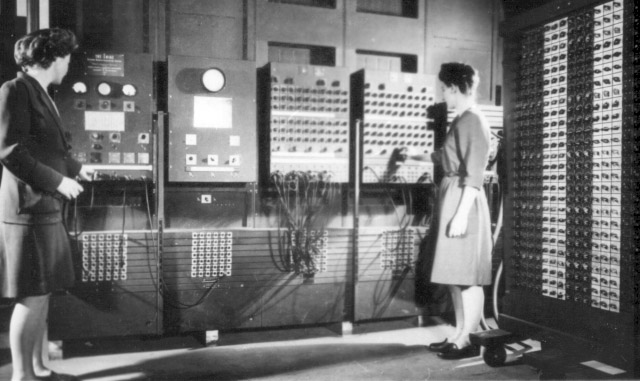
    Programmers Betty Jean Jennings, left, and Fran Bilas operate Eniac's main control panel at the Moore School of Electrical Engineering
    Programmers Betty Jean Jennings, left, and Fran Bilas operate Eniac’s main control panel at the Moore School of Electrical Engineering. Eniac was the first general-purpose electronic computer

    Although an exception to the rule, these figures are representative of the possibility of a computer programming female workforce. These statistics make it clear that this field is not, and should not be, male dominated.

    Two of our female programmers, Claudia Kremnitzer and Carol Badenhorst, have been in the industry for a number of years, and both feel that the growing number of women coming into the industry is representative of the fact that programming is increasingly being seen as a good career choice for both genders.

    Badenhorst became interested in computers as a potential career track after having been invited to do computer science as a seventh subject in high school in the 1980s, while Kremnitzer attended a software development course after school. Both believe that programming as a career choice offers flexibility that many other occupations lack, making it even more attractive to women who are concerned about balancing the needs of their families with their jobs.

    Changing stereotypes takes a long time, and a great effort must be put in to changing perceptions, but this does not mean young women should simply discount the possibility of a career in computer programming. With more companies leading the way, young women can be exposed to a greater number of female mentors and, in time, will come to realise that programming is not only a viable option, but a very lucrative and satisfying career choice.

    • Richard Firth is chairman and CEO of MIP


    MIP Richard Firth
    WhatsApp YouTube Follow on Google News Add as preferred source on Google
    Share. Facebook Twitter LinkedIn WhatsApp Telegram Email Copy Link
    Previous ArticleE-tolls a ‘damn good idea’
    Next Article Zomato attracts R7,2bn valuation

    Related Posts

    South Africa's skills advantage is being overlooked at home - Richard Firth

    South Africa’s skills advantage is being overlooked at home

    29 January 2026
    South Africa's skills advantage is being overlooked at home - Richard Firth

    It’s time for a new approach to government IT spend in South Africa

    19 November 2025
    fibre

    Beyond bandwidth: FNOs should prioritise customer service

    15 July 2025
    Company News
    Cell C delivers maiden results with growth momentum, financial flexibility - Jorges Mendes

    Cell C delivers maiden results with growth momentum, financial flexibility

    13 February 2026
    Start-up king joins Paratus Rwanda - Innocent Mutimura

    Start-up king joins Paratus Rwanda

    13 February 2026
    How NEC XON tackled identity risk for a major telco - Michael de Neuilly Rice

    How NEC XON tackled identity risk for a major telco

    11 February 2026
    Opinion
    A million reasons monopolies don't work - Duncan McLeod

    A million reasons monopolies don’t work

    10 February 2026
    Eskom unbundling U-turn threatens to undo hard-won electricity gains - Busi Mavuso

    Eskom unbundling U-turn threatens to undo hard-won electricity gains

    9 February 2026
    South Africa's skills advantage is being overlooked at home - Richard Firth

    South Africa’s skills advantage is being overlooked at home

    29 January 2026

    Subscribe to Updates

    Get the best South African technology news and analysis delivered to your e-mail inbox every morning.

    Latest Posts
    Cell C cleans up its balance sheet but faces tough trading reality

    Cell C cleans up its balance sheet but faces tough trading reality

    13 February 2026
    MVNO business shines in Cell C's first post-listing results - Jorges Mendes

    MVNO business shines in Cell C’s first post-listing results

    13 February 2026
    Ramaphosa presses ahead with Eskom break-up - Cyril Ramaphosa

    Ramaphosa presses ahead with Eskom break-up

    13 February 2026
    The key technology takeaways from Ramaphosa's 2026 Sona - Cyril Ramaphosa

    The key technology takeaways from Ramaphosa’s 2026 Sona

    13 February 2026
    © 2009 - 2026 NewsCentral Media
    • Cookie policy (ZA)
    • TechCentral – privacy and Popia

    Type above and press Enter to search. Press Esc to cancel.

    Manage consent

    TechCentral uses cookies to enhance its offerings. Consenting to these technologies allows us to serve you better. Not consenting or withdrawing consent may adversely affect certain features and functions of the website.

    Functional Always active
    The technical storage or access is strictly necessary for the legitimate purpose of enabling the use of a specific service explicitly requested by the subscriber or user, or for the sole purpose of carrying out the transmission of a communication over an electronic communications network.
    Preferences
    The technical storage or access is necessary for the legitimate purpose of storing preferences that are not requested by the subscriber or user.
    Statistics
    The technical storage or access that is used exclusively for statistical purposes. The technical storage or access that is used exclusively for anonymous statistical purposes. Without a subpoena, voluntary compliance on the part of your Internet Service Provider, or additional records from a third party, information stored or retrieved for this purpose alone cannot usually be used to identify you.
    Marketing
    The technical storage or access is required to create user profiles to send advertising, or to track the user on a website or across several websites for similar marketing purposes.
    • Manage options
    • Manage services
    • Manage {vendor_count} vendors
    • Read more about these purposes
    View preferences
    • {title}
    • {title}
    • {title}