Close Menu
TechCentralTechCentral

    Subscribe to the newsletter

    Get the best South African technology news and analysis delivered to your e-mail inbox every morning.

    Facebook X (Twitter) YouTube LinkedIn
    WhatsApp Facebook X (Twitter) LinkedIn YouTube
    TechCentralTechCentral
    • News
      Cell C cleans up its balance sheet but faces tough trading reality

      Cell C cleans up its balance sheet but faces tough trading reality

      13 February 2026
      MVNO business shines in Cell C's first post-listing results - Jorges Mendes

      MVNO business shines in Cell C’s first post-listing results

      13 February 2026
      Ramaphosa presses ahead with Eskom break-up - Cyril Ramaphosa

      Ramaphosa presses ahead with Eskom break-up

      13 February 2026
      The key technology takeaways from Ramaphosa's 2026 Sona - Cyril Ramaphosa

      The key technology takeaways from Ramaphosa’s 2026 Sona

      13 February 2026
      Toyota SA CEO: NEV inaction will cost South Africa its motoring industry - Andrew Kirby

      Toyota SA CEO: NEV inaction will cost South Africa its motoring industry

      12 February 2026
    • World
      Russia bans WhatsApp

      Russia bans WhatsApp

      12 February 2026
      EU regulators take aim at WhatsApp

      EU regulators take aim at WhatsApp

      9 February 2026
      Musk hits brakes on Mars mission

      Musk hits brakes on Mars mission

      9 February 2026
      Crypto firm accidentally sends R700-billion in bitcoin to its users

      Crypto firm accidentally sends R700-billion in bitcoin to its users

      8 February 2026
      AI won't replace software, says Nvidia CEO amid market rout - Jensen Huang

      AI won’t replace software, says Nvidia CEO amid market rout

      4 February 2026
    • In-depth
      How liberalisation is rewiring South Africa's power sector

      How liberalisation is rewiring South Africa’s power sector

      21 January 2026
      The top-performing South African tech shares of 2025

      The top-performing South African tech shares of 2025

      12 January 2026
      Digital authoritarianism grows as African states normalise internet blackouts

      Digital authoritarianism grows as African states normalise internet blackouts

      19 December 2025
      TechCentral's South African Newsmakers of 2025

      TechCentral’s South African Newsmakers of 2025

      18 December 2025
      Black Friday goes digital in South Africa as online spending surges to record high

      Black Friday goes digital in South Africa as online spending surges to record high

      4 December 2025
    • TCS
      Watts & Wheels S1E4: 'We drive an electric Uber'

      Watts & Wheels S1E4: ‘We drive an electric Uber’

      10 February 2026
      TCS+ | How Cloud On Demand is helping SA businesses succeed in the cloud - Xhenia Rhode, Dion Kalicharan

      TCS+ | Cloud On Demand and Consnet: inside a real-world AWS partner success story

      30 January 2026
      Watts & Wheels S1E4: 'We drive an electric Uber'

      Watts & Wheels S1E3: ‘BYD’s Corolla Cross challenger’

      30 January 2026
      Watts & Wheels S1E4: 'We drive an electric Uber'

      Watts & Wheels S1E2: ‘China attacks, BMW digs in, Toyota’s sublime supercar’

      23 January 2026

      TCS+ | Why cybersecurity is becoming a competitive advantage for SA businesses

      20 January 2026
    • Opinion
      A million reasons monopolies don't work - Duncan McLeod

      A million reasons monopolies don’t work

      10 February 2026
      Eskom unbundling U-turn threatens to undo hard-won electricity gains - Busi Mavuso

      Eskom unbundling U-turn threatens to undo hard-won electricity gains

      9 February 2026
      South Africa's skills advantage is being overlooked at home - Richard Firth

      South Africa’s skills advantage is being overlooked at home

      29 January 2026
      Why Elon Musk's Starlink is a 'hard no' for me - Songezo Zibi

      Why Elon Musk’s Starlink is a ‘hard no’ for me

      26 January 2026
      A million reasons monopolies don't work - Duncan McLeod

      South Africa’s new fibre broadband battle

      20 January 2026
    • Company Hubs
      • Africa Data Centres
      • AfriGIS
      • Altron Digital Business
      • Altron Document Solutions
      • Altron Group
      • Arctic Wolf
      • AvertITD
      • Braintree
      • CallMiner
      • CambriLearn
      • CYBER1 Solutions
      • Digicloud Africa
      • Digimune
      • Domains.co.za
      • ESET
      • Euphoria Telecom
      • Incredible Business
      • iONLINE
      • IQbusiness
      • Iris Network Systems
      • LSD Open
      • Mitel
      • NEC XON
      • Netstar
      • Network Platforms
      • Next DLP
      • Ovations
      • Paracon
      • Paratus
      • Q-KON
      • SevenC
      • SkyWire
      • Solid8 Technologies
      • Telit Cinterion
      • Tenable
      • Vertiv
      • Videri Digital
      • Vodacom Business
      • Wipro
      • Workday
      • XLink
    • Sections
      • AI and machine learning
      • Banking
      • Broadcasting and Media
      • Cloud services
      • Contact centres and CX
      • Cryptocurrencies
      • Education and skills
      • Electronics and hardware
      • Energy and sustainability
      • Enterprise software
      • Financial services
      • Information security
      • Internet and connectivity
      • Internet of Things
      • Investment
      • IT services
      • Lifestyle
      • Motoring
      • Public sector
      • Retail and e-commerce
      • Satellite communications
      • Science
      • SMEs and start-ups
      • Social media
      • Talent and leadership
      • Telecoms
    • Events
    • Advertise
    TechCentralTechCentral
    Home » In-depth » The standard model of particle physics may be broken

    The standard model of particle physics may be broken

    By The Conversation11 May 2022
    Twitter LinkedIn Facebook WhatsApp Email Telegram Copy Link
    News Alerts
    WhatsApp
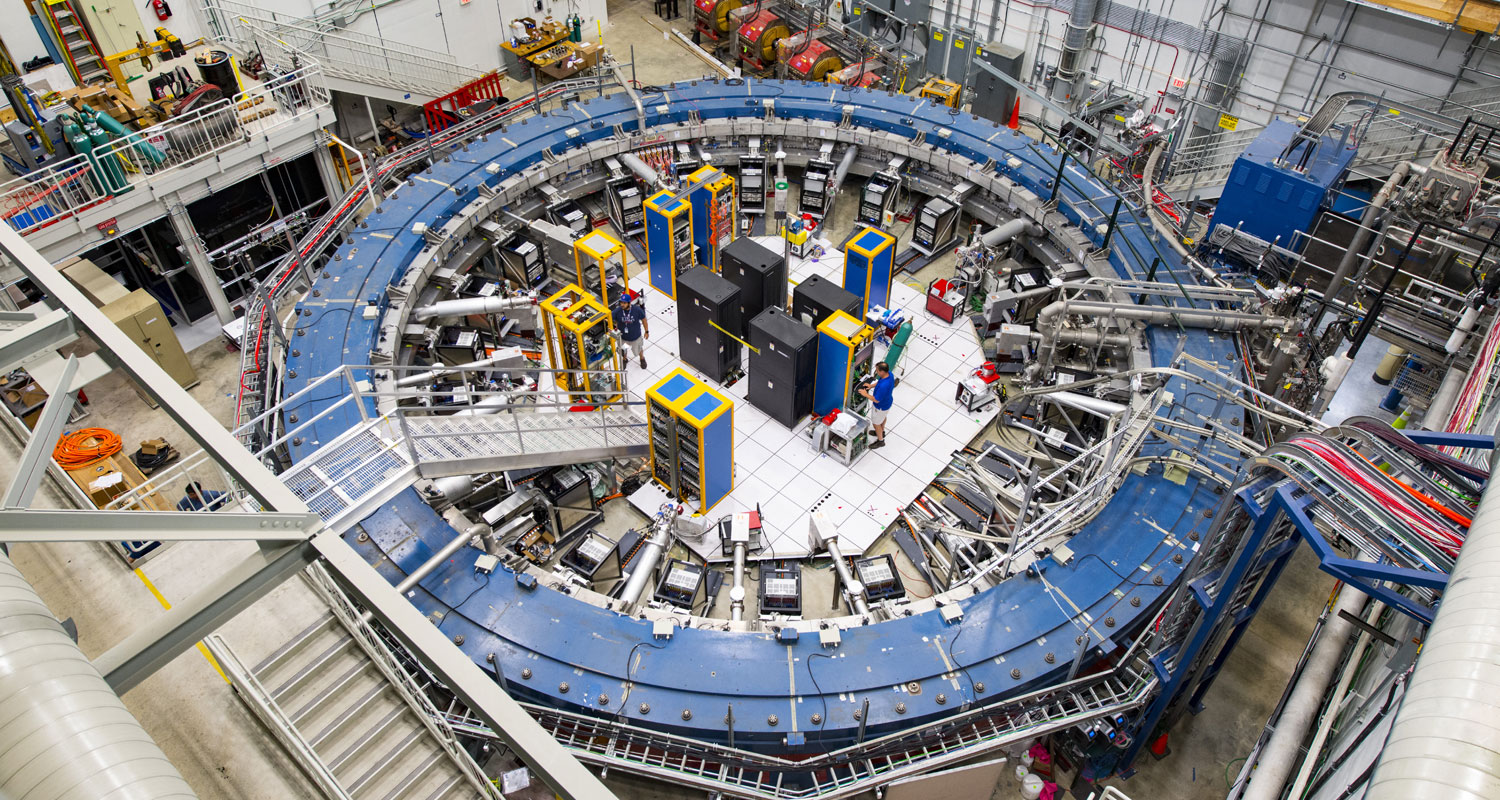
    The storage-ring magnet for the Muon G-2 experiment at Fermilab. Reidar Hahn/Wikipedia, CC BY-SA

    As a physicist working at the Large Hadron Collider (LHC) at Cern, one of the most frequent questions I am asked is this: “When are you going to find something?” Resisting the temptation to reply sarcastically, “Aside from the Higgs boson, which won the Nobel Prize, and a whole slew of new composite particles?”, I realise that the reason the question is posed so often is down to how we have portrayed progress in particle physics to the wider world.

    We often talk about progress in terms of discovering new particles, and it often is. Studying a new, very heavy particle helps us view underlying physical processes – often without annoying background noise. That makes it easy to explain the value of the discovery to the public and politicians.

    Recently, however, a series of precise measurements of already known, bog-standard particles and processes has threatened to shake up physics. And with the LHC getting ready to run at higher energy and intensity than ever before, it is time to start discussing the implications widely.

    In truth, particle physics has always proceeded in two ways, of which new particles is one. The other is by making very precise measurements that test the predictions of theories and look for deviations from what is expected.

    The early evidence for Einstein’s theory of general relativity, for example, came from discovering small deviations in the apparent positions of stars and from the motion of Mercury in its orbit.

    Three key findings

    Particles obey a counter-intuitive but hugely successful theory called quantum mechanics. This theory shows that particles far too massive to be made directly in a lab collision can still influence what other particles do (through something called “quantum fluctuations”). Measurements of such effects are very complex, however, and much harder to explain to the public.

    But recent results hinting at unexplained new physics beyond the standard model are of this second type. Detailed studies from the LHCb experiment found that a particle known as a beauty quark (quarks make up the protons and neutrons in the atomic nucleus) “decays” (falls apart) into an electron much more often than into a muon – the electron’s heavier, but otherwise identical, sibling. According to the standard model, this shouldn’t happen – hinting that new particles or even forces of nature may influence the process.
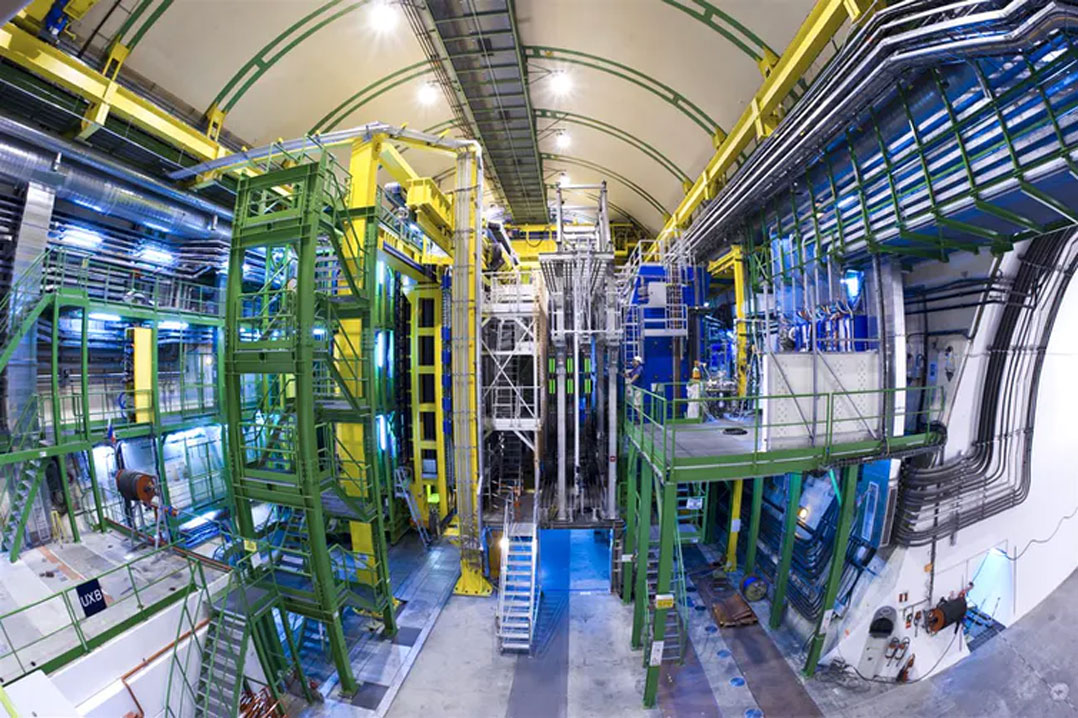
    LHCb experiment, Cern

    Intriguingly, though, measurements of similar processes involving “top quarks” from the Atlas experiment at the LHC show this decay does happen at equal rates for electrons and muons.

    Meanwhile, the Muon g-2 experiment at Fermilab in the US has recently made very precise studies of how muons “wobble” as their “spin” (a quantum property) interacts with surrounding magnetic fields. It found a small but significant deviation from some theoretical predictions – again suggesting that unknown forces or particles may be at work.

    The latest surprising result is a measurement of the mass of a fundamental particle called the W boson, which carries the weak nuclear force that governs radioactive decay. After many years of data taking and analysis, the experiment, also at Fermilab, suggests it is significantly heavier than theory predicts – deviating by an amount that would not happen by chance in more than a million million experiments. Again, it may be that yet undiscovered particles are adding to its mass.

    Interestingly, however, this also disagrees with some lower-precision measurements from the LHC (presented in this study and this one).

    The verdict

    While we are not absolutely certain these effects require a novel explanation, the evidence seems to be growing that some new physics is needed.

    Of course, there will be almost as many new mechanisms proposed to explain these observations as there are theorists. Many will look to various forms of “supersymmetry”. This is the idea that there are twice as many fundamental particles in the standard model than we thought, with each particle having a “super partner”. These may involve additional Higgs bosons (associated with the field that gives fundamental particles their mass).

    Others will go beyond this, invoking less recently fashionable ideas such as “technicolor”, which would imply that there are additional forces of nature (in addition to gravity, electromagnetism and the weak and strong nuclear forces), and might mean that the Higgs boson is in fact a composite object made of other particles. Only experiments will reveal the truth of the matter — which is good news for experimentalists.

    The experimental teams behind the new findings are all well respected and have worked on the problems for a long time. That said, it is no disrespect to them to note that these measurements are extremely difficult to make. What’s more, predictions of the standard model usually require calculations where approximations have to be made. This means different theorists can predict slightly different masses and rates of decay depending on the assumptions and level of approximation made. So, it may be that when we do more accurate calculations, some of the new findings will fit with the standard model.

    What the results illustrate is that there are multiple pathways to a deeper understanding of the new physics, and they all need to be explored

    Equally, it may be the researchers are using subtly different interpretations and so finding inconsistent results. Comparing two experimental results requires careful checking that the same level of approximation has been used in both cases.

    These are both examples of sources of “systematic uncertainty”, and while all concerned do their best to quantify them, there can be unforeseen complications that under- or over-estimate them.

    None of this makes the current results any less interesting or important. What the results illustrate is that there are multiple pathways to a deeper understanding of the new physics, and they all need to be explored.

    With the restart of the LHC, there are still prospects of new particles being made through rarer processes or found hidden under backgrounds that we have yet to unearth.The Conversation

    • Written by Roger Jones, professor of physics and head of department, Lancaster University
    • This article is republished from The Conversation under a Creative Commons licence

    Albert Einstein Cern Large Hadron Collider LHC Roger Jones
    WhatsApp YouTube Follow on Google News Add as preferred source on Google
    Share. Facebook Twitter LinkedIn WhatsApp Telegram Email Copy Link
    Previous ArticleGoogle I/O highlights: Search and Maps get big updates
    Next Article This SA healthtech start-up is working to disrupt health care

    Related Posts

    As Cern turns 70, it looks for ways to finance next big thing

    As Cern turns 70, it looks for ways to finance next big thing

    29 September 2024
    As Cern turns 70, it looks for ways to finance next big thing

    What comes after the Large Hadron Collider?

    13 May 2024

    Wits researchers pioneer new way to search for dark matter

    28 November 2023
    Company News
    Cell C delivers maiden results with growth momentum, financial flexibility - Jorges Mendes

    Cell C delivers maiden results with growth momentum, financial flexibility

    13 February 2026
    Start-up king joins Paratus Rwanda - Innocent Mutimura

    Start-up king joins Paratus Rwanda

    13 February 2026
    How NEC XON tackled identity risk for a major telco - Michael de Neuilly Rice

    How NEC XON tackled identity risk for a major telco

    11 February 2026
    Opinion
    A million reasons monopolies don't work - Duncan McLeod

    A million reasons monopolies don’t work

    10 February 2026
    Eskom unbundling U-turn threatens to undo hard-won electricity gains - Busi Mavuso

    Eskom unbundling U-turn threatens to undo hard-won electricity gains

    9 February 2026
    South Africa's skills advantage is being overlooked at home - Richard Firth

    South Africa’s skills advantage is being overlooked at home

    29 January 2026

    Subscribe to Updates

    Get the best South African technology news and analysis delivered to your e-mail inbox every morning.

    Latest Posts
    Cell C cleans up its balance sheet but faces tough trading reality

    Cell C cleans up its balance sheet but faces tough trading reality

    13 February 2026
    MVNO business shines in Cell C's first post-listing results - Jorges Mendes

    MVNO business shines in Cell C’s first post-listing results

    13 February 2026
    Ramaphosa presses ahead with Eskom break-up - Cyril Ramaphosa

    Ramaphosa presses ahead with Eskom break-up

    13 February 2026
    The key technology takeaways from Ramaphosa's 2026 Sona - Cyril Ramaphosa

    The key technology takeaways from Ramaphosa’s 2026 Sona

    13 February 2026
    © 2009 - 2026 NewsCentral Media
    • Cookie policy (ZA)
    • TechCentral – privacy and Popia

    Type above and press Enter to search. Press Esc to cancel.

    Manage consent

    TechCentral uses cookies to enhance its offerings. Consenting to these technologies allows us to serve you better. Not consenting or withdrawing consent may adversely affect certain features and functions of the website.

    Functional Always active
    The technical storage or access is strictly necessary for the legitimate purpose of enabling the use of a specific service explicitly requested by the subscriber or user, or for the sole purpose of carrying out the transmission of a communication over an electronic communications network.
    Preferences
    The technical storage or access is necessary for the legitimate purpose of storing preferences that are not requested by the subscriber or user.
    Statistics
    The technical storage or access that is used exclusively for statistical purposes. The technical storage or access that is used exclusively for anonymous statistical purposes. Without a subpoena, voluntary compliance on the part of your Internet Service Provider, or additional records from a third party, information stored or retrieved for this purpose alone cannot usually be used to identify you.
    Marketing
    The technical storage or access is required to create user profiles to send advertising, or to track the user on a website or across several websites for similar marketing purposes.
    • Manage options
    • Manage services
    • Manage {vendor_count} vendors
    • Read more about these purposes
    View preferences
    • {title}
    • {title}
    • {title}