Close Menu
TechCentralTechCentral

    Subscribe to the newsletter

    Get the best South African technology news and analysis delivered to your e-mail inbox every morning.

    Facebook X (Twitter) YouTube LinkedIn
    WhatsApp Facebook X (Twitter) LinkedIn YouTube
    TechCentralTechCentral
    • News
      Vodacom to take control of Safaricom in R36-billion deal - Shameel Joosub

      Vodacom to take control of Safaricom in R36-billion deal

      4 December 2025
      Black Friday goes digital in South Africa as online spending surges to record high

      Black Friday goes digital in South Africa as online spending surges to record high

      4 December 2025
      BYD takes direct aim at Toyota with launch of sub-R500 000 Sealion 5 PHEV

      BYD takes direct aim at Toyota with launch of sub-R500 000 Sealion 5 PHEV

      4 December 2025
      'Get it now': Takealot in new instant deliveries pilot

      ‘Get it now’: Takealot in new instant deliveries pilot

      4 December 2025
      What South Africans searched for most in 2025

      What South Africans searched for most in 2025, according to Google

      4 December 2025
    • World
      Amazon and Google launch multi-cloud service for faster connectivity

      Amazon and Google launch multi-cloud service for faster connectivity

      1 December 2025
      Google makes final court plea to stop US breakup

      Google makes final court plea to stop US breakup

      21 November 2025
      Bezos unveils monster rocket: New Glenn 9x4 set to dwarf Saturn V

      Bezos unveils monster rocket: New Glenn 9×4 set to dwarf Saturn V

      21 November 2025
      Tech shares turbocharged by Nvidia's stellar earnings

      Tech shares turbocharged by stellar Nvidia earnings

      20 November 2025
      Config file blamed for Cloudflare meltdown that disrupted the web

      Config file blamed for Cloudflare meltdown that disrupted the web

      19 November 2025
    • In-depth
      Jensen Huang Nvidia

      So, will China really win the AI race?

      14 November 2025
      Valve's Linux console takes aim at Microsoft's gaming empire

      Valve’s Linux console takes aim at Microsoft’s gaming empire

      13 November 2025
      iOCO's extraordinary comeback plan - Rhys Summerton

      iOCO’s extraordinary comeback plan

      28 October 2025
      Why smart glasses keep failing - no, it's not the tech - Mark Zuckerberg

      Why smart glasses keep failing – it’s not the tech

      19 October 2025
      BYD to blanket South Africa with megawatt-scale EV charging network - Stella Li

      BYD to blanket South Africa with megawatt-scale EV charging network

      16 October 2025
    • TCS
      TCS+ | How Cloud on Demand helps partners thrive in the AWS ecosystem - Odwa Ndyaluvane and Xenia Rhode

      TCS+ | How Cloud On Demand helps partners thrive in the AWS ecosystem

      4 December 2025
      TCS | MTN Group CEO Ralph Mupita on competition, AI and the future of mobile

      TCS | Ralph Mupita on competition, AI and the future of mobile

      28 November 2025
      TCS | Dominic Cull on fixing South Africa's ICT policy bottlenecks

      TCS | Dominic Cull on fixing South Africa’s ICT policy bottlenecks

      21 November 2025
      TCS | BMW CEO Peter van Binsbergen on the future of South Africa's automotive industry

      TCS | BMW CEO Peter van Binsbergen on the future of South Africa’s automotive industry

      6 November 2025
      TCS | Why Altron is building an AI factory - Bongani Andy Mabaso

      TCS | Why Altron is building an AI factory in Johannesburg

      28 October 2025
    • Opinion
      Your data, your hardware: the DIY AI revolution is coming - Duncan McLeod

      Your data, your hardware: the DIY AI revolution is coming

      20 November 2025
      Zero Carbon Charge founder Joubert Roux

      The energy revolution South Africa can’t afford to miss

      20 November 2025
      It's time for a new approach to government IT spend in South Africa - Richard Firth

      It’s time for a new approach to government IT spend in South Africa

      19 November 2025
      How South Africa's broken Rica system fuels murder and mayhem - Farhad Khan

      How South Africa’s broken Rica system fuels murder and mayhem

      10 November 2025
      South Africa's AI data centre boom risks overloading a fragile grid - Paul Colmer

      South Africa’s AI data centre boom risks overloading a fragile grid

      30 October 2025
    • Company Hubs
      • Africa Data Centres
      • AfriGIS
      • Altron Digital Business
      • Altron Document Solutions
      • Altron Group
      • Arctic Wolf
      • AvertITD
      • Braintree
      • CallMiner
      • CambriLearn
      • CYBER1 Solutions
      • Digicloud Africa
      • Digimune
      • Domains.co.za
      • ESET
      • Euphoria Telecom
      • Incredible Business
      • iONLINE
      • IQbusiness
      • Iris Network Systems
      • LSD Open
      • NEC XON
      • Netstar
      • Network Platforms
      • Next DLP
      • Ovations
      • Paracon
      • Paratus
      • Q-KON
      • SevenC
      • SkyWire
      • Solid8 Technologies
      • Telit Cinterion
      • Tenable
      • Vertiv
      • Videri Digital
      • Vodacom Business
      • Wipro
      • Workday
      • XLink
    • Sections
      • AI and machine learning
      • Banking
      • Broadcasting and Media
      • Cloud services
      • Contact centres and CX
      • Cryptocurrencies
      • Education and skills
      • Electronics and hardware
      • Energy and sustainability
      • Enterprise software
      • Financial services
      • Information security
      • Internet and connectivity
      • Internet of Things
      • Investment
      • IT services
      • Lifestyle
      • Motoring
      • Public sector
      • Retail and e-commerce
      • Satellite communications
      • Science
      • SMEs and start-ups
      • Social media
      • Talent and leadership
      • Telecoms
    • Events
    • Advertise
    TechCentralTechCentral
    Home » Sections » Science » After a nail-biting landing, what’s next for Mars InSight

    After a nail-biting landing, what’s next for Mars InSight

    By The Conversation29 November 2018
    Twitter LinkedIn Facebook WhatsApp Email Telegram Copy Link
    News Alerts
    WhatsApp
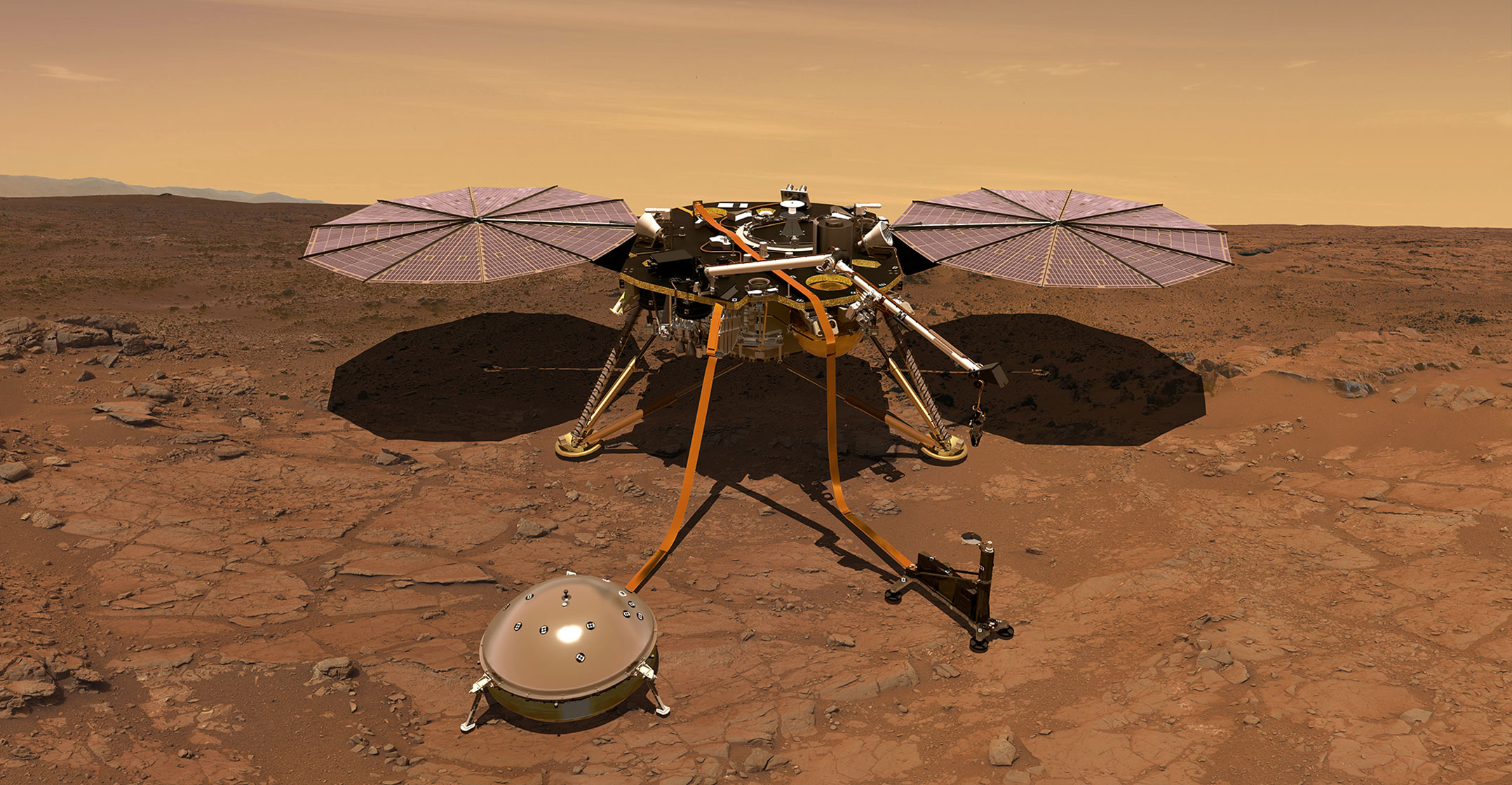
    Artist’s impression of the Mars lander. Image: Nasa

    It’s notoriously hard to land on Mars, yet Nasa managed just that with its recent InSight lander. From childhood, I’ve loved watching landings and other spacecraft manoeuvres on TV — always feeling a bit of that edge-of-the-seat excitement. But it didn’t prepare me for the feeling of watching a mission I’ve worked on. Each period of silence during the seven-minute descent of InSight felt like an eternity, with time re-exerting itself only during call-outs from systems engineer Christine Szalai. I will never forget the joy of the moment when she finally announced “touchdown confirmed”.

    The InSight mission has been over 10 years in the planning. Among planetary missions, it’s a bit of an oddball. While most missions are designed to look at the surface or atmosphere of planetary bodies, InSight’s goal is to look deep beneath the surface — helping us crack the mystery of how it and the other rocky planets formed.

    The InSight mission has been over 10 years in the planning. Among planetary missions, it’s a bit of an oddball

    The lander carries a number of instruments, including seismometers, a heat flow probe, magnetometer and a radio transmitter. The Heat Flow and Physical Properties Probe (HP3) will hammer to a depth of five metres below Mars’s surface, almost twice as far as the handheld drills of the lunar missions. Its measurements will tell us how quickly heat is being lost from the planet’s interior — helping us understand how Mars cools over time.

    The Rotation and Interior Structure Experiment (RISE) will essentially bounce a radio signal sent from Earth back to us. The difference in frequency between the original and returned signal can then be used to work out the velocity of the InSight lander relative to Earth, rather like the pitch of a siren tells us whether it is moving toward or away from us. We’re specifically interested in using the velocity to tell us how Mars’s axis of rotation wobbles over time. The size of these wobbles is dependent on the structure of the interior, and especially its dense metallic core. Just like a raw egg wobbles more than a hard-boiled one when spinning on a flat surface, Mars will wobble more if its core is liquid.

    Seismometers

    I work on the Seismic Experiment for Interior Structure (SEIS), which consists of two seismometers, mounted on a levelling system that will sit about 15cm above the surface of Mars. This experiment is designed to tell us the amount of seismic activity on Mars. We will also use the time it takes for seismic waves to reach the seismometers to tell us about the temperature and composition of the interior, rather like a doctor uses a CT scanner.

    We now have about three months during which the instruments will be deployed and activated. Over the next few days, the health of the systems will be checked, and the lander and surrounding area will be thoroughly imaged so that the operations team can decide where to place InSight’s heat flow probe and seismometers. The first image taken from the surface suggests that we have landed on a shallow sand-filled crater almost free of rocks, so it looks like there will be multiple options.
    Around mid-December, a robotic arm will lift the tripod-mounted seismometers off the deck of the lander and lower them to the surface. After detailed checks, the levelling system will be used to make sure the seismometers are perfectly horizontal. By mid-January, a shield should be placed over the top of the seismometers to protect them from the elements. Then they can be turned on, and the heat flow probe will be deployed.

    The heat flow probe will start returning data as soon as it starts to hammer its way beneath the surface, so we expect to have results in the first half of 2019. The radio experiment will take somewhat longer. It just so happens that, over the next year, we will not be in the best position to see the wobble of Mars’s pole. That changes in mid-2020, when we should be ideally situated to uncover the secrets of its core.

    Through its three main experiments, InSight will provide a ‘snapshot’ of the present day state and composition of Mars

    As for the SEIS experiment, when we see something exciting will depend on how often seismic energy is generated. We don’t currently know this. What we do know is that there are two potential sources of seismic activity: meteorite impacts and “marsquakes” created by movement along faults near the surface.

    While we know that meteorites frequently hit Mars, the rate of fault motion is a mystery. Unlike the Earth, Mars has no moving tectonic plates, so it is estimated that fault movement happens as the planet’s interior cools. However, some of the youngest faults on Mars appear to have been formed not by cooling, but by the movement of molten rock beneath the surface. Discovering the frequency and nature of marsquakes will help us work out the exact causes.

    Through its three main experiments, InSight will provide a “snapshot” of the present day state and composition of Mars. But that isn’t where the scientific discoveries will end. Ultimately, the mission will help us understand the processes that took place over 4.5 billion years ago, when the solar system was very young.

    Fundamental key

    Here’s why. The composition of a planet is set when it formed, which in the case of Mars was only a few million years after the sun ignited. We think that as a result of its greater distance from the sun, Mars formed from different, more volatile-rich material than Earth. However, until Mars’s composition is known, this idea is very hard to test and develop. The data returned from InSight will provide a fundamental key to understanding how the rocky planets in our solar system formed — and perhaps even those around other stars.

    The composition, temperature and magnetic field of our planet are also vital to sustaining life on our planet. So, even though InSight is not looking for life, it will give us new clues as to how Earth was uniquely primed for life over four billion years ago.

    InSight has already been a huge engineering success, and the science team now get the incredible opportunity to use it to reveal Mars’ secrets. We hope you’re as excited as we are.The Conversation

    • Written by Bob Myhill, UK Space Agency postdoctoral fellow, University of Bristol
    • This article is republished from The Conversation under a Creative Commons licence


    Bob Myhill Mars InSight Nasa top UK Space Agency
    Subscribe to TechCentral Subscribe to TechCentral
    Share. Facebook Twitter LinkedIn WhatsApp Telegram Email Copy Link
    Previous ArticleLiquid Telecom to expand free Wi-Fi in W Cape
    Next Article 5G set to be adopted faster than any previous generation

    Related Posts

    Low-Earth orbit satellites - the way forward for Africa

    Why car companies like Toyota are turning to space

    14 February 2025

    Bookmarks | The number of new mobile internet users is stalling

    25 November 2024
    Bookmarks | Firefox at 20 - does Mozilla's browser still matter?

    Bookmarks | Firefox at 20 – does Mozilla’s browser still matter?

    14 November 2024
    Company News
    AI is not a technology problem - iqbusiness

    AI is not a technology problem – iqbusiness

    5 December 2025
    Telcos are sitting on a data gold mine - but few know what do with it - Phillip du Plessis

    Telcos are sitting on a data gold mine – but few know what do with it

    4 December 2025
    Unlock smarter computing with your surface Copilot+ PC

    Unlock smarter computing with your Surface Copilot+ PC

    4 December 2025
    Opinion
    Your data, your hardware: the DIY AI revolution is coming - Duncan McLeod

    Your data, your hardware: the DIY AI revolution is coming

    20 November 2025
    Zero Carbon Charge founder Joubert Roux

    The energy revolution South Africa can’t afford to miss

    20 November 2025
    It's time for a new approach to government IT spend in South Africa - Richard Firth

    It’s time for a new approach to government IT spend in South Africa

    19 November 2025

    Subscribe to Updates

    Get the best South African technology news and analysis delivered to your e-mail inbox every morning.

    Latest Posts
    AI is not a technology problem - iqbusiness

    AI is not a technology problem – iqbusiness

    5 December 2025
    Vodacom to take control of Safaricom in R36-billion deal - Shameel Joosub

    Vodacom to take control of Safaricom in R36-billion deal

    4 December 2025
    Black Friday goes digital in South Africa as online spending surges to record high

    Black Friday goes digital in South Africa as online spending surges to record high

    4 December 2025
    BYD takes direct aim at Toyota with launch of sub-R500 000 Sealion 5 PHEV

    BYD takes direct aim at Toyota with launch of sub-R500 000 Sealion 5 PHEV

    4 December 2025
    © 2009 - 2025 NewsCentral Media
    • Cookie policy (ZA)
    • TechCentral – privacy and Popia

    Type above and press Enter to search. Press Esc to cancel.

    Manage consent

    TechCentral uses cookies to enhance its offerings. Consenting to these technologies allows us to serve you better. Not consenting or withdrawing consent may adversely affect certain features and functions of the website.

    Functional Always active
    The technical storage or access is strictly necessary for the legitimate purpose of enabling the use of a specific service explicitly requested by the subscriber or user, or for the sole purpose of carrying out the transmission of a communication over an electronic communications network.
    Preferences
    The technical storage or access is necessary for the legitimate purpose of storing preferences that are not requested by the subscriber or user.
    Statistics
    The technical storage or access that is used exclusively for statistical purposes. The technical storage or access that is used exclusively for anonymous statistical purposes. Without a subpoena, voluntary compliance on the part of your Internet Service Provider, or additional records from a third party, information stored or retrieved for this purpose alone cannot usually be used to identify you.
    Marketing
    The technical storage or access is required to create user profiles to send advertising, or to track the user on a website or across several websites for similar marketing purposes.
    • Manage options
    • Manage services
    • Manage {vendor_count} vendors
    • Read more about these purposes
    View preferences
    • {title}
    • {title}
    • {title}