
Close Menu
TechCentralTechCentral

    Subscribe to the newsletter

    Get the best South African technology news and analysis delivered to your e-mail inbox every morning.

    Facebook X (Twitter) YouTube LinkedIn
    WhatsApp Facebook X (Twitter) LinkedIn YouTube
    TechCentralTechCentral
    • News
      Nedbank hires MTN's former tech chief as group CIO - Nikos Angelopoulos

      Nedbank hires MTN’s former tech chief as group CIO

      31 July 2026
      Eskom's diesel bill falls 86% as breakdowns hit eight-year low

      Eskom’s diesel bill falls 86% as breakdowns hit eight-year low

      31 July 2026
      Ramaphosa signs off on taking the grid away from Eskom

      Ramaphosa signs off on taking the grid away from Eskom

      31 July 2026
      Microsoft just had the biggest day in stock market history

      Microsoft just had the biggest day in stock market history

      31 July 2026
      MTN Nigeria's growth engine stalled in second quarter - Karl Toriola

      MTN Nigeria’s growth engine stalled in second quarter

      31 July 2026
    • World
      Meta AI will now tell parents if their teen is in crisis

      Meta AI will now tell parents if their teen is in crisis

      17 July 2026
      IBM shares crash 25% as AI upends software spending - Arvind Krishna

      IBM shares crash 25% as AI upends software spending

      15 July 2026
      Jony Ive's first OpenAI device: an AI smart speaker - Jony Ive and Sam Altman

      Jony Ive’s first OpenAI device: an AI smart speaker

      15 July 2026
      Stripe, Advent in talks to buy PayPal for $53-billion

      Stripe, Advent in talks to buy PayPal for $53-billion

      15 July 2026
      Memory crisis sends smartphone market into steep decline

      Memory crisis sends smartphone market into steep decline

      13 July 2026
    • In-depth
      The plan to stop AI from breaking the world - Google DeepMind CEO Demis Hassabis. Image: John Sears

      The plan to stop AI from breaking the world

      16 July 2026
      The internet has a Strait of Hormuz problem

      The internet has a Strait of Hormuz problem

      15 July 2026
      AI boom sparks rally, frenzy and fear

      AI boom sparks rally, frenzy and fear

      11 June 2026
      Every plug-in hybrid on sale in South Africa, ranked by price - Lamborghini Temerario

      Every plug-in hybrid on sale in South Africa, ranked by price

      7 June 2026
      What Wi-Fi 8 will mean for wireless networks

      What Wi-Fi 8 will mean for wireless networks

      1 June 2026
    • TCS
      TCS+ | Why South African workers must become supervisors of digital labour - Accelera Digital Group Cliff de Wit

      TCS+ | Why South African workers must become supervisors of digital labour

      31 July 2026
      TCS | Rapid deployment rules can't work without municipalities: ACT - Nomvuyiso Batyi

      TCS | Icasa’s rules skip the real bottleneck: ACT

      30 July 2026
      TCS+ | iStore Business on why Apple makes sense for SMEs - Sudesh Pillay and Tamia Nontsikelelo

      TCS+ | iStore Business on why Apple makes sense for SMEs

      30 July 2026
      TCS+ | A smarter approach to cloud for South African businesses - Joel Chacko and Jonathan Oaker

      TCS+ | A smarter approach to cloud for South African businesses

      28 July 2026
      TCS | How Optasia lends billions to people banks can't see - Salvador Anglada

      TCS | How Optasia lends billions to people banks can’t see

      23 July 2026
    • Opinion
      The author, Jannie van Zyl

      Selling vapour is corporate suicide in slow motion

      16 July 2026
      Brazil's online gambling crackdown is a lesson for South Africa

      How Amazon outmanoeuvred Starlink in South Africa

      15 July 2026
      The Popia problem with agentic AI - Herman Haasbroek

      The Popia problem with agentic AI

      14 July 2026
      The author, Fanie van Rooyen

      South Africa can still catch the AI wave – here’s how

      7 July 2026
      The author, Fanie van Rooyen

      The AI utopia South Africa can’t afford

      1 July 2026
    • Company Hubs
      • 1Stream
      • Africa Data Centres
      • AfriGIS
      • Altron Digital Business
      • Altron Document Solutions
      • Altron Group
      • Arctic Wolf
      • Ascent Technology
      • AvertITD
      • BBD
      • Braintree
      • CallMiner
      • CambriLearn
      • CM Telecom
      • Contactable
      • CYBER1 Solutions
      • Digicloud Africa
      • Digimune
      • Domains.co.za
      • ESET
      • Euphoria Telecom
      • HOSTAFRICA
      • Incredible Business
      • iONLINE
      • IQbusiness
      • Iris Network Systems
      • Kaspersky
      • LSD Open
      • Mitel
      • NEC XON
      • Netstar
      • Network Platforms
      • Next DLP
      • Ovations
      • Paracon
      • Paratus
      • Q-KON
      • SevenC
      • SkyWire
      • Solid8 Technologies
      • Telit Cinterion
      • Telviva
      • Tenable
      • Vertiv
      • Videri Digital
      • Vodacom Business
      • Vox
      • Wipro
      • Workday
      • XLink
    • Sections
      • AI and machine learning
      • Banking
      • Broadcasting and Media
      • Cloud services
      • Contact centres and CX
      • Cryptocurrencies
      • Education and skills
      • Electronics and hardware
      • Energy and sustainability
      • Enterprise software
      • Financial services
      • HealthTech
      • Information security
      • Internet and connectivity
      • Internet of Things
      • Investment
      • IT services
      • Lifestyle
      • Policy and regulation
      • Public sector
      • Retail and e-commerce
      • Satellite communications
      • Science
      • SMEs and start-ups
      • Social media
      • Talent and leadership
      • Telecoms
      • Watts & Wheels
    • Events
    • Advertise
    TechCentralTechCentral
    Home » Opinion » Alistair Fairweather » Amazon misfires with the Fire Phone

    Amazon misfires with the Fire Phone

    By Alistair Fairweather23 June 2014
    Twitter LinkedIn Facebook WhatsApp Email Telegram Copy Link
    News Alerts
    WhatsApp

    Alistair-Fairweather-180-profileAmazon is not a consumer electronics company. Yes, the e-commerce giant has sold tens of millions of its own devices to customers. And yes, it has just launched a smart phone, but measuring Amazon by Samsung’s or Apple’s standards overlooks the most important thing about its business.

    When Amazon launched its Kindle e-reader late in 2007, many analysts were sceptical. The e-books market had never lived up to the hype that surrounded it during the dot-com boom, so how could a retailer expect to compete as a device manufacturer, and in an entirely untried product category?

    Amazon soon proved its critics wrong. Although it never releases official sales figures, analysis suggests that there are well over 50m of its e-readers in current use. Although e-reader sales peaked in 2011 and are now falling, Amazon is making more money than ever from the platform.

    How? Simple: an average Amazon customer who owns a Kindle device spends an estimated $1 233/year with the online retailer, 56% more than a non-Kindle owner who spends $790. This is Amazon’s secret — these devices are a means to an end, not an end in themselves.

    While the other players generate the majority of their profits from device sales, Amazon famously sells its devices at close to (or even below) cost. Its Kindle Fire tablets are less than half the price of its competitors’ products.

    Jeff Bezos, Amazon’s mercurial founder, understands something that most of his competitors in the space struggle to: there are many customers who care less about the technology itself than its price and what it can actually do for them.

    The devices he sells are a vector for delivering his real product: premium content. And Amazon doesn’t need to chase expensive 12- or 24-month upgrade cycles. If someone keeps a Kindle or Kindle Fire for five years, they are still spending money every year.
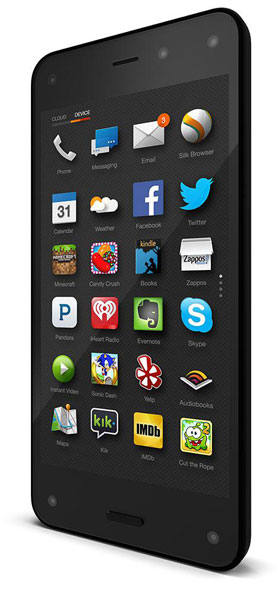
    Amazon's Fire Phone
    Amazon’s Fire Phone

    Amazon’s core customers are not style conscious youngsters or tech worshipping geeks, they are late adopters. They are price sensitive, nervous of new technology and generally uninterested in technical specifications. They don’t want a device that will revolutionise their lives — they want a convenient way to do what they already like doing: reading books, watching movies, surfing the Web and playing games.

    This means that while Apple, Samsung and HTC frantically cram more power and sex appeal into their new devices, Amazon’s devices can afford to be decidedly average in both power and looks. The technology on which they are built is essentially commoditised — usually at least 12 or even 24 months behind the cutting edge.

    The newest member of the Amazon device family, the Fire Phone, seems to follow this pattern. Its stats are not particularly sexy, and neither are its looks. Apart from some novelties, such as a 3D user interface, it’s essentially the little brother to the Kindle Fire tablet range.

    The company has made a lot of noise about a feature that allows you to point the phone’s camera at “any product” and instantly order said product from Amazon’s online store. It’s a gimmick and one that already exists on many other smartphones.

    The Fire Phone diverges from the Amazon recipe in one very important respect: price. The phone will cost $200 on a two-year contract, or $650 without one. That puts it in the same bracket as premium devices such as Apple’s iPhone and Samsung’s blockbuster Galaxy series.

    This is an odd time to change one’s pricing strategy. Unlike the e-reader and tablet markets, which were extremely open and fast-growing when Amazon entered them, the smartphone market is largely saturated and far more competitive. The heyday of its growth, three or four years ago, is now past.

    The smartphone market is also much more heavily influenced by the availability of apps. While tablets are primarily used for consumption, phones are utility devices. Because Amazon has chosen to modify heavily — or “fork” — Google’s Android operating system, the same apps will not work across both platforms.

    This means developers need to spend time and money developing for yet another operating system, one with relatively few potential customers. As both BlackBerry and Nokia have learnt to their detriment, many developers will be disinclined to do so.

    Smartphones are not well suited to consuming the kind of content at which Amazon excels. People do read articles and watch videos on their phones, but these are normally in short form. Relatively few people in developed countries will choose to read an entire book or watch a feature film on their phones.

    The people most likely to consume this kind of long form content on their phones are in developing countries such as India, Nigeria and Brazil. For these customers, their smartphone will be the first computing device they own. It is often their first screen — beating television (with its limited content) and computer screens (which they cannot afford).

    Amazon CEO Jeff Bezos (image: Steve Jurvetson)
    Amazon CEO Jeff Bezos (image: Steve Jurvetson)

    But Amazon’s current price point is prohibitive to these customers. They might be willing to spend $100 or even $150 on a handset, but $650 might as well be $6 500. The customers who can afford the $650 probably already have an iPhone or Samsung Galaxy, and probably a tablet or computer as well.

    Unless something radical changes, the Fire Phone is likely to prove a rare misstep for Bezos and the company he founded. It has arrived late to a market it thinks it understands.

    Although it will have spent far less on research and development than its rivals, Amazon still needs to recover those costs. That implies selling several million units of the Fire Phone within the first year. But even late adopters, Amazon’s bread and butter, already have smartphones, and shifting them to another platform will be extremely difficult.

    No, Amazon is not a consumer electronics company. It cares far less about selling devices than it does about reaching its customers. But unless it rethinks its current strategy, it is likely to be stuck with a lot of devices and not very many customers.  — (c) 2014 Mail & Guardian

    • Alistair Fairweather is chief technology officer at the Mail & Guardian
    • Visit the Mail & Guardian Online, the smart news source

    Follow TechCentral on Google News Add TechCentral as your preferred source on Google


    Alistair Fairweather Amazon Amazon Fire Phone Amazon.com Apple Jeff Bezos Samsung Electronics
    WhatsApp YouTube
    Share. Facebook Twitter LinkedIn WhatsApp Telegram Email Copy Link
    Previous ArticleNaspers numbers in a nutshell
    Next Article Court challenge to remove Usaasa boss

    Related Posts

    TCS+ | iStore Business on why Apple makes sense for SMEs - Sudesh Pillay and Tamia Nontsikelelo

    TCS+ | iStore Business on why Apple makes sense for SMEs

    30 July 2026
    Apple at Work: business technology that works as one

    Apple at Work: business technology that works as one

    29 July 2026
    Apple's next CEO plants his flag in Hollywood - John Ternus and Tim Cook

    Apple’s next CEO plants his flag in Hollywood

    28 July 2026
    Company News
    Domains.co.za launches self-hosted n8n VPS hosting

    Domains.co.za launches self-hosted n8n VPS hosting

    31 July 2026
    Smarter.tech '26 shows why smarter technology begins with context - Obsidian Systems

    Context is the missing piece in enterprise AI: Obsidian

    31 July 2026
    Huawei launches 12 intelligent transport solutions in South Africa - Sam Tang

    Huawei launches 12 intelligent transport solutions in South Africa

    30 July 2026
    Opinion
    The author, Jannie van Zyl

    Selling vapour is corporate suicide in slow motion

    16 July 2026
    Brazil's online gambling crackdown is a lesson for South Africa

    How Amazon outmanoeuvred Starlink in South Africa

    15 July 2026
    The Popia problem with agentic AI - Herman Haasbroek

    The Popia problem with agentic AI

    14 July 2026

    Subscribe to Updates

    Get the best South African technology news and analysis delivered to your e-mail inbox every morning.

    Latest Posts
    Nedbank hires MTN's former tech chief as group CIO - Nikos Angelopoulos

    Nedbank hires MTN’s former tech chief as group CIO

    31 July 2026
    Eskom's diesel bill falls 86% as breakdowns hit eight-year low

    Eskom’s diesel bill falls 86% as breakdowns hit eight-year low

    31 July 2026
    Ramaphosa signs off on taking the grid away from Eskom

    Ramaphosa signs off on taking the grid away from Eskom

    31 July 2026
    TCS+ | Why South African workers must become supervisors of digital labour - Accelera Digital Group Cliff de Wit

    TCS+ | Why South African workers must become supervisors of digital labour

    31 July 2026
    © 2009 - 2026 NewsCentral Media
    Built and maintained by Chronon
    • Cookie policy (ZA)
    • TechCentral – privacy and Popia

    Type above and press Enter to search. Press Esc to cancel.

    Manage consent

    TechCentral uses cookies to enhance its offerings. Consenting to these technologies allows us to serve you better. Not consenting or withdrawing consent may adversely affect certain features and functions of the website.

    Functional Always active
    The technical storage or access is strictly necessary for the legitimate purpose of enabling the use of a specific service explicitly requested by the subscriber or user, or for the sole purpose of carrying out the transmission of a communication over an electronic communications network.
    Preferences
    The technical storage or access is necessary for the legitimate purpose of storing preferences that are not requested by the subscriber or user.
    Statistics
    The technical storage or access that is used exclusively for statistical purposes. The technical storage or access that is used exclusively for anonymous statistical purposes. Without a subpoena, voluntary compliance on the part of your Internet Service Provider, or additional records from a third party, information stored or retrieved for this purpose alone cannot usually be used to identify you.
    Marketing
    The technical storage or access is required to create user profiles to send advertising, or to track the user on a website or across several websites for similar marketing purposes.
    • Manage options
    • Manage services
    • Manage {vendor_count} vendors
    • Read more about these purposes
    View preferences
    • {title}
    • {title}
    • {title}