Close Menu
TechCentralTechCentral

    Subscribe to the newsletter

    Get the best South African technology news and analysis delivered to your e-mail inbox every morning.

    Facebook X (Twitter) YouTube LinkedIn
    WhatsApp Facebook X (Twitter) LinkedIn YouTube
    TechCentralTechCentral
    • News
      Mastercard bets billions on the tech that could eat its lunch - Prakriti Singh

      Mastercard bets billions on the tech that could eat its lunch

      21 July 2026
      From care homes to production lines, the robots are coming

      From care homes to production lines, the robots are coming

      21 July 2026
      Remote work in South Africa hits record high

      Remote work in South Africa hits record high

      21 July 2026
      China weighs blocking the West from its best AI

      China weighs blocking the West from its best AI

      21 July 2026
      Openserve hits back in fibre ISP row

      Openserve hits back in fibre ISP row

      20 July 2026
    • World
      Meta AI will now tell parents if their teen is in crisis

      Meta AI will now tell parents if their teen is in crisis

      17 July 2026
      IBM shares crash 25% as AI upends software spending - Arvind Krishna

      IBM shares crash 25% as AI upends software spending

      15 July 2026
      Jony Ive's first OpenAI device: an AI smart speaker - Jony Ive and Sam Altman

      Jony Ive’s first OpenAI device: an AI smart speaker

      15 July 2026
      Stripe, Advent in talks to buy PayPal for $53-billion

      Stripe, Advent in talks to buy PayPal for $53-billion

      15 July 2026
      Memory crisis sends smartphone market into steep decline

      Memory crisis sends smartphone market into steep decline

      13 July 2026
    • In-depth
      The plan to stop AI from breaking the world - Google DeepMind CEO Demis Hassabis. Image: John Sears

      The plan to stop AI from breaking the world

      16 July 2026
      The internet has a Strait of Hormuz problem

      The internet has a Strait of Hormuz problem

      15 July 2026
      AI boom sparks rally, frenzy and fear

      AI boom sparks rally, frenzy and fear

      11 June 2026
      Every plug-in hybrid on sale in South Africa, ranked by price - Lamborghini Temerario

      Every plug-in hybrid on sale in South Africa, ranked by price

      7 June 2026
      What Wi-Fi 8 will mean for wireless networks

      What Wi-Fi 8 will mean for wireless networks

      1 June 2026
    • TCS
      Watts & Wheels S1E7: 'Ferrari's EV breaks the internet'

      Watts & Wheels S1E7: ‘Ferrari’s EV breaks the internet’

      8 July 2026
      TCS+ | How Tracker is turning vehicle data into business strategy - Silvia Schollenberger

      TCS+ | How Tracker is turning vehicle data into business strategy

      1 July 2026
      TCS+ | IBM Bob: an AI-powered 'development partner' for the enterprise - David Spurway

      TCS+ | IBM Bob: an AI-powered development partner for the enterprise

      30 June 2026
      Watts & Wheels S1E6: 'A flawless Alfa and a bakkie that divides'

      Watts & Wheels S1E6: ‘A flawless Alfa and a bakkie that divides’

      17 June 2026
      Watts & Wheels S1E6: 'A flawless Alfa and a bakkie that divides'

      Watts & Wheels S1E5: ‘A Bentley of the bush and a car that swims’

      8 June 2026
    • Opinion
      Selling vapour is corporate suicide in slow motion - Jannie van Zyl

      Selling vapour is corporate suicide in slow motion

      16 July 2026
      Brazil's online gambling crackdown is a lesson for South Africa

      How Amazon outmanoeuvred Starlink in South Africa

      15 July 2026
      The Popia problem with agentic AI - Herman Haasbroek

      The Popia problem with agentic AI

      14 July 2026
      The author, Fanie van Rooyen

      South Africa can still catch the AI wave – here’s how

      7 July 2026
      The author, Fanie van Rooyen

      The AI utopia South Africa can’t afford

      1 July 2026
    • Company Hubs
      • 1Stream
      • Africa Data Centres
      • AfriGIS
      • Altron Digital Business
      • Altron Document Solutions
      • Altron Group
      • Arctic Wolf
      • Ascent Technology
      • AvertITD
      • BBD
      • Braintree
      • CallMiner
      • CambriLearn
      • CM Telecom
      • Contactable
      • CYBER1 Solutions
      • Digicloud Africa
      • Digimune
      • Domains.co.za
      • ESET
      • Euphoria Telecom
      • HOSTAFRICA
      • Incredible Business
      • iONLINE
      • IQbusiness
      • Iris Network Systems
      • Kaspersky
      • LSD Open
      • Mitel
      • NEC XON
      • Netstar
      • Network Platforms
      • Next DLP
      • Ovations
      • Paracon
      • Paratus
      • Q-KON
      • SevenC
      • SkyWire
      • Solid8 Technologies
      • Telit Cinterion
      • Telviva
      • Tenable
      • Vertiv
      • Videri Digital
      • Vodacom Business
      • Wipro
      • Workday
      • XLink
    • Sections
      • AI and machine learning
      • Banking
      • Broadcasting and Media
      • Cloud services
      • Contact centres and CX
      • Cryptocurrencies
      • Education and skills
      • Electronics and hardware
      • Energy and sustainability
      • Enterprise software
      • Financial services
      • HealthTech
      • Information security
      • Internet and connectivity
      • Internet of Things
      • Investment
      • IT services
      • Lifestyle
      • Policy and regulation
      • Public sector
      • Retail and e-commerce
      • Satellite communications
      • Science
      • SMEs and start-ups
      • Social media
      • Talent and leadership
      • Telecoms
      • Watts & Wheels
    • Events
    • Advertise
    TechCentralTechCentral
    Home » In-depth » Can 3D films make you sick?

    Can 3D films make you sick?

    By The Conversation8 July 2015
    Twitter LinkedIn Facebook WhatsApp Email Telegram Copy Link
    News Alerts
    WhatsApp

    3d-640

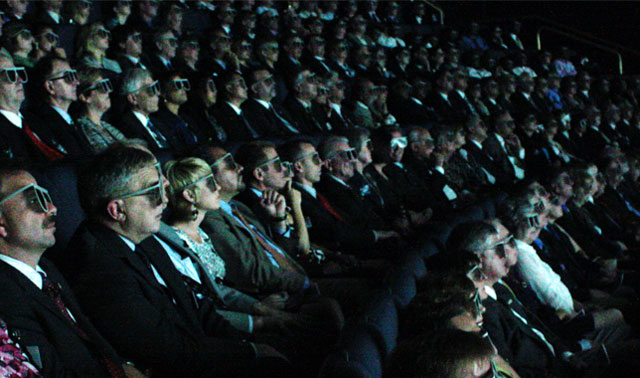
    The realism of today’s 3D blockbusters can blow audiences away. By using 3D glasses to present different images to the two eyes, stereoscopic 3D technology fools the brain into believing it is viewing a real scene rather than a flat image on a screen. Now 3D televisions enable viewers to experience the effect at home as well.

    Yet 3D has not become as popular as some might have hoped. Many people say watching 3D gives them unpleasant side effects such as headache or nausea. Scientists don’t fully understand why this is. It’s true that badly made 3D effects can cause discomfort. However, makers of 3D content are well aware of the possible issues and work hard to avoid them.

    A more fundamental problem may be conflict between different senses. When we watch a film such as Avatar, our visual system may tell us that we are wheeling high in the skies of a distant moon, but other senses tell us that we are sitting motionless in a chair. Of course, 2D films present this kind of conflict as well, but our brains may simply be more used to accepting that 2D content is not “real”.

    Some people have suggested that 3D content may cause more serious side effects. For example, Samsung’s safety leaflet links its 3D TV set to a vast range of possible symptoms — not only headache, fatigue, motion sickness and eye strain, but also decreased postural stability, altered vision, dizziness, cramps, convulsions and even loss of awareness. Clearly if 3D TV has such effects, there are important safety implications. But to date, very little work has been done to assess this.

    We recently invited 433 volunteers, aged from four to 82 years, into my lab to watch the film Toy Story on either a 2D or 3D TV. We used two common types of 3D TV, known as “active” and “passive”. Participants carried out a battery of tests designed to assess their balance and coordination, both before and after viewing. They wore two triaxial accelerometers — small devices to record their body movements — as they walked around a simple obstacle course. To assess eye-hand coordination, participants played a “buzz the wire” game, guiding a hoop along a convoluted wire track without allowing the two to come into contact.

    We argued that, if viewing 3D made participants dizzy, they would take longer to complete the obstacle course, and/or the accelerometers would show that their body movements were less stable. If it affected their vision, they would take longer to complete the “buzz the wire” game, and/or make more mistakes.

    Some people have suggested that adverse effects with 3D reflect underlying visual problems. So we also had our volunteers’ vision thoroughly assessed by eye care professionals before they visited the lab.

    On our objective tests of balance and coordination, we couldn’t detect any effects of 3D at all. Not surprisingly, people tended to perform a little better the second time around. But it didn’t seem to matter whether they had watched the film in 2D or 3D, or whether the 3D was active or passive. We also couldn’t find any links between age or eyesight and whether people were affected by 3D.

    toy-story-3d-640
    Toy Story

    We did find that people who had viewed the 3D movie reported that the depth was more realistic. They also reported more adverse effects, mainly headache and eye strain, but also including dizziness or nausea. However, it’s not clear that the dizziness was really due to 3D.

    Craftily, we gave some of our volunteers 3D glasses, making them think they were viewing in 3D, but showed them the film in 2D. These people reported dizziness at about the same rate (3%) as those viewing real 3D. In contrast, people viewing real 3D were much more likely to report headache or eyestrain (around 10%) than people who just thought they were viewing 3D. This suggests that while 3D gives some people a headache, it doesn’t really make people dizzy — people just expect it to.

    Of course, it’s possible that 3D caused an impairment that was so subtle or transient that our tests failed to detect it. On the other hand, that also implies less cause for concern in everyday life. We also tested only one 3D film, choosing Toy Story as something fun and engaging for all age groups. Even if computer-generated 3D from the experts at Pixar doesn’t cause dizziness, it remains possible that less carefully controlled 3D content — say, live-action football — could do so.

    Nevertheless, given the lack of previous work in this area, our study provides welcome reassurance. Can 3D effects give you a headache? Yes, for some people. Can they make you dizzy? Probably not. Do they make Toy Story more exciting? That depends who’s watching.The Conversation

    • Jenny Read is reader in vision science at the University of Newcastle
    • This article was originally published on The Conversation

    Follow TechCentral on Google News Add TechCentral as your preferred source on Google


    WhatsApp YouTube
    Share. Facebook Twitter LinkedIn WhatsApp Telegram Email Copy Link
    Previous ArticleWhy Facebook came to SA first
    Next Article Taxi industry cries foul over Uber

    Related Posts

    Mastercard bets billions on the tech that could eat its lunch - Prakriti Singh

    Mastercard bets billions on the tech that could eat its lunch

    21 July 2026
    From care homes to production lines, the robots are coming

    From care homes to production lines, the robots are coming

    21 July 2026
    Cloud adoption is done. Execution is the new frontier - Cloud on Demand

    Cloud adoption is done. Execution is the new frontier

    21 July 2026
    Company News
    Cloud adoption is done. Execution is the new frontier - Cloud on Demand

    Cloud adoption is done. Execution is the new frontier

    21 July 2026
    Data poisoning in AI models: what businesses need to know - Domains.co.za

    Data poisoning in AI models: what businesses need to know

    21 July 2026
    The AI-led industrial revolution has begun - CallMiner Bruce McMahon

    The AI-led industrial revolution has begun

    20 July 2026
    Opinion
    Selling vapour is corporate suicide in slow motion - Jannie van Zyl

    Selling vapour is corporate suicide in slow motion

    16 July 2026
    Brazil's online gambling crackdown is a lesson for South Africa

    How Amazon outmanoeuvred Starlink in South Africa

    15 July 2026
    The Popia problem with agentic AI - Herman Haasbroek

    The Popia problem with agentic AI

    14 July 2026

    Subscribe to Updates

    Get the best South African technology news and analysis delivered to your e-mail inbox every morning.

    Latest Posts
    Mastercard bets billions on the tech that could eat its lunch - Prakriti Singh

    Mastercard bets billions on the tech that could eat its lunch

    21 July 2026
    From care homes to production lines, the robots are coming

    From care homes to production lines, the robots are coming

    21 July 2026
    Cloud adoption is done. Execution is the new frontier - Cloud on Demand

    Cloud adoption is done. Execution is the new frontier

    21 July 2026
    Data poisoning in AI models: what businesses need to know - Domains.co.za

    Data poisoning in AI models: what businesses need to know

    21 July 2026
    © 2009 - 2026 NewsCentral Media
    Built and maintained by Chronon
    • Cookie policy (ZA)
    • TechCentral – privacy and Popia

    Type above and press Enter to search. Press Esc to cancel.

    Manage consent

    TechCentral uses cookies to enhance its offerings. Consenting to these technologies allows us to serve you better. Not consenting or withdrawing consent may adversely affect certain features and functions of the website.

    Functional Always active
    The technical storage or access is strictly necessary for the legitimate purpose of enabling the use of a specific service explicitly requested by the subscriber or user, or for the sole purpose of carrying out the transmission of a communication over an electronic communications network.
    Preferences
    The technical storage or access is necessary for the legitimate purpose of storing preferences that are not requested by the subscriber or user.
    Statistics
    The technical storage or access that is used exclusively for statistical purposes. The technical storage or access that is used exclusively for anonymous statistical purposes. Without a subpoena, voluntary compliance on the part of your Internet Service Provider, or additional records from a third party, information stored or retrieved for this purpose alone cannot usually be used to identify you.
    Marketing
    The technical storage or access is required to create user profiles to send advertising, or to track the user on a website or across several websites for similar marketing purposes.
    • Manage options
    • Manage services
    • Manage {vendor_count} vendors
    • Read more about these purposes
    View preferences
    • {title}
    • {title}
    • {title}