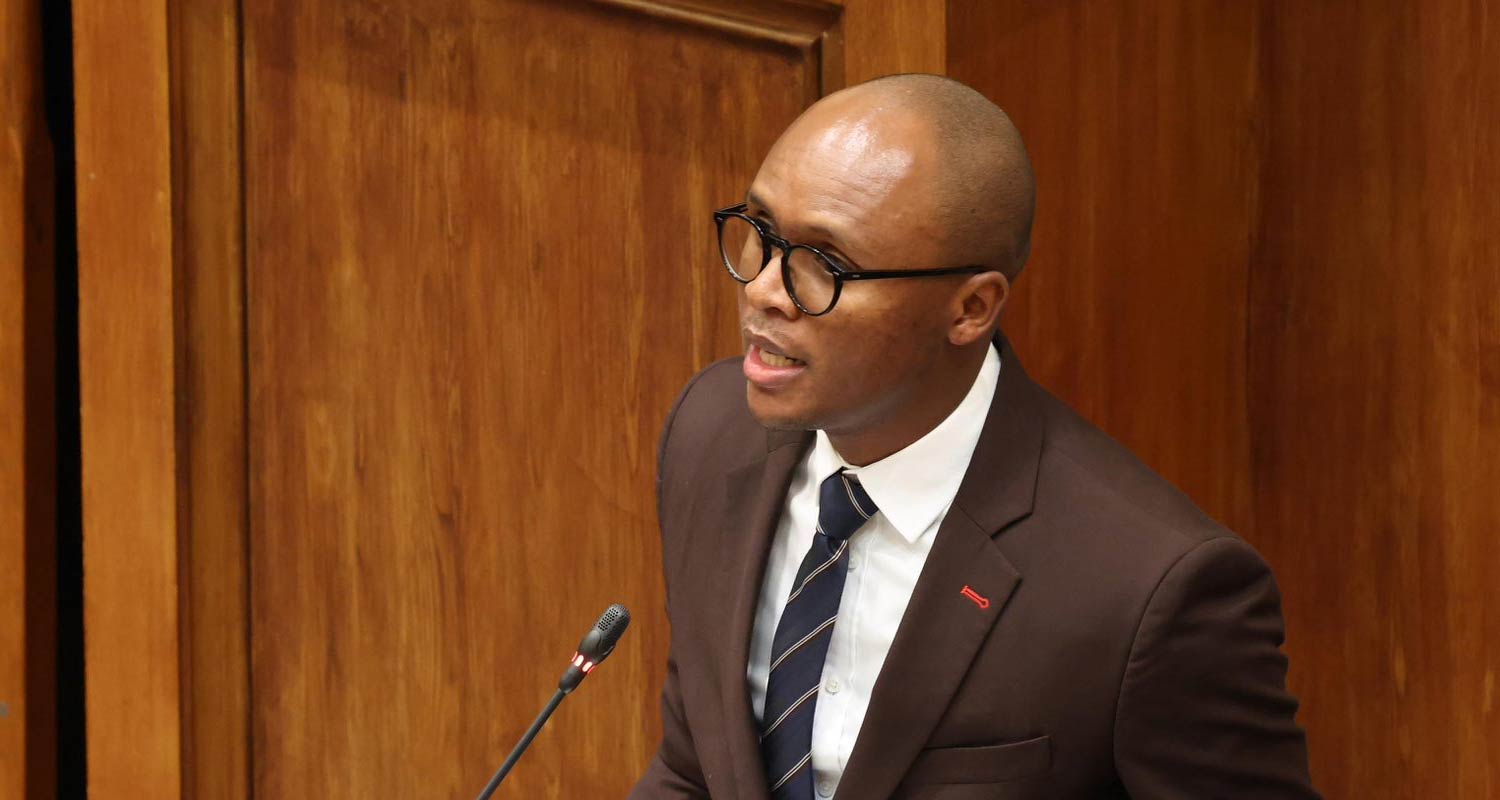
Communications minister Solly Malatsi has placed faster, cheaper and more reliable internet at the centre of the department of communications & digital technologies’ agenda for the year ahead, adding that the state cannot afford to deliver these services on its own.
Tabling his R2.55-billion budget vote in parliament on Tuesday, Malatsi made the case that 100% state ownership of portfolio entities was “no longer sustainable in the context of our fiscal reality”, and that partial privatisation and commercial partnerships with the private sector would be needed to get more South Africans online.
“The budgetary constraints on our department are clear and have a serious impact on the department and portfolio entities’ ability to deliver on our joint mandate. But we are not the only portfolio that is affected by this. Fiscal constraints are the reality that we must deal with, and we can no longer hide behind the lack of funds to explain why we fall short of what is expected of us,” Malatsi told parliament.
“Rather, we will be thinking differently about how we use what is available to us to fulfil our mandate as best as we can. One of our greatest assets is our private sector. When working alone, our impact will always be limited, but when we partner with the private sector, we can open doors to multiply our impact.”
This pitch lands at a moment when South Africa’s connectivity story is shifting. According to a digital infrastructure investment study commissioned by the Development Bank of South Africa, the country’s true connectivity access gap is now just 2.2% of households. But Malatsi argued that coverage figures no longer tell the full story. Digital lifelines, he said, only become real lifelines when people “can reach it, afford it, understand it and use it”.
The department, working with the World Bank, will review South Africa’s connectivity targets to capture affordability, device penetration, active usage and meaningful participation in the digital economy.
‘In some situations’
Malatsi was careful to describe this as partnerships and not wholesale privatisation, adding that partial privatisation “makes sense in some situations”.
This has somewhat played out in the case of the embattled South African Post Office, which has been in business rescue since July 2023. Public-private partnerships have been pitched as one avenue for the post office to pursue to ensure its survival. The Post Office needs a further R3.8-billion in funding, over and above the nearly R10-billion spent over the past decade, to save it. Both national treasury and the communications department have said they don’t have the money.
Read: Malatsi moves to rescue South Africa’s botched AI policy
“We must acknowledge that we find ourselves in a position that is becoming impossible to avoid the hard truth that 100% state ownership of our portfolio entities is no longer sustainable in the context of our fiscal reality,” said Malatsi.
The push towards a new outlook on state ownership was accompanied by a comparative shift in policy. Malatsi conceded that investors still view South Africa’s policy environment as “interventionist and protectionist” and that the fragmentation of mandates across the communications portfolio “creates opacity that hinders investment”.

The department’s expenditure allocation for the 2026/2027 financial year is R2.55-billion, of which R1.75-billion is transferred to portfolio entities:
- The South African Post Office receives R595-million for its universal service obligations. No mention was made of the R3.8-billion funding tranche needed to save the entity.
- Communications regulator Icasa receives R505-million and has a follow up to the 2022 spectrum auction among its priorities for the year.
- The SABC receives R234-million and remains embroiled in a yearslong dispute with signal distributor Sentech over historic debt; and
- The Film and Publications Board receives R112-million for the year.
Legislative changes are also in the works as the portfolio reforms to in efforts to attract greater investment into the sector. Malatsi cited the Electronic Communications Amendment Bill, which is being advanced to modernise the licensing framework and strengthen competition.
The minister also flagged equity-equivalent investment programmes to complement ownership requirements in telecoms – a clear nod to the foreign-investor lobby that has long pushed for an alternative to the 30% historically disadvantaged ownership rule.
Read: Malatsi runs out of patience with Icasa on BEE reform
On low-Earth-orbit satellites, Malatsi said the country could not wait a decade to develop domestic LEO capacity and would instead “create conditions for international operators to serve our people now”.
“We must now move from coverage to participation. We must move from access to use. We must move from isolated programmes to a coherent digital ecosystem,” he said. – © 2026 NewsCentral Media
Get breaking news from TechCentral on WhatsApp. Sign up here.