Close Menu
TechCentralTechCentral

    Subscribe to the newsletter

    Get the best South African technology news and analysis delivered to your e-mail inbox every morning.

    Facebook X (Twitter) YouTube LinkedIn
    WhatsApp Facebook X (Twitter) LinkedIn YouTube
    TechCentralTechCentral
    • News
      Post Office wants R2.2-billion from government as it braces for another loss

      Post Office wants R2.2-billion from government as it braces for another loss

      19 October 2026
      AI music is here and the rulebook is blank - Justin Erasmus

      AI music is here and the South African rulebook is blank

      19 October 2026
      SA start-up wants to put a padlock on your phone calls

      SA start-up wants to put a padlock on your phone calls

      19 October 2026
      A software revolution is heading for South African driveways

      A software revolution is heading for South African driveways

      19 October 2026
      Ispa asks if government still cares about the cost to communicate

      Ispa asks if government still cares about the cost to communicate

      19 October 2026
    • World
      OpenAI turns the tables on Apple in trade secrets fight

      OpenAI turns the tables on Apple in trade secrets fight

      15 October 2026
      Google's Gemini 4 Argon is finally here

      Google’s Gemini 4 Argon is finally here

      14 October 2026
      Apple's new HomeView smart home hub

      Apple takes another shot at the smart home

      13 October 2026
      AI is now holding up the world economy, says IMF

      AI is now propping up the world economy, says IMF

      12 October 2026
      SpaceX takes aim at US wireless carriers with spectrum acquisition

      Starlink is coming for your mobile operator

      9 October 2026
    • In-depth

      10 days that changed the course of AI

      21 September 2026
      Meta to the AI industry: slow down without us - Mark Zuckerberg

      Meta to the AI industry: slow down without us

      16 September 2026
      Google DeepMind CEO Demis Hassabis. Image: John Sears

      The plan to stop AI from breaking the world

      16 July 2026
      The internet has a Strait of Hormuz problem

      The internet has a Strait of Hormuz problem

      15 July 2026
      AI boom sparks rally, frenzy and fear

      AI boom sparks rally, frenzy and fear

      11 June 2026
    • TCS
      W&W | LDV's Gerhard Moolman on electric bakkies, fleet orders and 'school fees'

      W&W | LDV’s Gerhard Moolman on electric bakkies and fleets

      9 October 2026
      TCS | Frogfoot sees bigger fibre deals coming - TechCentral Show guests Abraham van der Merwe and Shane Chorley

      TCS | Frogfoot sees bigger fibre deals coming

      8 October 2026
      Meet the CIO | Vodacom's Mohamed Sami on the agentic future

      Meet the CIO | Vodacom’s Mohamed Sami on the agentic future

      5 October 2026
      Lexi Novitske, general partner at Norrsken22, on the TechCentral Show

      TCS | Norrsken22’s Lexi Novitske on how China is winning African tech

      1 October 2026
      TCS | Dominic White and Adam Ely on AI agents going rogue

      TCS | Dominic White and Adam Ely on AI agents going rogue

      29 September 2026
    • Opinion
      Nonkqubela Thathakahle Jordan-Dyani

      Why cybersecurity is now a national security issue for South Africa

      15 October 2026
      When a machine can choose, who does it become? Fanie van Rooyen

      When a machine can choose, who does it become?

      9 October 2026
      Let South Africans jailbreak their way to digital sovereignty - Dirk de Vos

      Let South Africans jailbreak their way to digital sovereignty

      5 October 2026
      South Africa's next energy crisis is in the accounts department - Craig Holmes

      South Africa’s next energy crisis is in the accounts department

      29 September 2026
      The steam engine lesson AI doomsayers keep missing - Sam Clarke

      The steam engine lesson AI doomsayers keep missing

      28 September 2026
    • Company News
      • 1Stream
      • Africa Data Centres
      • AfriGIS
      • Altron Digital Business
      • Altron Document Solutions
      • Altron Group
      • Arctic Wolf
      • Ascent Technology
      • AvertITD
      • BBD
      • Braintree
      • CallMiner
      • CambriLearn
      • CM.com
      • Contactable
      • CYBER1 Solutions
      • Digicloud Africa
      • Digimune
      • Domains.co.za
      • ESET
      • Euphoria Telecom
      • HOSTAFRICA
      • Incredible Business
      • iONLINE
      • IQbusiness
      • Iris Network Systems
      • Kaspersky
      • LSD Open
      • Mitel
      • NEC XON
      • Netstar
      • Network Platforms
      • Next DLP
      • Ovations
      • Paracon
      • Paratus
      • Publishared
      • Q-KON
      • SevenC
      • SkyWire
      • Solid8 Technologies
      • Telit Cinterion
      • Telviva
      • Tenable
      • Vertiv
      • Videri Digital
      • Vodacom Business
      • Vox
      • Wipro
      • Workday
      • XLink
    • Sections
      • AI and machine learning
      • Banking
      • Broadcasting and media
      • Cloud services
      • Contact centres and CX
      • Cryptocurrencies
      • Education and skills
      • Electronics and hardware
      • Energy and sustainability
      • Enterprise software
      • Fintech and payments
      • HealthTech
      • Information security
      • Internet and connectivity
      • Internet of things
      • Investment
      • IT services
      • Lifestyle
      • Policy and regulation
      • Public sector
      • Retail and e-commerce
      • Satellite communications
      • Science
      • SMEs and start-ups
      • Social media
      • Talent and leadership
      • Telecoms
      • Watts & Wheels
    • Events
    • Advertise
    TechCentralTechCentral
    Home » In-depth » Chip giant ASML places big bets on a tiny future

    Chip giant ASML places big bets on a tiny future

    By Toby Sterling20 May 2022
    Twitter LinkedIn Facebook WhatsApp Email Telegram Copy Link
    Get breaking news on WhatsApp

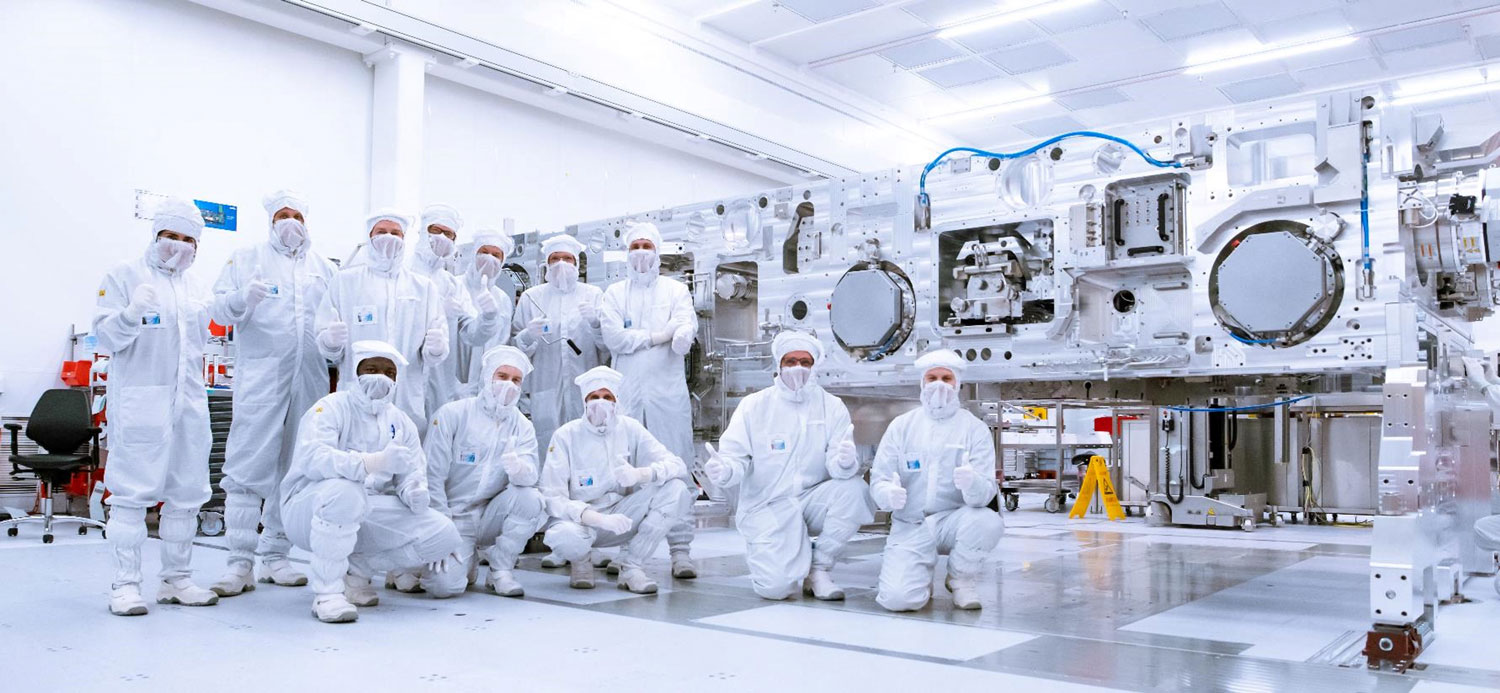
    ASML employees pose in front of the partially completed frame of the company’s newest product. The “High NA EUV” tool, still under development, will cost around $400-million and will be used to help create the circuitry of a new generation of computer chips

    ASML, a semiconductor industry and stock market giant, has to think smaller. Or maybe bigger.

    It is building machines the size of double-decker buses, weighing over 200t, in its quest to produce beams of focused light that create the microscopic circuitry on computer chips used in everything from phones and laptops to cars and AI.

    The company has enjoyed a rosy decade, its shares leaping 1 000% to take its value past €200-billion as it swept up most of the world’s business for these lithography systems.

    It’s now preparing to roll out a new, $400-million machine for next-generation chips which it hopes will be its flagship by the late 2020s but for now remains an engineering challenge.

    EUV stands for extreme ultraviolet, the wavelength of light used by ASML’s most advanced machines

    Executives at ASML’s headquarters in the Dutch town of Veldhoven said a prototype was on track to be completed in the first half of 2023. They said the company and long-time R&D partner IMEC were setting up a test lab on the spot — a first — so top chip makers and their suppliers can explore the machine’s properties and prepare to use production models as early as 2025.

    Yet, as investors expect further dominance and growth to justify ASML’s valuation at 35 times 2021 earnings, there is little margin for error should the company encounter technical or supply-chain snags.

    “Every check is green right now,” said Christophe Fouquet, head of EUV programmes at ASML. “But, you know, we still have to see it all [assembled] together.”

    EUV stands for extreme ultraviolet, the wavelength of light used by ASML’s most advanced machines.

    Eclipsed

    The fortunes of the project are also important for ASML’s customers, chip makers racing to expand production amid a global shortage. They include US player Intel, South Korea’s Samsung and Taiwan’s TSMC, the biggest, which makes chips for the likes of Apple, AMD and Nvidia.

    Industry specialist Dan Hutcheson of VLSI Research, who is not involved with the ASML project, said the new technology — known as a “High-NA” version of EUV — could provide a significant advantage to some chip makers. “It’s a bit like who’s got the best gun,” he said.

    “So, either ASML makes it happen or they don’t make it happen,” he added. “But if they make it happen, and you don’t have your orders and you miss out on this, you’ve immediately made yourself non-competitive.”

    He said TSMC eclipsed its rivals by integrating ASML’s EUV machines first in the late 2010s — a mistake Intel CEO Pat Gelsinger has vowed not to make again with High-NA.

    Lithography is a key determinant of how small circuitry on a chip can get, with High-NA promising a 66% reduction. Smaller is better in chip making, as the more transistors you pack in the same space, the faster and more energy efficient a chip can be.

    An illustration released by ASML shows an impression of how the pilot model of ASML’s newest product, a “High NA EUV” lithography tool, will look on the outside when it is finished. The machines, about the size of a double-decker bus, will cost $400-million each

    Circuitry is now approaching the atomic level, leading to predictions that the end is nigh for Moore’s Law, a famous 1960’s observation that the number of transistors on a microchip doubles about every two years.

    “If they (ASML) don’t succeed, it will become difficult to continue with Moore’s Law,” said Jos Versteeg, an analyst at Dutch-based bank InsingerGilissen, though he noted engineers had defied similar doubts in the past.

    Since 2000, ASML has rapidly taken market share from Japanese competitors Nikon and Canon, which now mainly focus on older technology. ASML controls more than 90% of the lithography market. No competitor is attempting to build an EUV system, citing high development costs.

    Shortages of ASML’s machines, which cost up to $160-million each, are a bottleneck for chip makers, who have plans to spend more than $100-billion in the coming years to build extra fabrication plants to meet demand.

    The High-NA machines will be about 30% bigger than their predecessors, which themselves require three Boeing 747s to carry them in sections.

    An optical system is prepared for testing in a vacuum chamber at Carl Zeiss SMT in Oberkochen, Germany, in this undated handout photo. Zeiss is developing optical systems that will go into the newest tool being developed by ASML to create a new generation of computer chips

    IMEC, a non-profit research group that cooperates with companies across the semiconductor industry, believes setting up the lab at ASML could save up to a year in development time.

    ASML said it had five orders for pilot machines, which should be delivered in 2024, and “more than five” orders from five different customers for faster production models for delivery starting in 2025.

    But this is no slam-dunk. There are formidable challenges in integrating a host of complex components, including an optics system of polished, hyper-smooth curved mirrors, which are being built in a vacuum by Germany’s Carl Zeiss.

    Versteeg at InsingerGilissen said that while ASML enjoyed a near monopoly, its “pricing is dependent on the productivity of the machines”. Meanwhile, it must sell EUV tools to the shrinking number of companies that make leading-edge chips, which include memory chip makers SK Hynix and Micron.

    ASML is also tied to the wider fortunes of the cyclical chip industry, which some researchers expect to double past $1-trillion in annual sales this decade.

    Fouquet worries most about supply-chain issues.

    “Right now, and like with every other product, we see some stress in the supply chain, and this is if you ask me today, probably the biggest challenge we have with High-NA.”  — (c) 2022 Reuters

    Add TechCentral as a preferred source on GoogleFollow TechCentral on Google NewsGet breaking news on WhatsApp


    AMD ASML Intel Nvidia Pat Gelsinger Samsung TSMC
    WhatsApp YouTube
    Share. Facebook Twitter LinkedIn WhatsApp Telegram Email Copy Link
    Previous ArticleMusk moves to soothe investor fears over Tesla
    Next Article Creating an effective employer value proposition for the new era of work

    Related Posts

    A software revolution is heading for South African driveways

    A software revolution is heading for South African driveways

    19 October 2026
    Apple's new HomeView smart home hub

    Apple takes another shot at the smart home

    13 October 2026
    The AI trade is cracking

    The AI trade is cracking

    13 October 2026
    Company News
    Winners, from left: Zandile Monaisa (Rand Refinery), Sibongakonke Kheswa (PSG Capital), Stefan Links (Forestry South Africa), Thabang Modiba (Mondelez International), Charmaine Ncube (Razor PR), Shaun Burger-Smal (Bestmed Medical Scheme), Nandipha Ngcobo (Transnet), Tracy Mulwela (Vodacom), Cheryl-Lynn Freeman (Mzansi Business Services), Yasheen Harrielall (Zutari), Valentine Mabaso (Taonga Business Group) and Thabang Thlaku (African Rainbow Minerals). Image: Rising Star Awards

    Celebrating South Africa’s rising stars: the leaders shaping what comes next

    19 October 2026
    Paratus Zambia delivers Starlink to thousands of children in Family Legacy schools

    Paratus Zambia delivers Starlink to thousands of children in Family Legacy schools

    15 October 2026
    Data sovereignty in South Africa is not an address - Ascent Technology, Johan Lamberts

    Data sovereignty in South Africa is not an address

    15 October 2026
    Opinion
    Nonkqubela Thathakahle Jordan-Dyani

    Why cybersecurity is now a national security issue for South Africa

    15 October 2026
    When a machine can choose, who does it become? Fanie van Rooyen

    When a machine can choose, who does it become?

    9 October 2026
    Let South Africans jailbreak their way to digital sovereignty - Dirk de Vos

    Let South Africans jailbreak their way to digital sovereignty

    5 October 2026

    Subscribe to Updates

    Get the best South African technology news and analysis delivered to your e-mail inbox every morning.

    Latest Posts
    Post Office wants R2.2-billion from government as it braces for another loss

    Post Office wants R2.2-billion from government as it braces for another loss

    19 October 2026
    AI music is here and the rulebook is blank - Justin Erasmus

    AI music is here and the South African rulebook is blank

    19 October 2026
    SA start-up wants to put a padlock on your phone calls

    SA start-up wants to put a padlock on your phone calls

    19 October 2026
    A software revolution is heading for South African driveways

    A software revolution is heading for South African driveways

    19 October 2026
    © 2009 - 2026 NewsCentral Media
    Built and maintained by Chronon
    • Cookie policy (ZA)
    • TechCentral – privacy and Popia

    Type above and press Enter to search. Press Esc to cancel.

    Manage consent

    TechCentral uses cookies to enhance its offerings. Consenting to these technologies allows us to serve you better. Not consenting or withdrawing consent may adversely affect certain features and functions of the website.

    Functional Always active
    The technical storage or access is strictly necessary for the legitimate purpose of enabling the use of a specific service explicitly requested by the subscriber or user, or for the sole purpose of carrying out the transmission of a communication over an electronic communications network.
    Preferences
    The technical storage or access is necessary for the legitimate purpose of storing preferences that are not requested by the subscriber or user.
    Statistics
    The technical storage or access that is used exclusively for statistical purposes. The technical storage or access that is used exclusively for anonymous statistical purposes. Without a subpoena, voluntary compliance on the part of your Internet Service Provider, or additional records from a third party, information stored or retrieved for this purpose alone cannot usually be used to identify you.
    Marketing
    The technical storage or access is required to create user profiles to send advertising, or to track the user on a website or across several websites for similar marketing purposes.
    • Manage options
    • Manage services
    • Manage {vendor_count} vendors
    • Read more about these purposes
    View preferences
    • {title}
    • {title}
    • {title}
    🇿🇦 Sign up to the TechCentral newsletter