
Close Menu
TechCentralTechCentral

    Subscribe to the newsletter

    Get the best South African technology news and analysis delivered to your e-mail inbox every morning.

    Facebook X (Twitter) YouTube LinkedIn
    WhatsApp Facebook X (Twitter) LinkedIn YouTube
    TechCentralTechCentral
    • News
      Big Microsoft 365 price increases coming next year

      Big Microsoft price increases coming next year

      5 December 2025
      Vodacom to take control of Safaricom in R36-billion deal - Shameel Joosub

      Vodacom to take control of Safaricom in R36-billion deal

      4 December 2025
      Black Friday goes digital in South Africa as online spending surges to record high

      Black Friday goes digital in South Africa as online spending surges to record high

      4 December 2025
      BYD takes direct aim at Toyota with launch of sub-R500 000 Sealion 5 PHEV

      BYD takes direct aim at Toyota with launch of sub-R500 000 Sealion 5 PHEV

      4 December 2025
      'Get it now': Takealot in new instant deliveries pilot

      ‘Get it now’: Takealot in new instant deliveries pilot

      4 December 2025
    • World
      Amazon and Google launch multi-cloud service for faster connectivity

      Amazon and Google launch multi-cloud service for faster connectivity

      1 December 2025
      Google makes final court plea to stop US breakup

      Google makes final court plea to stop US breakup

      21 November 2025
      Bezos unveils monster rocket: New Glenn 9x4 set to dwarf Saturn V

      Bezos unveils monster rocket: New Glenn 9×4 set to dwarf Saturn V

      21 November 2025
      Tech shares turbocharged by Nvidia's stellar earnings

      Tech shares turbocharged by stellar Nvidia earnings

      20 November 2025
      Config file blamed for Cloudflare meltdown that disrupted the web

      Config file blamed for Cloudflare meltdown that disrupted the web

      19 November 2025
    • In-depth
      Jensen Huang Nvidia

      So, will China really win the AI race?

      14 November 2025
      Valve's Linux console takes aim at Microsoft's gaming empire

      Valve’s Linux console takes aim at Microsoft’s gaming empire

      13 November 2025
      iOCO's extraordinary comeback plan - Rhys Summerton

      iOCO’s extraordinary comeback plan

      28 October 2025
      Why smart glasses keep failing - no, it's not the tech - Mark Zuckerberg

      Why smart glasses keep failing – it’s not the tech

      19 October 2025
      BYD to blanket South Africa with megawatt-scale EV charging network - Stella Li

      BYD to blanket South Africa with megawatt-scale EV charging network

      16 October 2025
    • TCS
      TCS+ | How Cloud on Demand helps partners thrive in the AWS ecosystem - Odwa Ndyaluvane and Xenia Rhode

      TCS+ | How Cloud On Demand helps partners thrive in the AWS ecosystem

      4 December 2025
      TCS | MTN Group CEO Ralph Mupita on competition, AI and the future of mobile

      TCS | Ralph Mupita on competition, AI and the future of mobile

      28 November 2025
      TCS | Dominic Cull on fixing South Africa's ICT policy bottlenecks

      TCS | Dominic Cull on fixing South Africa’s ICT policy bottlenecks

      21 November 2025
      TCS | BMW CEO Peter van Binsbergen on the future of South Africa's automotive industry

      TCS | BMW CEO Peter van Binsbergen on the future of South Africa’s automotive industry

      6 November 2025
      TCS | Why Altron is building an AI factory - Bongani Andy Mabaso

      TCS | Why Altron is building an AI factory in Johannesburg

      28 October 2025
    • Opinion
      Your data, your hardware: the DIY AI revolution is coming - Duncan McLeod

      Your data, your hardware: the DIY AI revolution is coming

      20 November 2025
      Zero Carbon Charge founder Joubert Roux

      The energy revolution South Africa can’t afford to miss

      20 November 2025
      It's time for a new approach to government IT spend in South Africa - Richard Firth

      It’s time for a new approach to government IT spend in South Africa

      19 November 2025
      How South Africa's broken Rica system fuels murder and mayhem - Farhad Khan

      How South Africa’s broken Rica system fuels murder and mayhem

      10 November 2025
      South Africa's AI data centre boom risks overloading a fragile grid - Paul Colmer

      South Africa’s AI data centre boom risks overloading a fragile grid

      30 October 2025
    • Company Hubs
      • Africa Data Centres
      • AfriGIS
      • Altron Digital Business
      • Altron Document Solutions
      • Altron Group
      • Arctic Wolf
      • AvertITD
      • Braintree
      • CallMiner
      • CambriLearn
      • CYBER1 Solutions
      • Digicloud Africa
      • Digimune
      • Domains.co.za
      • ESET
      • Euphoria Telecom
      • Incredible Business
      • iONLINE
      • IQbusiness
      • Iris Network Systems
      • LSD Open
      • NEC XON
      • Netstar
      • Network Platforms
      • Next DLP
      • Ovations
      • Paracon
      • Paratus
      • Q-KON
      • SevenC
      • SkyWire
      • Solid8 Technologies
      • Telit Cinterion
      • Tenable
      • Vertiv
      • Videri Digital
      • Vodacom Business
      • Wipro
      • Workday
      • XLink
    • Sections
      • AI and machine learning
      • Banking
      • Broadcasting and Media
      • Cloud services
      • Contact centres and CX
      • Cryptocurrencies
      • Education and skills
      • Electronics and hardware
      • Energy and sustainability
      • Enterprise software
      • Financial services
      • Information security
      • Internet and connectivity
      • Internet of Things
      • Investment
      • IT services
      • Lifestyle
      • Motoring
      • Public sector
      • Retail and e-commerce
      • Satellite communications
      • Science
      • SMEs and start-ups
      • Social media
      • Talent and leadership
      • Telecoms
    • Events
    • Advertise
    TechCentralTechCentral
    Home » Opinion » Alison Gillwald » Data deficit means we’re in the dark about the digital divide

    Data deficit means we’re in the dark about the digital divide

    By Alison Gillwald1 November 2018
    Twitter LinkedIn Facebook WhatsApp Email Telegram Copy Link
    News Alerts
    WhatsApp
    Alison Gillwald

    Digital concerns underpin many of the United Nations’ Sustainable Development Goals. Gender equality, good health, quality education, industry innovation, smart and sustainable cities: these all require strong information and communications technology systems to become a reality.

    For all of this to happen, developing countries will have to overcome the “digital divide”. This refers to the gap between those who are connected — first to voice and now to Internet services — and those who aren’t.

    But there’s a problem. We simply don’t have the data in developing countries, and in global statistics, to know what the status quo is or whether the digital divide is being closed. So we don’t know if information and communications technologies are contributing to the achievement of the SDG targets.

    These perspectives underscore the fact that addressing digital inequality isn’t a technology problem. It’s a classical development challenge.

    There is some supply-side data provided by operators and collected by regulators. This is fed into the UN statistical system. It’s then used as the basis of multiple digital indices that now exist. But this has many limitations for policy or planning in developing and emerging economies.

    For example, it can’t be used to measure several basic indicators — like gender, age and income levels — in the predominantly prepaid mobile markets of the Global South.

    The After Access Survey, which was run across 16 countries in the Global South in 2017, fills some of these data gaps. The survey tells us who has access to and uses mobile phones for what purposes. It also reveals data about Internet users and non-users, and the reasons people aren’t online — usually, because Internet enabled devices are too expensive.

    Digital indicators

    All this allows us to compare digital indicators from a range of countries and to see patterns among countries. It shows us that in large populations like Nigeria, India and Bangladesh, irrespective of their distribution of wealth its a struggle to get people connected.

    It enables better comparisons on outcomes between countries with similar size economies. We can also compare ICT policy outcomes in the countries that were surveyed.

    The findings offer a useful guide for policymakers. This is because the survey is nationally representative. It unmasks the inequalities in the national aggregations. This allows policymakers to see beyond the descriptive statistics to identifying the determinants — like education and income — of Internet access and use.

    These perspectives underscore the fact that addressing digital inequality isn’t a technology problem. It’s a classical development challenge.

    Key findings

    As the world moves from simple voice services and devices to more complex Internet-based services, the issues of digital inequality become more complex than just connectivity. More comprehensive indicators and data modelling is required to understand issues of inclusion and exclusion, and what factors are driving them.

    The After Access survey provides the only representative insights into who is on the Web, what they do, who is not and what prevents them from getting online. These were some of the key findings:

    • In the seven African countries surveyed, individuals have an average of two Sim cards (which are captured in the supply side data as two subscribers). There are two likely reasons for this. The first is that it allows people to get a signal when there is not one for their primary provider. Secondly, they have another Sim to make cheaper calls to speak to people on other networks, or if it’s a data card, to get a promotional package, such as a “free” social networking time with a new card.
    • Mobile phone penetration and Internet penetration across the globe is broadly aligned with gross national income per capita. Broadly speaking, countries with richer people on average are more connected than poorer countries.

    But our findings also suggest interesting variations.
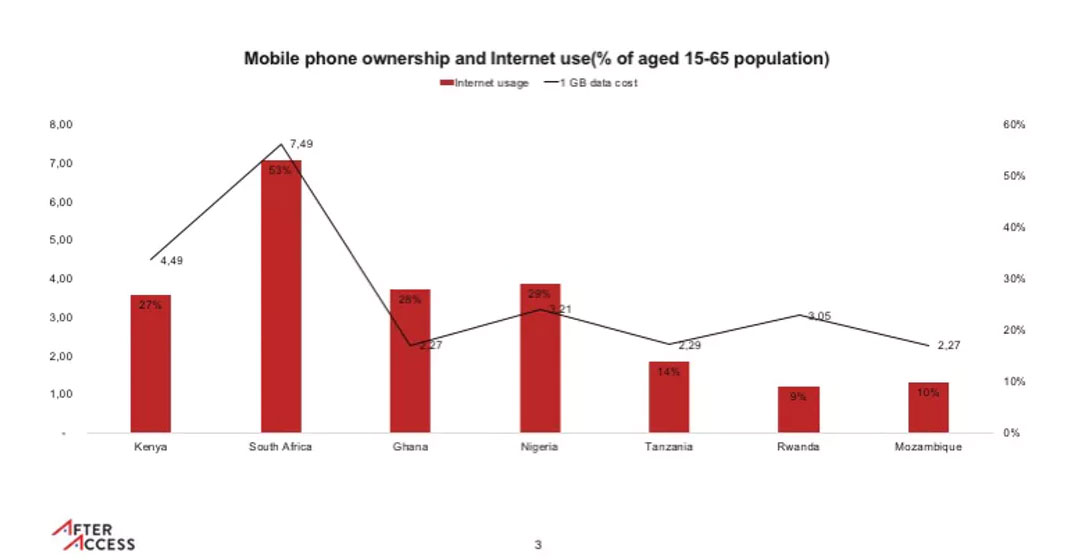
    Overall, the five Latin American countries surveyed, together with South Africa, have the highest mobile phone penetration rates. But South Africa has a lower Internet penetration rate than any of the Latin America countries. This includes those with lower gross national incomes.
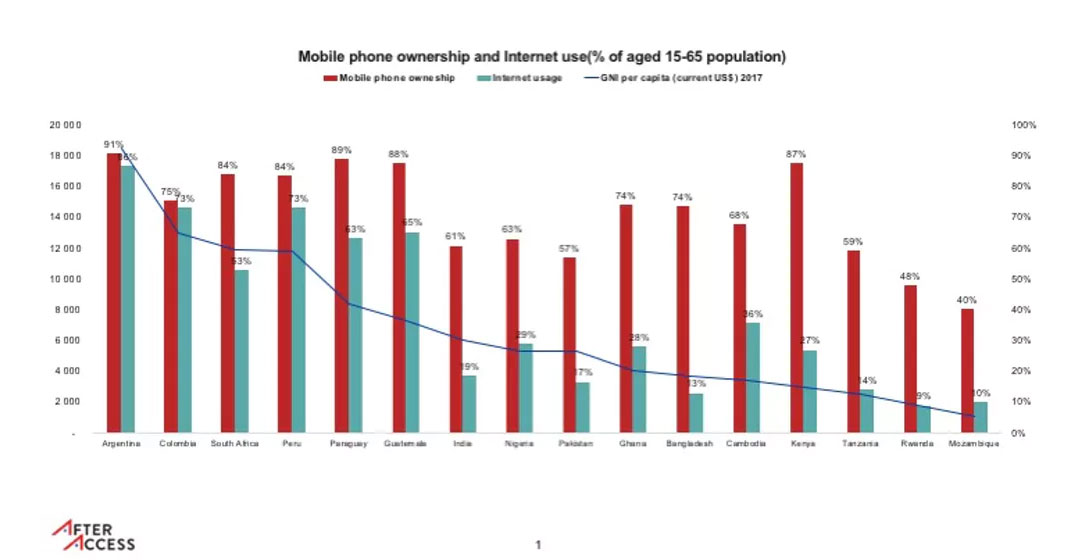
    Myanmar and Cambodia have much higher Internet penetration rates than African and Asian countries with similar gross national income rates. They also have higher rates than their larger gross national income counterparts, India and Nigeria.

    Genuine redress

    These indicators, and other data collected in the After Access survey, can be used to provide evidence that can help policymakers and planners and assess the impact of policy outcomes.

    They can confirm — or challenge — general assumptions about relations such as gender; or about the relationship between economic growth and Internet penetration. They can also clarify thinking about what the biggest challenges are to getting people online.

    Policymakers need to extend their lenses to the development of relevant local content and applications in local languages

    The affordability and human development challenge is far more difficult to solve than the infrastructure deficit with which development banks and governments’ are preoccupied. In many countries, networks cover between 60% and 80% of the population. Yet there is less than the 20% Internet-connected critical mass required to see the network effects associated with economic growth and development.

    And even where enabling environments that are conducive to investment have been created for the extension of networks, our survey data illustrates how the socially and economically marginalised are unable to harness the Internet to enhance their social and economic well-being.

    The data available shows that besides affordability, human development — particularly education and the resulting income — are the primary determinants of access, intensity of use and the use of the Internet for production; not only consumption.

    Policymakers need to extend their lenses to the development of relevant local content and applications in local languages. These are all important stimulants to getting people online if countries hope the harness the benefits of the Internet for all their citizens.The Conversation

    • Alison Gillwald is adjunct orofessor, Nelson Mandela School of Public Governance, University of Cape Town
    • This article is republished from The Conversation under a Creative Commons licence


    Alison Gillwald top
    Subscribe to TechCentral Subscribe to TechCentral
    Share. Facebook Twitter LinkedIn WhatsApp Telegram Email Copy Link
    Previous ArticleSA mining veteran wants to build $1-billion battery metals giant
    Next Article Bitcoin at 10: how it all started and what the future holds

    Related Posts

    A shift in South Africa's communications landscape - Richard Firth

    Telkom urges Icasa to scrap call termination fees completely

    12 December 2024

    18GW in unplanned breakdowns cripple Eskom

    2 November 2021

    Nersa kicks the Karpowership can down the road

    13 September 2021
    Company News
    AI is not a technology problem - iqbusiness

    AI is not a technology problem – iqbusiness

    5 December 2025
    Telcos are sitting on a data gold mine - but few know what do with it - Phillip du Plessis

    Telcos are sitting on a data gold mine – but few know what do with it

    4 December 2025
    Unlock smarter computing with your surface Copilot+ PC

    Unlock smarter computing with your Surface Copilot+ PC

    4 December 2025
    Opinion
    Your data, your hardware: the DIY AI revolution is coming - Duncan McLeod

    Your data, your hardware: the DIY AI revolution is coming

    20 November 2025
    Zero Carbon Charge founder Joubert Roux

    The energy revolution South Africa can’t afford to miss

    20 November 2025
    It's time for a new approach to government IT spend in South Africa - Richard Firth

    It’s time for a new approach to government IT spend in South Africa

    19 November 2025

    Subscribe to Updates

    Get the best South African technology news and analysis delivered to your e-mail inbox every morning.

    Latest Posts
    Big Microsoft 365 price increases coming next year

    Big Microsoft price increases coming next year

    5 December 2025
    AI is not a technology problem - iqbusiness

    AI is not a technology problem – iqbusiness

    5 December 2025
    Vodacom to take control of Safaricom in R36-billion deal - Shameel Joosub

    Vodacom to take control of Safaricom in R36-billion deal

    4 December 2025
    Black Friday goes digital in South Africa as online spending surges to record high

    Black Friday goes digital in South Africa as online spending surges to record high

    4 December 2025
    © 2009 - 2025 NewsCentral Media
    • Cookie policy (ZA)
    • TechCentral – privacy and Popia

    Type above and press Enter to search. Press Esc to cancel.

    Manage consent

    TechCentral uses cookies to enhance its offerings. Consenting to these technologies allows us to serve you better. Not consenting or withdrawing consent may adversely affect certain features and functions of the website.

    Functional Always active
    The technical storage or access is strictly necessary for the legitimate purpose of enabling the use of a specific service explicitly requested by the subscriber or user, or for the sole purpose of carrying out the transmission of a communication over an electronic communications network.
    Preferences
    The technical storage or access is necessary for the legitimate purpose of storing preferences that are not requested by the subscriber or user.
    Statistics
    The technical storage or access that is used exclusively for statistical purposes. The technical storage or access that is used exclusively for anonymous statistical purposes. Without a subpoena, voluntary compliance on the part of your Internet Service Provider, or additional records from a third party, information stored or retrieved for this purpose alone cannot usually be used to identify you.
    Marketing
    The technical storage or access is required to create user profiles to send advertising, or to track the user on a website or across several websites for similar marketing purposes.
    • Manage options
    • Manage services
    • Manage {vendor_count} vendors
    • Read more about these purposes
    View preferences
    • {title}
    • {title}
    • {title}