
Close Menu
TechCentralTechCentral

    Subscribe to the newsletter

    Get the best South African technology news and analysis delivered to your e-mail inbox every morning.

    Facebook X (Twitter) YouTube LinkedIn
    WhatsApp Facebook X (Twitter) LinkedIn YouTube
    TechCentralTechCentral
    • News
      Big Microsoft 365 price increases coming next year

      Big Microsoft price increases coming next year

      5 December 2025
      Vodacom to take control of Safaricom in R36-billion deal - Shameel Joosub

      Vodacom to take control of Safaricom in R36-billion deal

      4 December 2025
      Black Friday goes digital in South Africa as online spending surges to record high

      Black Friday goes digital in South Africa as online spending surges to record high

      4 December 2025
      BYD takes direct aim at Toyota with launch of sub-R500 000 Sealion 5 PHEV

      BYD takes direct aim at Toyota with launch of sub-R500 000 Sealion 5 PHEV

      4 December 2025
      'Get it now': Takealot in new instant deliveries pilot

      ‘Get it now’: Takealot in new instant deliveries pilot

      4 December 2025
    • World
      Amazon and Google launch multi-cloud service for faster connectivity

      Amazon and Google launch multi-cloud service for faster connectivity

      1 December 2025
      Google makes final court plea to stop US breakup

      Google makes final court plea to stop US breakup

      21 November 2025
      Bezos unveils monster rocket: New Glenn 9x4 set to dwarf Saturn V

      Bezos unveils monster rocket: New Glenn 9×4 set to dwarf Saturn V

      21 November 2025
      Tech shares turbocharged by Nvidia's stellar earnings

      Tech shares turbocharged by stellar Nvidia earnings

      20 November 2025
      Config file blamed for Cloudflare meltdown that disrupted the web

      Config file blamed for Cloudflare meltdown that disrupted the web

      19 November 2025
    • In-depth
      Jensen Huang Nvidia

      So, will China really win the AI race?

      14 November 2025
      Valve's Linux console takes aim at Microsoft's gaming empire

      Valve’s Linux console takes aim at Microsoft’s gaming empire

      13 November 2025
      iOCO's extraordinary comeback plan - Rhys Summerton

      iOCO’s extraordinary comeback plan

      28 October 2025
      Why smart glasses keep failing - no, it's not the tech - Mark Zuckerberg

      Why smart glasses keep failing – it’s not the tech

      19 October 2025
      BYD to blanket South Africa with megawatt-scale EV charging network - Stella Li

      BYD to blanket South Africa with megawatt-scale EV charging network

      16 October 2025
    • TCS
      TCS+ | How Cloud on Demand helps partners thrive in the AWS ecosystem - Odwa Ndyaluvane and Xenia Rhode

      TCS+ | How Cloud On Demand helps partners thrive in the AWS ecosystem

      4 December 2025
      TCS | MTN Group CEO Ralph Mupita on competition, AI and the future of mobile

      TCS | Ralph Mupita on competition, AI and the future of mobile

      28 November 2025
      TCS | Dominic Cull on fixing South Africa's ICT policy bottlenecks

      TCS | Dominic Cull on fixing South Africa’s ICT policy bottlenecks

      21 November 2025
      TCS | BMW CEO Peter van Binsbergen on the future of South Africa's automotive industry

      TCS | BMW CEO Peter van Binsbergen on the future of South Africa’s automotive industry

      6 November 2025
      TCS | Why Altron is building an AI factory - Bongani Andy Mabaso

      TCS | Why Altron is building an AI factory in Johannesburg

      28 October 2025
    • Opinion
      Your data, your hardware: the DIY AI revolution is coming - Duncan McLeod

      Your data, your hardware: the DIY AI revolution is coming

      20 November 2025
      Zero Carbon Charge founder Joubert Roux

      The energy revolution South Africa can’t afford to miss

      20 November 2025
      It's time for a new approach to government IT spend in South Africa - Richard Firth

      It’s time for a new approach to government IT spend in South Africa

      19 November 2025
      How South Africa's broken Rica system fuels murder and mayhem - Farhad Khan

      How South Africa’s broken Rica system fuels murder and mayhem

      10 November 2025
      South Africa's AI data centre boom risks overloading a fragile grid - Paul Colmer

      South Africa’s AI data centre boom risks overloading a fragile grid

      30 October 2025
    • Company Hubs
      • Africa Data Centres
      • AfriGIS
      • Altron Digital Business
      • Altron Document Solutions
      • Altron Group
      • Arctic Wolf
      • AvertITD
      • Braintree
      • CallMiner
      • CambriLearn
      • CYBER1 Solutions
      • Digicloud Africa
      • Digimune
      • Domains.co.za
      • ESET
      • Euphoria Telecom
      • Incredible Business
      • iONLINE
      • IQbusiness
      • Iris Network Systems
      • LSD Open
      • NEC XON
      • Netstar
      • Network Platforms
      • Next DLP
      • Ovations
      • Paracon
      • Paratus
      • Q-KON
      • SevenC
      • SkyWire
      • Solid8 Technologies
      • Telit Cinterion
      • Tenable
      • Vertiv
      • Videri Digital
      • Vodacom Business
      • Wipro
      • Workday
      • XLink
    • Sections
      • AI and machine learning
      • Banking
      • Broadcasting and Media
      • Cloud services
      • Contact centres and CX
      • Cryptocurrencies
      • Education and skills
      • Electronics and hardware
      • Energy and sustainability
      • Enterprise software
      • Financial services
      • Information security
      • Internet and connectivity
      • Internet of Things
      • Investment
      • IT services
      • Lifestyle
      • Motoring
      • Public sector
      • Retail and e-commerce
      • Satellite communications
      • Science
      • SMEs and start-ups
      • Social media
      • Talent and leadership
      • Telecoms
    • Events
    • Advertise
    TechCentralTechCentral
    Home » In-depth » The data war behind net neutrality

    The data war behind net neutrality

    By The Conversation24 January 2018
    Twitter LinkedIn Facebook WhatsApp Email Telegram Copy Link
    News Alerts
    WhatsApp

    In the social and political saga surrounding the question of network neutrality, what is often overlooked is the data war going on behind the scenes. The real fuel behind the debate is the enormous volume of data we generate with each search and click.

    As a marketable commodity, large-scale audience data has completely transformed the global economic landscape in less than a decade. The emergence of Google, Amazon, Facebook and Apple germinated a disruptive new business model that capitalises on what many consider to be the new oil: data.

    Based on a study published by eMarketer in September 2017, we can see how user-data companies (UDCs) now hold the top five positions among the largest brands in the world.

    In 2006, five of the top 10 brands were retailers. By 2017, nine of the top 10 brands in the world were UDCs.

    The nature of the data business model can be understood by the relationship between its three core pillars: the Internet user, who generates the data; the content publisher, who offers the Internet user a service (often free) in exchange for personal data; and the advertiser, who buys data from content publishers in order to run more effective marketing campaigns.

    The schema below attempts to illustrate the nature of this Internet user data paradigm:
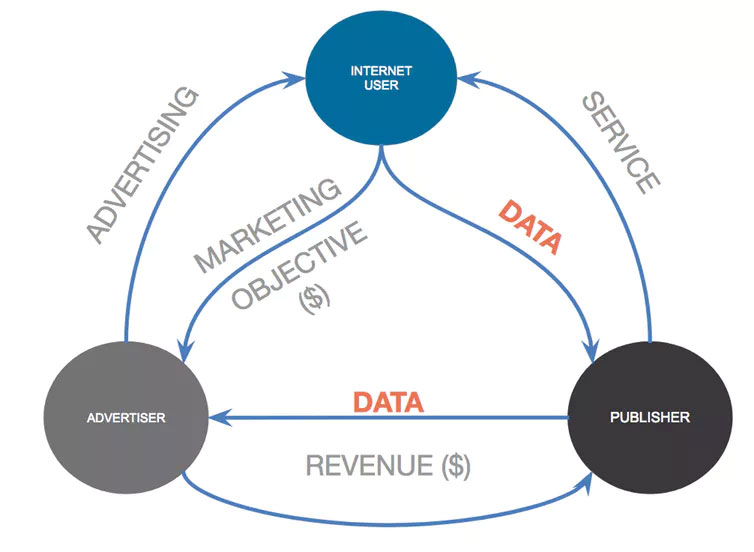
    Credit: Adviso Conseil

    Clearly, the winners in the 2017 repeal are the large US telecommunications companies, who happen to be the glue, as Internet providers, between the Internet user and the publisher (Google, Facebook). They stand to gain an enormous strategic advantage with the end of net neutrality.

    By having more control over an individual’s Internet usage, those companies are in a position to adjust prices in ways that could significantly benefit their bottom line. For example, AT&T could decide that from now on, given the large bandwidth used by Netflix, the latter would have to pay a usage fee to maintain its regular website streaming speed.

    Conversely, the Internet service provider could just as well charge Internet users an extra fee to maintain their Netflix streaming at a regular or faster speed. In an extreme case of greed, the ISP could overcharge both Netflix and its user.

    But there is more to it than that.

    In 2015, Fortune purported what it deemed to be the “real reason Verizon bought AOL”. In that article, journalist Kevin Fitchard observed:

    Verizon isn’t trying to create an Internet powerhouse with this investment. It’s likely just trying to gain some type of foothold in the changing online industry, as its traditional communications business slows down.

    Fitchard is alluding to the dominance of the data business model that gave rise to Google, Amazon, Facebook and Apple. As such, we can see why telecoms companies like Verizon that control the Internet channels through which the data is transmitted would also want to control — and take advantage of — the data itself. As Fitchard further observes in the same article:

    While AOL may be most known for its dial-up services and growing content empire — which includes The Huffington Post, Engadget and TechCrunch — it also has put together a sophisticated suite of advertising technologies for online and traditional media that no other company (aside from Google and Facebook) can match.

    The advertising technology in question, commonly referred to as programmatic advertising, uses advanced machine learning and artificial intelligence (AI) on the data generated by online user behaviour, and tracked by browser cookies or device IDs stored in mobile applications. Much of the advertising performance offered by Google, Facebook, AOL and others is largely attributed to their investments in this kind of technology, which Verizon can now leverage.

    As described in an e-mail by John Cosley, director of marketing for Microsoft search advertising, digital ads are “perhaps by far the most lucrative application of AI and machine learning in the industry”.

    Digital ads are ‘perhaps by far the most lucrative application of AI and machine learning in the industry’

    To maximise the power of these advertising algorithms, companies need to secure big data. Since Internet users are the prime generators of this precious raw material, publishers need to continually increase the number of visitors coming to their websites or mobile applications.

    In a move to secure that expansion, shortly after its acquisition of AOL, Verizon bought Yahoo, Google’s competitor in the search engine market. Yahoo also has access to the entire Microsoft advertising network and its user data.

    To assess the impact of this streak of acquisitions on total user reach of Verizon vs Google and Facebook, we used comScore data from May 2017, made available courtesy of Adviso Conseil. The comScore platform is essentially an audience analytics software used to track the data coming from most of the large desktop and mobile publishers in the world.

    The data pulled for this graphic shows the distribution of unique visitors across all the top platforms in the US. The chart clearly shows Yahoo and Microsoft competing closely with Google and Facebook in terms of user reach.
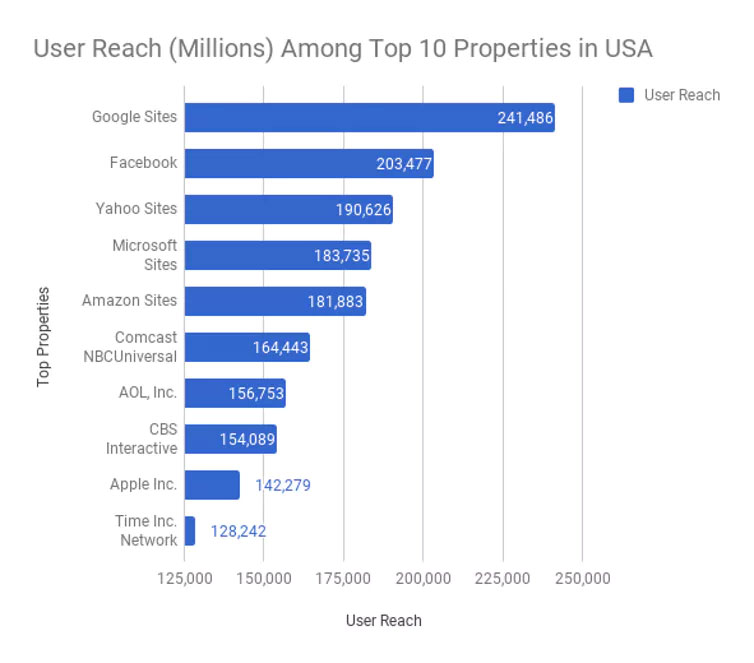
    comScore data for the US, June 2017

    The competitive advantage of this merger — now a super-entity called Oath by Zerizon — stands out immediately when one looks at the combined reach of AOL, Huffpost and Yahoo.

    The best way to illustrate the direct relationship between data and net neutrality is to simply ask the following question: if a telecoms company like Verizon were in a position to compete with Google and Facebook for data dollars, what happens if it also controls the data pipeline used by its competitors?

    The answer is obvious. If US telecoms firms can capriciously control Internet access, while also controlling platforms that compete with Google, Amazon, Facebook and Apple, what stops them from impeding the pipeline of their competitors? Absolutely nothing.

    Back in 2014, German Chancellor Angela Merkel spoke out against net neutrality. We expect the recent decision in the US to further affect the polarity of opinions on net neutrality in that region and in the rest of the world.

    We should also note that Google, in an obvious pre-emptive response to the end of net neutrality, launched its own ISP infrastructure in 2010 called Google Fiber.

    In the end, with the reigning status of the global top 10 brands on the line, the data war is undoubtedly what drives the debate over net neutrality.The Conversation

    • Written by Roger Kamena, principal consultant, Digital Media and Data Science, L’Université TÉLUQ; Daniel Lemire, professor, L’Université TÉLUQ; and Nicolas Scott, Université de Montréal
    • This article was originally published on The Conversation


    Amazon Apple AT&T Facebook Google top Verizon
    Subscribe to TechCentral Subscribe to TechCentral
    Share. Facebook Twitter LinkedIn WhatsApp Telegram Email Copy Link
    Previous ArticleA great world city may soon run out of water
    Next Article Rand breaches R12/$ for first time since 2015

    Related Posts

    Black Friday goes digital in South Africa as online spending surges to record high

    Black Friday goes digital in South Africa as online spending surges to record high

    4 December 2025
    What South Africans searched for most in 2025

    What South Africans searched for most in 2025, according to Google

    4 December 2025
    Samsung goes trifold while Apple folds its arms

    Samsung goes trifold while Apple folds its arms

    2 December 2025
    Company News
    AI is not a technology problem - iqbusiness

    AI is not a technology problem – iqbusiness

    5 December 2025
    Telcos are sitting on a data gold mine - but few know what do with it - Phillip du Plessis

    Telcos are sitting on a data gold mine – but few know what do with it

    4 December 2025
    Unlock smarter computing with your surface Copilot+ PC

    Unlock smarter computing with your Surface Copilot+ PC

    4 December 2025
    Opinion
    Your data, your hardware: the DIY AI revolution is coming - Duncan McLeod

    Your data, your hardware: the DIY AI revolution is coming

    20 November 2025
    Zero Carbon Charge founder Joubert Roux

    The energy revolution South Africa can’t afford to miss

    20 November 2025
    It's time for a new approach to government IT spend in South Africa - Richard Firth

    It’s time for a new approach to government IT spend in South Africa

    19 November 2025

    Subscribe to Updates

    Get the best South African technology news and analysis delivered to your e-mail inbox every morning.

    Latest Posts
    Big Microsoft 365 price increases coming next year

    Big Microsoft price increases coming next year

    5 December 2025
    AI is not a technology problem - iqbusiness

    AI is not a technology problem – iqbusiness

    5 December 2025
    Vodacom to take control of Safaricom in R36-billion deal - Shameel Joosub

    Vodacom to take control of Safaricom in R36-billion deal

    4 December 2025
    Black Friday goes digital in South Africa as online spending surges to record high

    Black Friday goes digital in South Africa as online spending surges to record high

    4 December 2025
    © 2009 - 2025 NewsCentral Media
    • Cookie policy (ZA)
    • TechCentral – privacy and Popia

    Type above and press Enter to search. Press Esc to cancel.

    Manage consent

    TechCentral uses cookies to enhance its offerings. Consenting to these technologies allows us to serve you better. Not consenting or withdrawing consent may adversely affect certain features and functions of the website.

    Functional Always active
    The technical storage or access is strictly necessary for the legitimate purpose of enabling the use of a specific service explicitly requested by the subscriber or user, or for the sole purpose of carrying out the transmission of a communication over an electronic communications network.
    Preferences
    The technical storage or access is necessary for the legitimate purpose of storing preferences that are not requested by the subscriber or user.
    Statistics
    The technical storage or access that is used exclusively for statistical purposes. The technical storage or access that is used exclusively for anonymous statistical purposes. Without a subpoena, voluntary compliance on the part of your Internet Service Provider, or additional records from a third party, information stored or retrieved for this purpose alone cannot usually be used to identify you.
    Marketing
    The technical storage or access is required to create user profiles to send advertising, or to track the user on a website or across several websites for similar marketing purposes.
    • Manage options
    • Manage services
    • Manage {vendor_count} vendors
    • Read more about these purposes
    View preferences
    • {title}
    • {title}
    • {title}