Close Menu
TechCentralTechCentral

    Subscribe to the newsletter

    Get the best South African technology news and analysis delivered to your e-mail inbox every morning.

    Facebook X (Twitter) YouTube LinkedIn
    WhatsApp Facebook X (Twitter) LinkedIn YouTube
    TechCentralTechCentral
    • News
      iOCO eyes return to 'serial acquirer' status - Rhys Summerton

      iOCO eyes return to ‘serial acquirer’ status

      18 March 2026
      iOCO scraps 'work from home' - and says it's boosting productivity

      iOCO scraps ‘work from home’ – and says it’s boosting productivity

      18 March 2026
      Commission to probe Showmax closure

      Commission to probe Showmax closure

      18 March 2026
      Zimi, Charge Holdings partner to electrify freight on N3 corridor - Andries Malherbe and Michael Maas

      Zimi, Charge Holdings partner to electrify freight on N3 corridor

      18 March 2026
      iOCO shifts to offence with first acquisition since turnaround - Rhys Summerton

      iOCO shifts to offence with first acquisition in eight years

      18 March 2026
    • World
      Peter Thiel's secretive Rome conference draws Church attention

      Peter Thiel’s secretive Rome conference draws Church attention

      16 March 2026
      Musk launches Macrohard in cheeky nod to Microsoft - Elon Musk

      Musk launches Macrohard in cheeky nod to Microsoft

      12 March 2026
      Europe is building an alternative to Microsoft Office

      Europe is building an alternative to Microsoft Office

      11 March 2026
      Microsoft bets on Anthropic as it loosens ties with OpenAI

      Microsoft bets on Anthropic as it loosens ties with OpenAI

      10 March 2026
      World hit by worst oil shock since the 1970s

      World hit by worst oil shock since the 1970s

      9 March 2026
    • In-depth
      The last generation of coders

      The last generation of coders

      18 February 2026
      Sentech is in dire straits

      Sentech is in dire straits

      10 February 2026
      How liberalisation is rewiring South Africa's power sector

      How liberalisation is rewiring South Africa’s power sector

      21 January 2026
      The top-performing South African tech shares of 2025

      The top-performing South African tech shares of 2025

      12 January 2026
      Digital authoritarianism grows as African states normalise internet blackouts

      Digital authoritarianism grows as African states normalise internet blackouts

      19 December 2025
    • TCS
      TCS+ | Vox Kiwi: a wireless solution promising a fibre-like experience - Theo van Zyl

      TCS+ | Vox Kiwi: a wireless solution promising a fibre-like experience

      13 March 2026
      TCS+ | Flipping the narrative on AI in the Global South - Josefin Rosén

      TCS+ | Flipping the narrative on AI in the Global South

      13 March 2026
      TCS | Sink or swim? Antony Makins on how AI is rewriting the rules of work

      TCS | Sink or swim? Antony Makins on how AI is rewriting the rules of work

      5 March 2026
      TCS+ | Bolt ups the ante on platform safety - Simo Kalajdzic

      TCS+ | Bolt ups the ante on platform safety

      4 March 2026
      Watts & Wheels S1E4: 'We drive an electric Uber'

      Watts & Wheels S1E4: ‘We drive an electric Uber’

      10 February 2026
    • Opinion
      South Africa's energy future hinges on getting wheeling right - Aishah Gire

      South Africa’s energy future hinges on getting wheeling right

      10 March 2026
      Hold the doom: the case for a South African comeback - Duncan McLeod

      Apple just dropped a bomb on the Windows world

      5 March 2026
      VC's centre of gravity is shifting - and South Africa is in the frame - Alison Collier

      VC’s centre of gravity is shifting – and South Africa is in the frame

      3 March 2026
      Hold the doom: the case for a South African comeback - Duncan McLeod

      Hold the doom: the case for a South African comeback

      26 February 2026
      The AI fraud crisis your bank is not ready for - Andries Maritz

      The AI fraud crisis your bank is not ready for

      18 February 2026
    • Company Hubs
      • 1Stream
      • Africa Data Centres
      • AfriGIS
      • Altron Digital Business
      • Altron Document Solutions
      • Altron Group
      • Arctic Wolf
      • AvertITD
      • Braintree
      • CallMiner
      • CambriLearn
      • CYBER1 Solutions
      • Digicloud Africa
      • Digimune
      • Domains.co.za
      • ESET
      • Euphoria Telecom
      • HOSTAFRICA
      • Incredible Business
      • iONLINE
      • IQbusiness
      • Iris Network Systems
      • LSD Open
      • Mitel
      • NEC XON
      • Netstar
      • Network Platforms
      • Next DLP
      • Ovations
      • Paracon
      • Paratus
      • Q-KON
      • SevenC
      • SkyWire
      • Solid8 Technologies
      • Telit Cinterion
      • Tenable
      • Vertiv
      • Videri Digital
      • Vodacom Business
      • Wipro
      • Workday
      • XLink
    • Sections
      • AI and machine learning
      • Banking
      • Broadcasting and Media
      • Cloud services
      • Contact centres and CX
      • Cryptocurrencies
      • Education and skills
      • Electronics and hardware
      • Energy and sustainability
      • Enterprise software
      • Financial services
      • HealthTech
      • Information security
      • Internet and connectivity
      • Internet of Things
      • Investment
      • IT services
      • Lifestyle
      • Motoring
      • Policy and regulation
      • Public sector
      • Retail and e-commerce
      • Satellite communications
      • Science
      • SMEs and start-ups
      • Social media
      • Talent and leadership
      • Telecoms
    • Events
    • Advertise
    TechCentralTechCentral
    Home » Sections » Energy and sustainability » How renewables are helping Eskom keep the lights on

    How renewables are helping Eskom keep the lights on

    By Hilton Tarrant10 April 2019
    Twitter LinkedIn Facebook WhatsApp Email Telegram Copy Link
    News Alerts
    WhatsApp

    A deft social media disinformation/misinformation campaign — deliberate or otherwise — during last month’s load shedding chaos sought to blame renewable independent power producers (IPPs) for the dysfunction. Former executives have also persistently blamed the high cost of electricity generated by these providers as the reason for Eskom’s financial mess (because of pass-through tariffs, this is most certainly not the case).

    Quite how power from renewables would be the cause of more than a week’s worth of chaotic load shedding is anyone’s guess. In fact, data published by the department of public enterprises and Eskom at last week’s update briefing shows just how important the contribution from solar and wind is becoming.

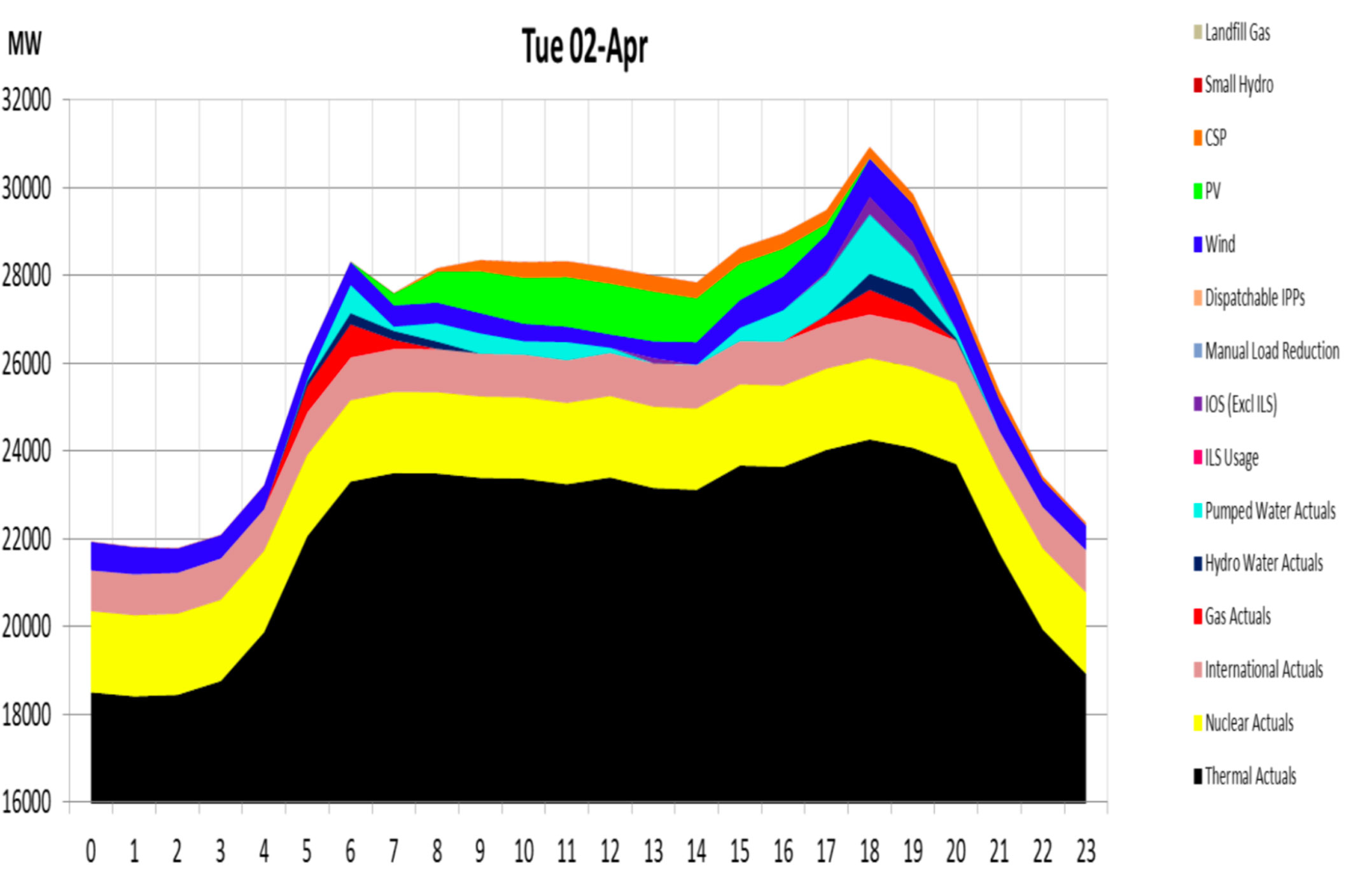
    On 2 April, a day with a reportedly elevated risk of load shedding, Eskom was able to provide 29.8GW of supply during the evening peak. But demand peaked at just under 31GW at around 6pm. The difference of more than 1GW was met using wind and concentrated solar power from IPPs.

    Together, wind and solar – both photovoltaic and concentrated solar power – are already consistently supplying just under 2GW of power

    Eskom used pumped water schemes and its hydro plants (total of 1.7GW), open cycle gas turbines (546MW) and demand-side management through its so-called “virtual power station” (409 MW) to achieve its nearly 30GW. Tellingly, it did not (have to) rely on either of the (very pricey) Avon or Dedisa gas peaking plants.

    Wind comprised the bulk of the additional supply provided by the IPPs during the peak, with only a residual amount — easily less than 200MW — from concentrated solar.

    The picture through the day is startling.
    Source: Department of public enterprises/Eskom presentation

    Together, wind and solar — both photovoltaic (PV) and concentrated solar power — are already consistently supplying just under 2GW of power. This equates to 7% of total supply, and during the 8am to 5pm workday is significantly more than the amount currently being supplied by imports from Cahora Bassa. In fact, the three together just about equate to (or exceed) the amount being supplied by Koeberg (1.8GW).

    4.8GW from IPPs

    The total capacity of IPPs, as at 31 March 2018, was 4.8GW. Exclude the 1GW from the Avon and Dedisa peaking plants (which Eskom seems to sometimes include and other times exclude from its “capacity”), and you’re left with 3.8GW, primarily from solar and wind. Eskom points to an average load factor of 31.5% for fiscal 2018, but this is obviously distorted by the unavailability of solar overnight. During the day, the load factor is comfortably over 50%.

    And, given the current dire performance from Eskom’s coal fleet, without renewable energy from the IPPs (at around 2GW), we would be in a near-perpetual state of stage-two load shedding.

    This is what no one at the utility and very few in government will admit.

    Consider this: in fiscal 2018, Eskom purchased 9.6GWh of electricity from IPPs (renewables and gas). This is 24% more than the amount of power imported from Cahora Bassa in the same period. (Ironically the amount of electricity purchased from IPPs in the 2018 financial year was lower than in FY2017, but this is not at all surprising given the previous leadership.)
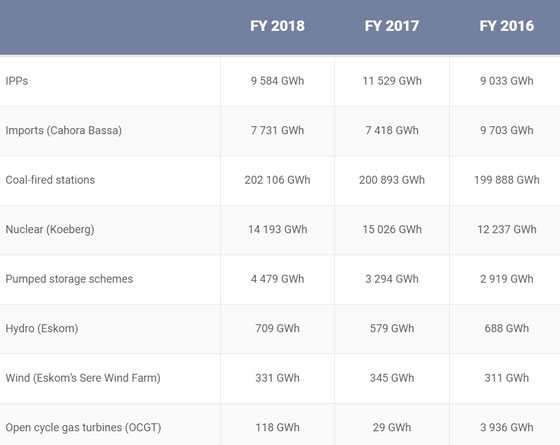
    Eskom admits in its own integrated report that it operates “most of the base-load and peaking capacity, although the role played by independent power producers (IPPs) is expanding” (author’s emphasis).

    By 2022/2023, Eskom expects supply from IPPs to increase to 19.9GWh, more than double the amount in FY2018. Although this number is conservative, even at this level it will come close to exceeding nuclear (Koeberg) and imports combined.

    By 2022/2023, Eskom expects supply from IPPs to increase to 19.9GWh, more than double the amount in FY2018

    Coal supply has peaked. Regardless of the Medupi and Kusile power stations, the wheels of decommissioning have been set in motion — perhaps forcefully so, given the age of some Eskom plants — and dozens of units will be shut down over the coming years.

    Energy from renewables (again, primarily solar and wind) will take up the slack. Already, there are signs that this transition — “just” or otherwise — is going to be painful and disruptive. (The burst of disinformation/misinformation last month is only the proverbial tip of the iceberg.)

    Government’s updated draft integrated resource plan (2018) puts coal at under 45% of total capacity by 2030, with solar (PV and concentrated solar) at around 12%, wind at around 15% and gas/diesel at some 16%. At this point — should this plan be finalised and implemented in its current state — capacity from these sources will exceed coal in just over a decade from now.

    Does Eskom — and government — fully grasp this future?

    • This article was originally published on Moneyweb and is used here with permission
    Follow TechCentral on Google News Add TechCentral as your preferred source on Google


    Eskom top
    WhatsApp YouTube
    Share. Facebook Twitter LinkedIn WhatsApp Telegram Email Copy Link
    Previous ArticleYouTube is developing choose-your-own-adventure programmes
    Next Article MTN launches trial indoor 5G network at Kyalami

    Related Posts

    Eskom marks 300 days without load shedding

    Eskom marks 300 days without load shedding

    16 March 2026
    South Africa's energy future hinges on getting wheeling right - Aishah Gire

    South Africa’s energy future hinges on getting wheeling right

    10 March 2026
    Eskom tariffs to surge on 1 April as Nersa blunder hits home

    Eskom tariffs to surge on 1 April as Nersa blunder hits home

    10 March 2026
    Company News
    SA is off the FATF grey list - now it's time to modernise compliance - Fenergo

    SA is off the FATF grey list – now it’s time to modernise compliance

    18 March 2026
    Zoyk: Cost-effective payment processing for small businesses in Southern Africa

    Zoyk: Cost-effective payment processing for small businesses in Southern Africa

    18 March 2026
    What enterprise AI can't do for you (yet) - BBD Software

    What enterprise AI can’t do for you (yet)

    18 March 2026
    Opinion
    South Africa's energy future hinges on getting wheeling right - Aishah Gire

    South Africa’s energy future hinges on getting wheeling right

    10 March 2026
    Hold the doom: the case for a South African comeback - Duncan McLeod

    Apple just dropped a bomb on the Windows world

    5 March 2026
    VC's centre of gravity is shifting - and South Africa is in the frame - Alison Collier

    VC’s centre of gravity is shifting – and South Africa is in the frame

    3 March 2026

    Subscribe to Updates

    Get the best South African technology news and analysis delivered to your e-mail inbox every morning.

    Latest Posts
    iOCO eyes return to 'serial acquirer' status - Rhys Summerton

    iOCO eyes return to ‘serial acquirer’ status

    18 March 2026
    iOCO scraps 'work from home' - and says it's boosting productivity

    iOCO scraps ‘work from home’ – and says it’s boosting productivity

    18 March 2026
    Commission to probe Showmax closure

    Commission to probe Showmax closure

    18 March 2026
    Zimi, Charge Holdings partner to electrify freight on N3 corridor - Andries Malherbe and Michael Maas

    Zimi, Charge Holdings partner to electrify freight on N3 corridor

    18 March 2026
    © 2009 - 2026 NewsCentral Media
    • Cookie policy (ZA)
    • TechCentral – privacy and Popia

    Type above and press Enter to search. Press Esc to cancel.

    Manage consent

    TechCentral uses cookies to enhance its offerings. Consenting to these technologies allows us to serve you better. Not consenting or withdrawing consent may adversely affect certain features and functions of the website.

    Functional Always active
    The technical storage or access is strictly necessary for the legitimate purpose of enabling the use of a specific service explicitly requested by the subscriber or user, or for the sole purpose of carrying out the transmission of a communication over an electronic communications network.
    Preferences
    The technical storage or access is necessary for the legitimate purpose of storing preferences that are not requested by the subscriber or user.
    Statistics
    The technical storage or access that is used exclusively for statistical purposes. The technical storage or access that is used exclusively for anonymous statistical purposes. Without a subpoena, voluntary compliance on the part of your Internet Service Provider, or additional records from a third party, information stored or retrieved for this purpose alone cannot usually be used to identify you.
    Marketing
    The technical storage or access is required to create user profiles to send advertising, or to track the user on a website or across several websites for similar marketing purposes.
    • Manage options
    • Manage services
    • Manage {vendor_count} vendors
    • Read more about these purposes
    View preferences
    • {title}
    • {title}
    • {title}