Close Menu
TechCentralTechCentral

    Subscribe to the newsletter

    Get the best South African technology news and analysis delivered to your e-mail inbox every morning.

    Facebook X (Twitter) YouTube LinkedIn
    WhatsApp Facebook X (Twitter) LinkedIn YouTube
    TechCentralTechCentral
    • News
      Africa's most popular phones have a tracking problem

      Africa’s most popular phones have a tracking problem

      24 July 2026
      Vodacom taps UJ, AWS to build its AI talent pipeline - Vodacom Group CEO Shameel Joosub

      Vodacom taps UJ, AWS to build its AI talent pipeline

      24 July 2026
      Intel is back in the game - Intel CEO Lip-Bu Tan. Laure Andrillon/Reuters

      Intel is back in the game

      24 July 2026
      Fat bonuses at Telkom despite group missing own targets - Serame Taukobong

      Fat bonuses at Telkom despite group missing own targets

      23 July 2026
      Massive changes coming to Amazon Prime Video - Jeff Bezos

      Massive changes coming to Amazon Prime Video

      23 July 2026
    • World
      Meta AI will now tell parents if their teen is in crisis

      Meta AI will now tell parents if their teen is in crisis

      17 July 2026
      IBM shares crash 25% as AI upends software spending - Arvind Krishna

      IBM shares crash 25% as AI upends software spending

      15 July 2026
      Jony Ive's first OpenAI device: an AI smart speaker - Jony Ive and Sam Altman

      Jony Ive’s first OpenAI device: an AI smart speaker

      15 July 2026
      Stripe, Advent in talks to buy PayPal for $53-billion

      Stripe, Advent in talks to buy PayPal for $53-billion

      15 July 2026
      Memory crisis sends smartphone market into steep decline

      Memory crisis sends smartphone market into steep decline

      13 July 2026
    • In-depth
      The plan to stop AI from breaking the world - Google DeepMind CEO Demis Hassabis. Image: John Sears

      The plan to stop AI from breaking the world

      16 July 2026
      The internet has a Strait of Hormuz problem

      The internet has a Strait of Hormuz problem

      15 July 2026
      AI boom sparks rally, frenzy and fear

      AI boom sparks rally, frenzy and fear

      11 June 2026
      Every plug-in hybrid on sale in South Africa, ranked by price - Lamborghini Temerario

      Every plug-in hybrid on sale in South Africa, ranked by price

      7 June 2026
      What Wi-Fi 8 will mean for wireless networks

      What Wi-Fi 8 will mean for wireless networks

      1 June 2026
    • TCS
      TCS | How Optasia lends billions to people banks can't see - Salvador Anglada

      TCS | How Optasia lends billions to people banks can’t see

      23 July 2026
      The rands-and-cents case for electric trucks - William Kelly Watts & Wheels with Wills

      The rands-and-cents case for electric trucks

      20 July 2026
      Watts & Wheels S1E7: 'Ferrari's EV breaks the internet'

      Watts & Wheels S1E7: ‘Ferrari’s EV breaks the internet’

      8 July 2026
      TCS | Pick n Pay's Enrico Ferigolli on Penny, the AI that shops for you

      TCS | Pick n Pay’s Enrico Ferigolli on Penny, the AI that shops for you

      2 July 2026
      TCS+ | How Tracker is turning vehicle data into business strategy - Silvia Schollenberger

      TCS+ | How Tracker is turning vehicle data into business strategy

      1 July 2026
    • Opinion
      Selling vapour is corporate suicide in slow motion - Jannie van Zyl

      Selling vapour is corporate suicide in slow motion

      16 July 2026
      Brazil's online gambling crackdown is a lesson for South Africa

      How Amazon outmanoeuvred Starlink in South Africa

      15 July 2026
      The Popia problem with agentic AI - Herman Haasbroek

      The Popia problem with agentic AI

      14 July 2026
      The author, Fanie van Rooyen

      South Africa can still catch the AI wave – here’s how

      7 July 2026
      The author, Fanie van Rooyen

      The AI utopia South Africa can’t afford

      1 July 2026
    • Company Hubs
      • 1Stream
      • Africa Data Centres
      • AfriGIS
      • Altron Digital Business
      • Altron Document Solutions
      • Altron Group
      • Arctic Wolf
      • Ascent Technology
      • AvertITD
      • BBD
      • Braintree
      • CallMiner
      • CambriLearn
      • CM Telecom
      • Contactable
      • CYBER1 Solutions
      • Digicloud Africa
      • Digimune
      • Domains.co.za
      • ESET
      • Euphoria Telecom
      • HOSTAFRICA
      • Incredible Business
      • iONLINE
      • IQbusiness
      • Iris Network Systems
      • Kaspersky
      • LSD Open
      • Mitel
      • NEC XON
      • Netstar
      • Network Platforms
      • Next DLP
      • Ovations
      • Paracon
      • Paratus
      • Q-KON
      • SevenC
      • SkyWire
      • Solid8 Technologies
      • Telit Cinterion
      • Telviva
      • Tenable
      • Vertiv
      • Videri Digital
      • Vodacom Business
      • Vox
      • Wipro
      • Workday
      • XLink
    • Sections
      • AI and machine learning
      • Banking
      • Broadcasting and Media
      • Cloud services
      • Contact centres and CX
      • Cryptocurrencies
      • Education and skills
      • Electronics and hardware
      • Energy and sustainability
      • Enterprise software
      • Financial services
      • HealthTech
      • Information security
      • Internet and connectivity
      • Internet of Things
      • Investment
      • IT services
      • Lifestyle
      • Policy and regulation
      • Public sector
      • Retail and e-commerce
      • Satellite communications
      • Science
      • SMEs and start-ups
      • Social media
      • Talent and leadership
      • Telecoms
      • Watts & Wheels
    • Events
    • Advertise
    TechCentralTechCentral
    Home » Gadgets & Reviews » Kindle Fire HD reviewed

    Kindle Fire HD reviewed

    By Craig Wilson26 September 2013
    Twitter LinkedIn Facebook WhatsApp Email Telegram Copy Link
    News Alerts
    WhatsApp

    Kindle-Fire-HD-alt-640

    Amazon’s Kindles — the e-readers that first popularised the brand and the Android-powered “Fire” versions — continue to improve with each release. But serving as a platform through which to distribute the online retailer’s content, they’re of limited use outside supported regions.

    The Kindle Fire HD continues Amazon’s move from e-readers to fully fledged tablets intended to compete with Apple’s iPad and Samsung’s Galaxy Tab range. Easily the most attractive Kindle Fire to date, the HD includes a glorious 8,9-inch, 1 920×1 200-pixel display and stereo speakers, making it an excellent tablet for consuming media.

    But therein lies the problem. While you can transfer your own music or videos to the device using the included micro USB cable, you can’t buy them from the Amazon online store without a US credit card and billing address.

    The same problem arises when trying to purchase apps from Amazon. You can’t just use the regular Google Play store because, although the Fire HD runs Android, it’s a closely controlled version of the software.
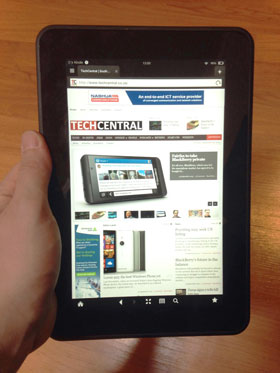
    Kindle-Fire-HD-280Although it is possible to purchase digital books using the Fire HD — and if you have a Kindle account your previous purchases can all be downloaded to the device — the Fire HD is punted as an all-in-one media solution. In South Africa, though, the Fire is essentially reduced to a colour-display Web browser and e-reader (that doesn’t even offer the benefits of e-ink).

    Worse, because you can’t customise its menus, you’re destined to be taunted by the types of media you can’t actually purchase every time you use it.

    There’s another problem facing Kindle’s Fire HD: it’s just been replaced. Earlier this week, Amazon showed off its two new Fire HDX devices, a 7-inch and an 8,9-inch version, both with faster processors, more RAM, higher-resolution displays and promises of longer battery life. That means the current Fire HD line-up will get cheaper, but it doesn’t alleviate the problems.

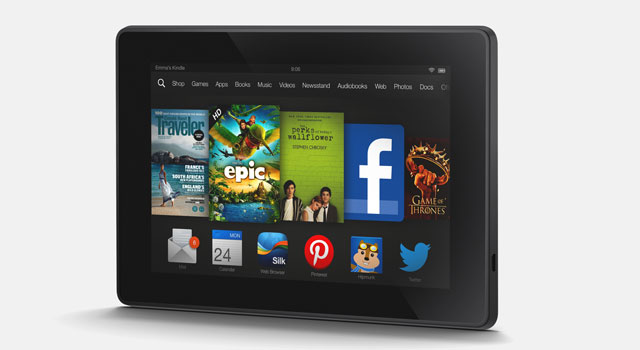
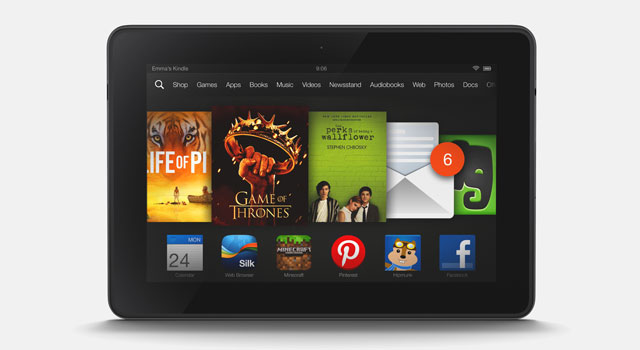
    The Fire HD’s equivalent of a home screen is the “carousel”, which shows the most recently used books, videos, music, apps and games. This makes sense. After all, the Fire HD isn’t meant to be a tablet computer in the same way that rival offerings are. It’s no replacement for a laptop, either. Instead, the Fire HD is a machine for media consumption, and this shows in every facet of its design.

    Long-pressing any book, app or other content brings up a contextual menu where it can be favourited, ensuring it will show up in the carousel. Tapping the small star at the bottom of most screens takes you to back to the carousel instantly.

    Above the carousel is the “shop” button, which launches the Amazon online store, followed by a selection of “content libraries” — games, apps, books, music, videos, newsstand, audio books, Web, photos, docs.

    Of these, those useable in South Africa are free games and apps; purchased books; and music, videos, photos and docs physically transferred to the device by the user (documents can also be e-mailed to the device).

    This may sound tolerable, but having to transfer so much content manually and being frequently greeted with messages warning you that content isn’t available in your region is extremely frustrating. The Fire range is meant offer a seamless, media consumption experience but outside of supported regions it simply doesn’t.

    Air of class
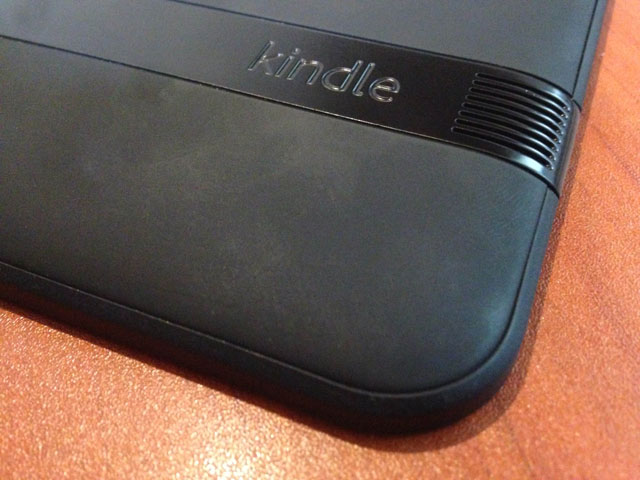
    The plain, black styling gives the unit an air of class, the rubberised rear and edges make it feel hardy, and the contrast, colour and detail on the display are exceptional, especially on a tablet that costs about R4 000.

    The Fire HD is powered by a dual-core 1,5GHz processor and 1GB of RAM, making it perfect for graphics-intensive games or HD video content on paper. In practice, we found moving between menus or even inputting text with the on-screen keyboard induced small amounts of lag.
    Kindle-Fire-HD-rear-640

    Amazon’s stripped down version of Android 4.0 presents users with a simplistic interface wholly controlled by on-screen buttons. The bezels around the display are devoid of capacitive buttons and the only physical buttons are the volume rocker and power/lock button on its right edge.

    On the whole, operating the Fire HD is simple enough, but there are times when it confuses. For example, the on-screen home button is sometimes in different places, or it and the back and favourites button disappear altogether. Also, when holding the device in landscape orientation, the controls are down the right-hand side, something left-handed people are no doubt used to, but something users should nevertheless be able to customise.

    One thing we did rather like about the Fire HD was its browser — once we eventually found it. Silk, as it’s called, presents a simple interface that’ll be familiar to anyone used to any of the major browsers on a mobile device.

    New tabs are added by tapping the plus button above the address bar and an options button allows for bookmarking, sharing of links and searching for text.

    The default search engine is Bing, but this can be changed to Google or Yahoo in the settings menu. But what we really liked was the “reading view” option that appears next to the address bar on applicable web pages. Tap it and the article you’re reading is stripped to just the text and inline imagery —  great for reading lengthy pieces of text online.
    Kindle-HD-Fire-front-640

    During the Fire HD’s launch event, Amazon CEO Jeff Bezos called it the “best tablet at any price”. The 16GB Wi-Fi-only version we reviewed is priced at between R4 000 and R4 400 (depending on retailer), which is decidedly cheaper than the R5 499 for the equivalent fourth-generation iPad, and somewhat cheaper than the R4 099 Samsung is asking for it’s Galaxy Tab 2 10.1.

    But it’s not really fair to compare the Fire HD to those tablets. In terms of functionality, they’re simply not even playing the same sport, let alone in the same league.

    No access to Google Play means no access to apps like Gmail, Calendar, Maps and Chrome.

    It’s therefore hard to recommend the Fire HD over any of its rivals because it’s simply too limited in what it offers and too restrictive in what it lets you do with it. If you’re looking for a cheaper tablet primarily for reading, you’re better off buying a Kindle Paperwhite or other dedicated e-reader. If you’re interested in a high-resolution display for watching video or trawling the Web, your best bet is an iPad or Galaxy Tab.

    With the Fire HD, Amazon’s shown itself capable of making great hardware, but without the necessary licensing agreements in place globally to allow for frictionless content distribution, the Fire is destined to remain a curiosity rather than a contender in unsupported regions.  — © 2013 NewsCentral Media

    • TechCentral’s review unit was supplied by Kindle distributor Circuit City

    Follow TechCentral on Google News Add TechCentral as your preferred source on Google


    WhatsApp YouTube
    Share. Facebook Twitter LinkedIn WhatsApp Telegram Email Copy Link
    Previous ArticlePoynting may seek US listing
    Next Article Sentech cleans up its act

    Related Posts

    Africa's most popular phones have a tracking problem

    Africa’s most popular phones have a tracking problem

    24 July 2026
    Vodacom taps UJ, AWS to build its AI talent pipeline - Vodacom Group CEO Shameel Joosub

    Vodacom taps UJ, AWS to build its AI talent pipeline

    24 July 2026
    Intel is back in the game - Intel CEO Lip-Bu Tan. Laure Andrillon/Reuters

    Intel is back in the game

    24 July 2026
    Company News
    Why Europe is turning to South Africa for cross-border innovation - BBD Software

    Why Europe is turning to South Africa for cross-border innovation

    24 July 2026
    Green dashboards, stalled change: the CIO's blind spot - Change Logic Marchant van den Heever

    Green dashboards, stalled change: the CIO’s blind spot

    24 July 2026
    Why Africa's cloud needs more than one path - Africa Data Centres

    Why Africa’s cloud needs more than one path

    23 July 2026
    Opinion
    Selling vapour is corporate suicide in slow motion - Jannie van Zyl

    Selling vapour is corporate suicide in slow motion

    16 July 2026
    Brazil's online gambling crackdown is a lesson for South Africa

    How Amazon outmanoeuvred Starlink in South Africa

    15 July 2026
    The Popia problem with agentic AI - Herman Haasbroek

    The Popia problem with agentic AI

    14 July 2026

    Subscribe to Updates

    Get the best South African technology news and analysis delivered to your e-mail inbox every morning.

    Latest Posts
    Africa's most popular phones have a tracking problem

    Africa’s most popular phones have a tracking problem

    24 July 2026
    Vodacom taps UJ, AWS to build its AI talent pipeline - Vodacom Group CEO Shameel Joosub

    Vodacom taps UJ, AWS to build its AI talent pipeline

    24 July 2026
    Intel is back in the game - Intel CEO Lip-Bu Tan. Laure Andrillon/Reuters

    Intel is back in the game

    24 July 2026
    Why Europe is turning to South Africa for cross-border innovation - BBD Software

    Why Europe is turning to South Africa for cross-border innovation

    24 July 2026
    © 2009 - 2026 NewsCentral Media
    Built and maintained by Chronon
    • Cookie policy (ZA)
    • TechCentral – privacy and Popia

    Type above and press Enter to search. Press Esc to cancel.

    Manage consent

    TechCentral uses cookies to enhance its offerings. Consenting to these technologies allows us to serve you better. Not consenting or withdrawing consent may adversely affect certain features and functions of the website.

    Functional Always active
    The technical storage or access is strictly necessary for the legitimate purpose of enabling the use of a specific service explicitly requested by the subscriber or user, or for the sole purpose of carrying out the transmission of a communication over an electronic communications network.
    Preferences
    The technical storage or access is necessary for the legitimate purpose of storing preferences that are not requested by the subscriber or user.
    Statistics
    The technical storage or access that is used exclusively for statistical purposes. The technical storage or access that is used exclusively for anonymous statistical purposes. Without a subpoena, voluntary compliance on the part of your Internet Service Provider, or additional records from a third party, information stored or retrieved for this purpose alone cannot usually be used to identify you.
    Marketing
    The technical storage or access is required to create user profiles to send advertising, or to track the user on a website or across several websites for similar marketing purposes.
    • Manage options
    • Manage services
    • Manage {vendor_count} vendors
    • Read more about these purposes
    View preferences
    • {title}
    • {title}
    • {title}