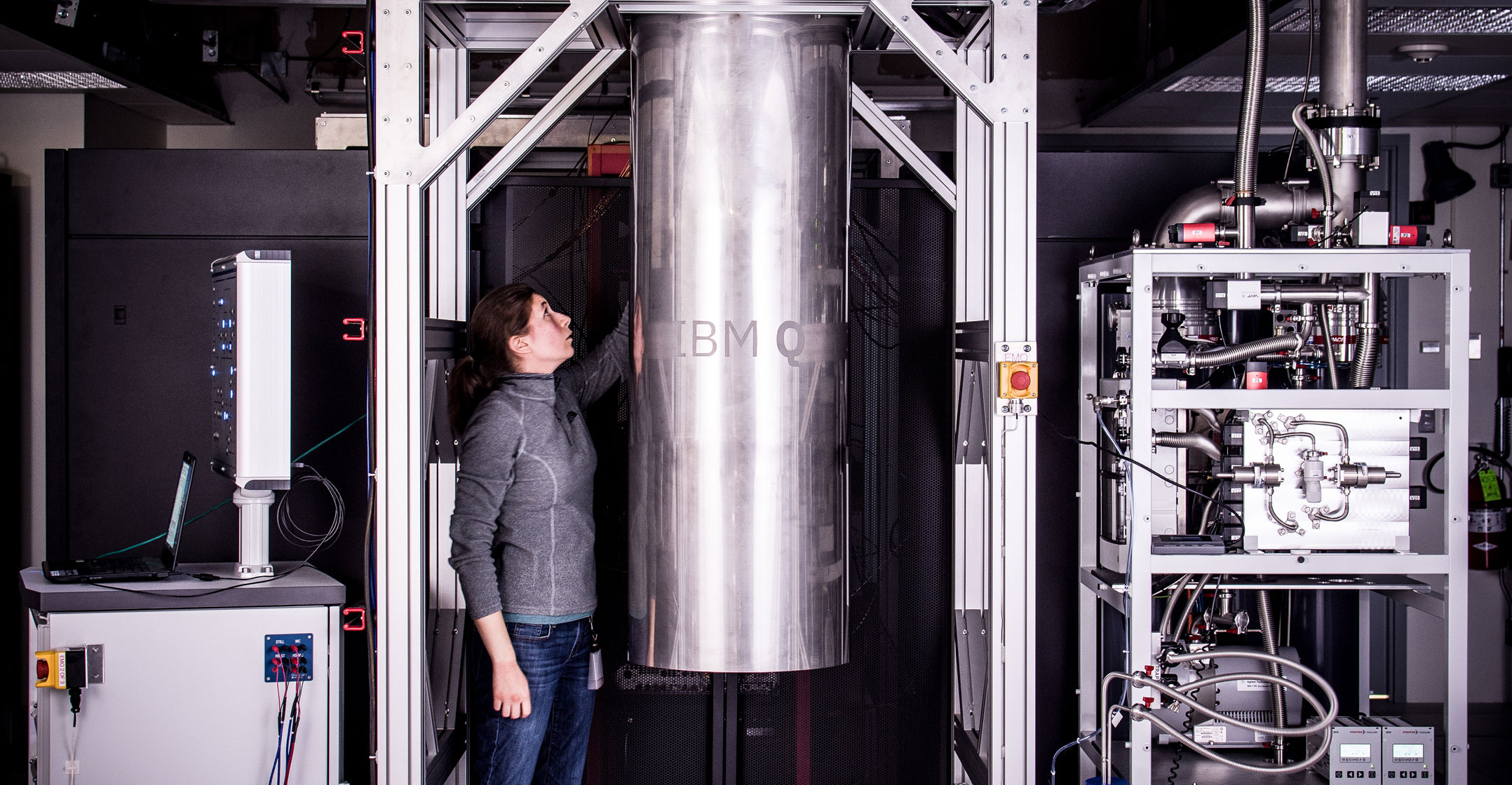
It’s a sunny Tuesday morning in late March at IBM’s Thomas J Watson Research Centre. The corridor from the reception area follows the long, curving glass curtain-wall that looks out over the visitors’ parking lot to leafless trees covering a distant hill in Yorktown Heights, New York, an hour north of Manhattan. Walk past the podium from the Jeopardy! episodes at which IBM’s Watson smote the human champion of the TV quiz show, turn right into a hallway, and you’ll enter a windowless lab where a quantum computer is chirping away.
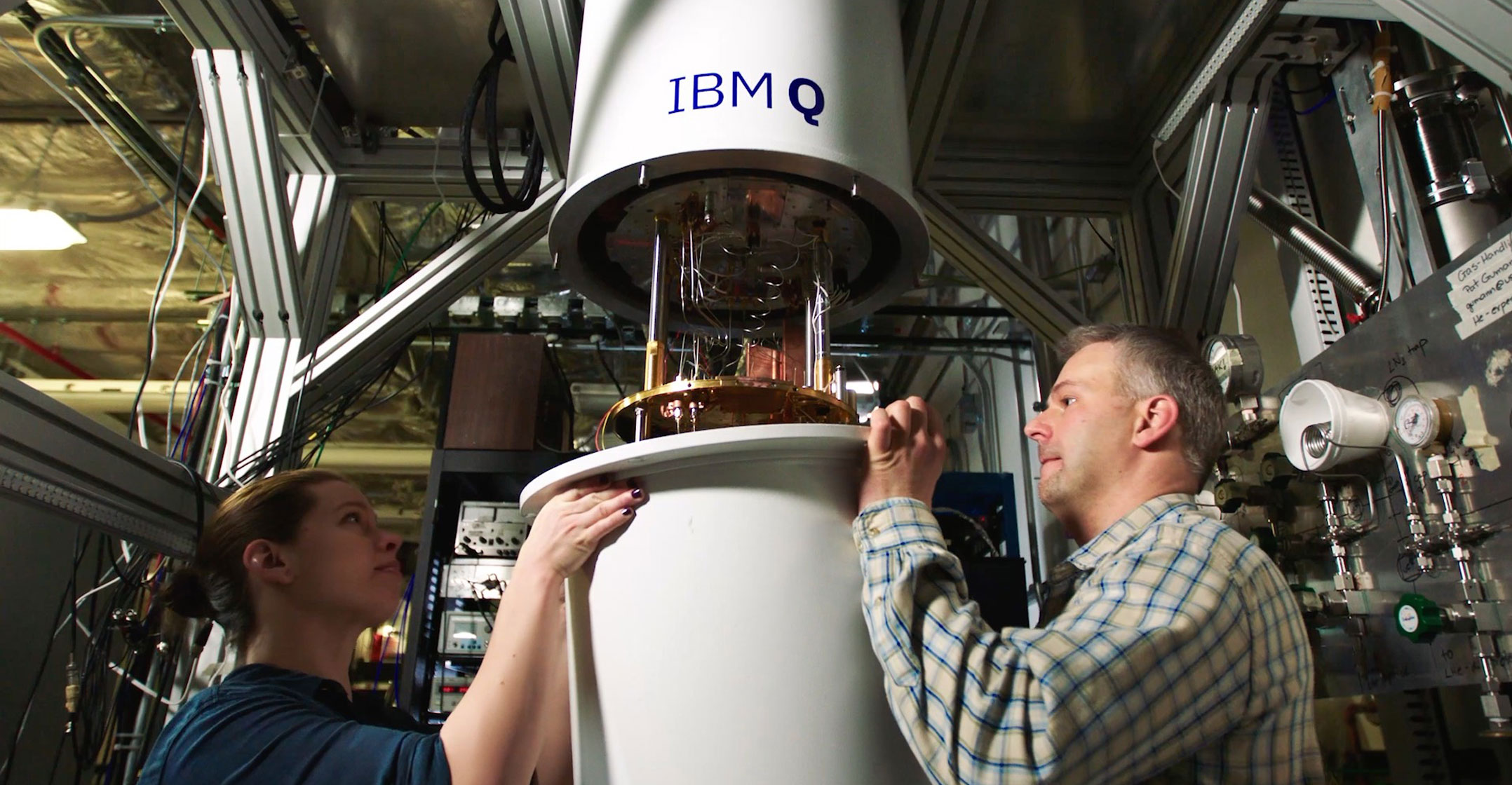
Actually, “chirp” isn’t quite the right word. It’s a somewhat metallic sound, chush … chush … chush, that’s made by the equipment that lowers the temperature inside a so-called dilution refrigerator to within hailing distance of absolute zero. Encapsulated in a white canister suspended from a frame, the dilution refrigerator cools a superconducting chip studded with a handful of quantum bits, or qubits.
Quantum computing has been around, in theory if not in practice, for several decades. But these new types of machines, designed to harness quantum mechanics and potentially process unimaginable amounts of data, are certifiably a big deal. “I would argue that a working quantum computer is perhaps the most sophisticated technology that humans have ever built,” says Chad Rigetti, founder and CEO of Rigetti Computing, a start-up in Berkeley, California. Quantum computers, he says, harness nature at a level we became aware of only about 100 years ago — one that isn’t apparent to us in everyday life.
What’s more, the potential of quantum computing is enormous. Tapping into the weird way nature works could potentially speed up computing so some problems that are now intractable to classical computers could finally yield solutions. And maybe not just for chemistry and materials science. With practical breakthroughs in speed on the horizon, Wall Street’s antennae are twitching.
The second investment that CME Group’s venture arm ever made was in 1QB Information Technologies, a quantum-computing software company in Vancouver. “From the start at CME Ventures, we’ve been looking further ahead at transformational innovations and technologies that we think could have an impact on the financial-services industry in the future,” says Rumi Morales, head of CME Ventures.
Biggest impact
That 1QBit financing round, in 2015, was led by Royal Bank of Scotland. Kevin Hanley, RBS’s director of innovation, says quantum computing is likely to have the biggest impact on industries that are data-rich and time-sensitive. “We think financial services is kind of in the cross hairs of that profile,” he says.
Goldman Sachs Group is an investor in D-Wave Systems, another quantum player, as is In-Q-Tel, the CIA-backed venture capital company, says Vern Brownell, CEO of D-Wave. The Burnaby, Canada-based company makes machines that do something called quantum annealing. “Quantum annealing is basically using the quantum computer to solve optimisation problems at the lowest level,” Brownell says. “We’ve taken a slightly different approach where we’re actually trying to engage with customers, make our computers more and more powerful, and provide this advantage to them in the form of a programmable, usable computer.”
Marcos López de Prado, a senior MD at Guggenheim Partners who’s also a scientific adviser at 1QBit and a research fellow at the US department of energy’s Lawrence Berkeley National Laboratory, says it’s all about context. “The reason quantum computing is so exciting is its perfect marriage with machine learning,” he says. “I would go as far as to say that currently this is the main application for quantum computing.”
Part of that simply derives from the idea of a quantum computer: harnessing a physical device to find an answer, López de Prado says. He sometimes explains it by pointing to the videogame Angry Birds. When you play it on your iPad, the central processing units use some mathematical equations that have been programmed into a library to simulate the effects of gravity and the interaction of objects bouncing and colliding. “This is how digital computers work,” he says.
By contrast, quantum computers turn that approach on its head, López de Prado says. The paradigm for quantum computers is this: let’s throw some birds and see what happens. Encode into the quantum microchip this problem: these are your birds and where you throw them from, so what’s the optimal trajectory? “Then you let the computer check all possible solutions essentially — or a very large combination of them — and come back with an answer,” he says. In a quantum computer, there’s no mathematician cracking the problem, he says. “The laws of physics crack the problem for you.”
The fundamental building blocks of our world are quantum mechanical. “If you look at a molecule,” says Dario Gil, vice president for science and solutions at IBM Research, “the reason molecules form and are stable is because of the interactions of these electron orbitals. Each calculation in there — each orbital — is a quantum mechanical calculation.”
Quadrillions
The number of those calculations, in turn, increases exponentially with the number of electrons you’re trying to model. By the time you have 50 electrons, you have 2 to the 50th power calculations, Gil says. “That’s a phenomenally large number, so we can’t compute it today,” he says. (For the record, it’s 1,125 quadrillion. So if you fired up your laptop and started cranking through several calculations a second, it would take a few million years to run through them all.) Connecting information theory to physics could provide a path to solving such problems, Gil says. A 50-qubit quantum computer might begin to be able to do it.
Landon Downs, president and co-founder of 1QBit, says it’s now becoming possible to unlock the computational power of the quantum world. “This has huge implications for producing new materials or creating new drugs, because we can actually move from a paradigm of discovery to a new era of quantum design,” he says in an email. Rigetti, whose company is building hybrid quantum-classical machines, says one moonshot use of quantum computing could be to model catalysts that remove carbon and nitrogen from the atmosphere — and thereby help fix global warming.
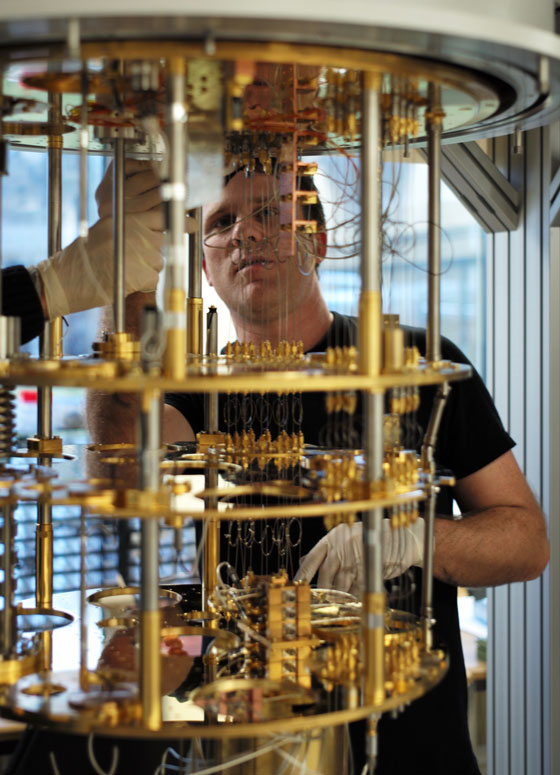
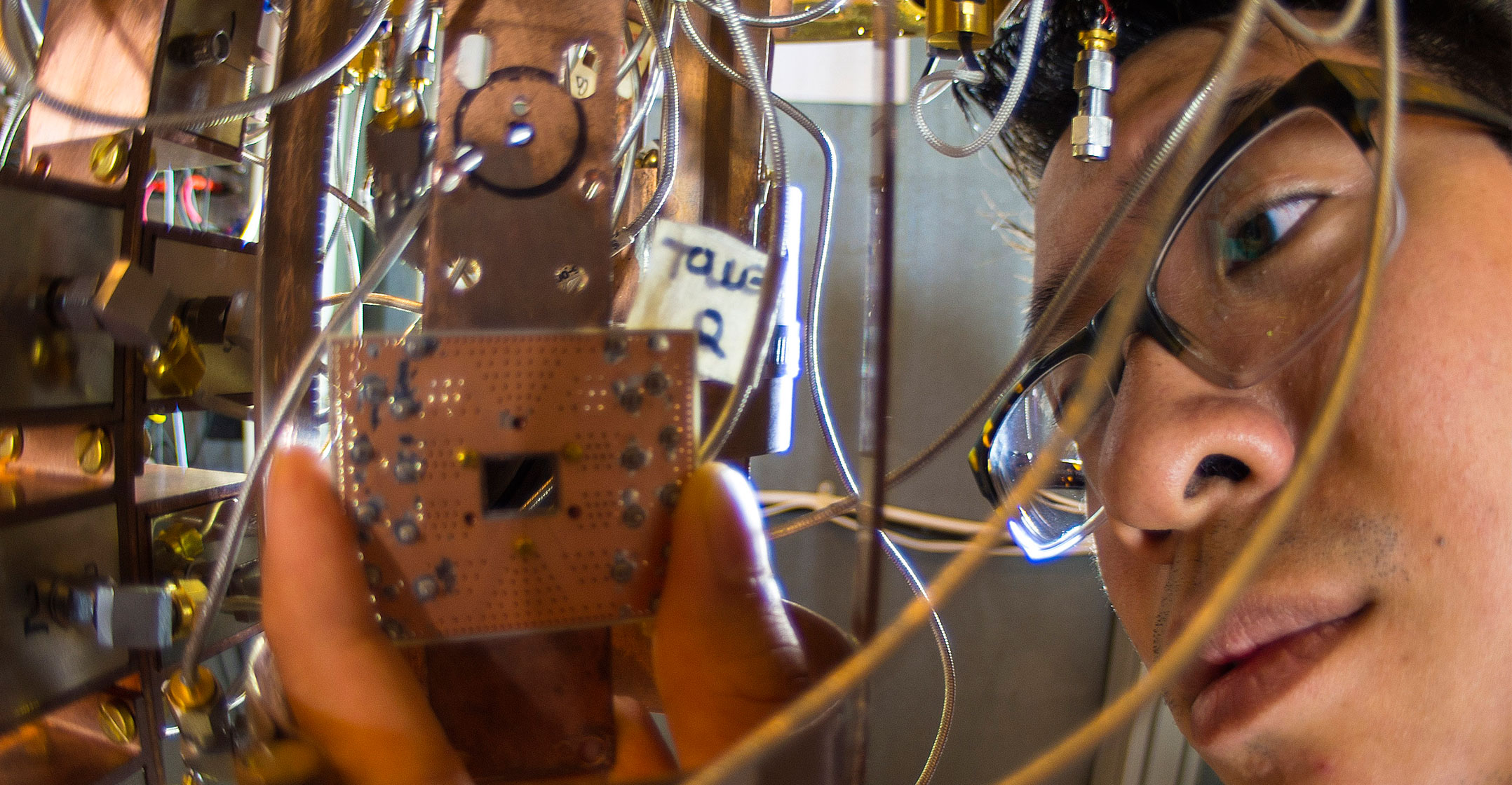
The quantum-computing community hums with activity and excitement these days. Teams around the world — at start-ups, corporations, universities, and government labs — are racing to build machines using a welter of different approaches to process quantum information. Superconducting qubit chips too elementary for you? How about trapped ions, which have brought together researchers from the University of Maryland and the National Institute of Standards and Technology? Or maybe the topological approach that Microsoft is developing through an international effort called Station Q? The aim is to harness a particle called a non-abelian anyon — which has not yet been definitively proven to exist.
These are early days, to be sure. As of late May, the number of quantum computers in the world that clearly, unequivocally do something faster or better than a classical computer remains zero, according to Scott Aaronson, a professor of computer science and director of the Quantum Information Centre at the University of Texas at Austin. Such a signal event would establish “quantum supremacy”. In Aaronson’s words: “That we don’t have yet.”
Yet someone may accomplish the feat as soon as this year. Most insiders say one clear favourite is a group at Google led by John Martinis, a physics professor at the University of California at Santa Barbara. According to Martinis, the group’s goal is to achieve supremacy with a 49-qubit chip. As of late May, he says, the team was testing a 22-qubit processor as an intermediate step toward a showdown with a classical supercomputer. “We are optimistic about this, since prior chips have worked well,” he said in an e-mail.
The idea of using quantum mechanics to process information dates back decades. One key event happened in 1981, when IBM and MIT co-sponsored a conference on the physics of computation at the university’s Endicott House in Dedham, Massachusetts. At the conference, Richard Feynman, the famed physicist, proposed building a quantum computer. “Nature isn’t classical, dammit, and if you want to make a simulation of nature, you’d better make it quantum mechanical,” he said in his talk. “And by golly, it’s a wonderful problem, because it doesn’t look so easy.”
He got that part right. The basic idea is to take advantage of a couple of the weird properties of the atomic realm: superposition and entanglement. Superposition is the mind-bending observation that a particle can be in two states at the same time. Bring out your ruler to get a measurement, however, and the particle will collapse into one state or the other. And you won’t know which until you try, except in terms of probabilities. This effect is what underlies Schrödinger’s cat, the thought-experiment animal that’s both alive and dead in a box until you sneak a peek.
Sure, bending your brain around that one doesn’t come especially easy; nothing in everyday life works that way, of course. Yet about a million experiments since the early 20th century show that superposition is a thing. And if superposition happens to be your thing, the next step is figuring out how to strap such a crazy concept into a harness.
Qubits
Enter qubits. Classical bits can be a 0 or a 1; run a string of them together through “logic gates” (AND, OR, NOT, etc), and you’ll multiply numbers, draw an image, and whatnot. A qubit, by contrast, can be a 0, a 1 or both at the same time, says IBM’s Gil.
Ready for entanglement? (You’re in good company if you baulk; Albert Einstein famously rebelled against the idea, calling it “spooky action at a distance”.) Well, let’s say two qubits were to get entangled; Gil says that would make them perfectly correlated. A quantum computer could then utilise a menagerie of distinctive logic gates. The so-called Hadamard gate, for example, puts a qubit into a state of perfect superposition. (There may be something called a “square root of NOT” gate, but let’s take a pass on that one.) If you tap the superposition and entanglement in clever arrangements of the weird quantum gates, you start to get at the potential power of quantum computing.
If you have two qubits, you can explore four states: 00, 01, 10 and 11. (Note that that’s 4: 2 raised to the power 2.) “When I perform a logical operation on my quantum computer, I can operate on all of this at once,” Gil says. And the number of states you can look at is 2 raised to the power of the number of qubits. So if you could make a 50-qubit universal quantum computer, you could in theory explore all of those 1,125 quadrillion states — at the same time.
What gives quantum computing its special advantage, says Aaronson, of the University of Texas, is that quantum mechanics is based on things called amplitudes. “Amplitudes are sort of like probabilities, but they can also be negative — in fact, they can also be complex numbers,” he says. So if you want to know the probability that something will happen, you add up the amplitudes for all the different ways that it can happen, he says.
“The idea with a quantum computation is that you try to choreograph a pattern of interference so that for each wrong answer to your problem, some paths leading there have positive amplitudes and some have negative amplitudes, so they cancel each other out,” Aaronson says. “Whereas the paths leading to the right answer all have amplitudes that are in phase with each other.” The tricky part is that you have to arrange everything not knowing in advance which answer is the right one. “So I would say it’s the exponentiality of quantum states combined with this potential for interference between positive and negative amplitudes — that’s really the source of the power of quantum computing,” he says.
Did we mention that there are problems that a classical computer can’t solve? You probably harness one such difficulty every day when you use encryption on the Internet. The problem is that it’s not easy to find the prime factors of a large number. To review: the prime factors of 15 are 5 and 3. That’s easy. If the number you’re trying to factor has, say, 200 digits, it’s very hard. Even with your laptop running an excellent algorithm, you might have to wait years to find the prime factors.
That brings us to another milestone in quantum computing: Shor’s algorithm. Published in 1994 by Peter Shor, now a maths professor at MIT, the algorithm demonstrated an approach that you could use to find the factors of a big number — if you had a quantum computer, which didn’t exist at the time. Essentially, Shor’s algorithm would perform some operations that would point to the regions of numbers in which the answer was most likely to be found.
The following year, Shor also discovered a way to perform quantum error correction. “Then people really got the idea that, wow, this is a different way of computing things and is more powerful in certain test cases,” says Robert Schoelkopf, director of the Yale Quantum Institute and Sterling professor of applied physics and physics. “Then there was a big upswelling of interest from the physics community to figure out how you could make quantum bits and logic gates between quantum bits and all of those things.”
Two decades later, those things are here. — Reported by Jon Asmundsson, (c) 2017 Bloomberg LP