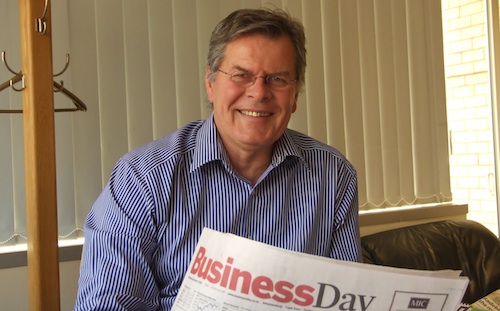
Business Day editor Peter Bruce, in his column in Monday’s newspaper, had a remarkable go at First National Bank CEO Michael Jordaan.
Jordaan had sent a note to the bank’s staff headlined “Do we really need newspapers?” in which he’d questioned the need for the company to continue spending good money on newspaper subscriptions. “We think we should simply stop subscribing to newspapers,” Jordaan wrote.
Bruce fired back, accusing Jordaan of putting a knife in journalism’s back, and took particular exception to the FNB CEO’s statement that all the news is available for free online. “Of course it is, but how did it get there? I’ll tell you. It was written and edited by journalists who earn salaries working for newspapers.
“You can be indifferent to the future of newspapers, but not about journalism,” he wrote.
Bruce’s column came just days after I sat down with him in his Rosebank, Johannesburg office to talk about the future of the newspaper industry.
There’s no doubt that Bruce is passionate to his very core about newspapers and, though concerned about the future of quality journalism, makes it clear he has no doubt that newspapers are not going anywhere. It’s not a view shared by all of his colleagues.
When I suggest to Bruce that no-one under 30 will ever regularly buy a newspaper, he says I’m dead wrong. “Young people always say they’ll never read a newspaper, until they start,” he says.
Bruce says that what concerns him much more than the Internet — at least for the time being — is the worldwide economic crisis and what it’s doing to advertising revenues.
“It’s difficult to separate the effect of the Internet on newspapers and the effect of the financial crisis. But I suspect you may find the economic crisis is having a far more potent effect.”
At Business Day, Bruce says he feels the financial crisis “far more acutely than the Internet”. Business Day has retrenched staff in recent months and cut costs to the bone — and other newspapers are doing the same.
“It may be the wrong response, I don’t know, but I feel the Internet is something I can do something about, whereas I can’t do anything about the financial crisis,” Bruce says glumly.
He says it’s too easy to blame the online world for the financial ill health of the newspaper industry, especially in the US. “Papers there have failed not because of the Internet,” he says. “They’ve failed because they’ve been too leveraged in a really bad economy.”
Bruce says he used to fear the online world but that’s changed. Business Day’s website recently got a makeover and Bruce says he’s become “excited” about what can be done on the Web. “There’s stacks of room for newspapers and the Web to live together, really beneficially.”
He says newsprint has a long future ahead of it, but admits he’s “deeply concerned” about what the Internet means for the future of quality journalism.
He’s worried that free online content is going to undermine quality content. Good journalism, he says, is expensive. Newspapers have been able to support these costs because advertising is expensive, he says.
It’s not clear to Bruce whether online advertising models can pay for the sort of quality journalism people expect from newspapers.
That probably means people are going to have to fork out more for newspapers, to pay for the journalism and to offset a decline in advertising as readers go online. It could prove to be a vicious circle.
In recent years, Business Day has been pushing up its cover price, far in excess of the inflation rate. The paper costs R9,50/copy, compared to R5 for The Star, the Johannesburg daily.
“We should be selling Business Day for about R16,50.”
But BDFM, Business Day’s publisher, has had to put a brake on the price increases because of the economic crisis. “I’d want to be selling the paper for R12 right now, but in this climate I just can’t do that.”
Going the way of the vinyl record?
Ray Hartley, editor of The Times, is not nearly as bullish on the future of print as Bruce. He says newspapers will eventually go the way of vinyl. They’ll still exist, but it won’t be the main way people get their daily news content.
“There’s a new generation of consumers who just don’t get newspapers,” Hartley says. “Why would I want to read the news the next morning? It’s yesterday’s news.”
He says for people who have grown up reading newspapers — and here I assume he means people over a certain age — there is some “residual loyalty” to them. “But youngsters nowadays couldn’t give a stuff, frankly, where they get their information from as long as they get it before their friends so they can share it with them.”
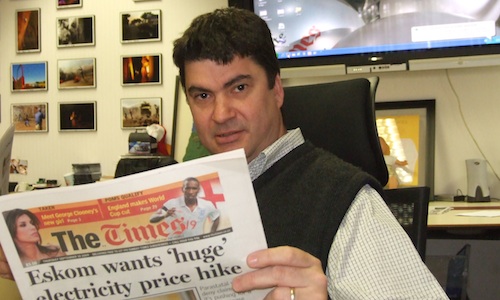
Hartley says The Times, which is the daily sister paper to the Sunday Times – both newspapers are owned by JSE-listed media group Avusa – has already stopped thinking about itself as a newspaper. Instead, it is a producer of content that is then served through a variety of channels.
“The amount of time people spend reading newspapers has declined dramatically but the amount of time people spend consuming news across all platforms has expanded dramatically,” Hartley says. “The news business is booming; it’s just not booming in newspapers.
“At The Times, we’ve tried to create a particular personality for the paper that is not just news,” says Hartley. “It’s not just about news and information anymore. It’s about the social exchangeability of that news. We don’t talk about readership anymore, we talk about audience, about social currency.”
Hartley has been one of the country’s biggest proponents of technology in print media. He was the first newspaper editor in SA (that I’m aware of) to introduce a fully integrated newsroom, where journalists are expected to produce material not only for the newspaper, but also for the Web.
When Avusa launched The Times in 2007, its journalists were told they were expected to write not only for the paper and the website but also to produce multimedia content, including video material and podcasts.
Unlike Bruce, Hartley believes it is inevitable that people will migrate in large numbers from newsprint. It’s just a question of when. The challenge for editors, he says, is ensuring that when readers of their newspapers desert them for the Web those readers don’t go to a website operated by a competitor.
Hartley says SA newspaper editors and publishers are fortunate in that they have been given a period of grace because of the country’s high telecommunications costs. They can learn from the US experience. Whether they will is another matter.
A number of people have remarked to me in recent weeks that newspaper editors can be thankful for former communications minister Ivy Matsepe-Casaburri. Thanks to her blunders in telecoms policy formulation, SA is years behind in broadband penetration, they say.
“We’re actually in a very fortunate position because we have seen what happens in other markets when broadband becomes ubiquitous,” says Hartley. “People became disloyal to print.
“These are the golden years [in SA print media],” he says. “Now’s the time to worry about the Internet, not once your audience has already left you. [Editors] need to plan now and build their infrastructure around digital platforms. The wolf will be at the door soon enough.”
Wolf at the door
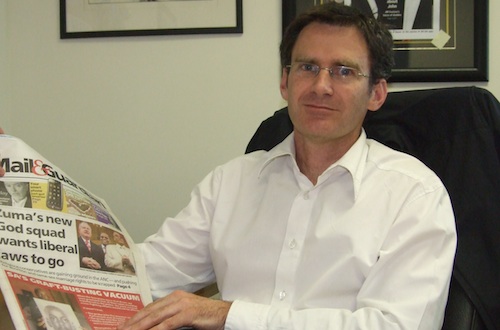
Mail & Guardian editor Nic Dawes thinks that proverbial wolf is already at the door, especially at newspapers that appeal to SA’s small pool of high-income earners.
“I think people have underestimated the extent to which there has already been an impact,” Dawes says. “It hasn’t so much driven down circulations yet, but it has put a ceiling on growth in some areas of the market.”
Though the Mail & Guardian has demonstrated a healthy increase in its print circulation in recent years, Dawes says that without the Internet, “our growth would have been stronger still”.
The Mail & Guardian was the first big newspaper in SA to launch an online edition. It pioneered the space in many respects but has fallen behind in visitor numbers in recent years. Part of the reason for this was a poorly thought-through agreement with Naspers. But that’s an entire story on its own.
Dawes, who took over earlier this year as editor of the Mail & Guardian from Ferial Haffajee, who now edits City Press, has big plans for the newspaper’s website.
He says the Mail & Guardian Online has given up trying to compete head-on with the likes of Media24’s News24 and the Independent Group’s Independent Online, or IOL. Both of these sites tend to use mainly Sapa, Reuters and other wire copy without adding much editorial value.
“We’ve been doing the wrong thing trying to compete in commodity news,” Dawes says. “Simply chucking up wire copy under our brand is not good enough.”
Dawes says he wants to use the Web to provoke more conversations with readers.
“In the paper, we leave a lot of stuff out, but on the Web, stupidly, we’ve been trying to post everything. That’s going to change.”
Dawes says he is under no illusion that the Internet will eventually hit the Mail & Guardian’s print circulation, but says it’s not going to happen immediately.
“Newspaper circulations have been growing worldwide, except at the top end of the market where there is stagnation and decline.”
Though the Mail & Guardian’s print circulation is still growing — it’s selling about 50 000 copies a week — it targets the high-end of the market that is most likely to switch first to the Internet for news.
What about the suggestion that people under 30, especially those with money, will never become regular newspaper buyers? “I think that’s kak,” Dawes says. “Relevance is important in newspapers. If you make newspapers relevant to people, they’ll read them. Print is a great interface. There’s still a lot of good about it.”
Because the Internet has proved to be such as disruptive force, people “tend to speak about it in apocalyptic terms”, says Dawes, “but the real fundamentals are still there: content is still king, and advertising still works.”
What about mobile?
All three of the newspaper editors I interviewed for this article – Bruce, Hartley and Dawes – agree that mobile phones could prove to be even more disruptive to the news business than the computer-based Web.
Dawes says unlimited data plans on cellphones, coupled with one particular handset — the Apple iPhone — have driven up readership for The Guardian‘s online edition in the UK. And people are reading The Guardian online at times that perhaps they didn’t before — on the Tube, or the bus.
He says the same trend in mobile news consumption will eventually reach SA, but it’ll take a long time. Bandwidth prices will have to fall further, and the price of large-screen cellular handsets will have to fall dramatically.
Perhaps young Daily Sun readers will be getting their daily gossip fix on their cellphones, instead of from the newspaper, in as little as five years, Dawes says.
Hartley agrees that news delivered via mobile phones could eventually become big business for media companies. But he says no-one has figured out the right model yet. There’s no doubt in his mind, though, that South Africans will take to news on their mobiles like ducks to water.
“If technology is within the financial grasp of South Africans, they have shown they are early adopters. We’ve seen this with cellphones. The only thing holding them back is cost.”
Cellphones also excite Bruce. “We could talk to readers on their phones all day long. But if it’s going to be quality content, someone will have to pay for it.”
Will they pay?
And therein lies the biggest debate. Who is going to pay for quality journalism? Or does the digital world simply mean that quality journalism will suffer?
The debate over whether users should pay for content online has surfaced for the umpteenth time, this time around thanks to News Corp’s Rupert Murdoch, who has said he will put up pay walls on News Corp’s newspaper websites.
Many of his peers have said that horse has already bolted, that people will simply find another source for the content, where they don’t have to pay. I’m inclined to agree. I’m far from convinced Murdoch will get it right, especially not with his less high-brow websites.
Hartley says newspapers can only charge for content online if it is unique and has value. If the information can be found elsewhere, online newspapers that charge for content will simply lose their audiences. The Wall Street Journal arguably has that content, and, until recently, charged for some of it and was relatively successful in doing so. But how many newspapers produce content that has as much value as the Journal? I’d argue, very few.
Hartley thinks newspapers may get away with charging for some content, but concedes that newspapers will still have give away their big stories to attract audiences. And newspaper groups can’t get together to agree to throw up pay walls because they’d be hauled before the competition authorities for collusion.
Dawes has a different view on the subject. He believes content has basically been free anyway given that newspapers have cost so little. “They’re so cheap, they may as well be free. To insist people are suddenly getting content for free that they’ve traditionally been paying for is rubbish.”
Newspapers would be crazy to throw up pay walls around all their content, Dawes says. Their journalists would resign and start rival products online that are twice as good.
“The real trouble for newspapers is not that people pay or don’t pay for content, it’s that they don’t pay for the whole package. The paper becomes disaggregated.”
One journalist who embraced the Web in its early days, Alec Hogg, believes the changes sweeping the newspaper industry are inevitable. “It’s finally online’s time,” he tells me over coffee at Melrose Arch, north of Johannesburg.
Hogg, who founded Moneyweb after years in the print media, says the business model for newspapers is in grave doubt. “When the Boston Globe closes, when the LA Times goes into receivership, there’s a message there. I love newspapers. I grew up with them. But the reality is that we in the media business sometimes misunderstand how people consume us.”
Hogg points his finger around the coffee shop. “Who here is reading a newspaper?” he asks me. “Ten years ago, most of them would be have been reading a paper. Not anymore.”
I look around. Obviously, many people are in conversation. But of those sitting on their own, a few have laptops open. And a few are fiddling with their phones. But reading a newspaper? Not one. — Duncan McLeod, TechCentral