Close Menu
TechCentralTechCentral

    Subscribe to the newsletter

    Get the best South African technology news and analysis delivered to your e-mail inbox every morning.

    Facebook X (Twitter) YouTube LinkedIn
    WhatsApp Facebook X (Twitter) LinkedIn YouTube
    TechCentralTechCentral
    • News
      DStv drops premium paywall on Fifa World Cup in Canal+-era shift - SuperSport Rendani Ramovha

      DStv drops premium paywall on Fifa World Cup in Canal+-era shift

      17 April 2026
      How a connectivity levy became a tax on telecoms

      How a connectivity levy became a tax on telecoms

      17 April 2026
      Wits project pits African creators against AI music's blind spots

      Wits project pits African creators against AI music’s blind spots

      17 April 2026
      Prosus offloads 4.5% of Delivery Hero to Uber for €270-million

      Prosus offloads 4.5% of Delivery Hero to Uber for €270-million

      17 April 2026
      Numsa digs in for 8% as Eskom wage pact splits unions

      Numsa digs in as Eskom wage pact splits unions

      17 April 2026
    • World
      Adobe bets on AI agents to fend off cheaper rivals

      Adobe bets on AI agents to fend off cheaper rivals

      16 April 2026
      Google poised to lose ad crown to Meta

      Google poised to lose ad crown to Meta

      14 April 2026
      Grand Theft Data - hackers hit Rockstar Games - Grand Theft Auto

      Grand Theft Data – hackers hit Rockstar Games

      14 April 2026
      UK PM Keir Starmer declares war on doomscrolling

      UK PM Keir Starmer declares war on doomscrolling

      13 April 2026
      Big Tech is going nuclear

      Big Tech is going nuclear

      10 April 2026
    • In-depth
      Africa switches on as Europe dims the lights

      Africa switches on as Europe dims the lights

      9 April 2026
      The biggest untapped EV market on Earth is hiding in plain sight

      The biggest untapped EV market on Earth is hiding in plain sight

      1 April 2026
      The R18-billion tech giant hiding in plain sight - Jens Montanana

      The R16-billion tech giant hiding in plain sight

      26 March 2026
      The last generation of coders

      The last generation of coders

      18 February 2026
      Sentech is in dire straits

      Sentech is in dire straits

      10 February 2026
    • TCS
      TCS | Werner Lindemann on how AI is rewriting the infosec rulebook

      TCS | Werner Lindemann on how AI is rewriting the infosec rulebook

      15 April 2026
      TCS | Donovan Marsh on AI and the future of filmmaking

      TCS | Donovan Marsh on AI and the future of filmmaking

      7 April 2026
      TCS+ | Vodacom Business moves to crack the SME tech gap - Andrew Fulton, Sannesh Beharie

      TCS+ | Vodacom Business moves to crack the SME tech gap

      7 April 2026
      TCS | MTN's Divysh Joshi on the strategy behind Pi - Divyesh Joshi

      TCS | MTN’s Divyesh Joshi on the strategy behind Pi

      1 April 2026
      Anoosh Rooplal

      TCS | Anoosh Rooplal on the Post Office’s last stand

      27 March 2026
    • Opinion
      The conflict of interest at the heart of PayShap's slow adoption - Cheslyn Jacobs

      The conflict of interest at the heart of PayShap’s slow adoption

      26 March 2026
      South Africa's energy future hinges on getting wheeling right - Aishah Gire

      South Africa’s energy future hinges on getting wheeling right

      10 March 2026
      Hold the doom: the case for a South African comeback - Duncan McLeod

      Apple just dropped a bomb on the Windows world

      5 March 2026
      R230-million in the bag for Endeavor's third Harvest Fund - Alison Collier

      VC’s centre of gravity is shifting – and South Africa is in the frame

      3 March 2026
      Hold the doom: the case for a South African comeback - Duncan McLeod

      Hold the doom: the case for a South African comeback

      26 February 2026
    • Company Hubs
      • 1Stream
      • Africa Data Centres
      • AfriGIS
      • Altron Digital Business
      • Altron Document Solutions
      • Altron Group
      • Arctic Wolf
      • Ascent Technology
      • AvertITD
      • BBD
      • Braintree
      • CallMiner
      • CambriLearn
      • CYBER1 Solutions
      • Digicloud Africa
      • Digimune
      • Domains.co.za
      • ESET
      • Euphoria Telecom
      • HOSTAFRICA
      • Incredible Business
      • iONLINE
      • IQbusiness
      • Iris Network Systems
      • Kaspersky
      • LSD Open
      • Mitel
      • NEC XON
      • Netstar
      • Network Platforms
      • Next DLP
      • Ovations
      • Paracon
      • Paratus
      • Q-KON
      • SevenC
      • SkyWire
      • Solid8 Technologies
      • Telit Cinterion
      • Telviva
      • Tenable
      • Vertiv
      • Videri Digital
      • Vodacom Business
      • Wipro
      • Workday
      • XLink
    • Sections
      • AI and machine learning
      • Banking
      • Broadcasting and Media
      • Cloud services
      • Contact centres and CX
      • Cryptocurrencies
      • Education and skills
      • Electronics and hardware
      • Energy and sustainability
      • Enterprise software
      • Financial services
      • HealthTech
      • Information security
      • Internet and connectivity
      • Internet of Things
      • Investment
      • IT services
      • Lifestyle
      • Motoring
      • Policy and regulation
      • Public sector
      • Retail and e-commerce
      • Satellite communications
      • Science
      • SMEs and start-ups
      • Social media
      • Talent and leadership
      • Telecoms
    • Events
    • Advertise
    TechCentralTechCentral
    Home » In-depth » Scientists are hoping to redefine the humble second – here’s why

    Scientists are hoping to redefine the humble second – here’s why

    By The Conversation29 March 2021
    Twitter LinkedIn Facebook WhatsApp Email Telegram Copy Link
    News Alerts
    WhatsApp

    Everyone needs to know the time. Ever since 17th century Dutch inventor Christiaan Huygens made the first pendulum clock, people have been thinking of good reasons to measure time more precisely.

    Getting the time right is important in so many ways, from running a railway to doing millisecond trades on the stock market. Now, for most of us, our clocks are checking themselves against a signal from atomic clocks, like those on GPS satellites.

    But a recent study by two teams of scientists in Boulder, Colorado might mean those signals will get much more accurate, by paving the way to effectively allow us to redefine the second more precisely. Atomic clocks could become so accurate, in fact, that we could begin to measure previously imperceptible gravity waves.

    Atomic clocks could become so accurate that we could begin to measure previously imperceptible gravity waves

    Modern clocks still use Huygens’ basic idea of an oscillator with a resonance – like a pendulum of a fixed length that will always move back and forth with the same frequency, or a bell that rings with a specific tone. This idea was greatly improved in the 18th century by John Harrison who realised that smaller, higher-frequency oscillators have more stable and pure resonances, making clocks more reliable.

    Nowadays, most everyday clocks use a tiny piece of quartz crystal in the shape of a miniature musical tuning fork, with very high frequency and stability. Not much has changed with this clock design in the past hundred years, although we’ve got better at making them cheaper more reproducible.

    ‘Discipline’

    The massive difference these days is the way that we check – or “discipline” – quartz clocks. Up until 1955, you needed to keep correcting your clock by checking it against a very regular astronomical phenomenon, like the sun or the moons of Jupiter. Now we discipline clocks against natural oscillations inside atoms.

    The atomic clock was first built by Louis Essen. It was used to redefine the second in 1967, a definition that has remained the same since.

    It works by counting the flipping frequency of a quantum property called spin in the electrons in caesium atoms. This natural atomic resonance is so sharp that you can tell if your quartz crystal clock signal wanders off in frequency by less than one part in 10¹⁵. That’s a millionth of a billionth. One second is officially defined as 9 192 631 770 caesium electron spin flips.
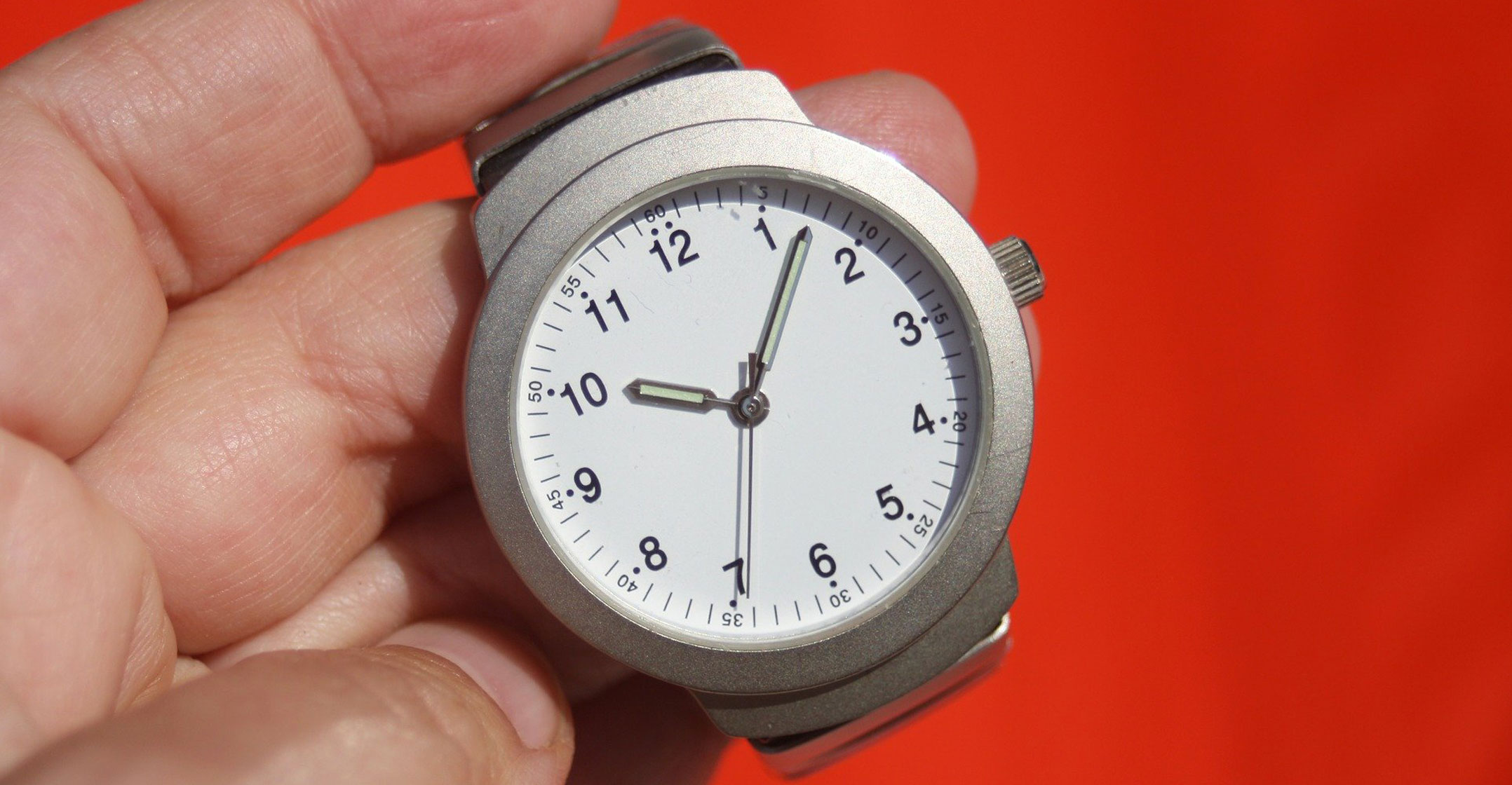
    The fact we can make such accurately disciplined oscillators makes frequency and time the most precisely measured of all physical quantities. We send out signals from atomic clocks all over the world, and up into space via GPS. Anyone with a GPS receiver in their mobile phone has access to an astonishingly accurate time measurement device.

    If you can measure time and frequency accurately, then there are all kinds of other things you can accurately measure, too. For example, measuring the spin flip frequency of certain atoms and molecules can tell you the strength of the magnetic field they experience, so if you can find the frequency precisely then you’ve also found the field strength precisely. The smallest possible magnetic field sensors work this way.

    But can we make better clocks that allow us to measure frequency or time even more precisely? The answer might still be just as John Harrison found, to go higher in frequency.

    Scientists are thinking about whether the international definition of the second could be redefined to make it more precise

    The caesium spin flip resonance has a frequency corresponding to microwaves, but some atoms have nice sharp resonances for optical light, a million times higher in frequency. Optical atomic clocks have shown extremely stable comparisons with one another, at least when a pair of them is placed only a few metres apart.

    Scientists are thinking about whether the international definition of the second could be redefined to make it more precise. But to achieve this, the different optical clocks that we would use to keep time precisely need to be trusted to read the same time even if they are in different labs thousands of miles apart. So far, such long-distance tests have been not much better than for microwave clocks.

    Ultra-fast lasers

    Now, using a new way of linking the clocks with ultra-fast lasers, researchers have shown that different kinds of optical atomic clocks can be placed a few kilometres apart and still agree within 1 part in 10¹⁸. This is just as good as previous measurements with pairs of identical clocks a few hundred metres apart, but about a hundred times more precise than achieved before with different clocks or large distances.

    The authors of the new study compared multiple clocks based on different types of atoms – ytterbium, aluminium and strontium in their case. The strontium clock was situated in the University of Colorado and the other two were in the US National Institute of Standards and Technology, down the road.

    The study connected the clocks with a laser beam through the air over 1.5km from building to building, and this link was shown to be just as good as an optical fibre under the road, in spite of air turbulence.

    But why do we need such accurate clocks? Although the atoms in the clock are supposed to be exactly the same wherever the clock sits and whoever looks at it, tiny useful differences can appear when the measurements of time are so precise.

    According to Einstein’s theory of general relativity, gravity distorts space-time, and we can measure this distortion. Optical clocks have already been used to detect the difference in the Earth’s gravitational field by moving just a centimetre in height.

    With more accurate clocks, maybe you could sense the creep in stress of the Earth’s crust and predict volcanic eruptions. Gravitational waves produced by distant black hole mergers have been seen – maybe we will now be able to detect much weaker waves from less cataclysmic events using a pair of satellites with optical clocks.The Conversation

    • Written by Ben Murdin, professor of photonics and quantum sciences, University of Surrey
    • This article is republished from The Conversation under a Creative Commons licence

    Follow TechCentral on Google News Add TechCentral as your preferred source on Google


    top
    WhatsApp YouTube
    Share. Facebook Twitter LinkedIn WhatsApp Telegram Email Copy Link
    Previous ArticleWatch | Journey to the enterprise cloud with SUSE
    Next Article Fridges, microwaves fall prey to global chip shortage

    Related Posts

    18GW in unplanned breakdowns cripple Eskom

    2 November 2021

    Nersa kicks the Karpowership can down the road

    13 September 2021

    If you think South African load shedding is bad, try Zimbabwe’s

    13 September 2021
    Company News
    Fibre: the backbone of South Africa's digital health ecosystem - Mweb

    Fibre: the backbone of South Africa’s digital health ecosystem

    16 April 2026
    New man to accelerate wholesale connectivity in the DRC - Gaetan Soltesz, FAST Congo

    New man to accelerate wholesale connectivity in the DRC

    15 April 2026
    Avast Business and Avert IT Distribution rewrite the SMB cybersecurity playbook

    Avast Business and Avert IT Distribution rewrite the SMB cybersecurity playbook

    15 April 2026
    Opinion
    The conflict of interest at the heart of PayShap's slow adoption - Cheslyn Jacobs

    The conflict of interest at the heart of PayShap’s slow adoption

    26 March 2026
    South Africa's energy future hinges on getting wheeling right - Aishah Gire

    South Africa’s energy future hinges on getting wheeling right

    10 March 2026
    Hold the doom: the case for a South African comeback - Duncan McLeod

    Apple just dropped a bomb on the Windows world

    5 March 2026

    Subscribe to Updates

    Get the best South African technology news and analysis delivered to your e-mail inbox every morning.

    Latest Posts
    DStv drops premium paywall on Fifa World Cup in Canal+-era shift - SuperSport Rendani Ramovha

    DStv drops premium paywall on Fifa World Cup in Canal+-era shift

    17 April 2026
    How a connectivity levy became a tax on telecoms

    How a connectivity levy became a tax on telecoms

    17 April 2026
    Wits project pits African creators against AI music's blind spots

    Wits project pits African creators against AI music’s blind spots

    17 April 2026
    Prosus offloads 4.5% of Delivery Hero to Uber for €270-million

    Prosus offloads 4.5% of Delivery Hero to Uber for €270-million

    17 April 2026
    © 2009 - 2026 NewsCentral Media
    • Cookie policy (ZA)
    • TechCentral – privacy and Popia

    Type above and press Enter to search. Press Esc to cancel.

    Manage consent

    TechCentral uses cookies to enhance its offerings. Consenting to these technologies allows us to serve you better. Not consenting or withdrawing consent may adversely affect certain features and functions of the website.

    Functional Always active
    The technical storage or access is strictly necessary for the legitimate purpose of enabling the use of a specific service explicitly requested by the subscriber or user, or for the sole purpose of carrying out the transmission of a communication over an electronic communications network.
    Preferences
    The technical storage or access is necessary for the legitimate purpose of storing preferences that are not requested by the subscriber or user.
    Statistics
    The technical storage or access that is used exclusively for statistical purposes. The technical storage or access that is used exclusively for anonymous statistical purposes. Without a subpoena, voluntary compliance on the part of your Internet Service Provider, or additional records from a third party, information stored or retrieved for this purpose alone cannot usually be used to identify you.
    Marketing
    The technical storage or access is required to create user profiles to send advertising, or to track the user on a website or across several websites for similar marketing purposes.
    • Manage options
    • Manage services
    • Manage {vendor_count} vendors
    • Read more about these purposes
    View preferences
    • {title}
    • {title}
    • {title}