Close Menu
TechCentralTechCentral

    Subscribe to the newsletter

    Get the best South African technology news and analysis delivered to your e-mail inbox every morning.

    Facebook X (Twitter) YouTube LinkedIn
    WhatsApp Facebook X (Twitter) LinkedIn YouTube
    TechCentralTechCentral
    • News
      Malatsi withdraws AI policy after fictitious sources scandal - Solly Malatsi

      Malatsi withdraws AI policy after fictitious sources scandal

      26 April 2026
      How AI could quietly hollow out South Africa's job market

      How AI could quietly hollow out South Africa’s job market

      26 April 2026
      SpaceX bets the rocket farm on AI

      SpaceX bets the rocket farm on AI

      26 April 2026
      Withdraw AI policy, Malatsi told as fake citations row grows - Solly Malatsi

      Withdraw AI policy, Malatsi told, as fake citations row grows

      26 April 2026
      The remarkable turnaround at Intel

      The remarkable turnaround at Intel

      26 April 2026
    • World
      More organic compounds detected on Mars - Nasa Curiosity rover

      More organic compounds detected on Mars

      21 April 2026
      Adobe bets on AI agents to fend off cheaper rivals

      Adobe bets on AI agents to fend off cheaper rivals

      16 April 2026
      Google poised to lose ad crown to Meta

      Google poised to lose ad crown to Meta

      14 April 2026
      Grand Theft Data - hackers hit Rockstar Games - Grand Theft Auto

      Grand Theft Data – hackers hit Rockstar Games

      14 April 2026
      UK PM Keir Starmer declares war on doomscrolling

      UK PM Keir Starmer declares war on doomscrolling

      13 April 2026
    • In-depth
      Africa switches on as Europe dims the lights

      Africa switches on as Europe dims the lights

      9 April 2026
      The biggest untapped EV market on Earth is hiding in plain sight

      The biggest untapped EV market on Earth is hiding in plain sight

      1 April 2026
      The R18-billion tech giant hiding in plain sight - Jens Montanana

      The R16-billion tech giant hiding in plain sight

      26 March 2026
      The last generation of coders

      The last generation of coders

      18 February 2026
      Sentech is in dire straits

      Sentech is in dire straits

      10 February 2026
    • TCS

      TCS+ | ‘The ISP for ISPs’: Vox’s shift to wholesale aggregator

      20 April 2026
      TCS | Werner Lindemann on how AI is rewriting the infosec rulebook

      TCS | Werner Lindemann on how AI is rewriting the infosec rulebook

      15 April 2026
      TCS | Donovan Marsh on AI and the future of filmmaking

      TCS | Donovan Marsh on AI and the future of filmmaking

      7 April 2026
      TCS+ | Vodacom Business moves to crack the SME tech gap - Andrew Fulton, Sannesh Beharie

      TCS+ | Vodacom Business moves to crack the SME tech gap

      7 April 2026
      TCS | MTN's Divysh Joshi on the strategy behind Pi - Divyesh Joshi

      TCS | MTN’s Divyesh Joshi on the strategy behind Pi

      1 April 2026
    • Opinion
      The conflict of interest at the heart of PayShap's slow adoption - Cheslyn Jacobs

      The conflict of interest at the heart of PayShap’s slow adoption

      26 March 2026
      South Africa's energy future hinges on getting wheeling right - Aishah Gire

      South Africa’s energy future hinges on getting wheeling right

      10 March 2026
      Hold the doom: the case for a South African comeback - Duncan McLeod

      Apple just dropped a bomb on the Windows world

      5 March 2026
      R230-million in the bag for Endeavor's third Harvest Fund - Alison Collier

      VC’s centre of gravity is shifting – and South Africa is in the frame

      3 March 2026
      Hold the doom: the case for a South African comeback - Duncan McLeod

      Hold the doom: the case for a South African comeback

      26 February 2026
    • Company Hubs
      • 1Stream
      • Africa Data Centres
      • AfriGIS
      • Altron Digital Business
      • Altron Document Solutions
      • Altron Group
      • Arctic Wolf
      • Ascent Technology
      • AvertITD
      • BBD
      • Braintree
      • CallMiner
      • CambriLearn
      • CYBER1 Solutions
      • Digicloud Africa
      • Digimune
      • Domains.co.za
      • ESET
      • Euphoria Telecom
      • HOSTAFRICA
      • Incredible Business
      • iONLINE
      • IQbusiness
      • Iris Network Systems
      • Kaspersky
      • LSD Open
      • Mitel
      • NEC XON
      • Netstar
      • Network Platforms
      • Next DLP
      • Ovations
      • Paracon
      • Paratus
      • Q-KON
      • SevenC
      • SkyWire
      • Solid8 Technologies
      • Telit Cinterion
      • Telviva
      • Tenable
      • Vertiv
      • Videri Digital
      • Vodacom Business
      • Wipro
      • Workday
      • XLink
    • Sections
      • AI and machine learning
      • Banking
      • Broadcasting and Media
      • Cloud services
      • Contact centres and CX
      • Cryptocurrencies
      • Education and skills
      • Electronics and hardware
      • Energy and sustainability
      • Enterprise software
      • Financial services
      • HealthTech
      • Information security
      • Internet and connectivity
      • Internet of Things
      • Investment
      • IT services
      • Lifestyle
      • Motoring
      • Policy and regulation
      • Public sector
      • Retail and e-commerce
      • Satellite communications
      • Science
      • SMEs and start-ups
      • Social media
      • Talent and leadership
      • Telecoms
    • Events
    • Advertise
    TechCentralTechCentral
    Home » Sections » Science » SpaceX vs Nasa: Who will get us to the moon first?

    SpaceX vs Nasa: Who will get us to the moon first?

    By The Conversation3 February 2021
    Twitter LinkedIn Facebook WhatsApp Email Telegram Copy Link
    News Alerts
    WhatsApp

    No one has visited the moon since 1972. But with the advent of commercial human spaceflight, the urge to return is resurgent and generating a new space race. Nasa has selected the private company SpaceX to be part of its commercial spaceflight operations, but the firm is also pursuing its own space exploration agenda.

    To enable flights to the moon and beyond, both Nasa and SpaceX are developing new, heavy-lift rockets: SpaceX’s Starship and Nasa’s Space Launch System.

    But how do they differ and which one is more powerful?

    Starship

    Rockets go through multiple stages to get into orbit. By discarding spent fuel tanks while in flight, the rocket becomes lighter and therefore easier to accelerate. Once in operation, SpaceX’s launch system will be comprised of two stages: the launch vehicle known as Super Heavy and the Starship.

    Super Heavy is powered by the Raptor rocket engine, burning a combination of liquid methane and liquid oxygen. The basic principle of a liquid-fuel rocket engine is that two propellants – a fuel such as kerosene and an oxidiser such as liquid oxygen – are brought together in a combustion chamber and ignited. The flame produces hot gas under high pressure which is expelled at high speed through the engine nozzle to produce thrust.

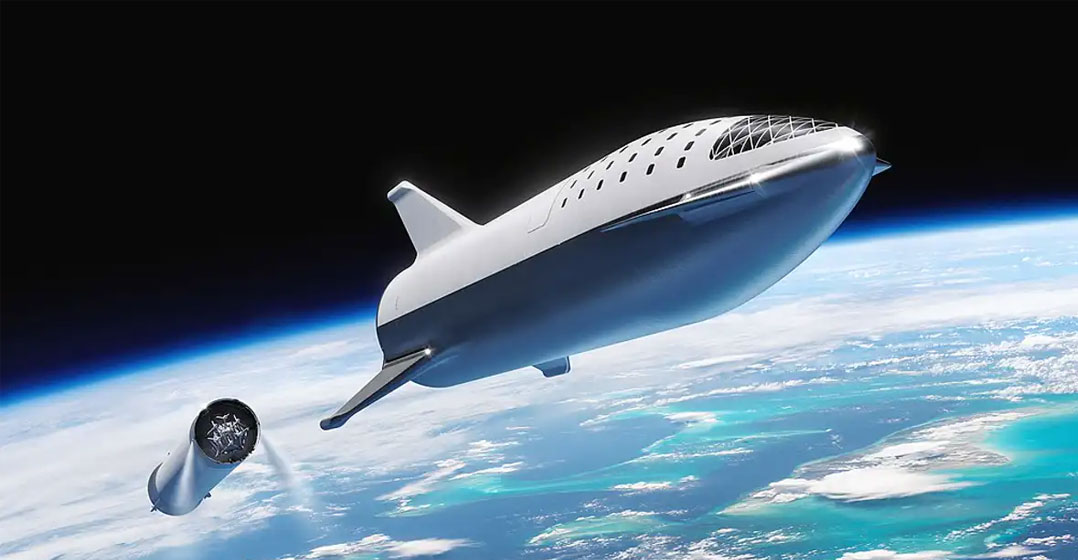
    The rocket will provide 6.8 million kilograms of thrust at launch, which is approximately twice as much as the rockets of the Apollo era. Atop the launcher sits the Starship, itself powered by another six Raptor engines and equipped with a large mission bay for accommodating satellites, compartments for up to 100 crew and even extra fuel tanks for refuelling in space, which is critical to long duration interplanetary human spaceflight.

    The Starship is designed to operate both in the vacuum of space and within the atmospheres of Earth and Mars

    The Starship is designed to operate both in the vacuum of space and within the atmospheres of Earth and Mars, using small moveable wings to glide to a desired landing zone.

    Once over the landing area, the Starship flips into a vertical position and uses its on-board Raptor engines to make a powered descent and landing. It will have sufficient thrust to lift itself off the surface of Mars or the moon, overcoming the weaker gravity of these worlds, and return to Earth – again making a powered soft landing. The Starship and Super Heavy are both fully re-useable and the entire system is designed to lift more than 100 tons of payload to the surface of the moon or Mars.

    The spacecraft is maturing rapidly. A recent test flight of the Starship prototype, the SN8, successfully demonstrated a number of the manoeuvres required to make this work. Unfortunately, there was a malfunction in one of the Raptor engines and the SN8 crashed on landing. Another test flight, this week, also exploded on landing.

    Nasa’s Space Launch System

    The Space Launch System (SLS) from Nasa will be taking the crown from the discontinued Saturn V as the most powerful rocket the agency has ever used. The current incarnation (SLS block 1) stands at almost 100m tall.

    The SLS core stage, containing more than 3.3 million litres of liquid hydrogen and liquid oxygen (equivalent to one-and-a-half Olympic-sized swimming pools), is powered by four RS-25 engines, three of which were used on the previous Space Shuttle. Their main difference from the Raptors is that they burn liquid hydrogen instead of methane.

    The core stage of the rocket is augmented by two solid rocket boosters, attached to its sides, providing a total combined thrust of 3.7 million kilograms at launch — about 5% more than the Saturn V. This will lift the spacecraft to low-Earth orbit. The upper stage is intended to lift the attached payload – the astronaut capsule – out of Earth’s orbit and is a smaller liquid fuel stage powered by a single RL-10 engine (already in use by Atlas and Delta rockets), which is smaller and lighter than the RS-25.
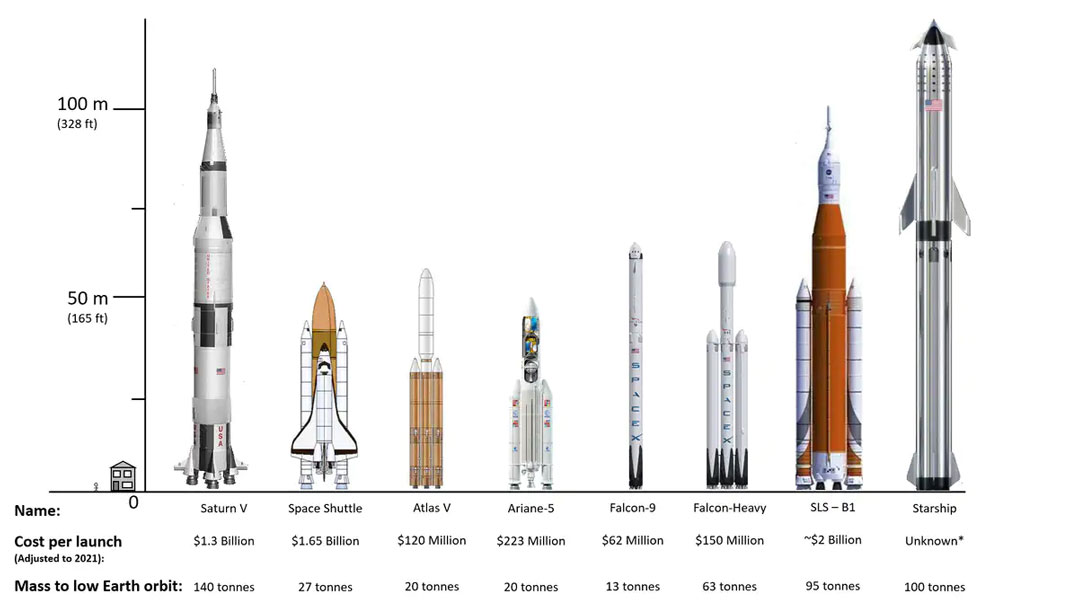
    Nasa’s SLS and SpaceX’s Starship, on the right, could both get us to the moon and beyond

    The Space Launch System will send the Orion crew capsule, which can support up to six crew for 21 days, to the moon as part of the Artemis-1 mission – a task that current Nasa rockets are currently not capable of performing.

    It is intended to have large acrylic windows so astronauts can watch the journey. It will also have its own engine and fuel supply, as well as secondary propulsion systems for returning to the Earth. Future space stations, such as the Lunar Gateway, will serve as a logistical hub, which may include refuelling.

    The core stage and booster rockets are unlikely to be reusable (instead of landing they will drop in the ocean), so there is a higher cost with the SLS system, both in materials and environmentally. It is designed to evolve to larger stages capable of carrying crew or cargo weighing up to 120 tonnes, which is potentially more than Starship.

    A lot of the technology being used in SLS is so-called “legacy equipment” in that it is adapted from previous missions, cutting down the research and development time. However, earlier this month, a test fire of the SLS core stage was stopped a minute into the eight-minute test due to a suspected component failure. No significant damage occurred, and the SLS programme manager, John Honeycutt, stated: “I don’t think we’re looking at a significant design change.”

    And the winner is…

    So, which spacecraft likely to reach carry a crew to the moon first? Artemis 2 is planned as the first crewed mission using SLS to perform a flyby of the moon and is expected to launch in August 2023. Whereas SpaceX has no specific date planned for crewed launch, it is running #dearMoon – a project involving lunar space tourism planned for 2023. Musk has also stated that a crewed Martian mission could take place as early as 2024, also using Starship.

    Ultimately, it is a competition between an agency that has had years of testing and experience but is limited by a fluctuating taxpayer budget and administration policy changes, and a company relatively new to the game but which has already launched 109 Falcon 9 rockets with a 98% success rate and has a dedicated long-term cash flow.

    Whoever reaches the moon first will inaugurate a new era of exploration of a world which still has much scientific value.The Conversation

    • Written by Gareth Dorrian, postdoctoral research fellow in space science, University of Birmingham, and Ian Whittaker, senior lecturer in physics, Nottingham Trent University
    • This article is republished from The Conversation under a Creative Commons licence

    Follow TechCentral on Google News Add TechCentral as your preferred source on Google


    Nasa SpaceX top
    WhatsApp YouTube
    Share. Facebook Twitter LinkedIn WhatsApp Telegram Email Copy Link
    Previous ArticleElon Musk triggers stampede for iPhone-only Clubhouse app
    Next Article It’s time to turn the managed services model on its head

    Related Posts

    SpaceX bets the rocket farm on AI

    SpaceX bets the rocket farm on AI

    26 April 2026
    Icasa caught in the political crossfire over Starlink - Elon Musk

    Icasa caught in the political crossfire over Starlink

    24 April 2026
    More organic compounds detected on Mars - Nasa Curiosity rover

    More organic compounds detected on Mars

    21 April 2026
    Company News
    Cybersecurity in the age of AI: why speed and trust now define resilience - iqbusiness

    Cybersecurity in the AI age: speed and trust define resilience

    24 April 2026
    Security by design is the channel's strongest pitch - Othelo Vieira

    Security by design is the channel’s strongest pitch

    23 April 2026
    Your brand is invisible to the AI that's choosing your competitor - Michelle Losco

    Your brand is invisible to the AI that’s choosing your competitor

    23 April 2026
    Opinion
    The conflict of interest at the heart of PayShap's slow adoption - Cheslyn Jacobs

    The conflict of interest at the heart of PayShap’s slow adoption

    26 March 2026
    South Africa's energy future hinges on getting wheeling right - Aishah Gire

    South Africa’s energy future hinges on getting wheeling right

    10 March 2026
    Hold the doom: the case for a South African comeback - Duncan McLeod

    Apple just dropped a bomb on the Windows world

    5 March 2026

    Subscribe to Updates

    Get the best South African technology news and analysis delivered to your e-mail inbox every morning.

    Latest Posts
    Malatsi withdraws AI policy after fictitious sources scandal - Solly Malatsi

    Malatsi withdraws AI policy after fictitious sources scandal

    26 April 2026
    How AI could quietly hollow out South Africa's job market

    How AI could quietly hollow out South Africa’s job market

    26 April 2026
    SpaceX bets the rocket farm on AI

    SpaceX bets the rocket farm on AI

    26 April 2026
    Withdraw AI policy, Malatsi told as fake citations row grows - Solly Malatsi

    Withdraw AI policy, Malatsi told, as fake citations row grows

    26 April 2026
    © 2009 - 2026 NewsCentral Media
    • Cookie policy (ZA)
    • TechCentral – privacy and Popia

    Type above and press Enter to search. Press Esc to cancel.

    Manage consent

    TechCentral uses cookies to enhance its offerings. Consenting to these technologies allows us to serve you better. Not consenting or withdrawing consent may adversely affect certain features and functions of the website.

    Functional Always active
    The technical storage or access is strictly necessary for the legitimate purpose of enabling the use of a specific service explicitly requested by the subscriber or user, or for the sole purpose of carrying out the transmission of a communication over an electronic communications network.
    Preferences
    The technical storage or access is necessary for the legitimate purpose of storing preferences that are not requested by the subscriber or user.
    Statistics
    The technical storage or access that is used exclusively for statistical purposes. The technical storage or access that is used exclusively for anonymous statistical purposes. Without a subpoena, voluntary compliance on the part of your Internet Service Provider, or additional records from a third party, information stored or retrieved for this purpose alone cannot usually be used to identify you.
    Marketing
    The technical storage or access is required to create user profiles to send advertising, or to track the user on a website or across several websites for similar marketing purposes.
    • Manage options
    • Manage services
    • Manage {vendor_count} vendors
    • Read more about these purposes
    View preferences
    • {title}
    • {title}
    • {title}