
Close Menu
TechCentralTechCentral

    Subscribe to the newsletter

    Get the best South African technology news and analysis delivered to your e-mail inbox every morning.

    Facebook X (Twitter) YouTube LinkedIn
    WhatsApp Facebook X (Twitter) LinkedIn YouTube
    TechCentralTechCentral
    • News
      The Tim Cook era is ending at Apple

      The Tim Cook era is ending at Apple

      15 November 2025
      Revolut hires heavy hitter as it readies its South African launch - Gaby Magomola

      Revolut hires heavy hitter as it readies its South African launch

      15 November 2025
      South Africa get first rating upgrade in nearly 20 years

      South Africa gets its first rating upgrade in nearly 20 years

      15 November 2025
      Discovery Bank opens the crypto gates - Hylton Kallner

      Discovery Bank opens the crypto gates

      14 November 2025
      Kuiper no more: Amazon Leo steps up to challenge to Musk's Starlink

      Kuiper no more: Amazon Leo steps up to challenge Musk’s Starlink

      14 November 2025
    • World
      EU moves to ring-fence 6GHz band for 6G, squeezing out Wi-Fi

      EU moves to ring-fence 6GHz band for 6G, squeezing out Wi-Fi

      13 November 2025
      The billionaire battle to put America back on the moon

      The billionaire battle to put America back on the moon

      12 November 2025
      DeepSeek warns of social upheaval from AI - Chen Deli

      China’s DeepSeek warns of social upheaval from AI

      7 November 2025
      Tesla investors hand Elon Musk the biggest pay deal in history

      Tesla investors hand Elon Musk the biggest pay deal in history

      7 November 2025
      Jensen Huang: 'China is going to win the AI race' - Nvidia

      Jensen Huang: ‘China is going to win the AI race’

      6 November 2025
    • In-depth
      Valve's Linux console takes aim at Microsoft's gaming empire

      Valve’s Linux console takes aim at Microsoft’s gaming empire

      13 November 2025
      iOCO's extraordinary comeback plan - Rhys Summerton

      iOCO’s extraordinary comeback plan

      28 October 2025
      Why smart glasses keep failing - no, it's not the tech - Mark Zuckerberg

      Why smart glasses keep failing – it’s not the tech

      19 October 2025
      BYD to blanket South Africa with megawatt-scale EV charging network - Stella Li

      BYD to blanket South Africa with megawatt-scale EV charging network

      16 October 2025
      DStv woos customers with free upgrades

      As DStv turns 30, it faces its toughest test yet

      6 October 2025
    • TCS
      TCS | Why Altron is building an AI factory - Bongani Andy Mabaso

      TCS | Why Altron is building an AI factory in Johannesburg

      28 October 2025

      TCS+ | Videsha Proothveerajh on Vodacom Business’s new approach to enterprise technology

      28 October 2025
      TCS | The company building a 'living computer' with human cells - Fred Jordan FinalSpark

      TCS | The company building a ‘living computer’ with human cells

      23 October 2025
      TCS | Why South Africans are starting to spend crypto, not just trade it

      TCS | Why South Africans are starting to spend crypto, not just trade it

      22 October 2025
      TCS+ | Managing Sims, saving money: how MSB Micro keeps businesses connected

      TCS+ | Managing Sims, saving money: how MSB Micro keeps businesses connected

      22 October 2025
    • Opinion
      How South Africa's broken Rica system fuels murder and mayhem - Farhad Khan

      How South Africa’s broken Rica system fuels murder and mayhem

      10 November 2025
      South Africa's AI data centre boom risks overloading a fragile grid - Paul Colmer

      South Africa’s AI data centre boom risks overloading a fragile grid

      30 October 2025
      How Eskom clawed its way back from the brink - Busi Mavuso

      How Eskom clawed its way back from the brink

      13 October 2025
      AI takes the throne - Brian Hungwe

      AI takes the throne

      6 October 2025
      How Eskom clawed its way back from the brink - Busi Mavuso

      Trump tariffs and diplomatic missteps push Agoa off the cliff

      6 October 2025
    • Company Hubs
      • Africa Data Centres
      • AfriGIS
      • Altron Digital Business
      • Altron Document Solutions
      • Altron Group
      • Arctic Wolf
      • AvertITD
      • Braintree
      • CallMiner
      • CambriLearn
      • CYBER1 Solutions
      • Digicloud Africa
      • Digimune
      • Domains.co.za
      • ESET
      • Euphoria Telecom
      • Incredible Business
      • iONLINE
      • Iris Network Systems
      • LSD Open
      • NEC XON
      • Netstar
      • Network Platforms
      • Next DLP
      • Ovations
      • Paracon
      • Paratus
      • Q-KON
      • SevenC
      • SkyWire
      • Solid8 Technologies
      • Telit Cinterion
      • Tenable
      • Vertiv
      • Videri Digital
      • Vodacom Business
      • Wipro
      • Workday
      • XLink
    • Sections
      • AI and machine learning
      • Banking
      • Broadcasting and Media
      • Cloud services
      • Contact centres and CX
      • Cryptocurrencies
      • Education and skills
      • Electronics and hardware
      • Energy and sustainability
      • Enterprise software
      • Financial services
      • Information security
      • Internet and connectivity
      • Internet of Things
      • Investment
      • IT services
      • Lifestyle
      • Motoring
      • Public sector
      • Retail and e-commerce
      • Satellite communications
      • Science
      • SMEs and start-ups
      • Social media
      • Talent and leadership
      • Telecoms
    • Events
    • Advertise
    TechCentralTechCentral
    Home » Sections » AI and machine learning » Systemic risk in the age of AI

    Systemic risk in the age of AI

    As cyberattacks and AI risks grow, the digital economy’s fragility has echoes in the 2008 financial crash.
    By The Conversation27 September 2025
    Twitter LinkedIn Facebook WhatsApp Email Telegram Copy Link
    News Alerts
    WhatsApp

    Systemic risk in the age of AIPeople’s lives are more enmeshed with digital systems than ever before, increasing users’ vulnerability and insecurity. From data leaks like the 2017 Equifax data breach to the more recent cyberattack on British retailer Marks & Spencer, business operations and data on the internet continue to be vulnerable.

    There are good reasons to believe that little will be done about these risks until a massive society-wide crisis emerges.

    My research suggests that there are significant failures in our current approaches to risk and innovation. Digital technologies remake social life through new technologies, communication platforms and forms of artificial intelligence. All of which, while very powerful, are also highly risky in terms of malfunctioning and vulnerability to being manipulated.

    There are significant similarities between the current trajectory of the digital economy and the 2008 financial crisis

    Yet governments are generally unable to distinguish between what are actually valuable contributions to society and what are intensely socially damaging.

    The digital economy includes “those businesses that increasingly rely upon information technology, data and the internet for their business models”. The companies dominating the digital economy continue to undertake a massive social experiment where they keep the lion’s share of the benefits while shunting the risks onto society as a whole.

    This could lead to a systemic digital crisis, ranging from a widespread breakdown of basic infrastructure, such as electricity or telecommunications due to a cyberattack, to an attack that modifies existing infrastructure to make it dangerous.

    There are significant similarities between the current trajectory of the digital economy and the 2008 financial crisis. In particular, what we are increasingly seeing in the digital world, which we saw in the pre-crisis financial world, is what American sociologist Charles Perrow called “tight coupling”.

    Interdependence

    Perrow argues that when systems exhibit high levels of interconnection without sufficient redundancy to compensate for failures, it can lead to catastrophic consequences.

    Likewise, high levels of complexity are generally considered to make highly interconnected systems riskier. Unanticipated risks and connections can lead to failures cascading across the system.

    Our existing digital economy shares many of these characteristics. The digital economy is characterised by a business model that focuses on businesses getting as large as possible as quickly as possible.

    Read: AI boom puts Africa at a crossroads

    The lead-up to the 2008 financial crisis and the current digital economy share both the amplification of interdependency alongside the reduction of redundancy. In the case of finance, this proceeded through massive borrowing to leverage earnings, leaving a smaller ratio of money left to cover any possible losses.

    In the digital economy, this need to continuously collect data increases interdependencies among datasets, platforms, corporations and networks. This increased interdependency is fundamental to the core business model of the digital economy.
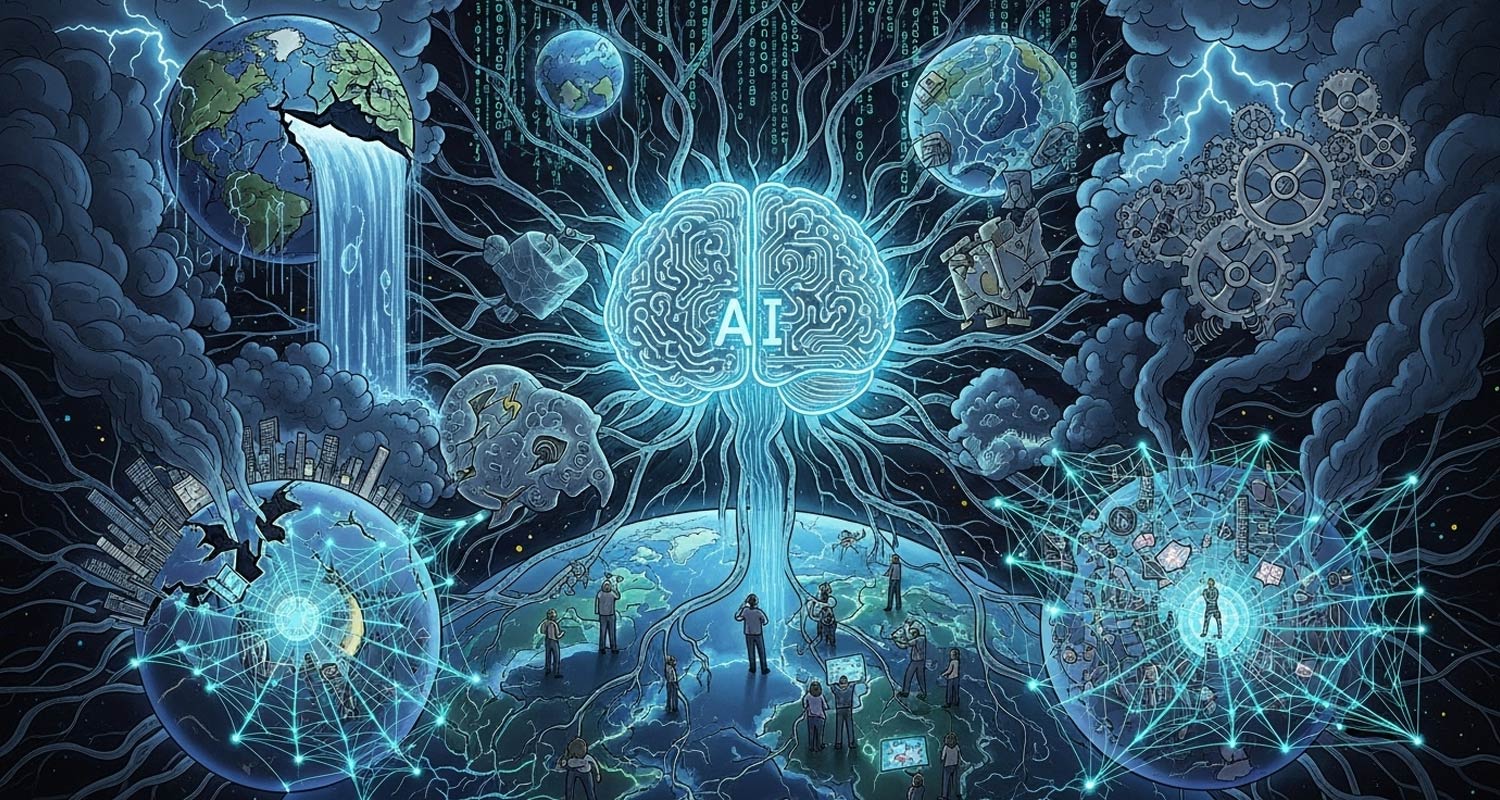
    The undermining of redundancy in the digital sphere is manifested in the “move-fast-and-break-things” ethos in which digital companies eliminate or acquire competitors as quickly as possible while eliminating analogue alternatives to their own digital networks.

    Last, these digital behemoths and their rapid growth increase the complexity of the digital economy and the monopolistic networks that dominate it.

    There is a key difference between the 2008 financial crisis and the contemporary digital economy. Unlike in the lead-up to the crisis, where a partially finance-driven prosperity quieted any obvious warning signs, the warning signs in the digital economy are front and centre for everyone to see.

    There is a key difference between the 2008 financial crisis and the contemporary digital economy

    The 2017 WannaCry and NotPetya malware attacks each caused billions of dollars in damages. More recently, the CrowdStrike failure in 2024 cancelled thousands of flights, and even took television stations off the air. Constant hacks, ransomware attacks and data leakages are warning signs that this is a deeply fragile system.

    AI has taken many of these vulnerabilities into overdrive, while adding new risks, such as AI hallucinations and the exponential growth in misinformation. The speed and scale of AI are expected to intensify existing risks to confidentiality, system integrity and availability.

    This is potentially the most significant, though unfortunate element in this story. There is massive system risk, yet they are not addressed directly, and the processes heightening these risks continue to accelerate.

    Read: China flaunts the future of war

    This suggests a deeper problem in our politics. While we do have some ability to regulate after the damage is done, we struggle to prevent the next crisis.The Conversation

    • The author, Dean Curran, is associate professor in sociology at the University of Calgary
    • This article is republished from The Conversation under a Creative Commons licence. Read the original article

    Get breaking news from TechCentral on WhatsApp. Sign up here.



    Dean Curran
    Subscribe to TechCentral Subscribe to TechCentral
    Share. Facebook Twitter LinkedIn WhatsApp Telegram Email Copy Link
    Previous ArticleThe people who will lead Africa’s new pay-TV giant
    Next Article AI vs artists: who owns the future of music?
    Company News
    Seize these 3 opportunities to build a digital Africa - Song Xiaodi Huawei

    Seize these 3 opportunities to build a digital Africa

    14 November 2025
    A new era of e-mail defence: KnowBe4 meets Microsoft

    A new era of e-mail defence: KnowBe4 meets Microsoft

    14 November 2025
    Liquid C2 shows businesses how to turn AI into real operational advantage

    Liquid C2 shows businesses how to turn AI into real operational advantage

    14 November 2025
    Opinion
    How South Africa's broken Rica system fuels murder and mayhem - Farhad Khan

    How South Africa’s broken Rica system fuels murder and mayhem

    10 November 2025
    South Africa's AI data centre boom risks overloading a fragile grid - Paul Colmer

    South Africa’s AI data centre boom risks overloading a fragile grid

    30 October 2025
    How Eskom clawed its way back from the brink - Busi Mavuso

    How Eskom clawed its way back from the brink

    13 October 2025

    Subscribe to Updates

    Get the best South African technology news and analysis delivered to your e-mail inbox every morning.

    Latest Posts
    The Tim Cook era is ending at Apple

    The Tim Cook era is ending at Apple

    15 November 2025
    Revolut hires heavy hitter as it readies its South African launch - Gaby Magomola

    Revolut hires heavy hitter as it readies its South African launch

    15 November 2025
    South Africa get first rating upgrade in nearly 20 years

    South Africa gets its first rating upgrade in nearly 20 years

    15 November 2025
    Discovery Bank opens the crypto gates - Hylton Kallner

    Discovery Bank opens the crypto gates

    14 November 2025
    © 2009 - 2025 NewsCentral Media
    • Cookie policy (ZA)
    • TechCentral – privacy and Popia

    Type above and press Enter to search. Press Esc to cancel.

    Manage consent

    TechCentral uses cookies to enhance its offerings. Consenting to these technologies allows us to serve you better. Not consenting or withdrawing consent may adversely affect certain features and functions of the website.

    Functional Always active
    The technical storage or access is strictly necessary for the legitimate purpose of enabling the use of a specific service explicitly requested by the subscriber or user, or for the sole purpose of carrying out the transmission of a communication over an electronic communications network.
    Preferences
    The technical storage or access is necessary for the legitimate purpose of storing preferences that are not requested by the subscriber or user.
    Statistics
    The technical storage or access that is used exclusively for statistical purposes. The technical storage or access that is used exclusively for anonymous statistical purposes. Without a subpoena, voluntary compliance on the part of your Internet Service Provider, or additional records from a third party, information stored or retrieved for this purpose alone cannot usually be used to identify you.
    Marketing
    The technical storage or access is required to create user profiles to send advertising, or to track the user on a website or across several websites for similar marketing purposes.
    • Manage options
    • Manage services
    • Manage {vendor_count} vendors
    • Read more about these purposes
    View preferences
    • {title}
    • {title}
    • {title}

