Close Menu
TechCentralTechCentral

    Subscribe to the newsletter

    Get the best South African technology news and analysis delivered to your e-mail inbox every morning.

    Facebook X (Twitter) YouTube LinkedIn
    WhatsApp Facebook X (Twitter) LinkedIn YouTube
    TechCentralTechCentral
    • News
      Ministerial churn hollowed out Sita, PSC probe finds

      Ministerial churn hollowed out Sita, PSC probe finds

      9 July 2026
      The fragile joint in the Capitec machine

      The fragile joint in the Capitec machine

      9 July 2026
      Quantum computers are coming for bitcoin

      Quantum computers are coming for bitcoin

      9 July 2026
      Rain's boldest - and strangest - deal yet - Conrad Leigh

      Rain’s boldest – and strangest – deal yet

      8 July 2026
      Netflix, e.tv look to fill the gap Showmax left behind

      Netflix, e.tv look to fill the gap Showmax left behind

      8 July 2026
    • World
      Swingeing jobs cuts at Microsoft's Xbox unit

      Swingeing jobs cuts at Microsoft’s Xbox unit

      6 July 2026

      SK Hynix ends Samsung’s 26-year reign at the top

      22 June 2026
      Google on the hook for what its AI tells users, court rules

      Google on the hook for what its AI tells users, court rules

      15 June 2026
      How Russians juggle VPNs to outwit the Kremlin

      How Russians juggle VPNs to outwit the Kremlin

      15 June 2026
      Amazon CEO flagged Anthropic AI risks to Washington - Andy Jassy

      Amazon CEO flagged Anthropic AI risks to Washington

      14 June 2026
    • In-depth
      AI boom sparks rally, frenzy and fear

      AI boom sparks rally, frenzy and fear

      11 June 2026
      Every plug-in hybrid on sale in South Africa, ranked by price - Lamborghini Temerario

      Every plug-in hybrid on sale in South Africa, ranked by price

      7 June 2026
      What Wi-Fi 8 will mean for wireless networks

      What Wi-Fi 8 will mean for wireless networks

      1 June 2026
      Alfa's electric rebel - Alfa Romeo Junior Elettrica Veloce

      Alfa’s electric rebel

      29 April 2026
      Africa switches on as Europe dims the lights

      Africa switches on as Europe dims the lights

      9 April 2026
    • TCS
      Watts & Wheels S1E7: 'Ferrari's EV breaks the internet'

      Watts & Wheels S1E7: ‘Ferrari’s EV breaks the internet’

      8 July 2026
      TCS+ | How Tracker is turning vehicle data into business strategy - Silvia Schollenberger

      TCS+ | How Tracker is turning vehicle data into business strategy

      1 July 2026
      TCS+ | IBM Bob: an AI-powered 'development partner' for the enterprise - David Spurway

      TCS+ | IBM Bob: an AI-powered development partner for the enterprise

      30 June 2026
      Watts & Wheels S1E6: 'A flawless Alfa and a bakkie that divides'

      Watts & Wheels S1E6: ‘A flawless Alfa and a bakkie that divides’

      17 June 2026
      Watts & Wheels S1E6: 'A flawless Alfa and a bakkie that divides'

      Watts & Wheels S1E5: ‘A Bentley of the bush and a car that swims’

      8 June 2026
    • Opinion
      The author, Fanie van Rooyen

      South Africa can still catch the AI wave – here’s how

      7 July 2026
      The author, Fanie van Rooyen

      The AI utopia South Africa can’t afford

      1 July 2026
      The author, Jannie van Zyl

      South Africa’s broadband future is being decided in orbit, not in Pretoria

      30 June 2026
      The author, Pambos Soteriades

      The pivot South Africa’s MVNOs cannot afford to miss

      23 June 2026
      Brazil's online gambling crackdown is a lesson for South Africa

      Brazil’s online gambling crackdown is a lesson for South Africa

      22 June 2026
    • Company Hubs
      • 1Stream
      • Africa Data Centres
      • AfriGIS
      • Altron Digital Business
      • Altron Document Solutions
      • Altron Group
      • Arctic Wolf
      • Ascent Technology
      • AvertITD
      • BBD
      • Braintree
      • CallMiner
      • CambriLearn
      • CM Telecom
      • Contactable
      • CYBER1 Solutions
      • Digicloud Africa
      • Digimune
      • Domains.co.za
      • ESET
      • Euphoria Telecom
      • HOSTAFRICA
      • Incredible Business
      • iONLINE
      • IQbusiness
      • Iris Network Systems
      • Kaspersky
      • LSD Open
      • Mitel
      • NEC XON
      • Netstar
      • Network Platforms
      • Next DLP
      • Ovations
      • Paracon
      • Paratus
      • Q-KON
      • SevenC
      • SkyWire
      • Solid8 Technologies
      • Telit Cinterion
      • Telviva
      • Tenable
      • Vertiv
      • Videri Digital
      • Vodacom Business
      • Wipro
      • Workday
      • XLink
    • Sections
      • AI and machine learning
      • Banking
      • Broadcasting and Media
      • Cloud services
      • Contact centres and CX
      • Cryptocurrencies
      • Education and skills
      • Electronics and hardware
      • Energy and sustainability
      • Enterprise software
      • Financial services
      • HealthTech
      • Information security
      • Internet and connectivity
      • Internet of Things
      • Investment
      • IT services
      • Lifestyle
      • Policy and regulation
      • Public sector
      • Retail and e-commerce
      • Satellite communications
      • Science
      • SMEs and start-ups
      • Social media
      • Talent and leadership
      • Telecoms
      • Watts & Wheels
    • Events
    • Advertise
    TechCentralTechCentral
    Home » Sections » Banking » The fragile joint in the Capitec machine

    The fragile joint in the Capitec machine

    Capitec’s premium valuation rests on three compounding bets. All three are working – but each is now under pressure.
    By Pambos Soteriades9 July 2026
    Twitter LinkedIn Facebook WhatsApp Email Telegram Copy Link
    News Alerts
    WhatsApp

    The fragile joint in the Capitec machine

    Capitec built its position on a bet most of the banking industry declined to make: that a customer who is poor today will be valuable in five to seven years, if their financial life develops normally. By then their income will have grown, they will have a credit history – and they will trust the bank that was there when they had nothing.

    The market has rewarded that bet with a valuation of about 30x earnings, roughly three times the multiple of other South African banks. The question is whether the structural advantages behind it can survive the competitive environment now arriving.

    Bet one: the poor customer becomes rich, slowly

    This is not a published strategy; it is visible in the data. In the last financial year, Capitec’s fully banked clients – customers who use it for saving, borrowing and spending – grew 12% to 9.9 million. Total personal banking customers grew 7% to 25.2 million. Customers earning over R50 000/month grew 21%.

    These are not new rich customers arriving from elsewhere: Capitec’s acquisition model targets the mass market. These are existing customers whose financial lives improved while Capitec held the relationship. If the trend continues, more of the base earns higher incomes, uses the bank for everything and qualifies for larger products.

    The risk is that the pipeline stalls. Youth unemployment – above 60% on the expanded definition for 15- to 24-year-olds – constrains how fast young people entering the workforce generate income growth, and wage growth is not keeping pace with inflation. Or new banks steal these customers before their lives improve, before switching costs become sticky.

    Bet two: branches and ATMs while everyone else closes them

    Every big bank in South Africa has reached the same conclusion: branches and ATMs are expensive, digital customers don’t need them, and efficiency runs through closure. Between 2019 and 2024, the major established banks closed a combined 8 249 ATMs – Absa 3 500, Standard Bank 3 759, FNB 990.

    Capitec moved in precisely the opposite direction, adding 3 787 ATMs. Why? Because some 60% of low-income South Africans still withdraw most of their income as cash. A bank that closes its ATMs does not modernise for this customer; it abandons them.

    Capitec can afford the expansion because it operates more efficiently: it spends 39c to make R1 of revenue, against 49-54c at other banks. Operating expenses rose 12% last year, but net interest income after credit impairments rose 18% and non-interest income grew 19%. A bank running at a 39% cost-to-income ratio can absorb rising branch and ATM costs in ways a bank at 54% cannot.
    The space Capitec is expanding into will not stay uncontested, though. Pepkor – whose South African retail estate of more than 2 500 stores (Pep, Ackermans, Dunns, Shoe City, Tekkie Town) exceeds the branch networks of the big four banks combined – is launching its own bank in April 2027, under the working name plusb and a CEO, Merwe Scholtz, who started his career at Capitec. Its target of 1.8 million primary banked customers by 2032 is modest against Capitec’s base, but it is aimed squarely at the customers Capitec thought it owned.

    Bet three: the phone as a banking window

    Capitec Connect launched in September 2022 on Cell C’s infrastructure and is now South Africa’s largest mobile virtual network operator, with 1.5 million active clients – up from 900 000 a year earlier. Net income tells the story: R35-million in FY2024, R193-million in FY2025, R442-million in FY2026.

    But the phone business is not primarily about connectivity. Some 80% of bundle sales happen inside the Capitec banking app, and every purchase teaches Capitec something: when customers buy data, how much they spend, what they can afford.

    For a mass market client who withdraws most of their income as cash, the phone reveals what cash transactions cannot – it extends Capitec’s visibility into financial behaviour in the spaces between banking transactions. The mechanism is structural and coherent, though it cannot be verified from public sources: Capitec does not publish data on how Connect’s behavioural signals feed into credit decisions.

    The risk is that this advantage only matters if Capitec owns the phone relationship – and it does not. Cell C does, including the IMSI range. Migration at scale is commercially prohibitive because the free on-net calls only work if every subscriber sits on one Cell C core.
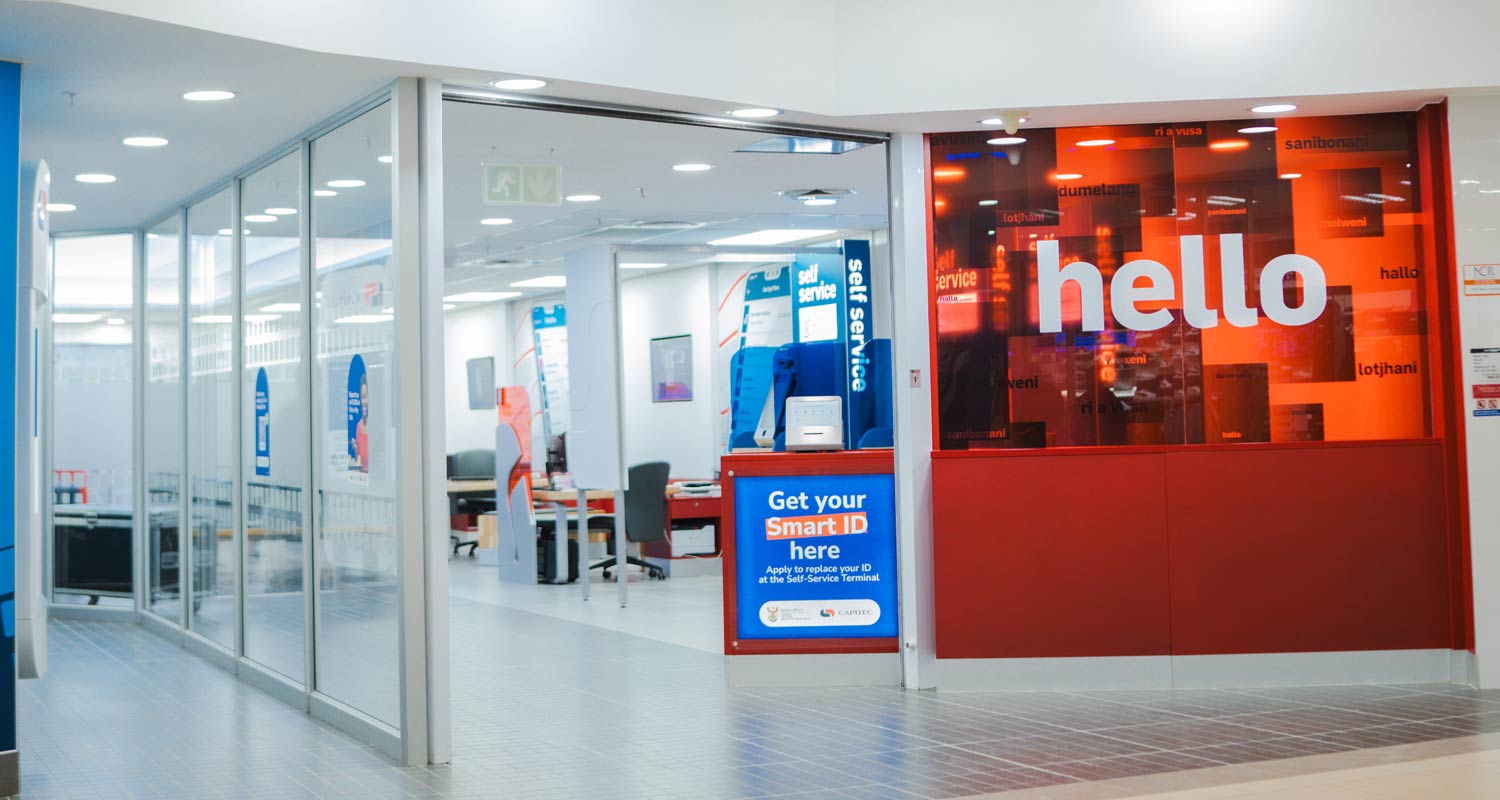
    Capitec smart ID

    At R442-million in annual net income, the MVNO is now materially significant – and if Cell C repriced wholesale access, or Capitec could not negotiate hard because the relationship matters too much, the entire mechanism breaks. Capitec has not publicly indicated a migration strategy. An unhedged dependency sits underneath the very mechanism that is supposed to deepen the data advantage.

    Why Capitec earns less than it should

    Capitec earned R16.85-billion last year – less than Standard Bank’s and FNB’s retail operations (R24.9-billion and R23.6-billion, respectively, in their most recent financial years), despite having far more customers. This paradox sits at the heart of the valuation premium. The market is betting three gaps close over time.

    • Deposits: Capitec holds less than 10% of South Africa’s retail deposits despite its dominance in customer numbers. Its customers have less money to deposit, and deposits fund the lending book – a larger, stickier deposit base funds a larger, higher-yielding book at lower cost. This is the anchor; everything else flows from it.
    • Banking intensity: Only 39% of Capitec’s customers use it for everything. A customer using one product generates one product’s revenue; a customer using five generates five times as much. The ratio is improving – but it is 39%.
    • Type of lending: Capitec lends mainly for short-term personal needs – R5 000 for an emergency, R10 000 for a crisis – where other banks lend R500 000 for a house. Small unsecured loans are higher-risk, higher-reward, and the risk is showing: the credit loss ratio rose from 7.5% to 8.1% last year, with impairment charges up 21% to R9.98-billion – though a meaningful share of that deterioration comes from AvaFin, Capitec’s European lending acquisition, rather than its South African book. If credit losses keep rising, the growth story does not work, because the money does not come back.

    The author, Pambos Soteriades
    The author, Pambos Soteriades

    None of this means the premium is wrong. It means the premium assumes the gaps close: that poor South Africans become progressively less poor, save more and borrow for bigger things – and that the bank holding the relationship from the beginning benefits most. That is a bet on economic mobility, and mobility does not happen at a consistent rate.

    Capitec is a structurally different bank with a different customer base and a different economic model, and right now all three of its bets are working – the data shows it. But the foundation is fragile in one place: the phone relationship it does not control.

    The structural position is real. The pressure on it is real, too. Whether the premium survives depends on whether Capitec can defend its bets while new competitors test all of them simultaneously. That is not guaranteed. It is not impossible either. It is genuinely uncertain – and it is worth watching.

    • The author, Pambos Soteriades, has spent 28 years in mobile telecommunications, including executive roles at Vodacom Group and Telkom Kenya. He is not affiliated with, employed by or invested in any operator, institution or company mentioned in this article
    • Subscribe to TechCentral’s daily newsletter
    • Get breaking news alertson WhatsApp
    Follow TechCentral on Google News Add TechCentral as your preferred source on Google


    Capitec Capitec Connect Cell C FNB Pambos Soteriades Pepkor Standard Bank
    WhatsApp YouTube
    Share. Facebook Twitter LinkedIn WhatsApp Telegram Email Copy Link
    Previous ArticleWhen the internet goes down, who picks up the phone?
    Next Article Ministerial churn hollowed out Sita, PSC probe finds

    Related Posts

    South Africa's IoT opportunity is smaller than it looks - and already taken

    South Africa’s IoT opportunity is smaller than it looks – and already taken

    3 July 2026
    New rules on how operators can cut off your dormant Sim

    New rules on how operators can cut off your dormant Sim

    2 July 2026
    Telcos agree plan to tighten Sim registration under Rica

    Telcos agree plan to tighten Sim registration under Rica

    26 June 2026
    Company News
    When the internet goes down, who picks up the phone? - Vox Business Fibre

    When the internet goes down, who picks up the phone?

    9 July 2026
    Rain launches unlimited mobile plans with LoopPhone

    Rain launches unlimited mobile plans with LoopPhone

    9 July 2026
    Altron Digital Business study links workplace tech to employee satisfaction - Craig Stewart

    Altron Digital Business study links workplace tech to employee satisfaction

    8 July 2026
    Opinion
    The author, Fanie van Rooyen

    South Africa can still catch the AI wave – here’s how

    7 July 2026
    The author, Fanie van Rooyen

    The AI utopia South Africa can’t afford

    1 July 2026
    The author, Jannie van Zyl

    South Africa’s broadband future is being decided in orbit, not in Pretoria

    30 June 2026

    Subscribe to Updates

    Get the best South African technology news and analysis delivered to your e-mail inbox every morning.

    Latest Posts
    Ministerial churn hollowed out Sita, PSC probe finds

    Ministerial churn hollowed out Sita, PSC probe finds

    9 July 2026
    The fragile joint in the Capitec machine

    The fragile joint in the Capitec machine

    9 July 2026
    When the internet goes down, who picks up the phone? - Vox Business Fibre

    When the internet goes down, who picks up the phone?

    9 July 2026
    Rain launches unlimited mobile plans with LoopPhone

    Rain launches unlimited mobile plans with LoopPhone

    9 July 2026
    © 2009 - 2026 NewsCentral Media
    Built and maintained by Chronon
    • Cookie policy (ZA)
    • TechCentral – privacy and Popia

    Type above and press Enter to search. Press Esc to cancel.

    Manage consent

    TechCentral uses cookies to enhance its offerings. Consenting to these technologies allows us to serve you better. Not consenting or withdrawing consent may adversely affect certain features and functions of the website.

    Functional Always active
    The technical storage or access is strictly necessary for the legitimate purpose of enabling the use of a specific service explicitly requested by the subscriber or user, or for the sole purpose of carrying out the transmission of a communication over an electronic communications network.
    Preferences
    The technical storage or access is necessary for the legitimate purpose of storing preferences that are not requested by the subscriber or user.
    Statistics
    The technical storage or access that is used exclusively for statistical purposes. The technical storage or access that is used exclusively for anonymous statistical purposes. Without a subpoena, voluntary compliance on the part of your Internet Service Provider, or additional records from a third party, information stored or retrieved for this purpose alone cannot usually be used to identify you.
    Marketing
    The technical storage or access is required to create user profiles to send advertising, or to track the user on a website or across several websites for similar marketing purposes.
    • Manage options
    • Manage services
    • Manage {vendor_count} vendors
    • Read more about these purposes
    View preferences
    • {title}
    • {title}
    • {title}