
Close Menu
TechCentralTechCentral

    Subscribe to the newsletter

    Get the best South African technology news and analysis delivered to your e-mail inbox every morning.

    Facebook X (Twitter) YouTube LinkedIn
    WhatsApp Facebook X (Twitter) LinkedIn YouTube
    TechCentralTechCentral
    • News
      'There are no adults in the room': the AI safety exodus

      ‘There are no adults in the room’: the AI safety exodus

      11 September 2026
      US in move to counter Huawei in Africa

      US in move to counter Huawei in Africa

      11 September 2026
      SAPS wants to deploy AI bodycams with facial recognition

      SAPS wants to deploy AI bodycams with facial recognition

      10 September 2026
      Lesaka's first profit comes as its merchant business goes backwards - Lincoln Mali

      Lesaka’s first profit comes as its merchant business goes backwards

      10 September 2026
      South Africa's electric car floodgates are opening

      South Africa’s electric car floodgates are opening

      10 September 2026
    • World
      'This is not circular': Jensen Huang defends $3.5-billion MediaTek deal

      ‘This is not circular’: Jensen Huang defends $3.5-billion MediaTek deal

      2 September 2026
      AI-generated music banned from Australian charts

      AI-generated music banned from Australian charts

      26 August 2026
      Traders brace for a R4.5-trillion swing in Nvidia's value

      Traders brace for a R4.5-trillion swing in Nvidia’s value

      25 August 2026
      Russia building its own Starlink - and faster than expected - Vadym Skibitskyi

      Russia building its own Starlink – and faster than expected

      11 August 2026
      Meta AI will now tell parents if their teen is in crisis

      Meta AI will now tell parents if their teen is in crisis

      17 July 2026
    • In-depth
      Google DeepMind CEO Demis Hassabis. Image: John Sears

      The plan to stop AI from breaking the world

      16 July 2026
      The internet has a Strait of Hormuz problem

      The internet has a Strait of Hormuz problem

      15 July 2026
      AI boom sparks rally, frenzy and fear

      AI boom sparks rally, frenzy and fear

      11 June 2026
      Every plug-in hybrid on sale in South Africa, ranked by price - Lamborghini Temerario

      Every plug-in hybrid on sale in South Africa, ranked by price

      7 June 2026
      What Wi-Fi 8 will mean for wireless networks

      What Wi-Fi 8 will mean for wireless networks

      1 June 2026
    • TCS
      Meet the CIO | Shoprite's Chris Shortt on what a supermarket becomes

      Meet the CIO | Shoprite’s Chris Shortt on what a supermarket becomes

      9 September 2026
      Rubicon's EV charging network is profitable - and growing fast - Watts & Wheels

      Rubicon’s EV charging network is profitable – and growing fast

      8 September 2026
      Winstone Jordaan on building a national EV charging network

      Winstone Jordaan on building a national EV charging network

      2 September 2026
      Watts & Wheels S1E8: 'Tesla lands in Africa, just not here'

      Watts & Wheels S1E8: ‘Tesla lands in Africa, just not here’

      24 August 2026
      TCS | Herotel CEO Van Zyl Botha on beating Starlink to South Africa

      TCS | Herotel CEO Van Zyl Botha on beating Starlink to South Africa

      14 August 2026
    • Opinion
      The fragile joint in the Capitec machine - Pambos Soteriades

      The R197-billion market the banks can’t reach

      25 August 2026
      South African tech's compounding debt problem - Jannie van Zyl

      Management consulting as we know it is over

      21 August 2026
      South African tech's compounding debt problem - Jannie van Zyl

      The most dangerous customer is the quiet one

      10 August 2026
      South African tech's compounding debt problem - Jannie van Zyl

      South African tech’s compounding debt problem

      29 July 2026
      The fragile joint in the Capitec machine - Pambos Soteriades

      Best network, worst vibes: the puzzle of SA telecoms

      20 July 2026
    • Company Hubs
      • 1Stream
      • Africa Data Centres
      • AfriGIS
      • Altron Digital Business
      • Altron Document Solutions
      • Altron Group
      • Arctic Wolf
      • Ascent Technology
      • AvertITD
      • BBD
      • Braintree
      • CallMiner
      • CambriLearn
      • CM.com
      • Contactable
      • CYBER1 Solutions
      • Digicloud Africa
      • Digimune
      • Domains.co.za
      • ESET
      • Euphoria Telecom
      • HOSTAFRICA
      • Incredible Business
      • iONLINE
      • IQbusiness
      • Iris Network Systems
      • Kaspersky
      • LSD Open
      • Mitel
      • NEC XON
      • Netstar
      • Network Platforms
      • Next DLP
      • Ovations
      • Paracon
      • Paratus
      • Q-KON
      • SevenC
      • SkyWire
      • Solid8 Technologies
      • Telit Cinterion
      • Telviva
      • Tenable
      • Vertiv
      • Videri Digital
      • Vodacom Business
      • Vox
      • Wipro
      • Workday
      • XLink
    • Sections
      • AI and machine learning
      • Banking
      • Broadcasting and Media
      • Cloud services
      • Contact centres and CX
      • Cryptocurrencies
      • Education and skills
      • Electronics and hardware
      • Energy and sustainability
      • Enterprise software
      • Financial services
      • HealthTech
      • Information security
      • Internet and connectivity
      • Internet of Things
      • Investment
      • IT services
      • Lifestyle
      • Policy and regulation
      • Public sector
      • Retail and e-commerce
      • Satellite communications
      • Science
      • SMEs and start-ups
      • Social media
      • Talent and leadership
      • Telecoms
      • Watts & Wheels
    • Events
    • Advertise
    TechCentralTechCentral
    Home » In-depth » The SA student at the forefront of a robotics revolution

    The SA student at the forefront of a robotics revolution

    By Regardt van der Berg31 July 2014
    Twitter LinkedIn Facebook WhatsApp Email Telegram Copy Link
    Get breaking news on WhatsApp

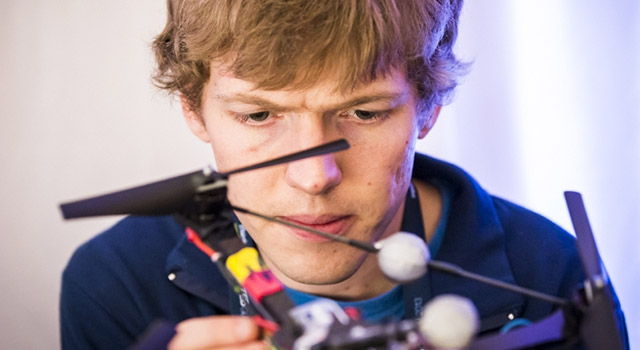
    Mark Müller
    Mark Müller

    Quadrocopters in South Africa have made headlines in recent months over whether it’s legal to use them. But quadrocopters are not just tools for filmmakers or toys for fun — there is a more serious side to them, one that could change the way we look at robotics.

    A South African robotics student living in Switzerland is working with some of the brightest minds in the world to produce research on collaborating robots in autonomous flight. Mark Müller, 28, is studying for his PhD under world-renowned roboticist Prof Raffaello D’Andrea at the Swiss Federal Institute of Technology in Zürich (ETH).

    Müller can be found at the university’s Institute of Dynamic Systems and Control. “It’s somewhat removed from the commercial debates currently underway in the industry,” he tells TechCentral via a Skype interview. “Two noticeable points of difference are that we don’t have a human pilot in the loop, and our flying robots collaborate to perform complex tasks, like building towers, catching balls and juggling, in a closed system that also enables learning.”

    Müller matriculated from Hoërskool Hartbeespoort, north-west of Johannesburg, in 2004. He graduated with a B Eng degree in mechanical engineering from the University of Pretoria in 2008 and then received a scholarship to do his MSc, also in mechanical engineering, at ETH. This is where he met D’Andrea. Their research seeks to redefine what autonomous systems are capable of.

    Robotics was not always an option for Müller. “I always knew about robotics, but it seemed like something so inaccessible. I soon realised this was not the case. I think that for a kid in South Africa, it’s not unrealistic anymore to build a robot and tinker with technology. This is partly because the tools are a lot more readily available online.”

    Müller expects to complete his PhD in mid-2015, after which he intends embarking on an academic career. “I think my career will always focus on robotics,” he says. “The world in 20 or 30 years will be vastly different to what we know now.”

    Robotics will open up many possibilities that will benefit everyone, he says.

    Arena of flying robots
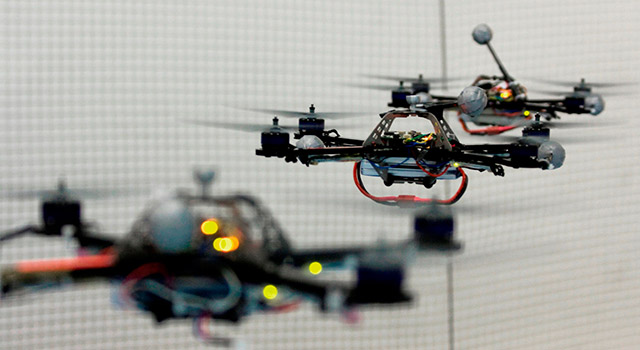
    The best way to understand what Müller and his fellow students are working on is to watch the impressive autonomous flight project called Flying Machine Arena (FMA) — see the video below. Essentially, the FMA is a portable space devoted to autonomous flight and consists of a high-precision motion capture system, a wireless communication network and custom software that executes sophisticated algorithms for estimation and control.

    The arena was built so that it can capture motion and locate multiple objects in the space, at rates exceeding 200 frames per second. This precision positioning system, which functions much like GPS, allows the team to develop complicated algorithms that are fused with data from the quadrocopters to predict the state of the objects into the future, allowing them to develop the correct responses.

    The system uses this knowledge to determine what commands the vehicles should execute next to achieve their desired behavior, such as performing high-speed flips, balancing objects, building structures, or even engaging in a game of paddle-ball.

    The system is then able to send system commands via wireless links to the quadrocopters, which execute them with the help of onboard computers and sensors such as rate gyros and accelerometers. Although the FMA will work with various objects, the team uses quadrocopters due to their agility, robustness and mechanical simplicity, says Müller.

    The quadrocopters are able to accelerate at 15m/s² and flip at 2 000 degrees per second, hovering at one moment while juggling and balancing objects the next. The radio commands that instruct the machines are transmitted at 50 times per second and each machine is about 50cm from tip-to-tip and weighs 500g. Further to the overhead cameras, the quadrocopters are fitted with accelerometers and angular rate gyroscopes to measure motion.

    “We are four PhD students working with Prof D’Andrea and we all work on different aspects of the project,” explains Müller. “I work on trajectory generation. This is how you move the vehicle from one point in space to another. I also work a bit on fail-safe technologies and how to react to unexpected events and recover from failures.”

    Mark Müller
    Mark Müller

    Müller’s colleagues work on other aspects of the project, including the learning abilities of these autonomous robots and how the quadrocopters build structures. One of the students is working on building novel new vehicles to work in the FMA. “We all do a little bit of development infrastructure, so working on getting the measurements and radio communications right … we do quite a lot of mathematics.”

    All of their ideas start with a sketch on a piece of paper. This is done to determine if the maths makes sense, says Müller. If it does, the team starts to code the simulation, a simple test to see if they got the maths right and that the solution makes sense.

    “We then do a more complicated simulation and finally we will implement it on a real system to see if it works. We spend a lot of time programming because in some sense; this is where the rubber meets the road.”

    Robotic helpers
    One of the team’s research areas is what Müller calls the next big thing in robotics: service robotics. “We are surrounded by dull and tedious jobs that are too complicated to automate at this point,” he says, using the example of an automatic vacuum cleaner. “If you can get robots to clean your house, you will have more time to do other things. It’s is a trivial example, but it extends to many things. This is the true ‘next big thing’: reducing the load on people and moving the tedious work to robots.”

    Roboticists have been working on this problem for a long time, but Müller says much work still has to be done. There are still many challenges that have to be overcome before autonomous robots regularly assist us in our everyday lives.

    “The technical challenges are quite large and include things like perception,” he explains. “We live in a world that is made for people and not necessarily for robots.”

    How a robot perceives the real world, and how it interacts with it, is part of that challenge. “For a human, it is trivial to pick up a cup and put it somewhere else. Automating the same task with robotics is difficult.”
    robotics1-640

    Another big problem is public acceptance and regulation around the use of robots. “But these are societal challenges, not technical ones we have to overcome.”

    Müller and other members of the team will attend the 19th World Congress of the International Federation of Automatic Control in Cape Town in late August. This event which, is held every three years, promotes automatic control (which include robotics) to the public.  — © 2014 NewsCentral Media

    Add TechCentral as a preferred source on GoogleFollow TechCentral on Google NewsGet breaking news on WhatsApp


    Mark Müller Raffaello D’Andrea
    WhatsApp YouTube
    Share. Facebook Twitter LinkedIn WhatsApp Telegram Email Copy Link
    Previous ArticleEconet inks money deal with MasterCard
    Next Article Vodacom opens new data centre

    Related Posts

    Company News
    Nitda, NDPC and Galaxy Backbone back CyFrica 2026

    Nitda, NDPC and Galaxy Backbone back CyFrica 2026

    11 September 2026
    Can an online school produce a scientist? CambriLearn has an independent answer

    Can an online school produce a scientist? CambriLearn has an independent answer

    9 September 2026
    The ASUS ExpertCenter Pro ET900N from Altron Arrow

    A petaflop on a desk – rethinking AI infrastructure for South Africa

    9 September 2026
    Opinion
    The fragile joint in the Capitec machine - Pambos Soteriades

    The R197-billion market the banks can’t reach

    25 August 2026
    South African tech's compounding debt problem - Jannie van Zyl

    Management consulting as we know it is over

    21 August 2026
    South African tech's compounding debt problem - Jannie van Zyl

    The most dangerous customer is the quiet one

    10 August 2026

    Subscribe to Updates

    Get the best South African technology news and analysis delivered to your e-mail inbox every morning.

    Latest Posts
    Nitda, NDPC and Galaxy Backbone back CyFrica 2026

    Nitda, NDPC and Galaxy Backbone back CyFrica 2026

    11 September 2026
    'There are no adults in the room': the AI safety exodus

    ‘There are no adults in the room’: the AI safety exodus

    11 September 2026
    US in move to counter Huawei in Africa

    US in move to counter Huawei in Africa

    11 September 2026
    SAPS wants to deploy AI bodycams with facial recognition

    SAPS wants to deploy AI bodycams with facial recognition

    10 September 2026
    © 2009 - 2026 NewsCentral Media
    Built and maintained by Chronon
    • Cookie policy (ZA)
    • TechCentral – privacy and Popia

    Type above and press Enter to search. Press Esc to cancel.

    Manage consent

    TechCentral uses cookies to enhance its offerings. Consenting to these technologies allows us to serve you better. Not consenting or withdrawing consent may adversely affect certain features and functions of the website.

    Functional Always active
    The technical storage or access is strictly necessary for the legitimate purpose of enabling the use of a specific service explicitly requested by the subscriber or user, or for the sole purpose of carrying out the transmission of a communication over an electronic communications network.
    Preferences
    The technical storage or access is necessary for the legitimate purpose of storing preferences that are not requested by the subscriber or user.
    Statistics
    The technical storage or access that is used exclusively for statistical purposes. The technical storage or access that is used exclusively for anonymous statistical purposes. Without a subpoena, voluntary compliance on the part of your Internet Service Provider, or additional records from a third party, information stored or retrieved for this purpose alone cannot usually be used to identify you.
    Marketing
    The technical storage or access is required to create user profiles to send advertising, or to track the user on a website or across several websites for similar marketing purposes.
    • Manage options
    • Manage services
    • Manage {vendor_count} vendors
    • Read more about these purposes
    View preferences
    • {title}
    • {title}
    • {title}

