Close Menu
TechCentralTechCentral

    Subscribe to the newsletter

    Get the best South African technology news and analysis delivered to your e-mail inbox every morning.

    Facebook X (Twitter) YouTube LinkedIn
    WhatsApp Facebook X (Twitter) LinkedIn YouTube
    TechCentralTechCentral
    • News
      DStv drops premium paywall on Fifa World Cup in Canal+-era shift - SuperSport Rendani Ramovha

      DStv drops premium paywall on Fifa World Cup in Canal+-era shift

      17 April 2026
      How a connectivity levy became a tax on telecoms

      How a connectivity levy became a tax on telecoms

      17 April 2026
      Wits project pits African creators against AI music's blind spots

      Wits project pits African creators against AI music’s blind spots

      17 April 2026
      Prosus offloads 4.5% of Delivery Hero to Uber for €270-million

      Prosus offloads 4.5% of Delivery Hero to Uber for €270-million

      17 April 2026
      Numsa digs in for 8% as Eskom wage pact splits unions

      Numsa digs in as Eskom wage pact splits unions

      17 April 2026
    • World
      Adobe bets on AI agents to fend off cheaper rivals

      Adobe bets on AI agents to fend off cheaper rivals

      16 April 2026
      Google poised to lose ad crown to Meta

      Google poised to lose ad crown to Meta

      14 April 2026
      Grand Theft Data - hackers hit Rockstar Games - Grand Theft Auto

      Grand Theft Data – hackers hit Rockstar Games

      14 April 2026
      UK PM Keir Starmer declares war on doomscrolling

      UK PM Keir Starmer declares war on doomscrolling

      13 April 2026
      Big Tech is going nuclear

      Big Tech is going nuclear

      10 April 2026
    • In-depth
      Africa switches on as Europe dims the lights

      Africa switches on as Europe dims the lights

      9 April 2026
      The biggest untapped EV market on Earth is hiding in plain sight

      The biggest untapped EV market on Earth is hiding in plain sight

      1 April 2026
      The R18-billion tech giant hiding in plain sight - Jens Montanana

      The R16-billion tech giant hiding in plain sight

      26 March 2026
      The last generation of coders

      The last generation of coders

      18 February 2026
      Sentech is in dire straits

      Sentech is in dire straits

      10 February 2026
    • TCS
      TCS | Werner Lindemann on how AI is rewriting the infosec rulebook

      TCS | Werner Lindemann on how AI is rewriting the infosec rulebook

      15 April 2026
      TCS | Donovan Marsh on AI and the future of filmmaking

      TCS | Donovan Marsh on AI and the future of filmmaking

      7 April 2026
      TCS+ | Vodacom Business moves to crack the SME tech gap - Andrew Fulton, Sannesh Beharie

      TCS+ | Vodacom Business moves to crack the SME tech gap

      7 April 2026
      TCS | MTN's Divysh Joshi on the strategy behind Pi - Divyesh Joshi

      TCS | MTN’s Divyesh Joshi on the strategy behind Pi

      1 April 2026
      Anoosh Rooplal

      TCS | Anoosh Rooplal on the Post Office’s last stand

      27 March 2026
    • Opinion
      The conflict of interest at the heart of PayShap's slow adoption - Cheslyn Jacobs

      The conflict of interest at the heart of PayShap’s slow adoption

      26 March 2026
      South Africa's energy future hinges on getting wheeling right - Aishah Gire

      South Africa’s energy future hinges on getting wheeling right

      10 March 2026
      Hold the doom: the case for a South African comeback - Duncan McLeod

      Apple just dropped a bomb on the Windows world

      5 March 2026
      R230-million in the bag for Endeavor's third Harvest Fund - Alison Collier

      VC’s centre of gravity is shifting – and South Africa is in the frame

      3 March 2026
      Hold the doom: the case for a South African comeback - Duncan McLeod

      Hold the doom: the case for a South African comeback

      26 February 2026
    • Company Hubs
      • 1Stream
      • Africa Data Centres
      • AfriGIS
      • Altron Digital Business
      • Altron Document Solutions
      • Altron Group
      • Arctic Wolf
      • Ascent Technology
      • AvertITD
      • BBD
      • Braintree
      • CallMiner
      • CambriLearn
      • CYBER1 Solutions
      • Digicloud Africa
      • Digimune
      • Domains.co.za
      • ESET
      • Euphoria Telecom
      • HOSTAFRICA
      • Incredible Business
      • iONLINE
      • IQbusiness
      • Iris Network Systems
      • Kaspersky
      • LSD Open
      • Mitel
      • NEC XON
      • Netstar
      • Network Platforms
      • Next DLP
      • Ovations
      • Paracon
      • Paratus
      • Q-KON
      • SevenC
      • SkyWire
      • Solid8 Technologies
      • Telit Cinterion
      • Telviva
      • Tenable
      • Vertiv
      • Videri Digital
      • Vodacom Business
      • Wipro
      • Workday
      • XLink
    • Sections
      • AI and machine learning
      • Banking
      • Broadcasting and Media
      • Cloud services
      • Contact centres and CX
      • Cryptocurrencies
      • Education and skills
      • Electronics and hardware
      • Energy and sustainability
      • Enterprise software
      • Financial services
      • HealthTech
      • Information security
      • Internet and connectivity
      • Internet of Things
      • Investment
      • IT services
      • Lifestyle
      • Motoring
      • Policy and regulation
      • Public sector
      • Retail and e-commerce
      • Satellite communications
      • Science
      • SMEs and start-ups
      • Social media
      • Talent and leadership
      • Telecoms
    • Events
    • Advertise
    TechCentralTechCentral
    Home » World » This is not a video game

    This is not a video game

    By Editor5 March 2012
    Twitter LinkedIn Facebook WhatsApp Email Telegram Copy Link
    News Alerts
    WhatsApp

    Elaborate systems that simulate combat in great detail are changing the nature of training and the conduct of warfare itself

    Towards the end of the Gulf war in 1991, an American armoured scout unit in Iraq’s southern desert stumbled upon a much larger elite force of dug-in Iraqi armour. Rather than retreating, the nine American tanks and 12 Bradley fighting vehicles attacked. When the battle ended about 25 minutes later, the Americans had destroyed, by one tally, 28 Iraqi tanks, 16 armoured vehicles and 39 trucks without suffering a single loss. The Battle of 73 Easting, named after a map co-ordinate, is now considered a masterpiece of American tactical manoeuvring. It prompted America’s department of defence to build a digital model of the battle for training.

    Neale Cosby, the retired army colonel who led the project at the Institute for Defence Analyses in Alexandria, Virginia, says it let commanders watch the action on panoramic screens, select alternate points of view and identify potential improvements in weaponry and tactics. The software was then upgraded so that it could be played like a video game in which “what if” circumstances — foggy night-time fighting against upgraded vehicle armour, say — could be tested. Widely demoed in Washington DC during the 1990s, the model kick-started “heavy-duty funding” for combat simulators, says Timothy Lenoir of Duke University, and began a technological revolution that has transformed training and changed the way war is waged.

    Simulation technology is not cheap. Lockheed Martin, an American defence giant, recently sold two F-16 fighter-jet simulators for US$24,5m. But training with real equipment invites accidents and generally costs even more, so defence ministries are keen on simulators. Systems can even be linked up to allow people in different countries to train together. Antycip Simulation, based in Paris, sells its simulation software and equipment to more than 15 governments in Africa, Europe and North America. The simulations range from laptops for control-room trainees to visually immersive studios, called pods, for foot soldiers. Everyone interacts simultaneously in the same virtual world. One network Antycip built for use by Nato allies links more than 400 simulation stations. Trainees see and hear the virtual world from their own point of view, whether peering out from behind a wall or approaching the scene in a helicopter. Antycip reports brisk business: its sales rose by 15% in 2011 to 11,5m euros ($15m).

    Trainees’ stress can be ratcheted up “by injecting more and more problems” into simulations, says Robert Carpenter, deputy technology director at Australia’s Army Simulation Group in Puckapunyal. Voice or video communications can be delayed. Virtual enemies can quicken attacks or wield deadlier weaponry. This helps commanders determine when particular defences might collapse or which gun placements would be most effective.

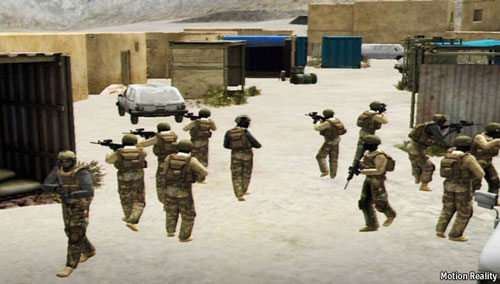
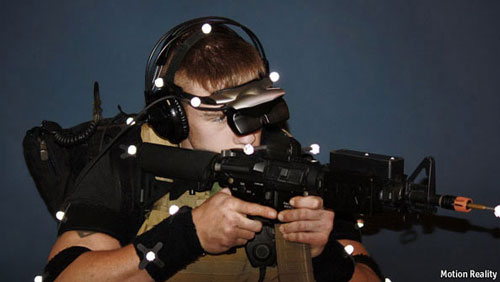
    Motion Reality, a firm based in Marietta, Georgia, that provided some of the technology used to animate Avatar, King Kong and the Lord of the Rings films, has built a mixed-reality “fight simulator”, called Virtsim, in conjunction with Raytheon, an American defence contractor. America’s Federal Bureau of Investigation began using the system in January at its academy in Quantico, Virginia, and it has also been sold to a Middle Eastern country. Training in an area the size of a basketball court, 12 commandos wear goggles that display high-resolution 3D images delivered wirelessly (see image above). Real objects in the training area commingle with computer-generated ones such as buildings and enemies. A virtual insurgent can be realistically displayed in the goggles of trainees who look in his direction — even if everybody is running. Trainees wear electrodes that deliver a painful shock when they are struck by a virtual bullet or bomb blast.

    Virtsim records participants’ movements so that exercises can be reviewed later from multiple angles. Superimposed graphics show such things as a trainee’s precise field of vision, so everyone can see exactly where he looked (or neglected to look) when clearing a room or before getting shot. Users say the collection of such detailed data eliminates all excuses.
    It is not just the technology that is becoming more elaborate. The latest simulations also take into account psychological factors, says Sébastien Saint-Luc of DCNS, a French builder of warships and submarines. The firm’s flagship naval simulator, Solaris Battlelab, models intangibles such as the effect that bad news (word that bombs have hit one’s defence ministry, for example) has on the ability of a vessel’s commanders to exchange information and make decisions during battle.

    When simulation meets reality
    Another recent trend is the tighter integration of simulators with real combat. Chester Kennedy, vice-president of simulation engineering at Lockheed Martin, points to a 2007 battle in which insurgents took advantage of a tactical error by American soldiers to kill some of them. Within 24 hours, Lockheed Martin had interviewed the survivors and then produced a simulator that placed other soldiers in the same situation so the mistake would not be repeated. The company now regularly simulates real battles.

    Indeed, simulation software is even being used in combat, says Bruno de Roodenbeke, a former French army general who now advises Masa Group, a French firm that develops a simulator called Sword, used by France’s defence ministry. In some types of fighting, senior commanders have time to use simulation software to rule out losing strategies before sending orders to commanders on the battlefield, he says. The ability to get things wrong without loss of life represents a profound transformation in the conduct of war.  — (c) 2012 The Economist

    • Subscribe to our free daily newsletter
    • Follow us on Twitter or on Google+ or on Facebook
    • Visit our sister website, SportsCentral (still in beta)

    Follow TechCentral on Google News Add TechCentral as your preferred source on Google


    WhatsApp YouTube
    Share. Facebook Twitter LinkedIn WhatsApp Telegram Email Copy Link
    Previous ArticleZA Tech Show: Episode 200 – ‘Tablet menagerie’
    Next Article How solar power could charge up Africa

    Related Posts

    DStv drops premium paywall on Fifa World Cup in Canal+-era shift - SuperSport Rendani Ramovha

    DStv drops premium paywall on Fifa World Cup in Canal+-era shift

    17 April 2026
    How a connectivity levy became a tax on telecoms

    How a connectivity levy became a tax on telecoms

    17 April 2026
    Wits project pits African creators against AI music's blind spots

    Wits project pits African creators against AI music’s blind spots

    17 April 2026
    Company News
    Fibre: the backbone of South Africa's digital health ecosystem - Mweb

    Fibre: the backbone of South Africa’s digital health ecosystem

    16 April 2026
    New man to accelerate wholesale connectivity in the DRC - Gaetan Soltesz, FAST Congo

    New man to accelerate wholesale connectivity in the DRC

    15 April 2026
    Avast Business and Avert IT Distribution rewrite the SMB cybersecurity playbook

    Avast Business and Avert IT Distribution rewrite the SMB cybersecurity playbook

    15 April 2026
    Opinion
    The conflict of interest at the heart of PayShap's slow adoption - Cheslyn Jacobs

    The conflict of interest at the heart of PayShap’s slow adoption

    26 March 2026
    South Africa's energy future hinges on getting wheeling right - Aishah Gire

    South Africa’s energy future hinges on getting wheeling right

    10 March 2026
    Hold the doom: the case for a South African comeback - Duncan McLeod

    Apple just dropped a bomb on the Windows world

    5 March 2026

    Subscribe to Updates

    Get the best South African technology news and analysis delivered to your e-mail inbox every morning.

    Latest Posts
    DStv drops premium paywall on Fifa World Cup in Canal+-era shift - SuperSport Rendani Ramovha

    DStv drops premium paywall on Fifa World Cup in Canal+-era shift

    17 April 2026
    How a connectivity levy became a tax on telecoms

    How a connectivity levy became a tax on telecoms

    17 April 2026
    Wits project pits African creators against AI music's blind spots

    Wits project pits African creators against AI music’s blind spots

    17 April 2026
    Prosus offloads 4.5% of Delivery Hero to Uber for €270-million

    Prosus offloads 4.5% of Delivery Hero to Uber for €270-million

    17 April 2026
    © 2009 - 2026 NewsCentral Media
    • Cookie policy (ZA)
    • TechCentral – privacy and Popia

    Type above and press Enter to search. Press Esc to cancel.

    Manage consent

    TechCentral uses cookies to enhance its offerings. Consenting to these technologies allows us to serve you better. Not consenting or withdrawing consent may adversely affect certain features and functions of the website.

    Functional Always active
    The technical storage or access is strictly necessary for the legitimate purpose of enabling the use of a specific service explicitly requested by the subscriber or user, or for the sole purpose of carrying out the transmission of a communication over an electronic communications network.
    Preferences
    The technical storage or access is necessary for the legitimate purpose of storing preferences that are not requested by the subscriber or user.
    Statistics
    The technical storage or access that is used exclusively for statistical purposes. The technical storage or access that is used exclusively for anonymous statistical purposes. Without a subpoena, voluntary compliance on the part of your Internet Service Provider, or additional records from a third party, information stored or retrieved for this purpose alone cannot usually be used to identify you.
    Marketing
    The technical storage or access is required to create user profiles to send advertising, or to track the user on a website or across several websites for similar marketing purposes.
    • Manage options
    • Manage services
    • Manage {vendor_count} vendors
    • Read more about these purposes
    View preferences
    • {title}
    • {title}
    • {title}