Close Menu
TechCentralTechCentral

    Subscribe to the newsletter

    Get the best South African technology news and analysis delivered to your e-mail inbox every morning.

    Facebook X (Twitter) YouTube LinkedIn
    WhatsApp Facebook X (Twitter) LinkedIn YouTube
    TechCentralTechCentral
    • News
      The Mythos hacking threat is looking overblown

      The Mythos hacking threat is looking overblown

      20 May 2026
      Inflation spikes higher - and the worst is still to come

      Inflation spikes higher – and the worst is still to come

      20 May 2026
      MTN to work with police to fight E Cape base station crime - Charles Molapisi MTN South Africa CEO

      MTN to turn its African towers into an AI inference grid

      20 May 2026
      Disney+ hikes prices in South Africa

      Disney+ hikes prices in South Africa

      20 May 2026
      Google launches the biggest reinvention of search in 25 years

      Google launches the biggest reinvention of search in 25 years

      20 May 2026
    • World
      Vatican confronts the age of artificial intelligence. Edgar Beltrán/The Pillar 

      Vatican confronts the age of artificial intelligence

      19 May 2026
      The walkout that could hit every laptop and AI server - Samsung

      The walkout that could hit every laptop and AI server

      18 May 2026
      Pop star sues Samsung for $15-million - Dua Lipa

      Pop star sues Samsung for $15-million

      11 May 2026
      OpenAI's new audio APIs aim for conversational voice agents

      OpenAI’s new audio APIs aim for conversational voice agents

      8 May 2026
      'It was my idea': Musk claims paternity of OpenAI - Elon Musk

      ‘It was my idea’: Musk claims paternity of OpenAI

      29 April 2026
    • In-depth
      Alfa's electric rebel - Alfa Romeo Junior Elettrica Veloce

      Alfa’s electric rebel

      29 April 2026
      Africa switches on as Europe dims the lights

      Africa switches on as Europe dims the lights

      9 April 2026
      The biggest untapped EV market on Earth is hiding in plain sight

      The biggest untapped EV market on Earth is hiding in plain sight

      1 April 2026
      Datatec is firing on all cylinders - Jens Montanana

      The R16-billion tech giant hiding in plain sight

      26 March 2026
      The last generation of coders

      The last generation of coders

      18 February 2026
    • TCS
      TCS+ | The Up&Up Group on the hidden cost of AI - Jason Harrison

      TCS+ | The Up&Up Group on the hidden cost of AI

      13 May 2026
      Michael Rossouw

      TCS+ | The retirement decision most South Africans get wrong

      6 May 2026
      TCS | The Cape Town start-up listening for TB with AI - Braden van Breda

      TCS | The Cape Town start-up listening for TB with AI

      4 May 2026

      TCS+ | ‘The ISP for ISPs’: Vox’s shift to wholesale aggregator

      20 April 2026
      TCS | Werner Lindemann on how AI is rewriting the infosec rulebook

      TCS | Werner Lindemann on how AI is rewriting the infosec rulebook

      15 April 2026
    • Opinion
      AI won't fix your culture - it will expose it - Jackie Kennedy

      AI won’t fix your culture – it will expose it

      19 May 2026
      Free calls, dead voice and Shameel Joosub's Spanish ghost - Duncan McLeod

      Free calls, dead voice and Shameel Joosub’s Spanish ghost

      22 April 2026
      The conflict of interest at the heart of PayShap's slow adoption - Cheslyn Jacobs

      The conflict of interest at the heart of PayShap’s slow adoption

      26 March 2026
      South Africa's energy future hinges on getting wheeling right - Aishah Gire

      South Africa’s energy future hinges on getting wheeling right

      10 March 2026
      Free calls, dead voice and Shameel Joosub's Spanish ghost - Duncan McLeod

      Apple just dropped a bomb on the Windows world

      5 March 2026
    • Company Hubs
      • 1Stream
      • Africa Data Centres
      • AfriGIS
      • Altron Digital Business
      • Altron Document Solutions
      • Altron Group
      • Arctic Wolf
      • Ascent Technology
      • AvertITD
      • BBD
      • Braintree
      • CallMiner
      • CambriLearn
      • CM Telecom
      • Contactable
      • CYBER1 Solutions
      • Digicloud Africa
      • Digimune
      • Domains.co.za
      • ESET
      • Euphoria Telecom
      • HOSTAFRICA
      • Incredible Business
      • iONLINE
      • IQbusiness
      • Iris Network Systems
      • Kaspersky
      • LSD Open
      • Mitel
      • NEC XON
      • Netstar
      • Network Platforms
      • Next DLP
      • Ovations
      • Paracon
      • Paratus
      • Q-KON
      • SevenC
      • SkyWire
      • Solid8 Technologies
      • Telit Cinterion
      • Telviva
      • Tenable
      • Vertiv
      • Videri Digital
      • Vodacom Business
      • Wipro
      • Workday
      • XLink
    • Sections
      • AI and machine learning
      • Banking
      • Broadcasting and Media
      • Cloud services
      • Contact centres and CX
      • Cryptocurrencies
      • Education and skills
      • Electronics and hardware
      • Energy and sustainability
      • Enterprise software
      • Financial services
      • HealthTech
      • Information security
      • Internet and connectivity
      • Internet of Things
      • Investment
      • IT services
      • Lifestyle
      • Motoring
      • Policy and regulation
      • Public sector
      • Retail and e-commerce
      • Satellite communications
      • Science
      • SMEs and start-ups
      • Social media
      • Talent and leadership
      • Telecoms
    • Events
    • Advertise
    TechCentralTechCentral
    Home » Sections » Energy and sustainability » This new technology could lead a renewable energy transformation

    This new technology could lead a renewable energy transformation

    By The Conversation1 September 2020
    Twitter LinkedIn Facebook WhatsApp Email Telegram Copy Link
    News Alerts
    WhatsApp
    Image: Science in HD/Unsplash

    The demand for cheaper, greener electricity means that the energy landscape is changing faster than at any other point in history. This is particularly true of solar-powered electricity and battery storage. The cost of both has dropped at unprecedented rates over the past decade and energy-efficient technologies such as LED lighting have also expanded.

    Access to cheap and ubiquitous solar power and storage will transform the way we produce and use power, allowing electrification of the transport sector. There is potential for new chemical-based economies in which we store renewable energy as fuels, and support new devices making up an “Internet of things”.

    But our current energy technologies won’t lead us to this future: We will soon hit efficiency and cost limits. The potential for future reductions in the cost of electricity from silicon solar, for example, is limited. The manufacture of each panel demands a fair amount of energy and factories are expensive to build. And although the cost of production can be squeezed a little further, the costs of a solar installation are now dominated by the extras – installation, wiring, the electronics and so on.

    Amazingly, the colour of light they absorb or emit can be changed simply by tweaking their chemical structure

    This means that current solar power systems are unlikely to meet the required fraction of our 30 terawatt global power requirements (they produce less than 1TW today) fast enough to address issues such as climate change.

    Likewise, our current LED lighting and display technologies are too expensive and not of good enough colour quality to realistically replace traditional lighting in a short enough time frame. This is a problem, as lighting currently accounts for 5% of the world’s carbon emissions. New technologies are needed to fill this gap, and quickly.

    Our lab in Cambridge, England is working with a promising new family of materials known as halide perovskites. They are semiconductors, conducting charges when stimulated with light. Perovskite inks are deposited onto glass or plastic to make extremely thin films — around one hundredth of the width of a human hair — made up of metal, halide and organic ions. When sandwiched between electrode contacts, these films make solar cell or LED devices.

    Versatile

    Amazingly, the colour of light they absorb or emit can be changed simply by tweaking their chemical structure. By changing the way we grow them, we can tailor them to be more suitable for absorbing light (for a solar panel) or emitting light (for an LED). This allows us to make different colour solar cells and LEDs emitting light from the ultraviolet, right through to the visible and near-infrared.

    Despite their cheap and versatile processing, these materials have been shown to be remarkably efficient as both solar cells and light emitters. Perovskite solar cells hit 25.2% efficiency in 2019, hot on the heels of crystalline silicon cells at 26.7%, and perovskite LEDs are already approaching off-the-shelf organic light-emitting diode (OLED) performances.

    These technologies are rapidly being commercialised, particularly on the solar cell front. UK-based Oxford Photovoltaics has built a production line and is filling its first purchase orders in early 2021. Polish company Saule Technologies released prototype products at the end of 2018, including a perovskite solar façade pilot. Chinese manufacturer Microquanta Semiconductor expects to produce more than 200 000 square metres of panels in its production line before yearend. The US-based Swift Solar (a company I co-founded) is pioneering high-performance cells with lightweight, flexible properties.

    Between these and other companies, there is rapid progress being made.
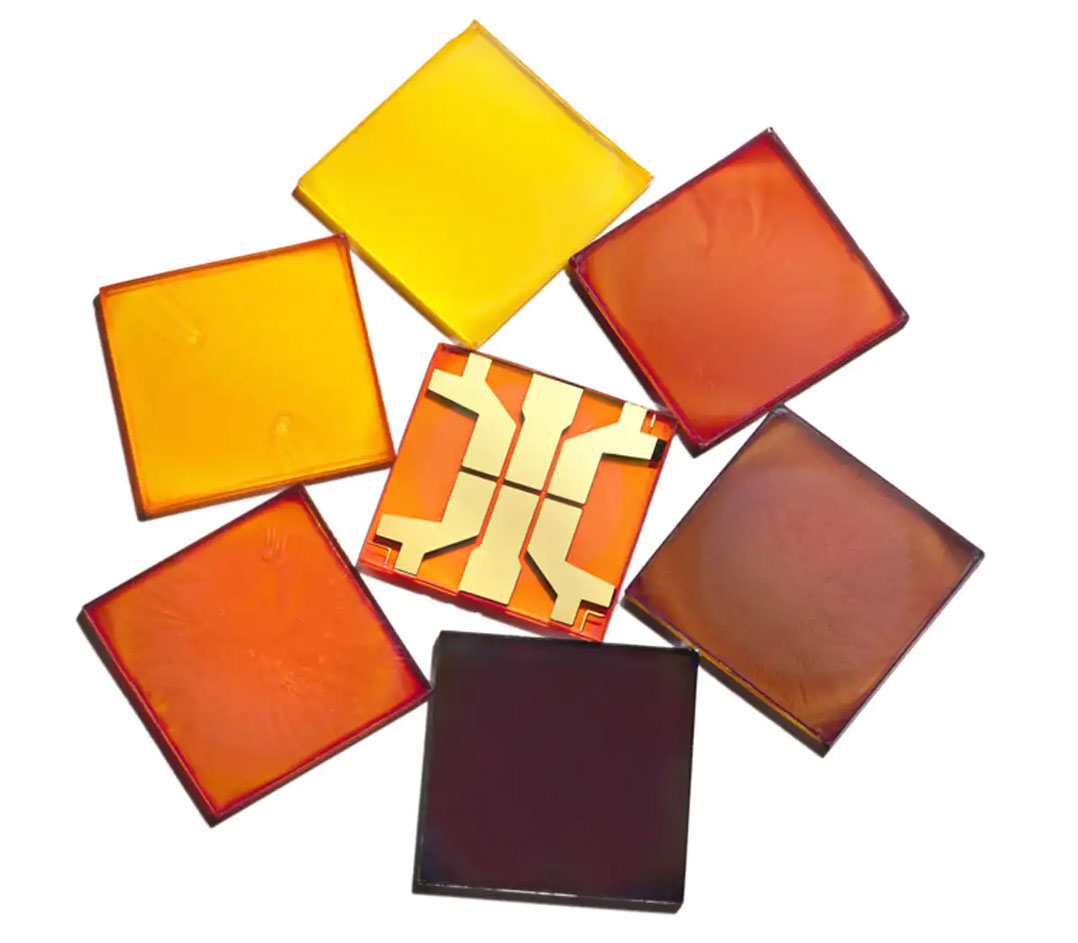
    Coloured perovskite solar cells and films. (c) Plamen Petkov for Scientific American, author provided

    Unlike conventional silicon cells, which need to be very uniform for high efficiency, perovskite films are comprised of mosaic “grains” of highly variable size (from nanometres to millimetres) and chemistry — and yet they perform nearly as well as the best silicon cells today. What’s more, small blemishes or defects in perovskite films do not lead to significant power losses. Such defects would be catastrophic for a silicon panel or a commercial LED. Although we are still trying to understand this, these materials are forcing the community to rewrite the textbook for what we consider as an ideal semiconductor: They can have very good optical and electronic properties in spite of — or perhaps even because of — disorder.

    We could hypothetically use these materials to make “designer” coloured solar cells that blend in to buildings or houses, or solar windows that look like tinted glass yet generate power.

    But the real opportunity is to develop highly efficient cells beyond the efficiency of silicon cells. For example, we can layer two different coloured perovskite films together in a “tandem” solar cell. Each layer would harvest different regions of the solar spectrum, increasing the overall efficiency of the cell.

    Efficiency boost

    Another example is what Oxford PV are pioneering: adding a perovskite layer on top of a standard silicon cell, boosting the efficiency of the existing technology without significant additional cost. These tandem layering approaches could quickly create a boost in efficiency of solar panels beyond 30%, which would reduce both the panel and system costs while also reducing their energy footprint.

    These perovskite layers are also being developed to manufacture flexible solar panels that can be processed to roll like newsprint, further reducing costs. Lightweight, high-power solar also opens up possibilities for powering electric vehicles and communication satellites.
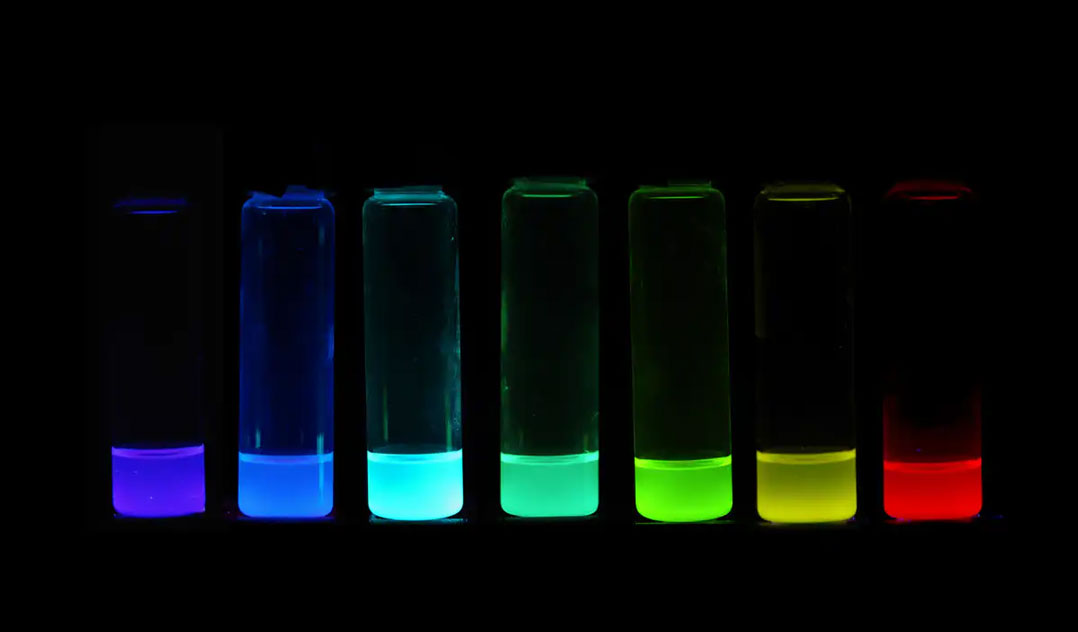
    Coloured perovskite light-emitting inks that can be cast down into thin films. (c) Sandeep Pathak, author provided

    For LEDs, perovskites can achieve fantastic colour quality which could lead to advanced flexible display technologies. Perovskites could also give cheaper, higher quality white lighting than today’s commercial LEDs, with the “colour temperature” of a globe able to be manufactured to give cool or warm white light or any desired shade in between. They are also generating excitement as building blocks for future quantum computers, as well as X-Ray detectors for extremely low dose medical and security imaging.

    Although the first products are already emerging, there are still challenges. One key issue is demonstrating long-term stability. But the research is promising, and once these are resolved, halide perovskites could truly propel the transformation of our energy production and consumption.The Conversation

    • Written by Sam Stranks, lecturer in energy and Royal Society University research fellow, University of Cambridge
    • This article is republished from The Conversation under a Creative Commons licence

    Follow TechCentral on Google News Add TechCentral as your preferred source on Google


    Sam Stranks top
    WhatsApp YouTube
    Share. Facebook Twitter LinkedIn WhatsApp Telegram Email Copy Link
    Previous ArticleRevix CEO Sean Sanders on the future of crypto investment
    Next Article Mupita takes the reins at MTN as Shuter era ends

    Related Posts

    18GW in unplanned breakdowns cripple Eskom

    2 November 2021

    Nersa kicks the Karpowership can down the road

    13 September 2021

    If you think South African load shedding is bad, try Zimbabwe’s

    13 September 2021
    Company News
    Network with industry leaders at Pan African DataCentres event

    Network with industry leaders at Pan African DataCentres event

    20 May 2026
    Why online learning is the future of education - Mweb

    Why online learning is the future of education

    20 May 2026
    Digital Parks Africa expands global network reach with Cogent

    Digital Parks Africa expands global network reach with Cogent

    19 May 2026
    Opinion
    AI won't fix your culture - it will expose it - Jackie Kennedy

    AI won’t fix your culture – it will expose it

    19 May 2026
    Free calls, dead voice and Shameel Joosub's Spanish ghost - Duncan McLeod

    Free calls, dead voice and Shameel Joosub’s Spanish ghost

    22 April 2026
    The conflict of interest at the heart of PayShap's slow adoption - Cheslyn Jacobs

    The conflict of interest at the heart of PayShap’s slow adoption

    26 March 2026

    Subscribe to Updates

    Get the best South African technology news and analysis delivered to your e-mail inbox every morning.

    Latest Posts
    The Mythos hacking threat is looking overblown

    The Mythos hacking threat is looking overblown

    20 May 2026
    Inflation spikes higher - and the worst is still to come

    Inflation spikes higher – and the worst is still to come

    20 May 2026
    MTN to work with police to fight E Cape base station crime - Charles Molapisi MTN South Africa CEO

    MTN to turn its African towers into an AI inference grid

    20 May 2026
    Disney+ hikes prices in South Africa

    Disney+ hikes prices in South Africa

    20 May 2026
    © 2009 - 2026 NewsCentral Media
    • Cookie policy (ZA)
    • TechCentral – privacy and Popia

    Type above and press Enter to search. Press Esc to cancel.

    Manage consent

    TechCentral uses cookies to enhance its offerings. Consenting to these technologies allows us to serve you better. Not consenting or withdrawing consent may adversely affect certain features and functions of the website.

    Functional Always active
    The technical storage or access is strictly necessary for the legitimate purpose of enabling the use of a specific service explicitly requested by the subscriber or user, or for the sole purpose of carrying out the transmission of a communication over an electronic communications network.
    Preferences
    The technical storage or access is necessary for the legitimate purpose of storing preferences that are not requested by the subscriber or user.
    Statistics
    The technical storage or access that is used exclusively for statistical purposes. The technical storage or access that is used exclusively for anonymous statistical purposes. Without a subpoena, voluntary compliance on the part of your Internet Service Provider, or additional records from a third party, information stored or retrieved for this purpose alone cannot usually be used to identify you.
    Marketing
    The technical storage or access is required to create user profiles to send advertising, or to track the user on a website or across several websites for similar marketing purposes.
    • Manage options
    • Manage services
    • Manage {vendor_count} vendors
    • Read more about these purposes
    View preferences
    • {title}
    • {title}
    • {title}