Close Menu
TechCentralTechCentral

    Subscribe to the newsletter

    Get the best South African technology news and analysis delivered to your e-mail inbox every morning.

    Facebook X (Twitter) YouTube LinkedIn
    WhatsApp Facebook X (Twitter) LinkedIn YouTube
    TechCentralTechCentral
    • News
      Vodacom to take control of Safaricom in R36-billion deal - Shameel Joosub

      Vodacom to take control of Safaricom in R36-billion deal

      4 December 2025
      Black Friday goes digital in South Africa as online spending surges to record high

      Black Friday goes digital in South Africa as online spending surges to record high

      4 December 2025
      BYD takes direct aim at Toyota with launch of sub-R500 000 Sealion 5 PHEV

      BYD takes direct aim at Toyota with launch of sub-R500 000 Sealion 5 PHEV

      4 December 2025
      'Get it now': Takealot in new instant deliveries pilot

      ‘Get it now’: Takealot in new instant deliveries pilot

      4 December 2025
      What South Africans searched for most in 2025

      What South Africans searched for most in 2025, according to Google

      4 December 2025
    • World
      Amazon and Google launch multi-cloud service for faster connectivity

      Amazon and Google launch multi-cloud service for faster connectivity

      1 December 2025
      Google makes final court plea to stop US breakup

      Google makes final court plea to stop US breakup

      21 November 2025
      Bezos unveils monster rocket: New Glenn 9x4 set to dwarf Saturn V

      Bezos unveils monster rocket: New Glenn 9×4 set to dwarf Saturn V

      21 November 2025
      Tech shares turbocharged by Nvidia's stellar earnings

      Tech shares turbocharged by stellar Nvidia earnings

      20 November 2025
      Config file blamed for Cloudflare meltdown that disrupted the web

      Config file blamed for Cloudflare meltdown that disrupted the web

      19 November 2025
    • In-depth
      Jensen Huang Nvidia

      So, will China really win the AI race?

      14 November 2025
      Valve's Linux console takes aim at Microsoft's gaming empire

      Valve’s Linux console takes aim at Microsoft’s gaming empire

      13 November 2025
      iOCO's extraordinary comeback plan - Rhys Summerton

      iOCO’s extraordinary comeback plan

      28 October 2025
      Why smart glasses keep failing - no, it's not the tech - Mark Zuckerberg

      Why smart glasses keep failing – it’s not the tech

      19 October 2025
      BYD to blanket South Africa with megawatt-scale EV charging network - Stella Li

      BYD to blanket South Africa with megawatt-scale EV charging network

      16 October 2025
    • TCS
      TCS+ | How Cloud on Demand helps partners thrive in the AWS ecosystem - Odwa Ndyaluvane and Xenia Rhode

      TCS+ | How Cloud On Demand helps partners thrive in the AWS ecosystem

      4 December 2025
      TCS | MTN Group CEO Ralph Mupita on competition, AI and the future of mobile

      TCS | Ralph Mupita on competition, AI and the future of mobile

      28 November 2025
      TCS | Dominic Cull on fixing South Africa's ICT policy bottlenecks

      TCS | Dominic Cull on fixing South Africa’s ICT policy bottlenecks

      21 November 2025
      TCS | BMW CEO Peter van Binsbergen on the future of South Africa's automotive industry

      TCS | BMW CEO Peter van Binsbergen on the future of South Africa’s automotive industry

      6 November 2025
      TCS | Why Altron is building an AI factory - Bongani Andy Mabaso

      TCS | Why Altron is building an AI factory in Johannesburg

      28 October 2025
    • Opinion
      Your data, your hardware: the DIY AI revolution is coming - Duncan McLeod

      Your data, your hardware: the DIY AI revolution is coming

      20 November 2025
      Zero Carbon Charge founder Joubert Roux

      The energy revolution South Africa can’t afford to miss

      20 November 2025
      It's time for a new approach to government IT spend in South Africa - Richard Firth

      It’s time for a new approach to government IT spend in South Africa

      19 November 2025
      How South Africa's broken Rica system fuels murder and mayhem - Farhad Khan

      How South Africa’s broken Rica system fuels murder and mayhem

      10 November 2025
      South Africa's AI data centre boom risks overloading a fragile grid - Paul Colmer

      South Africa’s AI data centre boom risks overloading a fragile grid

      30 October 2025
    • Company Hubs
      • Africa Data Centres
      • AfriGIS
      • Altron Digital Business
      • Altron Document Solutions
      • Altron Group
      • Arctic Wolf
      • AvertITD
      • Braintree
      • CallMiner
      • CambriLearn
      • CYBER1 Solutions
      • Digicloud Africa
      • Digimune
      • Domains.co.za
      • ESET
      • Euphoria Telecom
      • Incredible Business
      • iONLINE
      • IQbusiness
      • Iris Network Systems
      • LSD Open
      • NEC XON
      • Netstar
      • Network Platforms
      • Next DLP
      • Ovations
      • Paracon
      • Paratus
      • Q-KON
      • SevenC
      • SkyWire
      • Solid8 Technologies
      • Telit Cinterion
      • Tenable
      • Vertiv
      • Videri Digital
      • Vodacom Business
      • Wipro
      • Workday
      • XLink
    • Sections
      • AI and machine learning
      • Banking
      • Broadcasting and Media
      • Cloud services
      • Contact centres and CX
      • Cryptocurrencies
      • Education and skills
      • Electronics and hardware
      • Energy and sustainability
      • Enterprise software
      • Financial services
      • Information security
      • Internet and connectivity
      • Internet of Things
      • Investment
      • IT services
      • Lifestyle
      • Motoring
      • Public sector
      • Retail and e-commerce
      • Satellite communications
      • Science
      • SMEs and start-ups
      • Social media
      • Talent and leadership
      • Telecoms
    • Events
    • Advertise
    TechCentralTechCentral
    Home » In-depth » What if Moore’s Law fails?

    What if Moore’s Law fails?

    By The Conversation27 August 2015
    Twitter LinkedIn Facebook WhatsApp Email Telegram Copy Link
    News Alerts
    WhatsApp

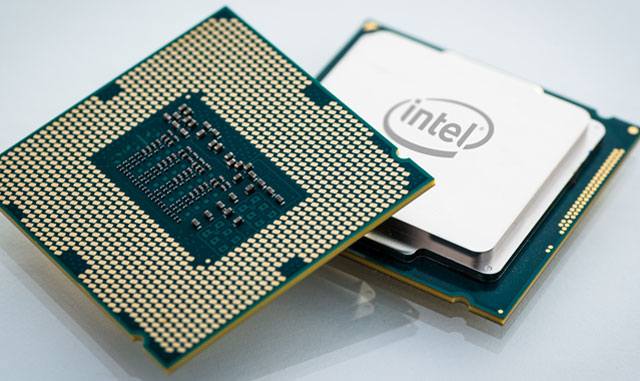
    intel-core-i7-640

    The semiconducting silicon chip launched the revolution of electronics and computerisation that has made life in the opening years of the 21st century scarcely recognisable from the start of the last. Silicon integrated circuits underpin practically everything we take for granted now in our interconnected, digital world: controlling the systems we use and allowing us to access and share information at will.

    The rate of progress since the first silicon transistor in 1947 has been enormous, with the number of transistors on a single chip growing from a few thousand in the earliest integrated circuits to more than 2bn today. Moore’s Law — that transistor density will double every two years — still holds true 50 years after it was proposed.

    Nevertheless, silicon electronics faces a challenge: the latest circuits measure just 7nm wide — between a red blood cell (7 500nm) and a single strand of DNA (2,5nm). The size of individual silicon atoms (around 0,2nm) would be a hard physical limit (with circuits one atom wide), but its behaviour becomes unstable and difficult to control before then.

    Without the ability to shrink integrated circuits further, silicon cannot continue producing the gains it has so far. Meeting this challenge may require rethinking how we manufacture devices, or even whether we need an alternative to silicon itself.

    To understand the challenge, we must look at why silicon became the material of choice for electronics. While it has many points in its favour — abundant, relatively easy to process, has good physical properties and possesses a stable native oxide (SiO2) which happens to be a good insulator — it also has several drawbacks.

    For example, a great advantage of combining more and more transistors into a single chip is that it enables an integrated circuit to process information faster. But this speed boost depends critically on how easily electrons are able to move within the semiconductor material. This is known as electron mobility, and while electrons in silicon are quite mobile, they are much more so in other semiconductor materials such as gallium arsenide, indium arsenide and indium antimonide.

    The useful conductive properties of semiconductors don’t just concern the movement of electrons, however, but also the movement of what are called electron holes — the gaps left behind in the lattice of electrons circling around the nucleus after electrons have been pushed out.
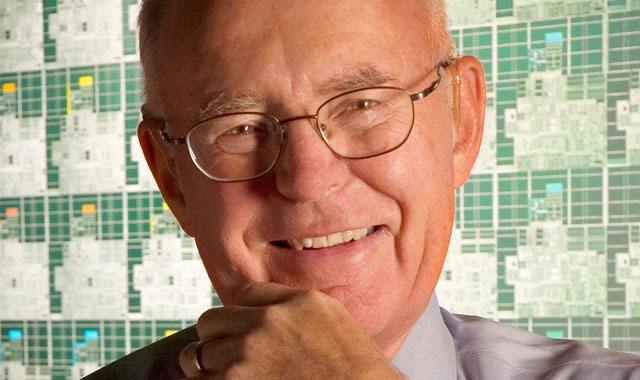
    Gordon Moore
    Gordon Moore

    Modern integrated circuits use a technique called complementary metal-oxide semiconductor (CMOS), which uses a pair of transistors, one using electrons and the other electron holes. But electron hole mobility in silicon is very poor, and this is a barrier to higher performance — so much so that for several years, manufacturers have had to boost it by including germanium with the silicon.

    Silicon’s second problem is that performance degrades badly at high temperatures. Modern integrated circuits with billions of transistors generate considerable heat, which is why a lot of effort goes into cooling them — think of the fans and heatsinks strapped to a typical desktop computer processor. Alternative semiconductors such as gallium nitride (GaN) and silicon carbide (SiC) cope much better at higher temperatures, which means they can be run faster and have begun to replace silicon in critical high-power applications such as amplifiers.

    Lastly, silicon is very poor at transmitting light. While lasers, LEDs and other photonic devices are commonplace today, they use alternative semiconductor compounds to silicon. As a result, two distinct industries have evolved: silicon for electronics and compound semiconductors for photonics. This situation has existed for years, but now there is a big push to combine electronics and photonics on a single chip. For the manufacturers, that’s quite a problem.

    New materials for future
    Of the many materials under investigation as partners for silicon to improve its electronic performance, perhaps three have promise in the short term.

    The first concerns silicon’s poor electron hole mobility. A small amount of germanium is already added to improve this, but using large amounts or even a move to all-germanium transistors would be better still. Germanium was the first material used for semiconductor devices, so really this is a “back to the future” move. But realigning the established industry around germanium would be quite a problem for manufacturers.

    The second concerns metal oxides. Silicon dioxide was used within transistors for many years, but with miniaturisation the layer of silicon dioxide has shrunk to be so thin that it has begun to lose its insulating properties, leading to unreliable transistors. Despite a move to using rare-earth hafnium dioxide (HfO2) as a replacement insulator, the search is on for alternatives with even better insulating properties.

    Most interesting, perhaps, is the use of so-called III-V compound semiconductors, particularly those containing indium such as indium arsenide and indium antimonide. These semiconductors have electron mobility up to 50 times higher than silicon. When combined with germanium-rich transistors, this approach could provide a major speed increase.

    silicon-640

    Yet all is not as simple as it seems. Silicon, germanium, oxides and the III-V materials are crystalline structures that depend on the integrity of the crystal for their properties. We cannot simply throw them together with silicon and get the best of both. Dealing with this problem, crystal lattice mismatch, is the major ongoing technological challenge.

    Despite its limitations, silicon electronics has proved adaptable, able to be fashioned into reliable, mass market devices available at minimal cost. So despite headlines about the “end of silicon” or the spectacular (and sometimes rather unrealistic) promise of alternative materials, silicon is still king and, backed by a huge and extremely well-developed global industry, will not be deposed in our lifetime.

    Instead, progress in electronics will come from improving silicon by integrating other materials. Companies such as IBM and Intel and university labs worldwide have poured time and effort into this challenge, and the results are promising: a hybrid approach that blends III-V materials, silicon and germanium could reach the market within a few years. Compound semiconductors have already found important uses in lasers, LED lighting/displays and solar panels where silicon simply cannot compete. More advanced compounds will be needed as electronic devices become progressively smaller and lower powered and also for high-power electronics where their characteristics are a significant improvement upon silicon’s capabilities.

    The future of electronics is bright, and it’s still going to be largely based on silicon — but now that silicon comes in many different flavours.The Conversation

    • Mark Hopkinson is professor of semiconductor materials at the University of Sheffield
    • This article was originally published on The Conversation


    Gordon Moore IBM Intel Mark Hopkinson
    Subscribe to TechCentral Subscribe to TechCentral
    Share. Facebook Twitter LinkedIn WhatsApp Telegram Email Copy Link
    Previous ArticleSpooks mum on SABC ‘spy operation’
    Next Article Dep’t defends Muthambi’s R600 000 trip

    Related Posts

    Signs of life at Intel

    Signs of life at Intel

    24 October 2025
    Intel fights back in the AI chip wars

    Intel fights back in the AI chip wars

    15 October 2025
    Panther Lake: the chip that Intel can't let fail

    Panther Lake: the chip that Intel can’t let fail

    8 October 2025
    Company News
    AI is not a technology problem - iqbusiness

    AI is not a technology problem – iqbusiness

    5 December 2025
    Telcos are sitting on a data gold mine - but few know what do with it - Phillip du Plessis

    Telcos are sitting on a data gold mine – but few know what do with it

    4 December 2025
    Unlock smarter computing with your surface Copilot+ PC

    Unlock smarter computing with your Surface Copilot+ PC

    4 December 2025
    Opinion
    Your data, your hardware: the DIY AI revolution is coming - Duncan McLeod

    Your data, your hardware: the DIY AI revolution is coming

    20 November 2025
    Zero Carbon Charge founder Joubert Roux

    The energy revolution South Africa can’t afford to miss

    20 November 2025
    It's time for a new approach to government IT spend in South Africa - Richard Firth

    It’s time for a new approach to government IT spend in South Africa

    19 November 2025

    Subscribe to Updates

    Get the best South African technology news and analysis delivered to your e-mail inbox every morning.

    Latest Posts
    AI is not a technology problem - iqbusiness

    AI is not a technology problem – iqbusiness

    5 December 2025
    Vodacom to take control of Safaricom in R36-billion deal - Shameel Joosub

    Vodacom to take control of Safaricom in R36-billion deal

    4 December 2025
    Black Friday goes digital in South Africa as online spending surges to record high

    Black Friday goes digital in South Africa as online spending surges to record high

    4 December 2025
    BYD takes direct aim at Toyota with launch of sub-R500 000 Sealion 5 PHEV

    BYD takes direct aim at Toyota with launch of sub-R500 000 Sealion 5 PHEV

    4 December 2025
    © 2009 - 2025 NewsCentral Media
    • Cookie policy (ZA)
    • TechCentral – privacy and Popia

    Type above and press Enter to search. Press Esc to cancel.

    Manage consent

    TechCentral uses cookies to enhance its offerings. Consenting to these technologies allows us to serve you better. Not consenting or withdrawing consent may adversely affect certain features and functions of the website.

    Functional Always active
    The technical storage or access is strictly necessary for the legitimate purpose of enabling the use of a specific service explicitly requested by the subscriber or user, or for the sole purpose of carrying out the transmission of a communication over an electronic communications network.
    Preferences
    The technical storage or access is necessary for the legitimate purpose of storing preferences that are not requested by the subscriber or user.
    Statistics
    The technical storage or access that is used exclusively for statistical purposes. The technical storage or access that is used exclusively for anonymous statistical purposes. Without a subpoena, voluntary compliance on the part of your Internet Service Provider, or additional records from a third party, information stored or retrieved for this purpose alone cannot usually be used to identify you.
    Marketing
    The technical storage or access is required to create user profiles to send advertising, or to track the user on a website or across several websites for similar marketing purposes.
    • Manage options
    • Manage services
    • Manage {vendor_count} vendors
    • Read more about these purposes
    View preferences
    • {title}
    • {title}
    • {title}