
Close Menu
TechCentralTechCentral

    Subscribe to the newsletter

    Get the best South African technology news and analysis delivered to your e-mail inbox every morning.

    Facebook X (Twitter) YouTube LinkedIn
    WhatsApp Facebook X (Twitter) LinkedIn YouTube
    TechCentralTechCentral
    • News
      Remgro's fibre empire roars back

      Remgro’s fibre empire roars back

      25 March 2026
      Truecaller cooperating with Info Regulator's Popia probe

      Truecaller cooperating with Info Regulator’s Popia probe

      25 March 2026
      Why Namibia slammed the door on Starlink

      Why Namibia slammed the door on Starlink

      25 March 2026
      Podcasters push back against regulatory overreach

      Podcasters push back against regulatory overreach

      25 March 2026
      Maziv plots fibre expansion blitz - Dietlof Mare

      Maziv plots fibre expansion blitz

      25 March 2026
    • World
      It's official: ads are coming to ChatGPT

      It’s official: ads are coming to ChatGPT

      23 March 2026
      Mystery Chinese AI model revealed to be Xiaomi's

      Mystery Chinese AI model revealed to be Xiaomi’s

      19 March 2026
      A mystery AI model has developers buzzing

      A mystery AI model has developers buzzing

      18 March 2026
      Samsung's trifold gamble ends in retreat

      Samsung’s trifold gamble ends in retreat

      17 March 2026
      Nvidia targets $1-trillion in AI chip sales as inference demand surges - Jensen Huang

      Nvidia targets $1-trillion in AI chip sales as inference demand surges

      17 March 2026
    • In-depth
      The last generation of coders

      The last generation of coders

      18 February 2026
      Sentech is in dire straits

      Sentech is in dire straits

      10 February 2026
      How liberalisation is rewiring South Africa's power sector

      How liberalisation is rewiring South Africa’s power sector

      21 January 2026
      The top-performing South African tech shares of 2025

      The top-performing South African tech shares of 2025

      12 January 2026
      Digital authoritarianism grows as African states normalise internet blackouts

      Digital authoritarianism grows as African states normalise internet blackouts

      19 December 2025
    • TCS
      Meet the CIO | HealthBridge CTO Anton Fatti on the future of digital health

      Meet the CIO | Healthbridge CTO Anton Fatti on the future of digital health

      23 March 2026
      TCS+ | Arctic Wolf unpacks the evolving threat landscape for SA businesses - Clare Loveridge and Jason Oehley

      TCS+ | Arctic Wolf unpacks the evolving threat landscape for SA businesses

      19 March 2026
      TCS+ | Vox Kiwi: a wireless solution promising a fibre-like experience - Theo van Zyl

      TCS+ | Vox Kiwi: a wireless solution promising a fibre-like experience

      13 March 2026
      TCS+ | Flipping the narrative on AI in the Global South - Josefin Rosén

      TCS+ | Flipping the narrative on AI in the Global South

      13 March 2026
      TCS | Sink or swim? Antony Makins on how AI is rewriting the rules of work

      TCS | Sink or swim? Antony Makins on how AI is rewriting the rules of work

      5 March 2026
    • Opinion
      South Africa's energy future hinges on getting wheeling right - Aishah Gire

      South Africa’s energy future hinges on getting wheeling right

      10 March 2026
      Hold the doom: the case for a South African comeback - Duncan McLeod

      Apple just dropped a bomb on the Windows world

      5 March 2026
      VC's centre of gravity is shifting - and South Africa is in the frame - Alison Collier

      VC’s centre of gravity is shifting – and South Africa is in the frame

      3 March 2026
      Hold the doom: the case for a South African comeback - Duncan McLeod

      Hold the doom: the case for a South African comeback

      26 February 2026
      The AI fraud crisis your bank is not ready for - Andries Maritz

      The AI fraud crisis your bank is not ready for

      18 February 2026
    • Company Hubs
      • 1Stream
      • Africa Data Centres
      • AfriGIS
      • Altron Digital Business
      • Altron Document Solutions
      • Altron Group
      • Arctic Wolf
      • Ascent Technology
      • AvertITD
      • Braintree
      • CallMiner
      • CambriLearn
      • CYBER1 Solutions
      • Digicloud Africa
      • Digimune
      • Domains.co.za
      • ESET
      • Euphoria Telecom
      • HOSTAFRICA
      • Incredible Business
      • iONLINE
      • IQbusiness
      • Iris Network Systems
      • LSD Open
      • Mitel
      • NEC XON
      • Netstar
      • Network Platforms
      • Next DLP
      • Ovations
      • Paracon
      • Paratus
      • Q-KON
      • SevenC
      • SkyWire
      • Solid8 Technologies
      • Telit Cinterion
      • Tenable
      • Vertiv
      • Videri Digital
      • Vodacom Business
      • Wipro
      • Workday
      • XLink
    • Sections
      • AI and machine learning
      • Banking
      • Broadcasting and Media
      • Cloud services
      • Contact centres and CX
      • Cryptocurrencies
      • Education and skills
      • Electronics and hardware
      • Energy and sustainability
      • Enterprise software
      • Financial services
      • HealthTech
      • Information security
      • Internet and connectivity
      • Internet of Things
      • Investment
      • IT services
      • Lifestyle
      • Motoring
      • Policy and regulation
      • Public sector
      • Retail and e-commerce
      • Satellite communications
      • Science
      • SMEs and start-ups
      • Social media
      • Talent and leadership
      • Telecoms
    • Events
    • Advertise
    TechCentralTechCentral
    Home » In-depth » Windows 8: the biggest news from Build

    Windows 8: the biggest news from Build

    By Editor13 September 2011
    Twitter LinkedIn Facebook WhatsApp Email Telegram Copy Link
    News Alerts
    WhatsApp
    Steven Sinofsky

    As technology companies continue driving towards the “next big thing”, they have a strange tendency to lose their way.

    For Apple, that moment was just prior to Steve Jobs’s return to the helm, when it was producing more products than it could conceivably keep a handle on while trying to be too many things to too many customers.

    And, on Tuesday evening (SA time), as Microsoft’s president for the Windows and Windows Live division, Steven Sinofsky, unveils Windows 8 — the software maker’s “next big thing” — he will be hoping like heck the moment Microsoft lost the plot is firmly in the past, namely its 2007 release of Windows Vista.

    From what TechCentral has been shown of Windows 8 at Microsoft’s Build developer conference in California, the software is a big departure from Vista and even from Vista’s more stable successor, Windows 7.

    It’s designed from the ground up to support multiple form factors — slates or tablets, notebooks, desktops and servers — and multiple architectures, including the traditional Intel x86 and now Arm chips that power tablets and other mobile devices. Microsoft is betting the farm on Windows 8 being the product that can unseat Apple from its perch in tablet computing.

    In sessions that were fraught with “demo blues”, Microsoft engineers on Monday showed off everything from how the new operating system boots at rapid speed from cold to how it deals with a new style of applications and content sharing between apps.

    TechCentral contributor Brett Haggard rounds up the biggest news from the event.

    The Windows 8 lock screen (click image to enlarge)

    Quite a departure
    First of all, Windows 8 is very smartphone-like. On boot, users are presented with a lock screen, similar to what they’d expect on a phone or tablet, displaying some of their most relevant information.

    The new login screen includes things such as what’s coming up next in the user’s diary, their unread e-mails and the status of their computer’s battery.

    Though users have the option of logging in with a password as they always have, Microsoft has created a new method called “picture password”, which involves the user making a gesture or two over a familiar picture.

    After logging in successfully, they’re presented with the start screen, which — and there’s no way of getting around this — heavily resembles the start screen on Windows Phone 7, Microsoft’s smartphone software.

    A couple of things are vastly different from previous versions of Windows, like the departure of traditional icon sets that user interfaces have had for decades. There’s also the emergence of touch as a universal mechanism for navigation.

    Jensen Harris, director of programme management for the Windows user experience team, says Microsoft has replaced icons with tiles because they are more “expressive”. For example, they can give users a preview of the content housed within an application.

    Harris says tiles can be resized, dragged and grouped on different parts of the start screen, which stretches out to the right almost like a movie reel.

    Users either gesture to pan across the start screen, or pinch to zoom out (something Microsoft calls “semantic zoom”) to get a “stepped back” view of the whole start screen.

    Metro-style apps
    The look and feel of the start screen carries through to the apps themselves, which again strongly resemble the slick, content-rich apps on Windows Phone 7, except with more real estate.

    The Windows 8 start screen (click image to enlarge)

    Microsoft calls this new style of application “Metro Style” and we can expect these apps to be content rich, fill the entire screen or be “snapped” to a variety of form factors. As a result, more than one application can be viewed or used at a time.

    Metro-style apps have also been designed around content and, as such, can share information with other programs easily or be searched for content that can in turn be sent to a contact. Microsoft enables this through a mechanism called “contracts”.

    Contracts have been described as the “clipboard of the future” and in the same way the clipboard helped apps move data around the operating system, so contracts allow content to be moved around Windows 8, but with added context.

    So, instead of an application being developed in such a way that it’s aware of the apps it’s compatible with, developers can make use of the “sharing” contract, for example, to pull information from another app that similarly supports the sharing contract to make its information available.

    Lucky charms
    Contracts are invoked by a sweeping right-to-left gesture from the edge of the touch screen and are represented by an interface or context menu Microsoft is calling “charms”. Charms consist of five icons, namely “start”, “share”, “search”, “devices” and “settings”.

    Though “share” and “search” allow users to make use of contracts, “start” takes users back to the start screen and “devices” allows users to access shortcuts of sorts that relate to external peripherals, such as projectors or printers.

    Microsoft has vastly expanded the hardware supported natively in Windows, but vendors are now encouraged to develop their own Metro-style apps for managing their devices. These will in turn be made accessible through the “devices” charm.

    The “settings” charm, as its name suggests, covers the settings for each app but also provides users with a quick route back to system-wide settings.

    The desktop’s not dead
    But what of apps designed for the more traditional Windows interface? The answer is that Microsoft has exposed the desktop interface in such a way that it will run more traditional apps as they were intended in an interface that is for all intents and purposes Windows 7.

    The desktop, Microsoft says, is exposed as an app on its own as opposed a different graphical environment. Because it looks so vastly different to the start screen and Metro-style apps, however, it still feels like there are two distinct operating systems running on Windows 8 and this is a little strange.

    Into the cloud
    Something that will probably be drowned out by all of the noise surrounding the unveiling of Windows 8 is just how good a job Microsoft has done in offering cloud computing — online services — as a cornerstone of the software.
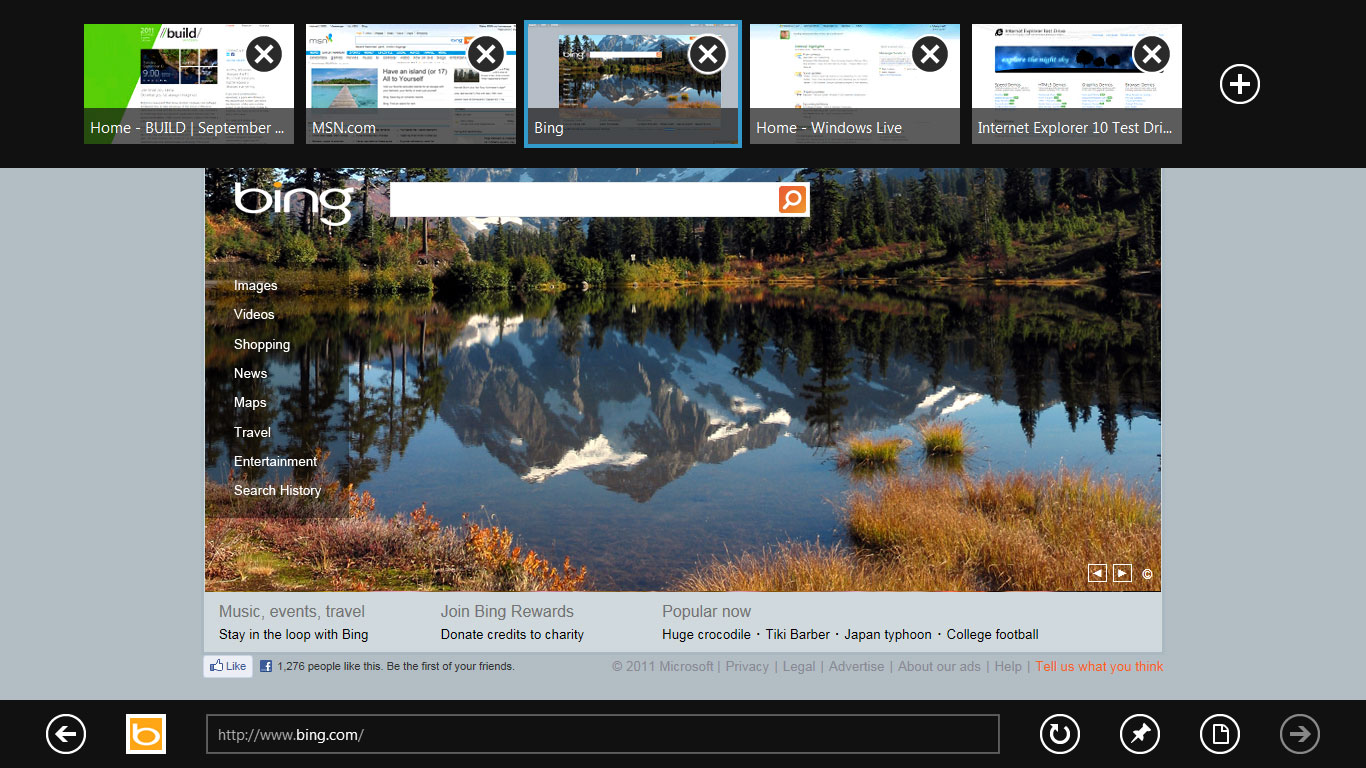
    Internet Explorer 10 has been designed with tablets in mind (click image to enlarge)

    Chris Jones, Microsoft’s corporate vice-president of Windows Live, says all a user’s data can be synchronised across multiple devices through Skydrive, its consumer-focused cloud storage solution.

    The same holds true for the personalised aspects of the operating system: the user’s choice of desktop wallpapers, images shown on the lock screen and security credentials.

    What’s particularly powerful is the Skydrive-powered photo reel Microsoft will include with Windows 8. When a user takes a photo on their tablet, smartphone or any other Live-enabled device, the photo reel will automatically sync with the cloud.

    This means a user can snap a photo using their phone and within seconds be editing that same photo on their notebook or desktop without having performed any manual transfer of the picture from the one device to the other.

    Though Jones says data can easily be synchronised with Skydrive, there’s often data lying around on a home PC that might not be important enough for storage and backup on Skydrive. Again, this is where Live comes to the rescue. By simply having the same Live ID present on two machines, users will be able to access data on a remote PC’s hard disk, all via the cloud.

    Windows Store
    It was expected, but Microsoft has now confirmed it will be launching an online app store, modelled heavily on the store it uses to sell Windows Phone apps — only on a much, much bigger scale.

    Though a developer will be able to publish an app and have it available in the store within a day, Microsoft isn’t saying yet if the store will be available in all markets at the time of Windows 8’s launch.

    Sinfosky tells TechCentral he can’t say when the store will be launched in SA and the company is saying nothing more about it for now.

    Iain McDonald, GM for the Windows Server Group, says Microsoft is concentrating first on finishing Windows 8. It will decide later which countries and regions have the “infrastructure and, more importantly, the scale of infrastructure” as well as the customer demand to make it feasible to offer the service.

    Our reading is that an SA version of the store will be available when Windows 8 launches, but that remains speculation for now.  — Brett Haggard, TechCentral

    • Subscribe to our free daily newsletter
    • Follow us on Twitter or on Facebook
    Follow TechCentral on Google News Add TechCentral as your preferred source on Google


    Apple Build Microsoft Steve Jobs Steven Sinofsky Windows 8
    WhatsApp YouTube
    Share. Facebook Twitter LinkedIn WhatsApp Telegram Email Copy Link
    Previous ArticleWindows 8 screenshots show off new user interface
    Next Article Vodacom ‘spiritually at odds’ with consumer act

    Related Posts

    Major security alert for iPhone users

    Major security alert for iPhone users

    18 March 2026
    Samsung's trifold gamble ends in retreat

    Samsung’s trifold gamble ends in retreat

    17 March 2026
    AI is coming to your accounting software

    Sage bets AI can save small business owners from admin hell

    13 March 2026
    Company News
    Why most Cisco partners leave money on the table at renewal time - Westcon-Comstor

    Why most Cisco partners leave money on the table at renewal time

    25 March 2026
    Why South Africa's technology leaders choose TechCentral

    Why South Africa’s technology leaders choose TechCentral

    25 March 2026
    The MSP stack is collapsing under its own weight. AI is forcing a reset - Acronis

    The MSP stack is collapsing under its own weight. AI is forcing a reset

    25 March 2026
    Opinion
    South Africa's energy future hinges on getting wheeling right - Aishah Gire

    South Africa’s energy future hinges on getting wheeling right

    10 March 2026
    Hold the doom: the case for a South African comeback - Duncan McLeod

    Apple just dropped a bomb on the Windows world

    5 March 2026
    VC's centre of gravity is shifting - and South Africa is in the frame - Alison Collier

    VC’s centre of gravity is shifting – and South Africa is in the frame

    3 March 2026

    Subscribe to Updates

    Get the best South African technology news and analysis delivered to your e-mail inbox every morning.

    Latest Posts
    Remgro's fibre empire roars back

    Remgro’s fibre empire roars back

    25 March 2026
    Truecaller cooperating with Info Regulator's Popia probe

    Truecaller cooperating with Info Regulator’s Popia probe

    25 March 2026
    Why Namibia slammed the door on Starlink

    Why Namibia slammed the door on Starlink

    25 March 2026
    Podcasters push back against regulatory overreach

    Podcasters push back against regulatory overreach

    25 March 2026
    © 2009 - 2026 NewsCentral Media
    • Cookie policy (ZA)
    • TechCentral – privacy and Popia

    Type above and press Enter to search. Press Esc to cancel.

    Manage consent

    TechCentral uses cookies to enhance its offerings. Consenting to these technologies allows us to serve you better. Not consenting or withdrawing consent may adversely affect certain features and functions of the website.

    Functional Always active
    The technical storage or access is strictly necessary for the legitimate purpose of enabling the use of a specific service explicitly requested by the subscriber or user, or for the sole purpose of carrying out the transmission of a communication over an electronic communications network.
    Preferences
    The technical storage or access is necessary for the legitimate purpose of storing preferences that are not requested by the subscriber or user.
    Statistics
    The technical storage or access that is used exclusively for statistical purposes. The technical storage or access that is used exclusively for anonymous statistical purposes. Without a subpoena, voluntary compliance on the part of your Internet Service Provider, or additional records from a third party, information stored or retrieved for this purpose alone cannot usually be used to identify you.
    Marketing
    The technical storage or access is required to create user profiles to send advertising, or to track the user on a website or across several websites for similar marketing purposes.
    • Manage options
    • Manage services
    • Manage {vendor_count} vendors
    • Read more about these purposes
    View preferences
    • {title}
    • {title}
    • {title}