 Brought to you by Freeform Dynamics in association with Nutanix
Business IT is being dragged down by the weight of the “old”. Whether it’s outdated assumptions, virtualisation platforms designed for consolidation not agility, or simply neophobia, this isn’t just disruption, it’s a death-grip.
Losing the weight requires fundamental change, and here’s why:
Flexible and agile is the ‘new normal’
Enterprise success today relies on speed, agility, security and availability, while always keeping costs under tight control.
But yesterday’s IT is not up to the job
Many enterprise IT platforms were built to solve yesterday’s problems, resulting in hard to manage systems with limited flexibility.
Cloud capabilities are wanted
Public cloud systems have the capabilities that business IT requires, but not all workloads are suited to running in the public cloud.
New IT infrastructures are available
Running cloud-like systems internally and combining them with public cloud resources is the way forward, but it requires new infrastructure platforms.
IT needs fresh ideas
The pressure on IT is mounting. Can you meet it before it becomes too great for today’s systems and processes? Can you meet it before something breaks – and breaks badly? How much longer can you put off real change – not just extension andadaptation, but fundamental change?
The demands are everywhere, and are coming faster than ever. Users and customers want new IT services or updates at the frequency they expect from the public cloud.
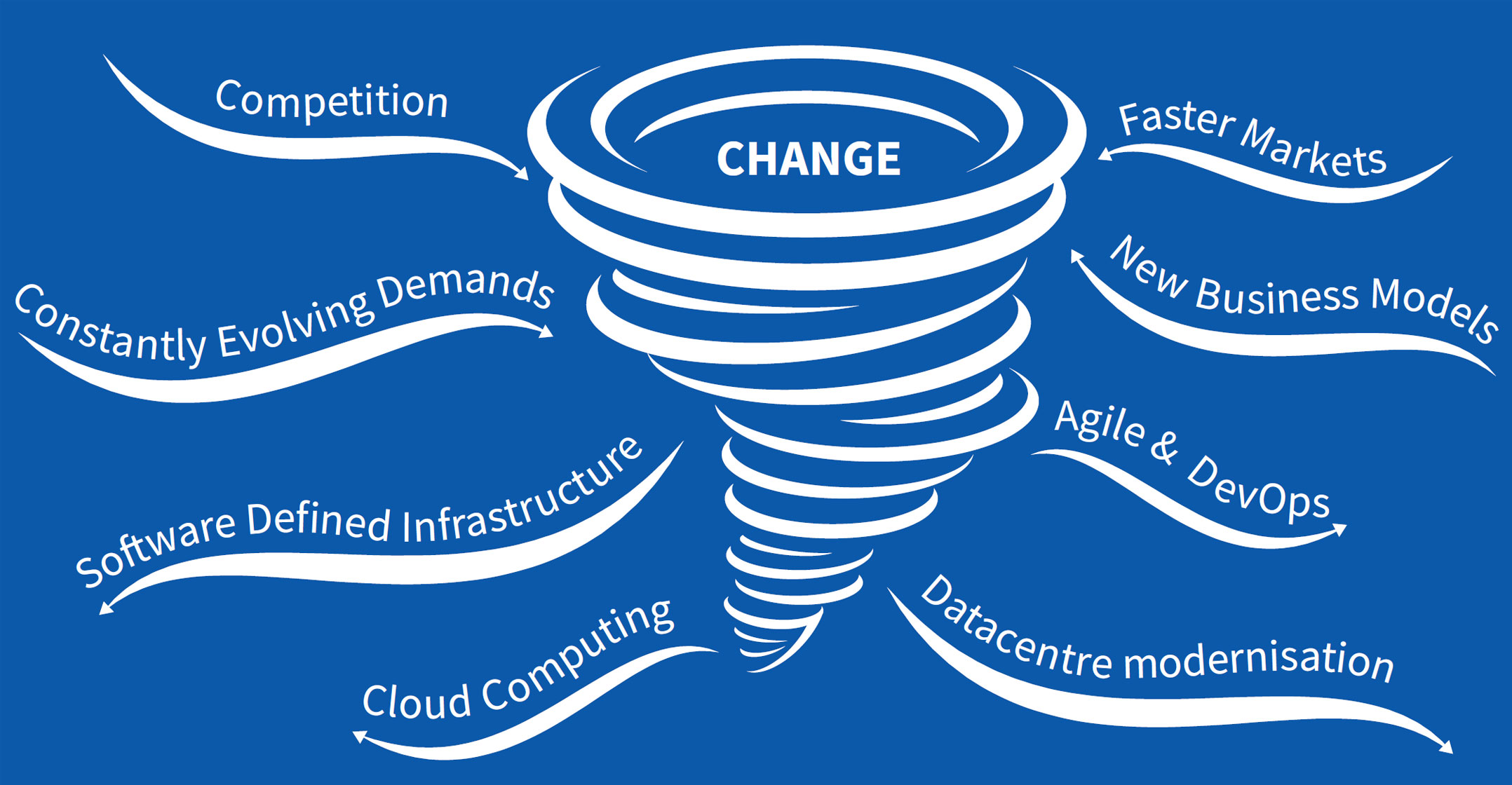 This puts pressure on your IT people, processes and systems to be able to deliver new applications to new users, anytime, anywhere.
You probably recognise most of this and may well have begun addressing the issues. It’s likely that Agile software methods and DevOps have already found their way into your kit bag, even if they have not yet scaled across the entire IT delivery system.
Are your IT platforms ready?
Like most organisations you are almost certainly building private clouds to improve IT flexibility and responsiveness, mimicking the capabilities you expect from public clouds. The challenge is how to blend these two together to enable a converged and hybrid approach to service delivery.
Building the hybrid future
The question then is what core solutions will you build your long term hybrid cloud IT platform on? This is challenging when it is likely that some of your existing kit will be several years old. How will you go from ideas and pilots to scalable and repeatable operations?
It’s time for a cold, hard, readiness check. It’s time to get ready to change. It’s time for an infrastructure rethink.
Remember that most of the IT that is in use today was not designed with hybrid cloud in mind.
Clouds bring flexibility
The growth of public cloud usage within business IT over the past decade has been dramatic. While some of this has been as a substitution of applications previously run on internal IT systems, much has taken place because of the core capabilities inherent to public cloud offerings.
Public cloud has great features
In many ways public cloud has set the scene – and, more importantly, the expectations of users and customers – in regard to flexibility, responsiveness, scalability and cost. You need a VM now? You spin one up in a few minutes at most.
You need extra resources to meet a surge? No problem, public cloud is on-demand. You want to pay for the resources from opex, not capex? Public cloud has the model for you.
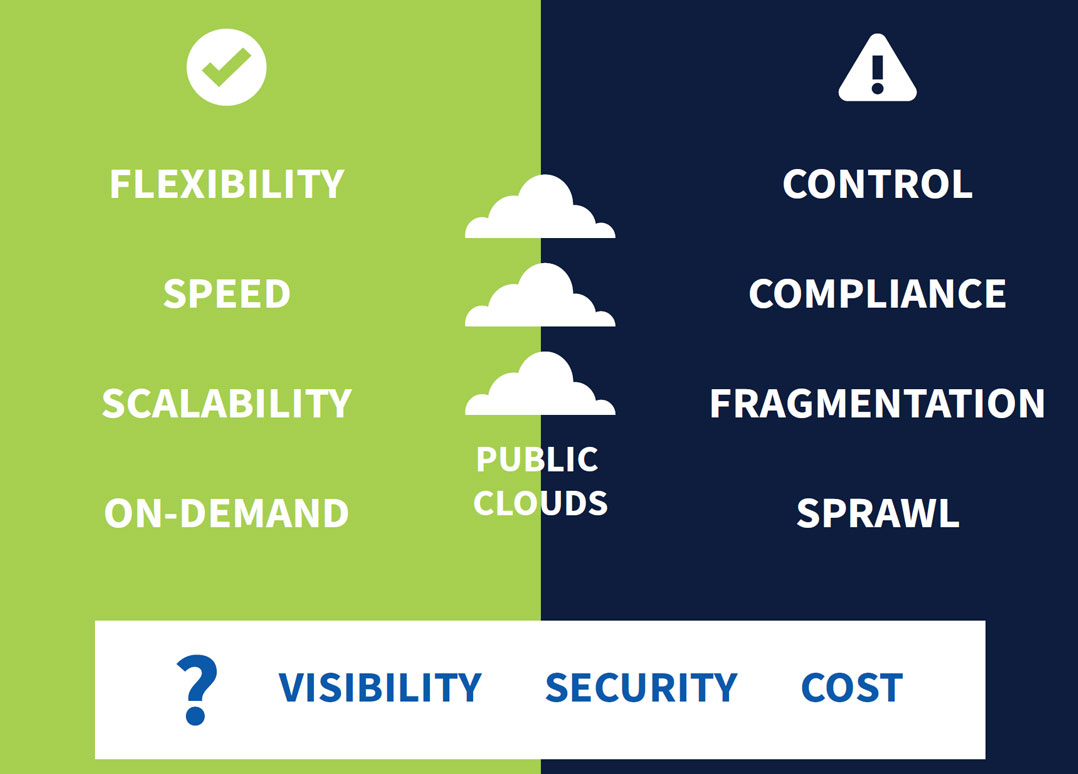 However, while public cloud is excellent in many respects, it has disadvantages, too. As a result, it isn’t able to meet every enterprise need or expectation. For example, you may have specific service-level requirements for low latency, or regulatory limits on the geographical location of data.
Taking it private
There are also questions to ask around cost and control, where private cloud may provide better answers. One that is too often ignored relates to “sunk costs” – once you have the data centre infrastructure and skilled staff in place, adding an incremental cluster or scaling an existing one up should be cheaper inhouse. Then you’ve paid for it, so it’s yours, with no ongoing fees.
In addition, many organisations have applications, services and data that, for whatever reason, they want to directly manage and control. That requires skills and infrastructure, and once you have those, you want to get as much use and value out of them as possible.
The message is that public cloud will be part of the mix, but alongside cloudy platforms in the data centre as part of a hybrid public/private approach.
Remember that the future is likely to be a mix of public/private cloud and bare metal systems.
Virtualisation is not enough
There is an old joke in which a traveller asks a local for directions. The local pauses a moment for thought, then replies: “If I wanted to get there, I wouldn’t start from here.”
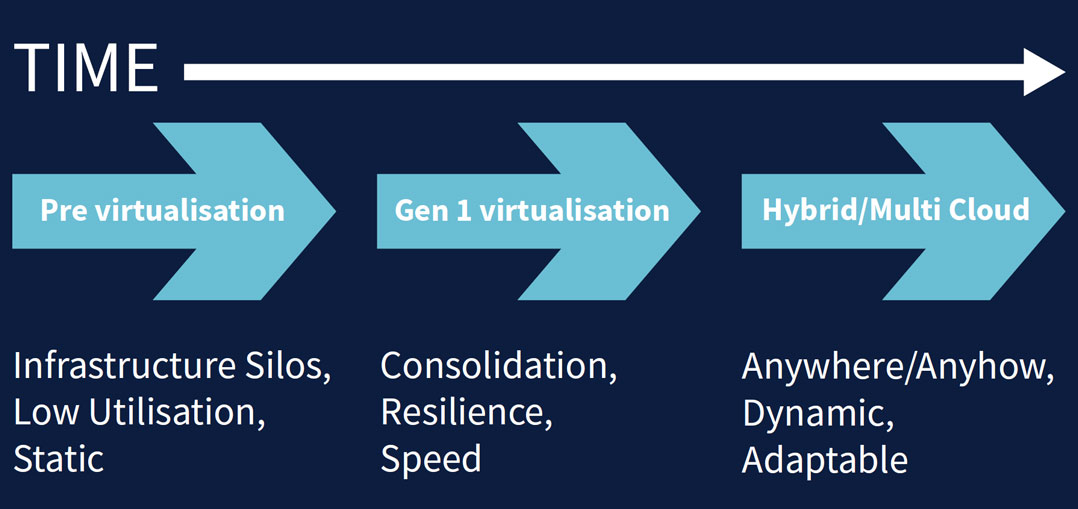
So it is with private cloud. Many organisations have tried building flexible, scalable and responsive on-demand systems based on their existing virtualisation technologies. The problem is that while first-generation virtualisation platforms worked very well to improve resource utilisation and provide some degree of flexibility, they weren’t designed to meet all of the demands expected of true cloud solutions today.
For example, they may have practical limitations or present excessive complexity in areas such as moving workloads between cloud and on-site resources, the portability of security policies and virtual machines, and policy driven governance in hybrid scenarios, to name but three.
 Commercial models are vital, too
It is also important to recognise that the legacy commercial models associated with these platforms were not designed with cloud in mind, whether public, private or hybrid.
They may feature highly constraining contract terms, for instance, or excessive software licensing and maintenance fees.
Starting from the wrong point brings challenges
Virtualisation platforms were never conceived for the IT world of today, where it is essential to be able to move workloads without interruption and with little advance notice. When those systems appeared a decade or more ago, the primary intention was to drive consolidation and operational efficiency.
Yes, these platforms have subsequently been enhanced to cope with the need for more scalability, flexibility and to give responsiveness to emulate the on-demand model. However, the truth is that they are starting from the wrong point – and perhaps more importantly, with the wrong philosophy.
Remember that evolving an existing virtualisation platform into a hybrid cloud infrastructure may not meet all your needs.
Building a new platform
In order to meet the fast-growing demand for workload flexibility, scalability and mobility, longer-established vendors and newcomers alike have brought new offerings to the market. Some of the ‘traditional’ vendors have responded with solutions based on their existing platforms, while others have introduced completely new architectures. But there are caveats and catches, and you need to be aware of all the “hedging” going on.
New platforms needed
Often, longer-established vendors try to preserve their existing customer engagements, so they encourage a purely incremental approach to adoption. Their goal, which is perfectly understandable, is to avoid disrupting existing revenue streams. However, this can slow down your IT and business transformation.
 Evolution or revolution?
The important question is whether such a “safe and evolutionary” path meets your needs. It may be fine in some areas, but it is likely that you also have projects where disruption is at least highly desirable, and perhaps absolutely necessary. For example, projects that relate to key, fast-moving business requirements that are subject to rapid change.
If you are going to disrupt, then revolution may well be the better route to take. That means you need to check out the newer platforms available, because some of these were built from the ground up specifically to serve the needs of the new dynamic, hybrid world – they are the hybrid cloud made real, if you like.
Remember that if you want the most flexible hybrid cloud capabilities, your best option is a solution that is built from scratch to do exactly that.
Vision, balance, strategy
Flexibility and wide deployment choice can easily lead to chaos if control and governance are lacking. Equally, attempting to rip and replace your IT platforms in their entirety is probably beyond your budget limits, plus there are solid operational reasons why this option is rarely taken.
IT service delivery for the future
The trick is to get the balance right. You will probably have a strategy to modernise across the board over time, but you are unlikely to either want or need to do everything at once. S,o keep your focus on areas where flexibility, “cloudy architectures” and/or a hybrid approach really matters.
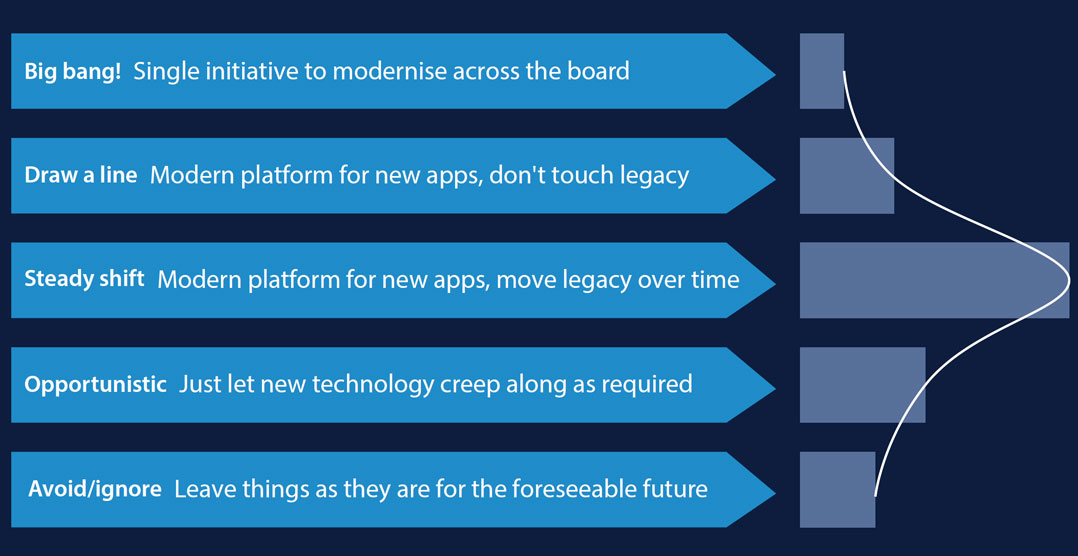 Early movers have often started by building new platforms to support those business areas where the ability to build and change applications quickly is essential.
Examples include customer engagement systems, supply chain enablement and improved logistics, workforce empowerment, and of course the rapidly evolving world of IoT.
What to look for in a cloud-flexible platform
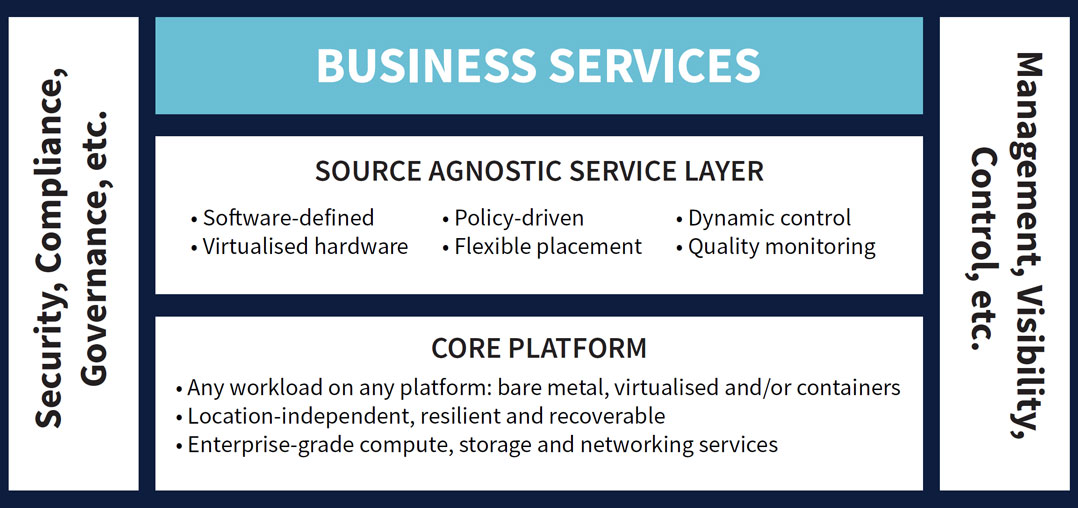
Today’s applications demand flexibility and agility like never before. First, it must be possible to deploy them anywhere, whether in-house, in a hosted environment, at the edge, or as a service on a public cloud. Then that location may need to change over time, for example to adapt to new usage patterns or supplier costs, or simply to take advantage of new technology.
To ensure maximum usability, the new platform must support differing application and service delivery mechanisms, from containers and multiple hypervisors to bare metal. And it must be secure and easy to administer.
Remember that seeking out quick wins can show the value of hybrid cloud, allowing you to then expand it to cover more workloads.
Final thoughts
Building a platform that can meet today’s requirements for speed, scalability and agility is a complex matter. You could build on what you already have in place, or put in a new platform architecture, perhaps one based on hyperconverged infrastructure (HCI). But as well as finding a solution that meets your application needs, there are other matters to consider.
For example, along with flexibility and agility, any platform that runs a variety of critical business systems also needs to be resilient and efficiently supported. That support may be needed around the clock, and perhaps around the globe.
It’s not just the technology
And there are non-technical issues to think about. As your business needs become less predictable, should you carry on paying for your IT Infrastructure in the same way that you have always done, or do you need greater financial flexibility? Should you be looking for solutions that can be funded in a variety of models?
IT solutions are evolving fast, and combined with business pressure for flexibility, we have reached an inflection point: incremental change is no longer adequate.
Substantive change is needed, and this is not something you can delay thinking about for much longer. Leave it too long and you may get caught out by your competitors, or by managed service and cloud providers.
About Freeform Dynamics
Freeform Dynamics is an IT industry analyst firm. Through our research and insights, we aim to help busy IT and business professionals get up to speed on the latest technology developments, and make better informed investment decisions. For more information, visit www.freeformdynamics.com or follow us on Twitter @FreeformCentral.
About Nutanix
Nutanix is a global leader in cloud software and hyperconverged infrastructure solutions, making infrastructure invisible so that IT can focus on the applications and services that power their business. Companies around the world use NutanixEnterprise Cloud OS software to bring one-click application management and mobility across public, private and distributed edge clouds so they can run any application at any scale with a dramatically lower total cost of ownership. The result is organisations that can rapidly deliver a high-performance IT environment on demand, giving application owners a true cloud-like experience. Learn more at www.nutanix.com or follow us on Twitter @nutanix.
- This promoted content may have been paid for by the party concerned