

Close Menu
TechCentralTechCentral

    Subscribe to the newsletter

    Get the best South African technology news and analysis delivered to your e-mail inbox every morning.

    Facebook X (Twitter) YouTube LinkedIn
    WhatsApp Facebook X (Twitter) LinkedIn YouTube
    TechCentralTechCentral
    • News
      Digital authoritarianism grows as African states normalise internet blackouts

      Digital authoritarianism grows as African states normalise internet blackouts

      19 December 2025
      Starlink satellite anomaly creates debris in rare orbital mishap

      Starlink satellite anomaly creates debris in rare orbital mishap

      19 December 2025
      TechCentral's South African Newsmakers of 2025

      TechCentral’s South African Newsmakers of 2025

      18 December 2025
      Malatsi buries Post Office's long-dead monopoly

      Malatsi buries Post Office monopoly the market ignored

      18 December 2025
      China races to crack EUV as chip war with the West intensifies

      China races to crack EUV lithography as chip war with the West intensifies

      18 December 2025
    • World
      Trump space order puts the moon back at centre of US, China rivalry - US President Donald Trump

      Trump space order puts the moon back at centre of US, China rivalry

      19 December 2025
      Warner Bros slams the door on Paramount

      Warner Bros slams the door on Paramount

      17 December 2025
      X moves to block bid to revive Twitter brand

      X moves to block bid to revive Twitter brand

      17 December 2025
      Oracle’s AI ambitions face scrutiny on earnings miss

      Oracle’s AI ambitions face scrutiny on earnings miss

      11 December 2025
      China will get Nvidia H200 chips - but not without paying Washington first

      China will get Nvidia H200 chips – but not without paying Washington first

      9 December 2025
    • In-depth
      Black Friday goes digital in South Africa as online spending surges to record high

      Black Friday goes digital in South Africa as online spending surges to record high

      4 December 2025
      Canal+ plays hardball - and DStv viewers feel the pain

      Canal+ plays hardball – and DStv viewers feel the pain

      3 December 2025
      Jensen Huang Nvidia

      So, will China really win the AI race?

      14 November 2025
      Valve's Linux console takes aim at Microsoft's gaming empire

      Valve’s Linux console takes aim at Microsoft’s gaming empire

      13 November 2025
      iOCO's extraordinary comeback plan - Rhys Summerton

      iOCO’s extraordinary comeback plan

      28 October 2025
    • TCS
      TCS+ | Africa's digital transformation - unlocking AI through cloud and culture - Cliff de Wit Accelera Digital Group

      TCS+ | Cloud without culture won’t deliver AI: Accelera’s Cliff de Wit

      12 December 2025
      TCS+ | How Cloud on Demand helps partners thrive in the AWS ecosystem - Odwa Ndyaluvane and Xenia Rhode

      TCS+ | How Cloud On Demand helps partners thrive in the AWS ecosystem

      4 December 2025
      TCS | MTN Group CEO Ralph Mupita on competition, AI and the future of mobile

      TCS | Ralph Mupita on competition, AI and the future of mobile

      28 November 2025
      TCS | Dominic Cull on fixing South Africa's ICT policy bottlenecks

      TCS | Dominic Cull on fixing South Africa’s ICT policy bottlenecks

      21 November 2025
      TCS | BMW CEO Peter van Binsbergen on the future of South Africa's automotive industry

      TCS | BMW CEO Peter van Binsbergen on the future of South Africa’s automotive industry

      6 November 2025
    • Opinion
      Netflix, Warner Bros deal raises fresh headaches for MultiChoice - Duncan McLeod

      Netflix, Warner Bros deal raises fresh headaches for MultiChoice

      5 December 2025
      BIN scans, DDoS and the next cybercrime wave hitting South Africa's banks - Entersekt Gerhard Oosthuizen

      BIN scans, DDoS and the next cybercrime wave hitting South Africa’s banks

      3 December 2025
      Your data, your hardware: the DIY AI revolution is coming - Duncan McLeod

      Your data, your hardware: the DIY AI revolution is coming

      20 November 2025
      Zero Carbon Charge founder Joubert Roux

      The energy revolution South Africa can’t afford to miss

      20 November 2025
      It's time for a new approach to government IT spend in South Africa - Richard Firth

      It’s time for a new approach to government IT spend in South Africa

      19 November 2025
    • Company Hubs
      • Africa Data Centres
      • AfriGIS
      • Altron Digital Business
      • Altron Document Solutions
      • Altron Group
      • Arctic Wolf
      • AvertITD
      • Braintree
      • CallMiner
      • CambriLearn
      • CYBER1 Solutions
      • Digicloud Africa
      • Digimune
      • Domains.co.za
      • ESET
      • Euphoria Telecom
      • Incredible Business
      • iONLINE
      • IQbusiness
      • Iris Network Systems
      • LSD Open
      • NEC XON
      • Netstar
      • Network Platforms
      • Next DLP
      • Ovations
      • Paracon
      • Paratus
      • Q-KON
      • SevenC
      • SkyWire
      • Solid8 Technologies
      • Telit Cinterion
      • Tenable
      • Vertiv
      • Videri Digital
      • Vodacom Business
      • Wipro
      • Workday
      • XLink
    • Sections
      • AI and machine learning
      • Banking
      • Broadcasting and Media
      • Cloud services
      • Contact centres and CX
      • Cryptocurrencies
      • Education and skills
      • Electronics and hardware
      • Energy and sustainability
      • Enterprise software
      • Financial services
      • Information security
      • Internet and connectivity
      • Internet of Things
      • Investment
      • IT services
      • Lifestyle
      • Motoring
      • Public sector
      • Retail and e-commerce
      • Satellite communications
      • Science
      • SMEs and start-ups
      • Social media
      • Talent and leadership
      • Telecoms
    • Events
    • Advertise
    TechCentralTechCentral
    Home » World » Drug smugglers deal in drones

    Drug smugglers deal in drones

    By The Conversation25 January 2015
    Twitter LinkedIn Facebook WhatsApp Email Telegram Copy Link
    News Alerts
    WhatsApp

    drone-640

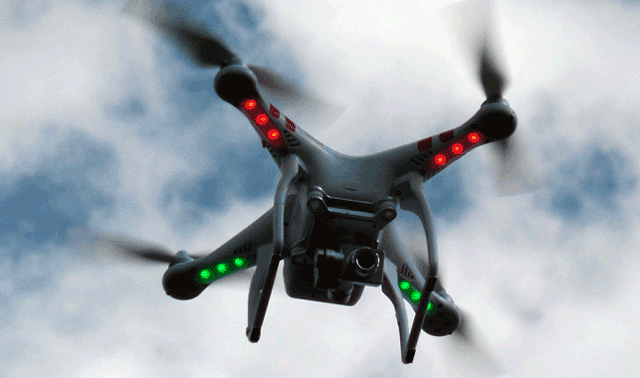
    It will come as no surprise to anyone that drugs are big business, so when a drone crashed in a car park of a US border town weighed down with several kilos of narcotics, it was just another example of smugglers taking advantage of the latest in technology.

    Studying technological innovation in the war on drugs, I’m often asked what methods smugglers use: pick any object or artefact you care to name and it’s almost certainly been tried.

    Over decades, drug smugglers have developed many ways of transporting and concealing their trade, often demonstrating very high levels of technical expertise, scientific knowledge and adaptability. Drug smuggling organisations are highly innovative, so mobile phones, GPS and better intelligence gathering strategies are used to make their business easier, and that of law enforcement more difficult.

    Even if smugglers cannot always match the hi-tech equipment used by law enforcement, they still remain one step ahead of their pursuers, whether by land, air or sea.

    During the 1980s, smugglers mainly used small aircraft to deliver air drops, or by commercial airlines or cargo aircraft. Drug mules, who carry drugs either in clothing, baggage or inside the body to their destinations, are still very common. Often drugs are smuggled by swallowing small, usually latex containers.

    On average, a “mule” is arrested every day in El Dorado, Colombia’s main airport. And Colombian police recently discovered that as a way to evade X-rays (or confuse the policeman looking at the screen) smugglers had switched to using liquid cocaine, instead of powdered solids. In recently years there have been reports of people transporting drugs via a small incision on the thigh or breast implants, and in 2013 a Canadian was discovered carrying a latex pregnant belly filled with cocaine.

    In 2014, nearly 700 parcels cases were reported in the cargo airport of Bogotá, demonstrating a wide array of objects used to transport drugs: magazines, children’s books, computers, a prosthetic leg, coffee, a mirror, an aquarium, a drum, sandwiches, an oscilloscope — you get the idea. And here I’m mentioning only the ruses used in Colombia — at the US-Mexico border other techniques are common, from ultralight planes and even catapults.

    For larger quantities, smugglers prefer going by sea: cargo ships, fishing ships, go-fast boats, and even submarines. The cartels began using go-fast boats in the nineties, usually a small fishing boat equipped with engines that allows them to surpass 25 knots, and increase speed and cargo capacities. This led to a competition between smugglers and the Colombian Coast Guard.

    During the 1990s, smugglers also used yachts and sailboats because these allowed them to hide greater amounts of cargo and to make longer trips. Smugglers developed considerable engineering skills, using fibreglass to build compartments to save weight and carry more cargo. Another method used extensively during this time — and still used today — is to hide drugs in commercial cargo ships travelling on commercial routes. This means greatly increased cargo capacities, and less risk to personnel as the cargo is unescorted. The Colombian police’s biggest drugs bust of 2014 was almost seven tonnes of cocaine in a container carrying pineapples.

    But surely their most impressive feat is the narcosub, a name given to describe a diverse range of submersible and semi-submersible boats. They can be crewed or unmanned, usually built in the jungles near to Columbia’s Pacific coast (although one was discovered while being built in Ecuador).

    The design of narcosubs gives some indication of the wide range of knowledge required to create them — from local knowledge construction techniques to formal engineering skills — which are brought together by the drugs trade. Some narcosubs are designed to be towed underwater or remote controlled; others are designed with boat hulls but sealed, allowing almost all of the hull to be submerged, to reduce visibility.

    Enforcement agencies do make huge efforts to counter all of these innovations. But while the smugglers succeed by getting any amount of drugs through, guaranteeing a return on an initially cheaper investment, law enforcement’s aim for total control means any breach represents failure.

    Looking at the big picture, capturing 200 tonnes of cocaine a year would hardly make any difference to drug smugglers’ trade, except to drive them to come up with yet more innovative methods.

    Amid all this and the history of the war on drugs, it shouldn’t come as any surprise that smugglers have started using drones. The question should be, for how long they have been using them? And if and when the drones fail — are intercepted, shot down or tracked — the smugglers will be sure to have another new (or old) trick up their sleeve.The Conversation

    • Javier Guerrero is PhD student, science, technology & innovation studies at the Edinburgh University
    • This article was originally published on The Conversation


    Javier Guerrero
    Subscribe to TechCentral Subscribe to TechCentral
    Share. Facebook Twitter LinkedIn WhatsApp Telegram Email Copy Link
    Previous ArticleCell C heads to court over call rates
    Next Article Microsoft’s in danger of becoming cool again
    Company News
    Why TechCentral is the most powerful platform for reaching IT decision makers

    Why TechCentral is the most powerful platform for reaching IT decision makers

    17 December 2025
    Business trends to watch in 2026 - Domains.co.za

    Business trends to watch in 2026

    17 December 2025
    MTN Zambia launches world's first 4G cloud smartphone solution - Huawei

    MTN Zambia launches world’s first 4G cloud smartphone solution

    17 December 2025
    Opinion
    Netflix, Warner Bros deal raises fresh headaches for MultiChoice - Duncan McLeod

    Netflix, Warner Bros deal raises fresh headaches for MultiChoice

    5 December 2025
    BIN scans, DDoS and the next cybercrime wave hitting South Africa's banks - Entersekt Gerhard Oosthuizen

    BIN scans, DDoS and the next cybercrime wave hitting South Africa’s banks

    3 December 2025
    Your data, your hardware: the DIY AI revolution is coming - Duncan McLeod

    Your data, your hardware: the DIY AI revolution is coming

    20 November 2025

    Subscribe to Updates

    Get the best South African technology news and analysis delivered to your e-mail inbox every morning.

    Latest Posts
    Digital authoritarianism grows as African states normalise internet blackouts

    Digital authoritarianism grows as African states normalise internet blackouts

    19 December 2025
    Starlink satellite anomaly creates debris in rare orbital mishap

    Starlink satellite anomaly creates debris in rare orbital mishap

    19 December 2025
    Trump space order puts the moon back at centre of US, China rivalry - US President Donald Trump

    Trump space order puts the moon back at centre of US, China rivalry

    19 December 2025
    TechCentral's South African Newsmakers of 2025

    TechCentral’s South African Newsmakers of 2025

    18 December 2025
    © 2009 - 2025 NewsCentral Media
    • Cookie policy (ZA)
    • TechCentral – privacy and Popia

    Type above and press Enter to search. Press Esc to cancel.

    Manage consent

    TechCentral uses cookies to enhance its offerings. Consenting to these technologies allows us to serve you better. Not consenting or withdrawing consent may adversely affect certain features and functions of the website.

    Functional Always active
    The technical storage or access is strictly necessary for the legitimate purpose of enabling the use of a specific service explicitly requested by the subscriber or user, or for the sole purpose of carrying out the transmission of a communication over an electronic communications network.
    Preferences
    The technical storage or access is necessary for the legitimate purpose of storing preferences that are not requested by the subscriber or user.
    Statistics
    The technical storage or access that is used exclusively for statistical purposes. The technical storage or access that is used exclusively for anonymous statistical purposes. Without a subpoena, voluntary compliance on the part of your Internet Service Provider, or additional records from a third party, information stored or retrieved for this purpose alone cannot usually be used to identify you.
    Marketing
    The technical storage or access is required to create user profiles to send advertising, or to track the user on a website or across several websites for similar marketing purposes.
    • Manage options
    • Manage services
    • Manage {vendor_count} vendors
    • Read more about these purposes
    View preferences
    • {title}
    • {title}
    • {title}