Close Menu
TechCentralTechCentral

    Subscribe to the newsletter

    Get the best South African technology news and analysis delivered to your e-mail inbox every morning.

    Facebook X (Twitter) YouTube LinkedIn
    WhatsApp Facebook X (Twitter) LinkedIn YouTube
    TechCentralTechCentral
    • News
      FirstRand ups stake in Optasia in R1.5-billion deal

      FirstRand ups stake in Optasia in R1.5-billion deal

      26 March 2026
      Remgro's fibre empire roars back

      Remgro’s fibre empire roars back

      25 March 2026
      Truecaller cooperating with Info Regulator's Popia probe

      Truecaller cooperating with Info Regulator’s Popia probe

      25 March 2026
      Why Namibia slammed the door on Starlink

      Why Namibia slammed the door on Starlink

      25 March 2026
      Podcasters push back against regulatory overreach

      Podcasters push back against regulatory overreach

      25 March 2026
    • World
      It's official: ads are coming to ChatGPT

      It’s official: ads are coming to ChatGPT

      23 March 2026
      Mystery Chinese AI model revealed to be Xiaomi's

      Mystery Chinese AI model revealed to be Xiaomi’s

      19 March 2026
      A mystery AI model has developers buzzing

      A mystery AI model has developers buzzing

      18 March 2026
      Samsung's trifold gamble ends in retreat

      Samsung’s trifold gamble ends in retreat

      17 March 2026
      Nvidia targets $1-trillion in AI chip sales as inference demand surges - Jensen Huang

      Nvidia targets $1-trillion in AI chip sales as inference demand surges

      17 March 2026
    • In-depth
      The last generation of coders

      The last generation of coders

      18 February 2026
      Sentech is in dire straits

      Sentech is in dire straits

      10 February 2026
      How liberalisation is rewiring South Africa's power sector

      How liberalisation is rewiring South Africa’s power sector

      21 January 2026
      The top-performing South African tech shares of 2025

      The top-performing South African tech shares of 2025

      12 January 2026
      Digital authoritarianism grows as African states normalise internet blackouts

      Digital authoritarianism grows as African states normalise internet blackouts

      19 December 2025
    • TCS
      Meet the CIO | HealthBridge CTO Anton Fatti on the future of digital health

      Meet the CIO | Healthbridge CTO Anton Fatti on the future of digital health

      23 March 2026
      TCS+ | Arctic Wolf unpacks the evolving threat landscape for SA businesses - Clare Loveridge and Jason Oehley

      TCS+ | Arctic Wolf unpacks the evolving threat landscape for SA businesses

      19 March 2026
      TCS+ | Vox Kiwi: a wireless solution promising a fibre-like experience - Theo van Zyl

      TCS+ | Vox Kiwi: a wireless solution promising a fibre-like experience

      13 March 2026
      TCS+ | Flipping the narrative on AI in the Global South - Josefin Rosén

      TCS+ | Flipping the narrative on AI in the Global South

      13 March 2026
      TCS | Sink or swim? Antony Makins on how AI is rewriting the rules of work

      TCS | Sink or swim? Antony Makins on how AI is rewriting the rules of work

      5 March 2026
    • Opinion
      South Africa's energy future hinges on getting wheeling right - Aishah Gire

      South Africa’s energy future hinges on getting wheeling right

      10 March 2026
      Hold the doom: the case for a South African comeback - Duncan McLeod

      Apple just dropped a bomb on the Windows world

      5 March 2026
      VC's centre of gravity is shifting - and South Africa is in the frame - Alison Collier

      VC’s centre of gravity is shifting – and South Africa is in the frame

      3 March 2026
      Hold the doom: the case for a South African comeback - Duncan McLeod

      Hold the doom: the case for a South African comeback

      26 February 2026
      The AI fraud crisis your bank is not ready for - Andries Maritz

      The AI fraud crisis your bank is not ready for

      18 February 2026
    • Company Hubs
      • 1Stream
      • Africa Data Centres
      • AfriGIS
      • Altron Digital Business
      • Altron Document Solutions
      • Altron Group
      • Arctic Wolf
      • Ascent Technology
      • AvertITD
      • Braintree
      • CallMiner
      • CambriLearn
      • CYBER1 Solutions
      • Digicloud Africa
      • Digimune
      • Domains.co.za
      • ESET
      • Euphoria Telecom
      • HOSTAFRICA
      • Incredible Business
      • iONLINE
      • IQbusiness
      • Iris Network Systems
      • LSD Open
      • Mitel
      • NEC XON
      • Netstar
      • Network Platforms
      • Next DLP
      • Ovations
      • Paracon
      • Paratus
      • Q-KON
      • SevenC
      • SkyWire
      • Solid8 Technologies
      • Telit Cinterion
      • Tenable
      • Vertiv
      • Videri Digital
      • Vodacom Business
      • Wipro
      • Workday
      • XLink
    • Sections
      • AI and machine learning
      • Banking
      • Broadcasting and Media
      • Cloud services
      • Contact centres and CX
      • Cryptocurrencies
      • Education and skills
      • Electronics and hardware
      • Energy and sustainability
      • Enterprise software
      • Financial services
      • HealthTech
      • Information security
      • Internet and connectivity
      • Internet of Things
      • Investment
      • IT services
      • Lifestyle
      • Motoring
      • Policy and regulation
      • Public sector
      • Retail and e-commerce
      • Satellite communications
      • Science
      • SMEs and start-ups
      • Social media
      • Talent and leadership
      • Telecoms
    • Events
    • Advertise
    TechCentralTechCentral
    Home » Sections » AI and machine learning » So, will China really win the AI race?

    So, will China really win the AI race?

    Jensen Huang says China could surpass the US in AI, prompting experts to debate whether Beijing can truly lead.
    By The Conversation14 November 2025
    Twitter LinkedIn Facebook WhatsApp Email Telegram Copy Link
    News Alerts
    WhatsApp
    Jensen Huang Nvidia
    Nvidia CEO Jensen Huang. Kent Nishimura/Reuters

    “China is going to win the AI race,” Nvidia CEO Jensen Huang told an AI summit in London earlier this month. The Taiwanese-born boss of the chip maker, the world’s most valuable public company, believes the Chinese are already just “nanoseconds” behind the Americans and well placed to overtake them.

    He pointed to China’s energy superiority and AI research talent, as well as the risk that the Trump administration’s ban on selling China the most advanced chips will just galvanise Beijing to close that technological gap.

    Huang did soften his stance later to say American could still win the race, but he has raised potentially existential questions about the road ahead. We asked two experts whether China is likely to prevail.

    Yes

    Greg Slabaugh, professor of computer vision and AI, Queen Mary University of London:

    Artificial intelligence has always been an international enterprise: papers, open-source models and datasets often move freely, and breakthroughs emerge from collaborations across borders. Yet in several domains, China’s research dominance is already clear.

    Take computer vision, the field that enables machines to interpret and reason about visual data. It underpins everything from autonomous vehicles and robotics to medical imaging and surveillance.

    Held in October in Hawaii, the 2025 International Conference on Computer Vision (ICCV) is one of the world’s most prestigious and competitive computer vision venues. Of the research papers presented, half of all authors were affiliated with Chinese institutions, far ahead of the second-placed US, which had 17% of papers. If Chinese nationals working abroad were included, the gap would be even wider.

    Chinese researchers are optimising algorithms to perform efficiently on domestic hardware

    Based on this admittedly simplistic metric, China has already won. It led the world in the volume and visibility of cutting-edge computer vision research at the conference, shaping the agenda in one of AI’s most dynamic areas.

    This strength stems from long-term strategic planning. In 2017, Beijing launched its new generation artificial intelligence development plan, a national strategy to make China the world leader in AI by 2030. That ambition has been backed by enormous state-guided investment.

    China’s recently launched National Venture Capital Guidance Fund, worth around US$138-billion, now channels capital into strategic “hard tech” sectors such as AI, semiconductors and quantum computing.

    Provincial governments and state-owned enterprises operate numerous additional funds that co-invest with private firms. Together, they create a coordinated financial ecosystem that can scale technologies from lab to market at speed.
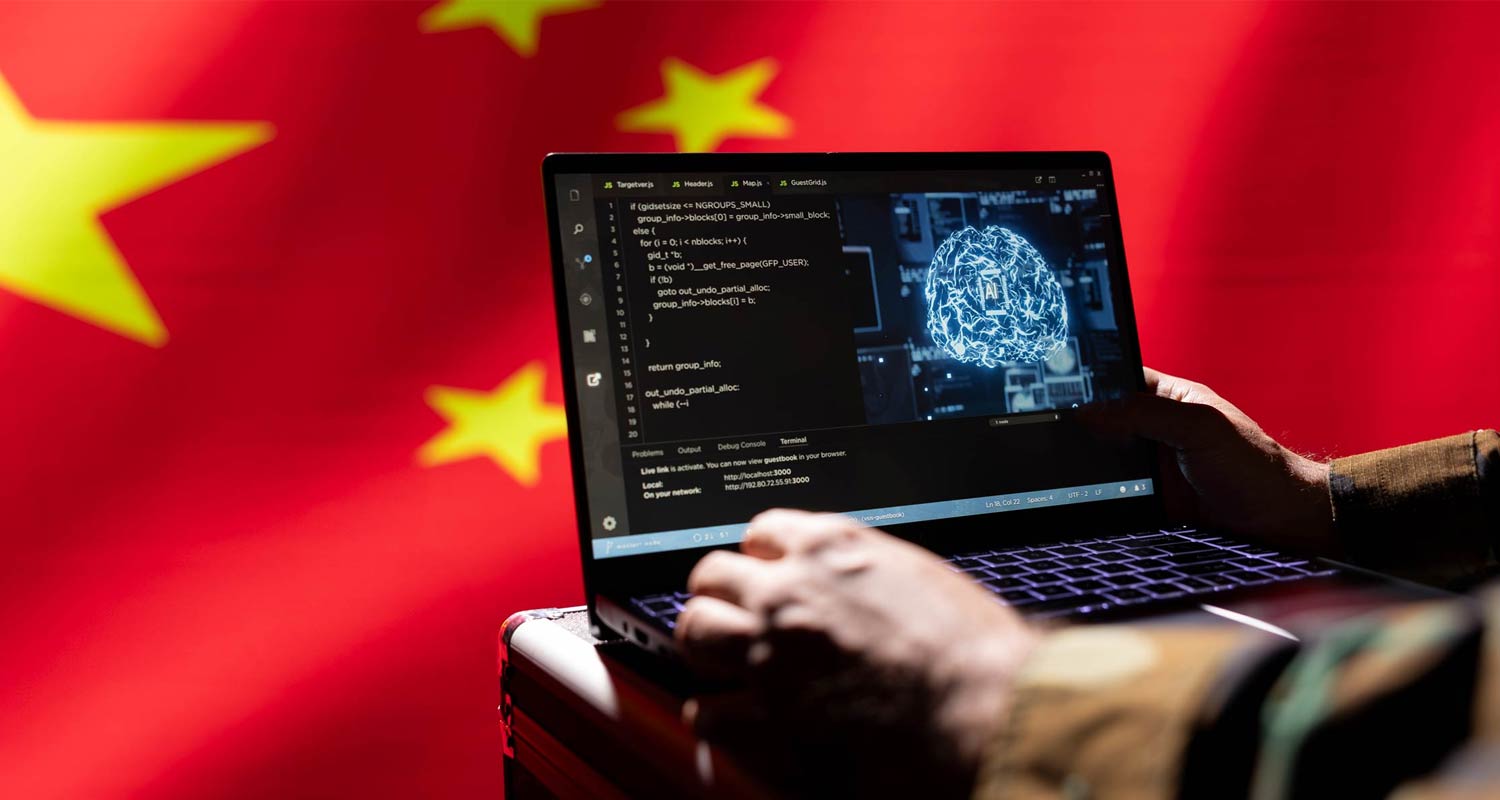
    How Beijing’s army of robot dogs and AI drones could redefine warfareThe US still leads in key areas: private-sector investment (by about 12 times), foundational models and advanced semiconductor design, led by companies like Nvidia. But China is moving quickly to close the gap. Its approach, guided more by state-led industrial policy than purely by market competition, aligns research, infrastructure and industry in a way that the more fragmented western system can struggle to match.

    Cities such as Beijing, Shanghai and Shenzhen now host vast AI computing hubs, also known as “AI factories”, which supply the computational power for both research and industry. Technology giants like Huawei, Alibaba, Baidu and more recently DeepSeek are building competitive large-scale models and high-performance hardware alternatives.

    Even with export controls limiting access to the most advanced chips, Chinese researchers are optimising algorithms to perform efficiently on domestic hardware – a hallmark of innovation under constraint.

    The most meaningful progress will come from open, responsible collaboration, balanced with sensible export controls

    China’s advantage also lies in scale. With 1.4 billion people and massive digital platforms, it generates data at a volume unmatched in other locations. This fuels rapid progress in model training and deployment.

    Meanwhile, China now produces more PhDs in the sciences than anywhere else, ensuring a deep pool of AI expertise to sustain momentum. More data, more talent and more coordinated investment create a self-accelerating loop that drives both research and industrial adoption.

    If current trends continue, Huang’s words could prove prophetic. China’s combination of scale, strategy and coordination gives it a real prospect of emerging as the world’s leading force in AI development and deployment.

    For the west, that could mean adapting to a landscape where standards, platforms and priorities are increasingly shaped by Chinese institutions and industrial ecosystems.

    But the future of AI should not be viewed as a zero-sum contest. The most meaningful progress will come from open, responsible collaboration, balanced with sensible export controls and safeguards for dual-use technologies.

    Seeing AI as a shared race for human progress might just help us advance further together.

    No

    Sean Kenji Starrs, lecturer in international development, King’s College London:

    We should first make clear how far ahead the US is. As of early November 2025, it boasts all the world’s top 10 AI firms by market value as well as 37 of the top 50. Nvidia is at number one, having become the first company to be valued at $5-trillion a few days before Huang’s speech.

    China has just four AI firms in the top 50 – the same as Israel. This list excludes major unlisted Chinese AI firms like DeepSeek (valuation US$15 billion), but also much bigger private US players: OpenAI ($500-billion), Anthropic (US$183 billion) and Databricks ($100-billion).

    Where the US really blows China out of the water is in AI compute power, driven by its access to the world’s most advanced chips. The US has total AI compute of 39.7 million petaflops – half of the world’s total (by mid-2025 numbers).
    China’s compute is the world’s seventh largest with 400 000 petaflops, far below even India’s 1.2 million petaflops. This is the result of the US export ban on Nvidia and AMD’s most advanced chips, and is despite the fact that China has 46% (230) of the world’s AI data clusters.

    With the launch of its low-cost high-performance large language model in January 2025, DeepSeek showed that Chinese firms can innovate around US export constraints and develop comparable AI models using far less resources. But DeepSeek could draw upon Nvidia chips stockpiled before the ban in 2023/2024.

    An insider has also claimed that DeepSeek secretly had access to 50 000 Nvidia H100s, very advanced chips which were never cleared for export to China (though a review by Nvidia claimed this wasn’t accurate). Meanwhile in September 2025, DeepSeek admitted that its model “unintentionally” distilled OpenAI’s ChatGPT (along with Anthropic’s Claude), underlining its reliance on US technology.

    Huang should take solace in the fact that he helms the most valuable company in history, and not peddle in self-interested alarmism

    The massive headstart that US rivals have will likely only grow as they continually have unrestricted access to the world’s most advanced chips, as well as capital spending of hundreds of billions of dollars. This is a marathon for the long-term, not a dash, and China is running with much weaker legs.

    Huang made his prediction about the AI race despite surely knowing better. It’s true that China has cheaper electricity, but they need a lot more of it because their AI chips are not only much slower but require more energy than Nvidia’s most advanced chips.

    Daily energy costs for US AI firms are a rounding error compared to their hundreds of billions of dollars of investment in infrastructure. US firms also have access to data centres in allied countries, including in the UAE and Saudi Arabia. These two nations have a combined 30.3 million petaflops of AI compute, which was built by US firms on condition they both severed ties with Chinese competitors.

    Self-interest

    What Huang really wants is for the Trump administration to ditch US export controls of his topline AI chips to China. But this isn’t going to happen. We live in a new era of “techno-nationalist globalisation” where major powers see national ownership of advanced technology as core to their security and geopolitical rivalry. The era of “free trade” is over.

    Huang should take solace in the fact that he helms the most valuable company in history, and not peddle in self-interested alarmism.The Conversation

    • This article is republished from The Conversation under a Creative Commons license. Read the original article

    Get breaking news from TechCentral on WhatsApp. Sign up here.

    Follow TechCentral on Google News Add TechCentral as your preferred source on Google


    Jensen Huang Nvidia
    WhatsApp YouTube
    Share. Facebook Twitter LinkedIn WhatsApp Telegram Email Copy Link
    Previous ArticleSeize these 3 opportunities to build a digital Africa
    Next Article Fragmented digital IDs are slowing Africa’s fintech boom

    Related Posts

    OpenClaw fever grips China

    OpenClaw fever grips China

    20 March 2026
    Africa's first Nvidia RTX Pro GPU servers have landed

    Africa’s first Nvidia RTX Pro GPU servers have landed

    19 March 2026
    Nvidia targets $1-trillion in AI chip sales as inference demand surges - Jensen Huang

    Nvidia targets $1-trillion in AI chip sales as inference demand surges

    17 March 2026
    Company News
    Defend your cloud with Altron Digital Business

    Defend your cloud with Altron Digital Business

    26 March 2026
    Why most Cisco partners leave money on the table at renewal time - Westcon-Comstor

    Why most Cisco partners leave money on the table at renewal time

    25 March 2026
    Why South Africa's technology leaders choose TechCentral

    Why South Africa’s technology leaders choose TechCentral

    25 March 2026
    Opinion
    South Africa's energy future hinges on getting wheeling right - Aishah Gire

    South Africa’s energy future hinges on getting wheeling right

    10 March 2026
    Hold the doom: the case for a South African comeback - Duncan McLeod

    Apple just dropped a bomb on the Windows world

    5 March 2026
    VC's centre of gravity is shifting - and South Africa is in the frame - Alison Collier

    VC’s centre of gravity is shifting – and South Africa is in the frame

    3 March 2026

    Subscribe to Updates

    Get the best South African technology news and analysis delivered to your e-mail inbox every morning.

    Latest Posts
    Defend your cloud with Altron Digital Business

    Defend your cloud with Altron Digital Business

    26 March 2026
    FirstRand ups stake in Optasia in R1.5-billion deal

    FirstRand ups stake in Optasia in R1.5-billion deal

    26 March 2026
    Remgro's fibre empire roars back

    Remgro’s fibre empire roars back

    25 March 2026
    Truecaller cooperating with Info Regulator's Popia probe

    Truecaller cooperating with Info Regulator’s Popia probe

    25 March 2026
    © 2009 - 2026 NewsCentral Media
    • Cookie policy (ZA)
    • TechCentral – privacy and Popia

    Type above and press Enter to search. Press Esc to cancel.

    Manage consent

    TechCentral uses cookies to enhance its offerings. Consenting to these technologies allows us to serve you better. Not consenting or withdrawing consent may adversely affect certain features and functions of the website.

    Functional Always active
    The technical storage or access is strictly necessary for the legitimate purpose of enabling the use of a specific service explicitly requested by the subscriber or user, or for the sole purpose of carrying out the transmission of a communication over an electronic communications network.
    Preferences
    The technical storage or access is necessary for the legitimate purpose of storing preferences that are not requested by the subscriber or user.
    Statistics
    The technical storage or access that is used exclusively for statistical purposes. The technical storage or access that is used exclusively for anonymous statistical purposes. Without a subpoena, voluntary compliance on the part of your Internet Service Provider, or additional records from a third party, information stored or retrieved for this purpose alone cannot usually be used to identify you.
    Marketing
    The technical storage or access is required to create user profiles to send advertising, or to track the user on a website or across several websites for similar marketing purposes.
    • Manage options
    • Manage services
    • Manage {vendor_count} vendors
    • Read more about these purposes
    View preferences
    • {title}
    • {title}
    • {title}