Close Menu
TechCentralTechCentral

    Subscribe to the newsletter

    Get the best South African technology news and analysis delivered to your e-mail inbox every morning.

    Facebook X (Twitter) YouTube LinkedIn
    WhatsApp Facebook X (Twitter) LinkedIn YouTube
    TechCentralTechCentral
    • News
      TechCentral's South African Newsmakers of 2025

      TechCentral’s South African Newsmakers of 2025

      18 December 2025
      Malatsi buries Post Office's long-dead monopoly

      Malatsi buries Post Office monopoly the market ignored

      18 December 2025
      China races to crack EUV as chip war with the West intensifies

      China races to crack EUV lithography as chip war with the West intensifies

      18 December 2025
      Coursera to buy Udemy, in which Prosus is an investor

      Coursera to buy Udemy, in which Prosus is an investor

      18 December 2025
      It has been a year of policy victories, but crypto firms warn momentum could fade without durable US legislation.- Donald Trump

      Crypto’s Trump-era boom faces a 2026 reality check

      18 December 2025
    • World
      Warner Bros slams the door on Paramount

      Warner Bros slams the door on Paramount

      17 December 2025
      X moves to block bid to revive Twitter brand

      X moves to block bid to revive Twitter brand

      17 December 2025
      Oracle’s AI ambitions face scrutiny on earnings miss

      Oracle’s AI ambitions face scrutiny on earnings miss

      11 December 2025
      China will get Nvidia H200 chips - but not without paying Washington first

      China will get Nvidia H200 chips – but not without paying Washington first

      9 December 2025
      IBM reportedly close to $11-billion deal to buy Confluent - Arvind Krishna

      IBM reportedly close to $11-billion deal to buy Confluent

      8 December 2025
    • In-depth
      Black Friday goes digital in South Africa as online spending surges to record high

      Black Friday goes digital in South Africa as online spending surges to record high

      4 December 2025
      Canal+ plays hardball - and DStv viewers feel the pain

      Canal+ plays hardball – and DStv viewers feel the pain

      3 December 2025
      Jensen Huang Nvidia

      So, will China really win the AI race?

      14 November 2025
      Valve's Linux console takes aim at Microsoft's gaming empire

      Valve’s Linux console takes aim at Microsoft’s gaming empire

      13 November 2025
      iOCO's extraordinary comeback plan - Rhys Summerton

      iOCO’s extraordinary comeback plan

      28 October 2025
    • TCS
      TCS+ | Africa's digital transformation - unlocking AI through cloud and culture - Cliff de Wit Accelera Digital Group

      TCS+ | Cloud without culture won’t deliver AI: Accelera’s Cliff de Wit

      12 December 2025
      TCS+ | How Cloud on Demand helps partners thrive in the AWS ecosystem - Odwa Ndyaluvane and Xenia Rhode

      TCS+ | How Cloud On Demand helps partners thrive in the AWS ecosystem

      4 December 2025
      TCS | MTN Group CEO Ralph Mupita on competition, AI and the future of mobile

      TCS | Ralph Mupita on competition, AI and the future of mobile

      28 November 2025
      TCS | Dominic Cull on fixing South Africa's ICT policy bottlenecks

      TCS | Dominic Cull on fixing South Africa’s ICT policy bottlenecks

      21 November 2025
      TCS | BMW CEO Peter van Binsbergen on the future of South Africa's automotive industry

      TCS | BMW CEO Peter van Binsbergen on the future of South Africa’s automotive industry

      6 November 2025
    • Opinion
      Netflix, Warner Bros deal raises fresh headaches for MultiChoice - Duncan McLeod

      Netflix, Warner Bros deal raises fresh headaches for MultiChoice

      5 December 2025
      BIN scans, DDoS and the next cybercrime wave hitting South Africa's banks - Entersekt Gerhard Oosthuizen

      BIN scans, DDoS and the next cybercrime wave hitting South Africa’s banks

      3 December 2025
      Your data, your hardware: the DIY AI revolution is coming - Duncan McLeod

      Your data, your hardware: the DIY AI revolution is coming

      20 November 2025
      Zero Carbon Charge founder Joubert Roux

      The energy revolution South Africa can’t afford to miss

      20 November 2025
      It's time for a new approach to government IT spend in South Africa - Richard Firth

      It’s time for a new approach to government IT spend in South Africa

      19 November 2025
    • Company Hubs
      • Africa Data Centres
      • AfriGIS
      • Altron Digital Business
      • Altron Document Solutions
      • Altron Group
      • Arctic Wolf
      • AvertITD
      • Braintree
      • CallMiner
      • CambriLearn
      • CYBER1 Solutions
      • Digicloud Africa
      • Digimune
      • Domains.co.za
      • ESET
      • Euphoria Telecom
      • Incredible Business
      • iONLINE
      • IQbusiness
      • Iris Network Systems
      • LSD Open
      • NEC XON
      • Netstar
      • Network Platforms
      • Next DLP
      • Ovations
      • Paracon
      • Paratus
      • Q-KON
      • SevenC
      • SkyWire
      • Solid8 Technologies
      • Telit Cinterion
      • Tenable
      • Vertiv
      • Videri Digital
      • Vodacom Business
      • Wipro
      • Workday
      • XLink
    • Sections
      • AI and machine learning
      • Banking
      • Broadcasting and Media
      • Cloud services
      • Contact centres and CX
      • Cryptocurrencies
      • Education and skills
      • Electronics and hardware
      • Energy and sustainability
      • Enterprise software
      • Financial services
      • Information security
      • Internet and connectivity
      • Internet of Things
      • Investment
      • IT services
      • Lifestyle
      • Motoring
      • Public sector
      • Retail and e-commerce
      • Satellite communications
      • Science
      • SMEs and start-ups
      • Social media
      • Talent and leadership
      • Telecoms
    • Events
    • Advertise
    TechCentralTechCentral
    Home » Editor's pick » ‘Fast radio bursts’ puzzle astronomers

    ‘Fast radio bursts’ puzzle astronomers

    By The Conversation20 November 2016
    Twitter LinkedIn Facebook WhatsApp Email Telegram Copy Link
    News Alerts
    WhatsApp
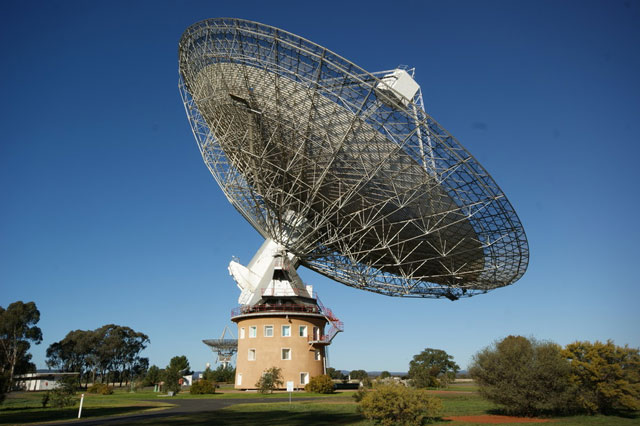
    Parkes Observatory, Australia, detected the blip. David McClenaghan, CSIRO, CC BY-SA
    Parkes Observatory, Australia, detected the blip. David McClenaghan, CSIRO, CC BY-SA

    The search for mysterious “fast radio bursts” — very brief but intense pulses of radio waves from outer space — is heating up. Nobody knows what causes these powerful bursts, but some have even speculated that the signals could be transmitted by distant alien civilisations. In fact, astronomers are so perplexed by the phenomenon that it is driving a renaissance in radio astronomy.

    Now an international team of astronomers has detected the brightest ever fast radio burst. Dubbed FRB 150807 after its discovery date, the burst of intense radio waves lasted less than half a millisecond — that is 0,1% of the time it takes a human to blink. And the study, published in Science, has come closer than any before it to pinning down where the blip came from. The research comes just days after another study reported having seen a fast radio burst together with an outburst of gamma rays, extremely energetic electromagnetic radiation.

    Despite their intensity, the nature and origin of fast radio bursts is still hotly debated. Some astronomers have suggested these brief, intense flashes are flares produced in the atmospheres of certain stars in our own Milky Way galaxy — a process similar to solar flares. Others argue they are caused by cosmic collisions such as a neutron star (a collapsed core of a large star) colliding with a black hole in a distant galaxy, or speculated that they could be alien signals.
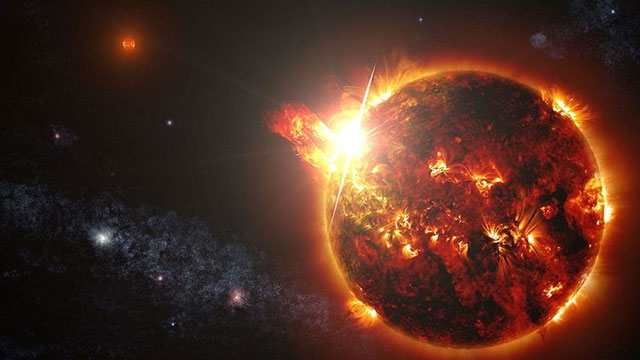
    Huge flare from small star. Nasa's Goddard Space Flight Center/S Wiessinger
    Huge flare from small star. Nasa’s Goddard Space Flight Center/S Wiessinger

    The first fast radio burst — the Lorimer burst — was discovered serendipitously by radio astronomers using Australia’s Parkes telescope to search for pulsed radio emissions from spinning neutron stars called pulsars. The Lorimer burst remained a curiosity until other fast radio bursts at different positions in the sky were discovered by other telescopes such as the giant Arecibo radio telescope in Puerto Rico and the 100-metre Greenbank dish in the US.

    But progress in understanding this enigmatic phenomenon has been slow. This is partly down to the short duration of the bursts, the limited resolution provided by the telescopes and the uncertainty of the sky positions of the bursts. Trying to discover a burst and, at exactly the same time, pinpoint accurately where in the sky it comes from is difficult. If a radio signal could be backed up by telescopes that are searching for other kinds of electromagnetic radiation (such as X-rays or the kind of “optical light” that we can see), we could measure the distance and understand the physics processes driving these events. If the processes driving these bursts are similar to those responsible for other cosmic explosions, such as gamma ray bursts, astronomers suspect that radiation at other wavelengths is likely to be emitted in the same event that caused the fast radio bursts. But it’s proven difficult to catch.

    Indirect estimates of distances have been made by measuring how the radio signal is smeared out. This can help infer the amount of material the light has travelled through. From this, the distance of the fast radio burst from Earth can be estimated, using a variety of assumptions such as the amount of matter between us. Such measurements have indicated that the origins of fast radio bursts lie far beyond our galaxy.

    Tracing the blip

    FRB 150807 is remarkable for its short duration, radio brightness and high degree of linear “polarisation” — a property describing the plane of the vibrations that make up the waves. Combining these properties, the new study suggests that the burst occurred in a galaxy over a billion light years away, identified by the Visible and Infrared Survey Telescope for Astronomy (Vista) Hemisphere Survey. This is the closest we’ve ever got to pinpointing where a fast radio burst came from.

    The polarisation of light is affected by magnetic fields surrounding it. Knowing that helped the researchers estimate the magnetic properties of the plasma through which the radio waves travelled. Their analysis suggests that there’s only negligible magnetisation of plasma close to the burst site. Interestingly, if this is correct, it would rule out strongly magnetised objects such as young neutron stars, magnetars or other objects causing it — favoured models so far.
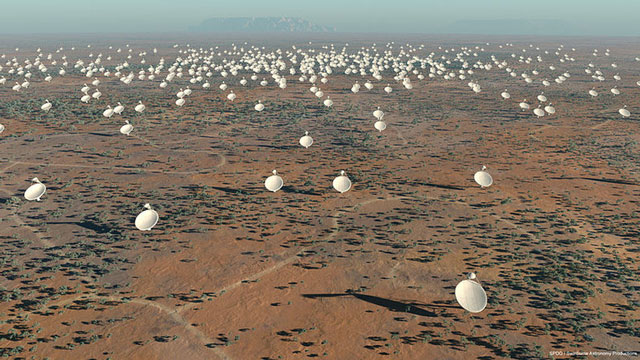
    Artist’s impression of the 5km diameter central core of antennas of the Square Kilometre Array, which will help shed light on fast radio bursts. Swinburne Astronomy Productions for SKA Project Development
    Artist’s impression of the 5km diameter central core of antennas of the Square Kilometre Array, which will help shed light on fast radio bursts. Swinburne Astronomy Productions for SKA Project Development

    This study shows that as the small number of recorded fast radio bursts grows and their properties become better known, the exciting prospect of understanding what produces them becomes increasingly feasible. They could also be used to map out the magnetic fields in the universe — something we know little about. The next breakthrough may come with the first detection of a visible counterpart or optical afterglow, from which we can measure an accurate distance.

    It may happen sooner than you think, given the other recent study’s tantalising report of possibly the first detection of a gamma-rays burst coinciding with a fast radio burst with Nasa’s Swift satellite. If the two bursts do indeed come from the same source that would be very exciting — it could mean this source is lot more energetic than we had anticipated.

    Analysis of FRB 150807 predicts that these events should not be rare — with 190 occurring across the sky per day. Future facilities such as the Large Synoptic Survey Telescope — which will survey the entire night sky every few days at optical wavelengths and the radio equivalent — and the Square Kilometre Array will revolutionise our view and understanding of these mysterious blips and the violent, ever-changing universe in which they live.The Conversation

    • Carole Mundell is head of physics, University of Bath
    • This article was originally published on The Conversation


    Subscribe to TechCentral Subscribe to TechCentral
    Share. Facebook Twitter LinkedIn WhatsApp Telegram Email Copy Link
    Previous ArticleOne day I will tell you the truth – Zuma
    Next Article Facebook to crack down on fake news

    Related Posts

    TechCentral's South African Newsmakers of 2025

    TechCentral’s South African Newsmakers of 2025

    18 December 2025
    Malatsi buries Post Office's long-dead monopoly

    Malatsi buries Post Office monopoly the market ignored

    18 December 2025
    China races to crack EUV as chip war with the West intensifies

    China races to crack EUV lithography as chip war with the West intensifies

    18 December 2025
    Company News
    Why TechCentral is the most powerful platform for reaching IT decision makers

    Why TechCentral is the most powerful platform for reaching IT decision makers

    17 December 2025
    Business trends to watch in 2026 - Domains.co.za

    Business trends to watch in 2026

    17 December 2025
    MTN Zambia launches world's first 4G cloud smartphone solution - Huawei

    MTN Zambia launches world’s first 4G cloud smartphone solution

    17 December 2025
    Opinion
    Netflix, Warner Bros deal raises fresh headaches for MultiChoice - Duncan McLeod

    Netflix, Warner Bros deal raises fresh headaches for MultiChoice

    5 December 2025
    BIN scans, DDoS and the next cybercrime wave hitting South Africa's banks - Entersekt Gerhard Oosthuizen

    BIN scans, DDoS and the next cybercrime wave hitting South Africa’s banks

    3 December 2025
    Your data, your hardware: the DIY AI revolution is coming - Duncan McLeod

    Your data, your hardware: the DIY AI revolution is coming

    20 November 2025

    Subscribe to Updates

    Get the best South African technology news and analysis delivered to your e-mail inbox every morning.

    Latest Posts
    TechCentral's South African Newsmakers of 2025

    TechCentral’s South African Newsmakers of 2025

    18 December 2025
    Malatsi buries Post Office's long-dead monopoly

    Malatsi buries Post Office monopoly the market ignored

    18 December 2025
    China races to crack EUV as chip war with the West intensifies

    China races to crack EUV lithography as chip war with the West intensifies

    18 December 2025
    Coursera to buy Udemy, in which Prosus is an investor

    Coursera to buy Udemy, in which Prosus is an investor

    18 December 2025
    © 2009 - 2025 NewsCentral Media
    • Cookie policy (ZA)
    • TechCentral – privacy and Popia

    Type above and press Enter to search. Press Esc to cancel.

    Manage consent

    TechCentral uses cookies to enhance its offerings. Consenting to these technologies allows us to serve you better. Not consenting or withdrawing consent may adversely affect certain features and functions of the website.

    Functional Always active
    The technical storage or access is strictly necessary for the legitimate purpose of enabling the use of a specific service explicitly requested by the subscriber or user, or for the sole purpose of carrying out the transmission of a communication over an electronic communications network.
    Preferences
    The technical storage or access is necessary for the legitimate purpose of storing preferences that are not requested by the subscriber or user.
    Statistics
    The technical storage or access that is used exclusively for statistical purposes. The technical storage or access that is used exclusively for anonymous statistical purposes. Without a subpoena, voluntary compliance on the part of your Internet Service Provider, or additional records from a third party, information stored or retrieved for this purpose alone cannot usually be used to identify you.
    Marketing
    The technical storage or access is required to create user profiles to send advertising, or to track the user on a website or across several websites for similar marketing purposes.
    • Manage options
    • Manage services
    • Manage {vendor_count} vendors
    • Read more about these purposes
    View preferences
    • {title}
    • {title}
    • {title}