Close Menu
TechCentralTechCentral

    Subscribe to the newsletter

    Get the best South African technology news and analysis delivered to your e-mail inbox every morning.

    Facebook X (Twitter) YouTube LinkedIn
    WhatsApp Facebook X (Twitter) LinkedIn YouTube
    TechCentralTechCentral
    • News
      Cell C cleans up its balance sheet but faces tough trading reality

      Cell C cleans up its balance sheet but faces tough trading reality

      13 February 2026
      MVNO business shines in Cell C's first post-listing results - Jorges Mendes

      MVNO business shines in Cell C’s first post-listing results

      13 February 2026
      Ramaphosa presses ahead with Eskom break-up - Cyril Ramaphosa

      Ramaphosa presses ahead with Eskom break-up

      13 February 2026
      The key technology takeaways from Ramaphosa's 2026 Sona - Cyril Ramaphosa

      The key technology takeaways from Ramaphosa’s 2026 Sona

      13 February 2026
      Toyota SA CEO: NEV inaction will cost South Africa its motoring industry - Andrew Kirby

      Toyota SA CEO: NEV inaction will cost South Africa its motoring industry

      12 February 2026
    • World
      Russia bans WhatsApp

      Russia bans WhatsApp

      12 February 2026
      EU regulators take aim at WhatsApp

      EU regulators take aim at WhatsApp

      9 February 2026
      Musk hits brakes on Mars mission

      Musk hits brakes on Mars mission

      9 February 2026
      Crypto firm accidentally sends R700-billion in bitcoin to its users

      Crypto firm accidentally sends R700-billion in bitcoin to its users

      8 February 2026
      AI won't replace software, says Nvidia CEO amid market rout - Jensen Huang

      AI won’t replace software, says Nvidia CEO amid market rout

      4 February 2026
    • In-depth
      How liberalisation is rewiring South Africa's power sector

      How liberalisation is rewiring South Africa’s power sector

      21 January 2026
      The top-performing South African tech shares of 2025

      The top-performing South African tech shares of 2025

      12 January 2026
      Digital authoritarianism grows as African states normalise internet blackouts

      Digital authoritarianism grows as African states normalise internet blackouts

      19 December 2025
      TechCentral's South African Newsmakers of 2025

      TechCentral’s South African Newsmakers of 2025

      18 December 2025
      Black Friday goes digital in South Africa as online spending surges to record high

      Black Friday goes digital in South Africa as online spending surges to record high

      4 December 2025
    • TCS
      Watts & Wheels S1E4: 'We drive an electric Uber'

      Watts & Wheels S1E4: ‘We drive an electric Uber’

      10 February 2026
      TCS+ | How Cloud On Demand is helping SA businesses succeed in the cloud - Xhenia Rhode, Dion Kalicharan

      TCS+ | Cloud On Demand and Consnet: inside a real-world AWS partner success story

      30 January 2026
      Watts & Wheels S1E4: 'We drive an electric Uber'

      Watts & Wheels S1E3: ‘BYD’s Corolla Cross challenger’

      30 January 2026
      Watts & Wheels S1E4: 'We drive an electric Uber'

      Watts & Wheels S1E2: ‘China attacks, BMW digs in, Toyota’s sublime supercar’

      23 January 2026

      TCS+ | Why cybersecurity is becoming a competitive advantage for SA businesses

      20 January 2026
    • Opinion
      A million reasons monopolies don't work - Duncan McLeod

      A million reasons monopolies don’t work

      10 February 2026
      Eskom unbundling U-turn threatens to undo hard-won electricity gains - Busi Mavuso

      Eskom unbundling U-turn threatens to undo hard-won electricity gains

      9 February 2026
      South Africa's skills advantage is being overlooked at home - Richard Firth

      South Africa’s skills advantage is being overlooked at home

      29 January 2026
      Why Elon Musk's Starlink is a 'hard no' for me - Songezo Zibi

      Why Elon Musk’s Starlink is a ‘hard no’ for me

      26 January 2026
      A million reasons monopolies don't work - Duncan McLeod

      South Africa’s new fibre broadband battle

      20 January 2026
    • Company Hubs
      • Africa Data Centres
      • AfriGIS
      • Altron Digital Business
      • Altron Document Solutions
      • Altron Group
      • Arctic Wolf
      • AvertITD
      • Braintree
      • CallMiner
      • CambriLearn
      • CYBER1 Solutions
      • Digicloud Africa
      • Digimune
      • Domains.co.za
      • ESET
      • Euphoria Telecom
      • Incredible Business
      • iONLINE
      • IQbusiness
      • Iris Network Systems
      • LSD Open
      • Mitel
      • NEC XON
      • Netstar
      • Network Platforms
      • Next DLP
      • Ovations
      • Paracon
      • Paratus
      • Q-KON
      • SevenC
      • SkyWire
      • Solid8 Technologies
      • Telit Cinterion
      • Tenable
      • Vertiv
      • Videri Digital
      • Vodacom Business
      • Wipro
      • Workday
      • XLink
    • Sections
      • AI and machine learning
      • Banking
      • Broadcasting and Media
      • Cloud services
      • Contact centres and CX
      • Cryptocurrencies
      • Education and skills
      • Electronics and hardware
      • Energy and sustainability
      • Enterprise software
      • Financial services
      • Information security
      • Internet and connectivity
      • Internet of Things
      • Investment
      • IT services
      • Lifestyle
      • Motoring
      • Public sector
      • Retail and e-commerce
      • Satellite communications
      • Science
      • SMEs and start-ups
      • Social media
      • Talent and leadership
      • Telecoms
    • Events
    • Advertise
    TechCentralTechCentral
    Home » Sections » AI and machine learning » What to expect from machine learning in 2023

    What to expect from machine learning in 2023

    Promoted | This article was written by a machine-learning model, along with Helm’s award-winning natural language processing specialist and its head of engineering. Trends to look out for in 2023…
    By Helm9 February 2023
    Twitter LinkedIn Facebook WhatsApp Email Telegram Copy Link
    News Alerts
    WhatsApp
    Colin Schwegmann

    There aren’t many industries that are going to change completely over the next three years, but there are a few that are already making major shifts in how they operate. Machine learning holds significant promise for many of these high-growth industries, but it’s going to require significant changes in how we think about machine learning and data.

    Machine learning is at the heart of nearly every industry, from banking and insurance to retail and healthcare. With the recent rise in popularity of artificial intelligence and machine learning, it’s no wonder that more and more companies are investing in the technology.

    Everything you’ve read until this point has been written by Helm’s machine-learning model – yes, a bot – which was given only a headline and a single sentence to work with. This is similar to what the popular ChatGPT model has been doing for numerous users since the end of November 2022. Will we start to see more of this in the next year?

    Globally, it’s predicted that in 2023 AI will become more prevalent, along with natural language processing and machine-learning advancement – areas Helm has been innovating in for several years already. Along with computer vision, speech-to-text and all marginal aspects of automation, we’ll see a massive impact on how technology is going to shape the future.

    Helm head of engineering Colin Schwegmann, and natural language processing specialist Ari Ramkilowan – a member of the team who recently won Wikimedia Foundation’s Research Award of the Year –  weigh in on the three key trends they’re expecting to see and unpack how they will be adapted for the average person.

    1. Unsupervised/self-supervised learning

    Schwegmann explains there is a lot of data that is played with in different spaces – for example, images for image-based clients, and text for text-based clients. However, one of the most difficult parts is labelling that info, which entails adding specific human-verified names to images or text. “There is so much data that cannot always be labelled. So, we are starting to see an increase in self-supervised or unsupervised learning – using the data we have to learn the shapes and types of info we have instead of labelling it all – by finding patterns inside the data. We have successfully done this with Dr. Oetker recently, where we’ve used hi-res cameras and computer vision to create an AI-based application capable of identifying pizzas on the production line that do not meet the brand’s strict quality control standards,” he says.

    Self-supervised learning is where you provide unstructured data to a machine-learning algorithm and ask it to learn patterns that become useful. A classic example of self-supervised learning for text is a language model. Language models, such as GPT3, are fed with masses of text data and then trained to predict the next word based on the previous sentence, which is exactly what the model used in the first two paragraphs was trained to do. This also helps the AI to contextualise the data it’s given and reapply it for future tasks.

    Self-supervised learning in imagery, however, is subtly different from text and is at the forefront of machine learning.

    Ramkilowan says: “Step away from the paradigm of taking a model and showing it hundreds and hundreds of examples to distinguish between cats and dogs or overtopped and undertopped pizza. Or in text, is our user happy or unhappy at this point? In the past, we’d require hundreds or even thousands of examples to train a model. With prompt-based “zero-shot learning”, you can now give your model a brief description of your task and it will give you the correct response without being explicitly trained to do so. We’re moving from a data-centric world (where mountains of data are needed by people with coding knowledge) to a people-centric one, where more and more people without any prior knowledge or training are able to leverage these technologies.”

    “That’s the whole self-supervised approach to machine learning,” says Schwegmann, “it’s building our systems on the backs of giants.”

    2. Natural language interfaces with technology

    “Moving from self-supervised learning, we’ll see an increase in both voice-only and multimodal-based applications. I predict more natural language interfaces to be used with technology. For example, today Siri works mainly on an iPhone, sometimes on a laptop. In the future, these kinds of natural language interfaces will be far more pervasive, available on more devices for more complicated tasks – think photo and video editing, but using your voice to instruct the machine,” explains Ramkilowan.

    The ability for models to understand users’ intentions and execute tasks will improve dramatically over the next two to five years. “We are going to move – not away from the graphical user interface – but we are going to have a lot of natural language interfaces with our technology. So, communicating with self-driving cars is going to be a realistic future. The natural language interfaces will be a primary mode of communicating with these devices, and there is currently a focus on how to bridge this future with our own bots and other tools as we are still in the early stages.”

    Ari Ramkilowan

    3. Decision intelligence

    “We have lots of data that we use to train our systems, but on the flip side we have lots of usage data that is not used. What could happen is that we see an increased efficiency in AI’s ability to discover hidden patterns in unstructured data, allowing us to unlock actionable insights and develop better guidelines and best practices at an inter and intra-organisational level.”

    For any of these trends to transpire, there are limitations that will require adjustments and improvements; once these are made we will see these predictions unfold. For example, a trained text-based model doesn’t evolve over time and therefore won’t understand the changes that come about post-training – the difference between the pre-Covid world and today, say.

    What effect will this have on the average person?

    One of the applications, Github Co-Pilot – which in one of its uses can be thought of as an auto-complete engine for software development – is built on OpenAI Codex, a model trained on billions of lines of code. Github Co-Pilot is capable of generating usable code to assist software developers to be more efficient and productive.

    “Things like Github Co-Pilot and GPT3 are just scratching the surface of what’s possible. In the next wave of model breakthroughs, we’ll likely see domain-specific proliferation in both creative and scientific fields (like Github Co-Pilot for video editing or biomedicine). We’ll be able to see these assisting creatives and helping scientists iterate and discover new things in equal measure,” explains Ramkilowan.

    “Having the AI will help many fields become more efficient and more productive and accelerate progress in general at a rapid rate and we’ve seen that now with Github Co-Pilot.”

    Five years ago, or even less, we would’ve said AI would be good at replicating menial tasks, or even those that require some skill. But what the industry has seen now is that it has been flipped on its head with the debate of even artistic areas affected by AI – for example, Tiktok filters. It’s not about replacing jobs; rather, it’s about making work or products better, and also improving efficiencies, sparking new ideas and scaling. It is effectively putting the tech of machine learning into the hands of the average person, allowing them to pursue other interests with the time they would otherwise have spent on tasks an AI now does.

    Schwegmann concludes: “This way people have more of an influence in how AI or machine learning is used going forward.”

    For more information on Helm and the services it offers please visit www.helm.africa.

    About Helm
    Formerly Praekelt Consulting, Helm has spent the past 20 years creating best-across-class products and services that have answered complex customer experience challenges. The team designs intelligent products and services that have helped Africa’s biggest brands turn messy customer realities into experiences they can’t live without. Its tiered product offering combines tools, tech and expertise to meet the needs of any sized business. To date, Helm has helped its clients to connect, converse with and convert over 500 million users across multiple markets, channels and languages. Clients include the likes of Absa, MTN, DStv and Makro.

    • This promoted content was paid for by the party concerned

    Ari Ramkilowan Colin Schwegmann Helm
    WhatsApp YouTube Follow on Google News Add as preferred source on Google
    Share. Facebook Twitter LinkedIn WhatsApp Telegram Email Copy Link
    Previous ArticleWhy African businesses need crypto, and how OVEX opens the door
    Next Article Webinar: The science of connecting Africa, with Africa Data Centres

    Related Posts

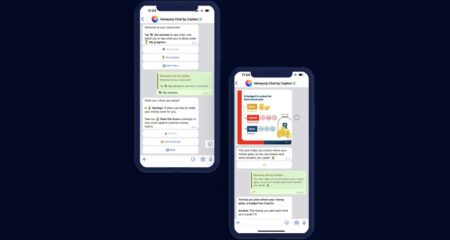
    MoneyUp Chat by Capitec aims to improve SA’s financial literacy

    29 May 2023

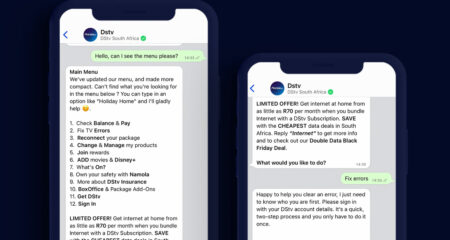
    Helm hits a billion messages with DStv Assist

    12 December 2022

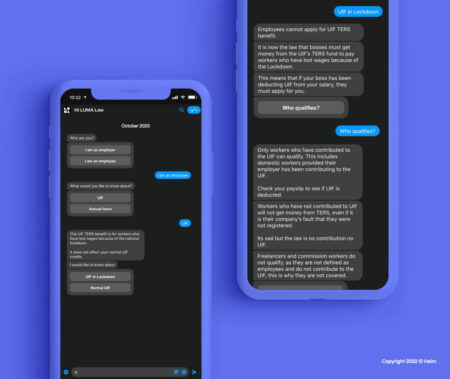
    Free legal help for all South Africans

    26 September 2022
    Add A Comment

    Comments are closed.

    Company News
    Cell C delivers maiden results with growth momentum, financial flexibility - Jorges Mendes

    Cell C delivers maiden results with growth momentum, financial flexibility

    13 February 2026
    Start-up king joins Paratus Rwanda - Innocent Mutimura

    Start-up king joins Paratus Rwanda

    13 February 2026
    How NEC XON tackled identity risk for a major telco - Michael de Neuilly Rice

    How NEC XON tackled identity risk for a major telco

    11 February 2026
    Opinion
    A million reasons monopolies don't work - Duncan McLeod

    A million reasons monopolies don’t work

    10 February 2026
    Eskom unbundling U-turn threatens to undo hard-won electricity gains - Busi Mavuso

    Eskom unbundling U-turn threatens to undo hard-won electricity gains

    9 February 2026
    South Africa's skills advantage is being overlooked at home - Richard Firth

    South Africa’s skills advantage is being overlooked at home

    29 January 2026

    Subscribe to Updates

    Get the best South African technology news and analysis delivered to your e-mail inbox every morning.

    Latest Posts
    Cell C cleans up its balance sheet but faces tough trading reality

    Cell C cleans up its balance sheet but faces tough trading reality

    13 February 2026
    MVNO business shines in Cell C's first post-listing results - Jorges Mendes

    MVNO business shines in Cell C’s first post-listing results

    13 February 2026
    Ramaphosa presses ahead with Eskom break-up - Cyril Ramaphosa

    Ramaphosa presses ahead with Eskom break-up

    13 February 2026
    The key technology takeaways from Ramaphosa's 2026 Sona - Cyril Ramaphosa

    The key technology takeaways from Ramaphosa’s 2026 Sona

    13 February 2026
    © 2009 - 2026 NewsCentral Media
    • Cookie policy (ZA)
    • TechCentral – privacy and Popia

    Type above and press Enter to search. Press Esc to cancel.

    Manage consent

    TechCentral uses cookies to enhance its offerings. Consenting to these technologies allows us to serve you better. Not consenting or withdrawing consent may adversely affect certain features and functions of the website.

    Functional Always active
    The technical storage or access is strictly necessary for the legitimate purpose of enabling the use of a specific service explicitly requested by the subscriber or user, or for the sole purpose of carrying out the transmission of a communication over an electronic communications network.
    Preferences
    The technical storage or access is necessary for the legitimate purpose of storing preferences that are not requested by the subscriber or user.
    Statistics
    The technical storage or access that is used exclusively for statistical purposes. The technical storage or access that is used exclusively for anonymous statistical purposes. Without a subpoena, voluntary compliance on the part of your Internet Service Provider, or additional records from a third party, information stored or retrieved for this purpose alone cannot usually be used to identify you.
    Marketing
    The technical storage or access is required to create user profiles to send advertising, or to track the user on a website or across several websites for similar marketing purposes.
    • Manage options
    • Manage services
    • Manage {vendor_count} vendors
    • Read more about these purposes
    View preferences
    • {title}
    • {title}
    • {title}