
Nearly six in 10 South African registered voters would accept exempting US companies from black economic empowerment requirements if it brought investment and jobs, according to polling published by The Common Sense – and support is strongest among black voters.
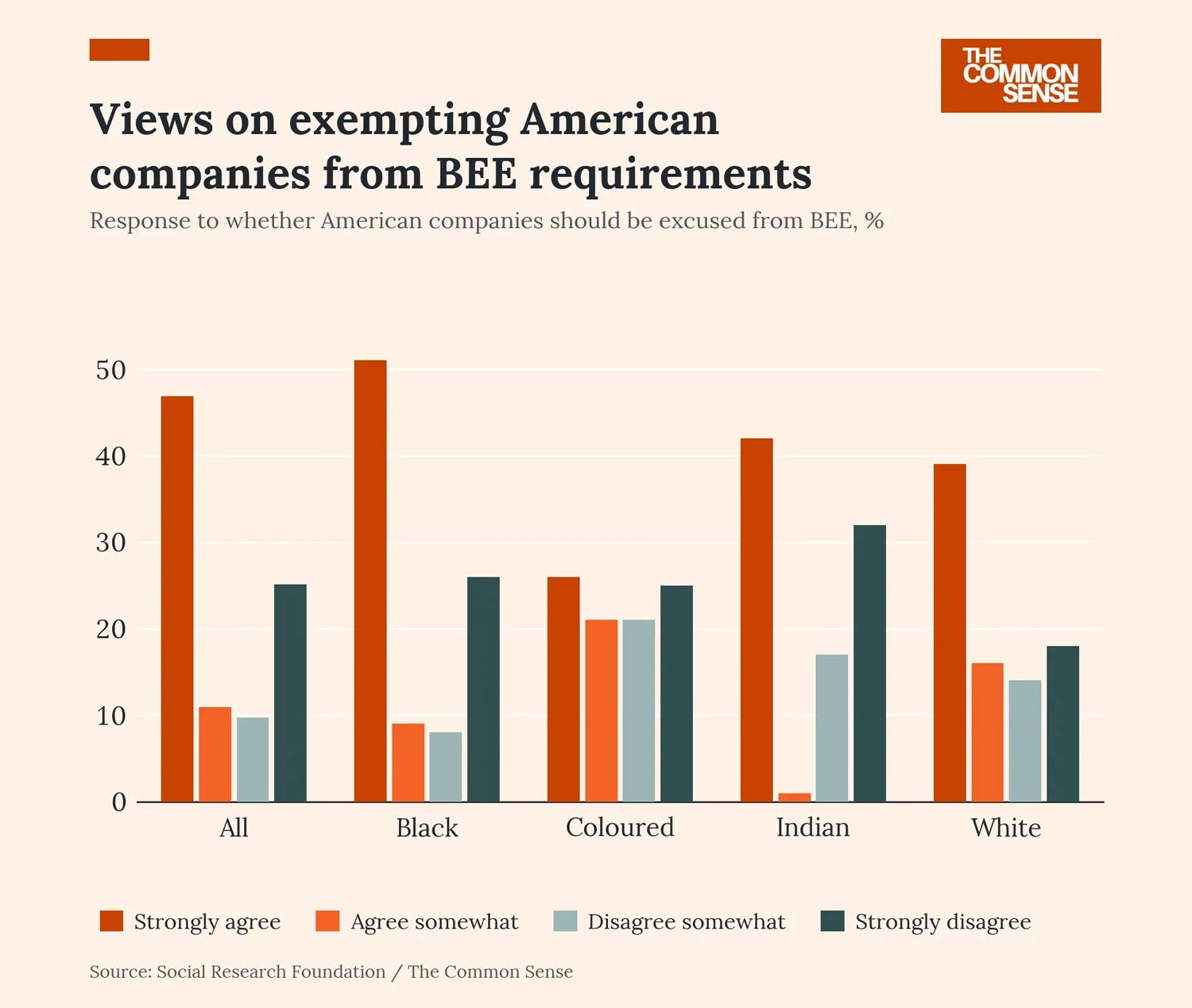
The Social Research Foundation’s (SRF’s) second-quarter 2026 market survey found 47% of voters strongly agreed and a further 11% somewhat agreed that American companies should be excused from B-BBEE to encourage them to invest in South Africa and create jobs. A quarter strongly disagreed and 10% somewhat disagreed, with the balance offering no view.
Among black respondents, 51% strongly agreed – the highest of any group – against 26% who strongly disagreed. Coloured respondents recorded the lowest strong agreement, at 26%, and were the most evenly split overall, with agreement and disagreement each sitting in the mid-40s. White respondents were more supportive, at 39% strong agreement and 55% agreement overall.
It is important to note that respondents were not asked whether B-BBEE should be scrapped, but rather whether an exemption was worth making in exchange for investment and jobs. It is a trade-off question, and the results are not a verdict on the policy itself.
Even so, the numbers are interesting given the debate in recent years that hinged in part on an assumption that any movement on ownership rules would be politically intolerable.
Communications minister Solly Malatsi’s solution is an equity equivalent investment programme (EEIP), which substitutes an equivalent local investment for the sale of equity, while leaving the empowerment obligation intact.
Impasse
It is not an exemption to broad-based black economic empowerment rules, and Malatsi has said repeatedly that new entrants will not be exempt from transformation obligations. The mechanism already exists in South African law and is used by Microsoft, IBM and Amazon Web Services, among others.
But, if the poll results are to be believed, the electorate appears willing to concede rather more than the policy asks for – while the policy itself has been mired in political squabbling.
Read: Starlink wants to be your next mobile operator
Malatsi gazetted his final policy direction on 12 December 2025, instructing Icasa to align its ownership rules with the ICT sector code, including full recognition of EEIPs. On 13 May, after months of silence, Icasa replied that full alignment would require a legislative amendment to the Electronic Communications Act, which sets a minimum 30% ownership threshold for individual licence holders.
That threw the question to the Electronic Communications Amendment Bill, now before parliament, with written submissions due on 21 August. An ownership provision does not appear in the version introduced in April.
In the meantime, Icasa has shut the front door. A gazette notice signed by chairman Mothibi Ramusi on 24 June set out that a constellation operator needs individual electronic communications service and network service licences along with the relevant spectrum licences – but that no invitation to apply for network licences is open, pending an inquiry the department directed the regulator to hold in August 2025.
The notice added a second obstacle: where a constellation’s gateway Earth station sits outside South Africa, an operator must show how lawful interception will be done.
SpaceX has yet to file a licence application. It has offered R500-million in free connectivity for 5 000 rural schools as an opening EEIP commitment.
The same SRF survey asked whether South Africa should protect American national security interests in order to secure US trade and investment. Agreement ran at 65% against 25% disagreement. Black respondents again recorded the highest strong agreement, at 52%.
Read: Icasa’s blunt message to Starlink and other satellite operators
Fieldwork ran from 8-31 July among 2 214 registered voters, using random digit dialling and telephonic interviews, and was carried out by Victory Research. The national margin of error is 2.1% at 95% confidence; subgroup figures carry considerably wider margins. – © 2026 NewsCentral Media
- Subscribe to TechCentral’s daily newsletter
- Get breaking news alerts on WhatsApp