
Close Menu
TechCentralTechCentral

    Subscribe to the newsletter

    Get the best South African technology news and analysis delivered to your e-mail inbox every morning.

    Facebook X (Twitter) YouTube LinkedIn
    WhatsApp Facebook X (Twitter) LinkedIn YouTube
    TechCentralTechCentral
    • News
      Vuyani Jarana: Mobile coverage masks a deeper broadband failure

      Vuyani Jarana: Mobile coverage masks a deeper broadband failure

      30 January 2026
      SABC Plus to flight Microsoft AI training videos

      SABC Plus to flight Microsoft AI training videos

      30 January 2026
      Fibre ducts

      Fibre industry consolidation in KZN

      30 January 2026
      Watts & Wheels S1E3: 'BYD's Corolla Cross challenger'

      Watts & Wheels S1E3: ‘BYD’s Corolla Cross challenger’

      30 January 2026
      What ordinary South Africans really think of AI

      What ordinary South Africans really think of AI

      30 January 2026
    • World
      Apple acquires audio AI start-up Q.ai

      Apple acquires audio AI start-up Q.ai

      30 January 2026
      SpaceX IPO may be largest in history

      SpaceX IPO may be largest in history

      28 January 2026
      Nvidia throws AI at the weather

      Nvidia throws AI at weather forecasting

      27 January 2026
      Debate erupts over value of in-flight Wi-Fi

      Debate erupts over value of in-flight Wi-Fi

      26 January 2026
      Intel takes another hit - Intel CEO Lip-Bu Tan. Laure Andrillon/Reuters

      Intel takes another hit

      23 January 2026
    • In-depth
      How liberalisation is rewiring South Africa's power sector

      How liberalisation is rewiring South Africa’s power sector

      21 January 2026
      The top-performing South African tech shares of 2025

      The top-performing South African tech shares of 2025

      12 January 2026
      Digital authoritarianism grows as African states normalise internet blackouts

      Digital authoritarianism grows as African states normalise internet blackouts

      19 December 2025
      TechCentral's South African Newsmakers of 2025

      TechCentral’s South African Newsmakers of 2025

      18 December 2025
      Black Friday goes digital in South Africa as online spending surges to record high

      Black Friday goes digital in South Africa as online spending surges to record high

      4 December 2025
    • TCS
      TCS+ | How Cloud On Demand is helping SA businesses succeed in the cloud - Xhenia Rhode, Dion Kalicharan

      TCS+ | Cloud On Demand and Consnet: inside a real-world AWS partner success story

      30 January 2026
      Watts & Wheels S1E3: 'BYD's Corolla Cross challenger'

      Watts & Wheels S1E2: ‘China attacks, BMW digs in, Toyota’s sublime supercar’

      23 January 2026

      TCS+ | Why cybersecurity is becoming a competitive advantage for SA businesses

      20 January 2026
      Watts & Wheels S1E3: 'BYD's Corolla Cross challenger'

      Watts & Wheels: S1E1 – ‘William, Prince of Wheels’

      8 January 2026
      TCS+ | Africa's digital transformation - unlocking AI through cloud and culture - Cliff de Wit Accelera Digital Group

      TCS+ | Cloud without culture won’t deliver AI: Accelera’s Cliff de Wit

      12 December 2025
    • Opinion
      South Africa's skills advantage is being overlooked at home - Richard Firth

      South Africa’s skills advantage is being overlooked at home

      29 January 2026
      Why Elon Musk's Starlink is a 'hard no' for me - Songezo Zibi

      Why Elon Musk’s Starlink is a ‘hard no’ for me

      26 January 2026
      South Africa's new fibre broadband battle - Duncan McLeod

      South Africa’s new fibre broadband battle

      20 January 2026
      AI moves from pilots to production in South African companies - Nazia Pillay SAP

      AI moves from pilots to production in South African companies

      20 January 2026
      South Africa's new fibre broadband battle - Duncan McLeod

      ANC’s attack on Solly Malatsi shows how BEE dogma trumps economic reality

      14 December 2025
    • Company Hubs
      • Africa Data Centres
      • AfriGIS
      • Altron Digital Business
      • Altron Document Solutions
      • Altron Group
      • Arctic Wolf
      • AvertITD
      • Braintree
      • CallMiner
      • CambriLearn
      • CYBER1 Solutions
      • Digicloud Africa
      • Digimune
      • Domains.co.za
      • ESET
      • Euphoria Telecom
      • Incredible Business
      • iONLINE
      • IQbusiness
      • Iris Network Systems
      • LSD Open
      • NEC XON
      • Netstar
      • Network Platforms
      • Next DLP
      • Ovations
      • Paracon
      • Paratus
      • Q-KON
      • SevenC
      • SkyWire
      • Solid8 Technologies
      • Telit Cinterion
      • Tenable
      • Vertiv
      • Videri Digital
      • Vodacom Business
      • Wipro
      • Workday
      • XLink
    • Sections
      • AI and machine learning
      • Banking
      • Broadcasting and Media
      • Cloud services
      • Contact centres and CX
      • Cryptocurrencies
      • Education and skills
      • Electronics and hardware
      • Energy and sustainability
      • Enterprise software
      • Financial services
      • Information security
      • Internet and connectivity
      • Internet of Things
      • Investment
      • IT services
      • Lifestyle
      • Motoring
      • Public sector
      • Retail and e-commerce
      • Satellite communications
      • Science
      • SMEs and start-ups
      • Social media
      • Talent and leadership
      • Telecoms
    • Events
    • Advertise
    TechCentralTechCentral
    Home » Sections » AI and machine learning » The AI hype is ending – now it might actually become useful

    The AI hype is ending – now it might actually become useful

    Like many new technologies, generative AI has been following a path known as the Gartner hype cycle.
    By Vitomir Kovanovic23 August 2024
    Twitter LinkedIn Facebook WhatsApp Email Telegram Copy Link
    News Alerts
    WhatsApp

    The AI hype is ending - now it might actually become usefulLess than two years ago, the launch of ChatGPT started a generative AI frenzy. Some said the technology would trigger a fourth Industrial Revolution, completely reshaping the world as we know it.

    In March 2023, Goldman Sachs predicted 300 million jobs would be lost or degraded due to AI. A huge shift seemed to be under way.

    Eighteen months later, generative AI is not transforming business. Many projects using the technology are being cancelled, such as an attempt by McDonald’s to automate drive-thru ordering which went viral on TikTok after producing comical failures. Government efforts to make systems to summarise public submissions and calculate welfare entitlements have met the same fate.

    So, what happened?

    The AI hype cycle

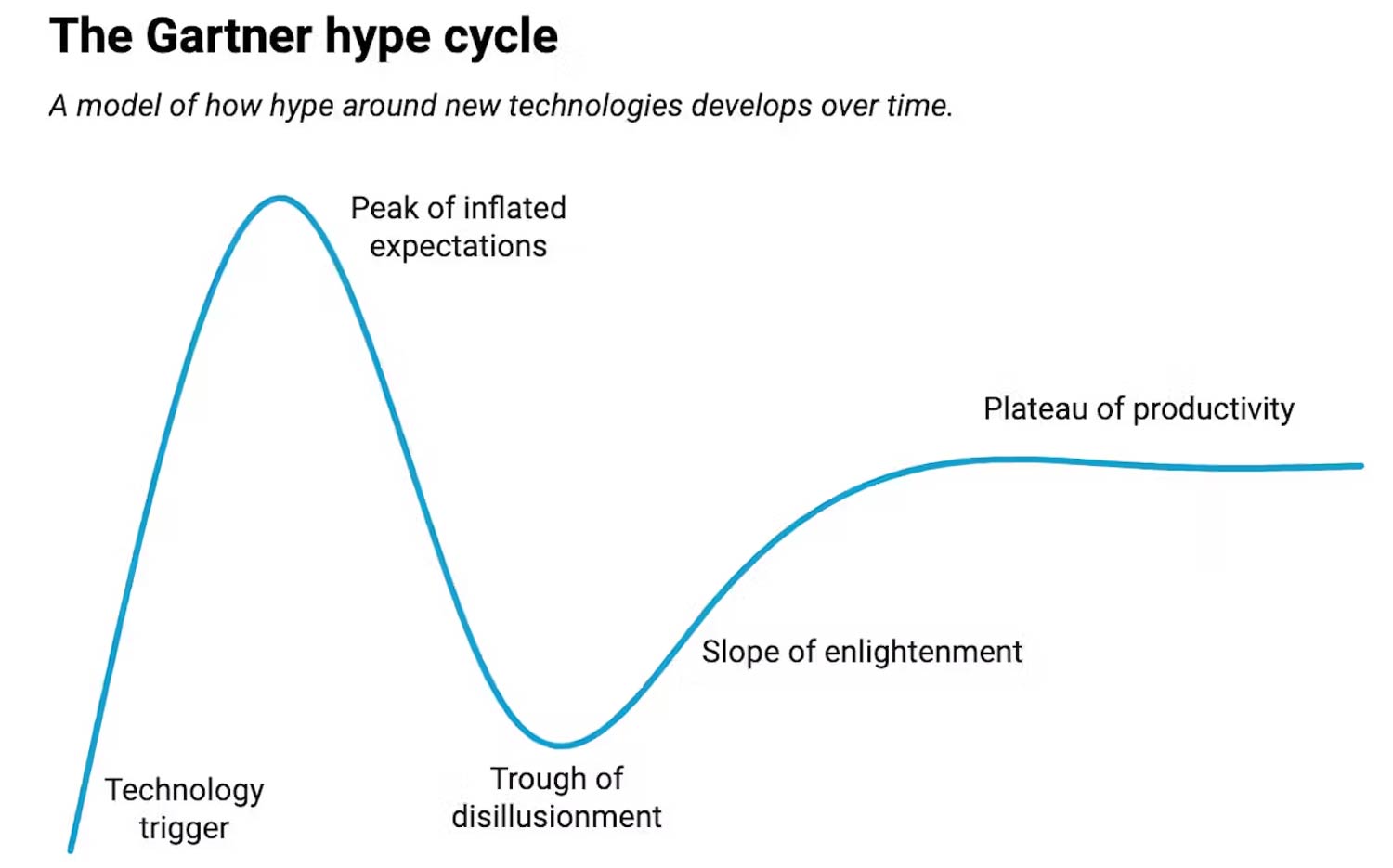
    Like many new technologies, generative AI has been following a path known as the Gartner hype cycle, first described by American tech research firm Gartner.

    This widely used model describes a recurring process in which the initial success of a technology leads to inflated public expectations that eventually fail to be realised. After the early “peak of inflated expectations” comes a “trough of disillusionment”, followed by a “slope of enlightenment” which eventually reaches a “plateau of productivity”.

    A Gartner report published in June listed most generative AI technologies as either at the peak of inflated expectations or still going upward. The report argued most of these technologies are two to five years away from becoming fully productive.

    Many compelling prototypes of generative AI products have been developed but adopting them in practice has been less successful. A study published last week by American think tank Rand showed 80% of AI projects fail, more than double the rate for non-AI projects.
    Shortcomings

    The Rand report lists many difficulties with generative AI, ranging from high investment requirements in data and AI infrastructure to a lack of needed human talent. However, the unusual nature of gen AI’s limitations represents a critical challenge.

    For example, generative AI systems can solve some highly complex university admission tests yet fail very simple tasks. This makes it very hard to judge the potential of these technologies, which leads to false confidence.

    After all, if it can solve complex differential equations or write an essay, it should be able to take simple drive-through orders, right?

    As the proverbial shovel-makers in a gold rush, Nvidia recently became the most valuable public company

    A recent study showed that the abilities of large language models such as GPT-4 do not always match what people expect of them. In particular, more capable models severely underperformed in high-stakes cases where incorrect responses could be catastrophic.

    These results suggest these models can induce false confidence in their users. Because they fluently answer questions, humans can reach overoptimistic conclusions about their capabilities and deploy the models in situations they are not suited for.

    Experience from successful projects shows it is tough to make a generative model follow instructions. For example, Khan Academy’s Khanmigo tutoring system often revealed the correct answers to questions despite being instructed not to.

    So why isn’t the generative AI hype over yet? There are a few reasons for this.

    First, generative AI technology, despite its challenges, is rapidly improving, with scale and size being the primary drivers of the improvement.

    Improved models

    Research shows that the size of language models (number of parameters), as well as the amount of data and computing power used for training all contribute to improved model performance. In contrast, the architecture of the neural network powering the model seems to have minimal impact.

    Large language models also display so-called emergent abilities, which are unexpected abilities in tasks for which they haven’t been trained. Researchers have reported new capabilities “emerging” when models reach a specific critical “breakthrough” size.

    Studies have found sufficiently complex large language models can develop the ability to reason by analogy and even reproduce optical illusions like those experienced by humans. The precise causes of these observations are contested, but there is no doubt large language models are becoming more sophisticated.

    So, AI companies are still at work on bigger and more expensive models, and tech companies such as Microsoft and Apple are betting on returns from their existing investments in generative AI. According to one recent estimate, generative AI will need to produce US$600-billion in annual revenue to justify current investments – and this figure is likely to grow to $1-trillion in the coming years.

    For the moment, the biggest winner from the generative AI boom is Nvidia, the largest producer of the chips powering the AI arms race. As the proverbial shovel-makers in a gold rush, Nvidia recently became the most valuable public company in history, tripling its share price in a single year to reach a valuation of $3-trillion in June.

    What comes next?

    As the AI hype begins to deflate and we move through the period of disillusionment, we are also seeing more realistic AI adoption strategies.

    • First, AI is being used to support humans, rather than replace them. A recent survey of American companies found they are mainly using AI to improve efficiency (49%), reduce labour costs (47%) and enhance the quality of products (58%).
    • Second, we also see a rise in smaller (and cheaper) generative AI models, trained on specific data and deployed locally to reduce costs and optimise efficiency. Even OpenAI, which has led the race for ever-larger models, has released the GPT-4o Mini model to reduce costs and improve performance.
    • Third, we see a strong focus on providing AI literacy training and educating the workforce on how AI works, its potentials and limitations, and best practices for ethical AI use. We are likely to have to learn (and re-learn) how to use different AI technologies for years to come.

    In the end, the AI revolution will look more like an evolution. Its use will gradually grow over time and, little by little, alter and transform human activities. Which is much better than replacing them.The Conversation

    • The author, Vitomir Kovanovic, is senior lecturer in learning analytics, University of South Australia
    • This article is republished from The Conversation under a Creative Commons licence

    Read next: Meta flying high as Zuckerberg sells his AI vision


    Gartner Microsoft Vitomir Kovanovic
    WhatsApp YouTube Follow on Google News Add as preferred source on Google
    Share. Facebook Twitter LinkedIn WhatsApp Telegram Email Copy Link
    Previous ArticleFNB hit by system outage – on pay day
    Next Article Eskom turnaround is no ‘miracle’: Mteto Nyati

    Related Posts

    SABC Plus to flight Microsoft AI training videos

    SABC Plus to flight Microsoft AI training videos

    30 January 2026
    Cloud adoption the weak link in SA's digital government push: Microsoft - Vukani Mngxati

    Cloud adoption the weak link in SA’s digital government push: Microsoft

    29 January 2026
    Elon Musk demands billions from OpenAI in explosive lawsuit

    Elon Musk demands billions from OpenAI in explosive lawsuit

    18 January 2026
    Company News
    Huawei turns 25 in South Africa, celebrates with major device discounts

    Huawei turns 25 in South Africa, celebrates with major device discounts

    30 January 2026
    Phishing has not disappeared, but it has grown up - KnowBe4

    Phishing has not disappeared, but it has grown up

    30 January 2026
    Smartphone affordability: South Africa's new economic divide - PayJoy

    Smartphone affordability: South Africa’s new economic divide

    29 January 2026
    Opinion
    South Africa's skills advantage is being overlooked at home - Richard Firth

    South Africa’s skills advantage is being overlooked at home

    29 January 2026
    Why Elon Musk's Starlink is a 'hard no' for me - Songezo Zibi

    Why Elon Musk’s Starlink is a ‘hard no’ for me

    26 January 2026
    South Africa's new fibre broadband battle - Duncan McLeod

    South Africa’s new fibre broadband battle

    20 January 2026

    Subscribe to Updates

    Get the best South African technology news and analysis delivered to your e-mail inbox every morning.

    Latest Posts
    Vuyani Jarana: Mobile coverage masks a deeper broadband failure

    Vuyani Jarana: Mobile coverage masks a deeper broadband failure

    30 January 2026
    TCS+ | How Cloud On Demand is helping SA businesses succeed in the cloud - Xhenia Rhode, Dion Kalicharan

    TCS+ | Cloud On Demand and Consnet: inside a real-world AWS partner success story

    30 January 2026
    Huawei turns 25 in South Africa, celebrates with major device discounts

    Huawei turns 25 in South Africa, celebrates with major device discounts

    30 January 2026
    SABC Plus to flight Microsoft AI training videos

    SABC Plus to flight Microsoft AI training videos

    30 January 2026
    © 2009 - 2026 NewsCentral Media
    • Cookie policy (ZA)
    • TechCentral – privacy and Popia

    Type above and press Enter to search. Press Esc to cancel.

    Manage consent

    TechCentral uses cookies to enhance its offerings. Consenting to these technologies allows us to serve you better. Not consenting or withdrawing consent may adversely affect certain features and functions of the website.

    Functional Always active
    The technical storage or access is strictly necessary for the legitimate purpose of enabling the use of a specific service explicitly requested by the subscriber or user, or for the sole purpose of carrying out the transmission of a communication over an electronic communications network.
    Preferences
    The technical storage or access is necessary for the legitimate purpose of storing preferences that are not requested by the subscriber or user.
    Statistics
    The technical storage or access that is used exclusively for statistical purposes. The technical storage or access that is used exclusively for anonymous statistical purposes. Without a subpoena, voluntary compliance on the part of your Internet Service Provider, or additional records from a third party, information stored or retrieved for this purpose alone cannot usually be used to identify you.
    Marketing
    The technical storage or access is required to create user profiles to send advertising, or to track the user on a website or across several websites for similar marketing purposes.
    • Manage options
    • Manage services
    • Manage {vendor_count} vendors
    • Read more about these purposes
    View preferences
    • {title}
    • {title}
    • {title}