
Close Menu
TechCentralTechCentral

    Subscribe to the newsletter

    Get the best South African technology news and analysis delivered to your e-mail inbox every morning.

    Facebook X (Twitter) YouTube LinkedIn
    WhatsApp Facebook X (Twitter) LinkedIn YouTube
    TechCentralTechCentral
    • News
      So, who exactly will buy Apple's R50 000 iPhone Duo

      Why Apple can’t tell you who its R50 000 iPhone is for

      11 September 2026
      South Africa is behind its neighbours on the plumbing of digital IDs

      South Africa is behind its neighbours on the plumbing of digital IDs

      11 September 2026
      South Africa to extradite US cyberfraud-gang suspects to US

      South Africa to extradite cyberfraud-gang suspects to US

      11 September 2026
      Newspaper group Caxton deploys AI editors

      Newspaper group Caxton deploys AI copy editors

      11 September 2026
      'There are no adults in the room': the AI safety exodus

      ‘There are no adults in the room’: the AI safety exodus

      11 September 2026
    • World
      'This is not circular': Jensen Huang defends $3.5-billion MediaTek deal

      ‘This is not circular’: Jensen Huang defends $3.5-billion MediaTek deal

      2 September 2026
      AI-generated music banned from Australian charts

      AI-generated music banned from Australian charts

      26 August 2026
      Traders brace for a R4.5-trillion swing in Nvidia's value

      Traders brace for a R4.5-trillion swing in Nvidia’s value

      25 August 2026
      Russia building its own Starlink - and faster than expected - Vadym Skibitskyi

      Russia building its own Starlink – and faster than expected

      11 August 2026
      Meta AI will now tell parents if their teen is in crisis

      Meta AI will now tell parents if their teen is in crisis

      17 July 2026
    • In-depth
      Google DeepMind CEO Demis Hassabis. Image: John Sears

      The plan to stop AI from breaking the world

      16 July 2026
      The internet has a Strait of Hormuz problem

      The internet has a Strait of Hormuz problem

      15 July 2026
      AI boom sparks rally, frenzy and fear

      AI boom sparks rally, frenzy and fear

      11 June 2026
      Every plug-in hybrid on sale in South Africa, ranked by price - Lamborghini Temerario

      Every plug-in hybrid on sale in South Africa, ranked by price

      7 June 2026
      What Wi-Fi 8 will mean for wireless networks

      What Wi-Fi 8 will mean for wireless networks

      1 June 2026
    • TCS
      Meet the CIO | Shoprite's Chris Shortt on what a supermarket becomes

      Meet the CIO | Shoprite’s Chris Shortt on what a supermarket becomes

      9 September 2026
      Rubicon's EV charging network is profitable - and growing fast - Watts & Wheels

      Rubicon’s EV charging network is profitable – and growing fast

      8 September 2026
      Winstone Jordaan on building a national EV charging network

      Winstone Jordaan on building a national EV charging network

      2 September 2026
      Watts & Wheels S1E8: 'Tesla lands in Africa, just not here'

      Watts & Wheels S1E8: ‘Tesla lands in Africa, just not here’

      24 August 2026
      TCS | Herotel CEO Van Zyl Botha on beating Starlink to South Africa

      TCS | Herotel CEO Van Zyl Botha on beating Starlink to South Africa

      14 August 2026
    • Opinion
      The fragile joint in the Capitec machine - Pambos Soteriades

      The R197-billion market the banks can’t reach

      25 August 2026
      South African tech's compounding debt problem - Jannie van Zyl

      Management consulting as we know it is over

      21 August 2026
      South African tech's compounding debt problem - Jannie van Zyl

      The most dangerous customer is the quiet one

      10 August 2026
      South African tech's compounding debt problem - Jannie van Zyl

      South African tech’s compounding debt problem

      29 July 2026
      The fragile joint in the Capitec machine - Pambos Soteriades

      Best network, worst vibes: the puzzle of SA telecoms

      20 July 2026
    • Company Hubs
      • 1Stream
      • Africa Data Centres
      • AfriGIS
      • Altron Digital Business
      • Altron Document Solutions
      • Altron Group
      • Arctic Wolf
      • Ascent Technology
      • AvertITD
      • BBD
      • Braintree
      • CallMiner
      • CambriLearn
      • CM.com
      • Contactable
      • CYBER1 Solutions
      • Digicloud Africa
      • Digimune
      • Domains.co.za
      • ESET
      • Euphoria Telecom
      • HOSTAFRICA
      • Incredible Business
      • iONLINE
      • IQbusiness
      • Iris Network Systems
      • Kaspersky
      • LSD Open
      • Mitel
      • NEC XON
      • Netstar
      • Network Platforms
      • Next DLP
      • Ovations
      • Paracon
      • Paratus
      • Q-KON
      • SevenC
      • SkyWire
      • Solid8 Technologies
      • Telit Cinterion
      • Telviva
      • Tenable
      • Vertiv
      • Videri Digital
      • Vodacom Business
      • Vox
      • Wipro
      • Workday
      • XLink
    • Sections
      • AI and machine learning
      • Banking
      • Broadcasting and Media
      • Cloud services
      • Contact centres and CX
      • Cryptocurrencies
      • Education and skills
      • Electronics and hardware
      • Energy and sustainability
      • Enterprise software
      • Financial services
      • HealthTech
      • Information security
      • Internet and connectivity
      • Internet of Things
      • Investment
      • IT services
      • Lifestyle
      • Policy and regulation
      • Public sector
      • Retail and e-commerce
      • Satellite communications
      • Science
      • SMEs and start-ups
      • Social media
      • Talent and leadership
      • Telecoms
      • Watts & Wheels
    • Events
    • Advertise
    TechCentralTechCentral
    Home » Opinion » Marcel Kramer » Could big data save SA’s class of 2016?

    Could big data save SA’s class of 2016?

    By Marcel Kramer4 May 2016
    Twitter LinkedIn Facebook WhatsApp Email Telegram Copy Link
    Get breaking news on WhatsApp

    marcel-kramer-180The matric pass rate has been in a steady decline since 2010, down from 75,8% last year to 70,7% this year. Many people have provided views on why this is happening, from learners being pushed to higher grades while not ready, lack of basic arithmetic and literacy skills, shortage of teachers, and inadequate teacher training, just to name a few. The challenges facing education remain enormous.

    But what if we could start a tailored turnaround per student, per teacher, per school? An adaptive learning platform with a strong analytics engine can assist in improving some of educational challenges facing South Africa.

    Our system, like many others, is designed around a one-curriculum-fits-all approach. Teachers can stay aware of individual learning differences to some degree, but in general everybody is expected to follow the same regime. The challenge is that we have a very diverse learner population, across myriad factors, meaning few students will match the average learner profile the curriculum is designed for.

    What further complicates the situation is that it’s not easy for a learner to deduce what their strengths, weaknesses and preferred learning style are, let alone for a teacher to be able to tailor classes to 50 learners, each with different styles.

    This is where an adaptive learning platform supported big data analytics can start making a difference. We speak of big data when a data set is too extensive and diverse to analyse using normal methods like spreadsheets. Adaptive learning platforms build on the insight created from this big data to tailor the learning experience to the individual leaner. An example of this is the “Connected Chemistry” curriculum in the US, which helps students learn key concepts in chemistry, statistics and mathematics while at the same time tracking their learning behaviour, uncovering how they prefer to learn. The Connected Chemistry software uses assessment tools as well as test evaluation to determine the learner’s learning pattern and uses this information to automatically refine the delivery of the content. If we unleash this analytical power on our education system, we could tailor learning paths for each learner to reflect their true learning style.

    While South Africa has already started to put components in place to allow us to work towards the Connected Chemistry example, such as the roll-out of tablets and digitisation of learning content, we still have a long way to go. But there are areas where we can already start to work towards an adaptive learning environment today. Numerous assessments are conducted in each grade to determine a learner’s readiness to progress to the next grade. These assessments are mostly manual and therefore not benefiting from historical data on those same learners. At the same time, Statistics South Africa is already collecting data about the education system in South Africa, from number of learners, learner to teacher ratio, annual pass rates, to dropout rates. There are five steps the educators can start to take which will always pay off:

    1. Digitise learner assessments. By building on the roll-out of computers and tablets to schools, educators can digitise the learning assessments thereby expanding the data centrally available about the learner’s strengths, weaknesses and learning styles.

    2. Look for patterns. Use the data to identify patterns in our education system that could signal potential improvements we could make to the system as a whole

    3. Start building learner profiles. Combine the data available to Stats SA with the data from the digital learner assessments and enrich it with data from the public domain, such as social media, to start building a profile of the individual learners. It will however be key to keep in mind South African data privacy laws.

    4. Equip learners and teachers. Equip the learners and teachers with the insights generated to create awareness about the most suitable learning path for that individual learner.
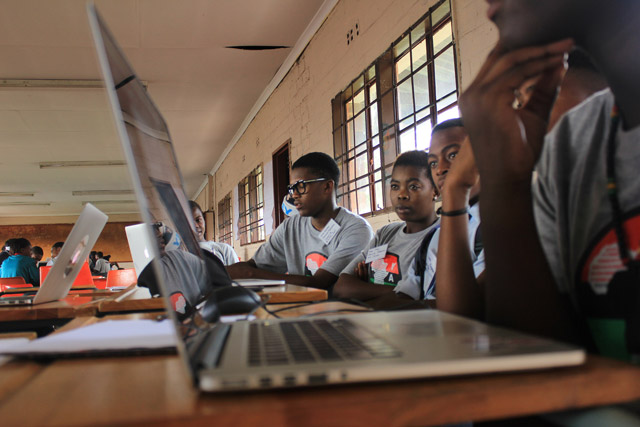
    Geekulcha-640

    The South African education system has to find the right balance between technology and educational concepts. Because, although these technologies can transform our education for the better, they can also severely impair it. There are many cases across the world where technology interventions had inverse effects. In all cases this was because focus on the learner outcomes was lost and overarching pedagogy wasn’t adapted to properly integrate the technologies.

    There is huge value in the data flowing through the education system. Applying big data analytics to establish an adaptive learning platform could start a data-driven way of equipping our learners for their matric exams — one learner at a time. The point of success will be on the intersection between technology and the education system. The technology in itself is not the solution, but is a critical enabler to inverting the matric results trend.

    • Marcel Kramer is senior manager, technology strategy, Accenture South Africa

    Add TechCentral as a preferred source on GoogleFollow TechCentral on Google NewsGet breaking news on WhatsApp


    Accenture Marcel Kramer
    WhatsApp YouTube
    Share. Facebook Twitter LinkedIn WhatsApp Telegram Email Copy Link
    Previous ArticleSAA warned it must start making money
    Next Article Post Office strike going ahead

    Related Posts

    Nedbank hires MTN's former tech chief as group CIO - Nikos Angelopoulos

    Nedbank hires MTN’s former tech chief as group CIO

    31 July 2026
    How Chinese cars took over South African showrooms

    How Chinese cars took over South African showrooms

    30 July 2026
    Everything you wanted to know about EVs but were afraid to ask

    Everything you wanted to know about EVs but were afraid to ask

    22 July 2026
    Company News
    Why businesses are moving n8n onto their own servers - Domains.co.za

    Why businesses are moving n8n onto their own servers

    11 September 2026
    Nitda, NDPC and Galaxy Backbone back CyFrica 2026

    Nitda, NDPC and Galaxy Backbone back CyFrica 2026

    11 September 2026
    Can an online school produce a scientist? CambriLearn has an independent answer

    Can an online school produce a scientist? CambriLearn has an independent answer

    9 September 2026
    Opinion
    The fragile joint in the Capitec machine - Pambos Soteriades

    The R197-billion market the banks can’t reach

    25 August 2026
    South African tech's compounding debt problem - Jannie van Zyl

    Management consulting as we know it is over

    21 August 2026
    South African tech's compounding debt problem - Jannie van Zyl

    The most dangerous customer is the quiet one

    10 August 2026

    Subscribe to Updates

    Get the best South African technology news and analysis delivered to your e-mail inbox every morning.

    Latest Posts
    So, who exactly will buy Apple's R50 000 iPhone Duo

    Why Apple can’t tell you who its R50 000 iPhone is for

    11 September 2026
    South Africa is behind its neighbours on the plumbing of digital IDs

    South Africa is behind its neighbours on the plumbing of digital IDs

    11 September 2026
    South Africa to extradite US cyberfraud-gang suspects to US

    South Africa to extradite cyberfraud-gang suspects to US

    11 September 2026
    Newspaper group Caxton deploys AI editors

    Newspaper group Caxton deploys AI copy editors

    11 September 2026
    © 2009 - 2026 NewsCentral Media
    Built and maintained by Chronon
    • Cookie policy (ZA)
    • TechCentral – privacy and Popia

    Type above and press Enter to search. Press Esc to cancel.

    Manage consent

    TechCentral uses cookies to enhance its offerings. Consenting to these technologies allows us to serve you better. Not consenting or withdrawing consent may adversely affect certain features and functions of the website.

    Functional Always active
    The technical storage or access is strictly necessary for the legitimate purpose of enabling the use of a specific service explicitly requested by the subscriber or user, or for the sole purpose of carrying out the transmission of a communication over an electronic communications network.
    Preferences
    The technical storage or access is necessary for the legitimate purpose of storing preferences that are not requested by the subscriber or user.
    Statistics
    The technical storage or access that is used exclusively for statistical purposes. The technical storage or access that is used exclusively for anonymous statistical purposes. Without a subpoena, voluntary compliance on the part of your Internet Service Provider, or additional records from a third party, information stored or retrieved for this purpose alone cannot usually be used to identify you.
    Marketing
    The technical storage or access is required to create user profiles to send advertising, or to track the user on a website or across several websites for similar marketing purposes.
    • Manage options
    • Manage services
    • Manage {vendor_count} vendors
    • Read more about these purposes
    View preferences
    • {title}
    • {title}
    • {title}