Close Menu
TechCentralTechCentral

    Subscribe to the newsletter

    Get the best South African technology news and analysis delivered to your e-mail inbox every morning.

    Facebook X (Twitter) YouTube LinkedIn
    WhatsApp Facebook X (Twitter) LinkedIn YouTube
    TechCentralTechCentral
    • News
      Moody's flags risk in Eskom grid split

      Moody’s flags risk in Eskom grid split

      1 June 2026
      The smartphone market is in big trouble

      The smartphone market is in big trouble

      1 June 2026
      Nvidia storms the Windows PC market with RTX Spark - Jensen Huang

      Nvidia storms the Windows PC market with RTX Spark

      1 June 2026
      Dell guns for MacBook Neo with low-cost laptop

      Dell guns for MacBook Neo with low-cost laptop

      1 June 2026
      Telkom reports this Tuesday: the real story will be in the detail - Serame Taukobong

      Telkom reports this Tuesday: the real story will be in the detail

      31 May 2026
    • World
      Nvidia's first CPUs to debut in Windows laptops this week

      Nvidia CPUs to debut in Windows laptops this week

      31 May 2026
      Watch: Bezos rocket erupts in fireball during ground test

      Watch: Bezos rocket erupts in fireball during ground test

      29 May 2026
      AI boom hands Samsung chip workers life-changing bonuses

      AI boom hands Samsung chip workers life-changing bonuses

      27 May 2026
      Luce lit: Ferrari unveils its first electric car

      Luce lit: Ferrari unveils its first electric car

      26 May 2026
      Huawei claims chip design breakthrough

      Huawei claims chip design breakthrough

      25 May 2026
    • In-depth
      Alfa's electric rebel - Alfa Romeo Junior Elettrica Veloce

      Alfa’s electric rebel

      29 April 2026
      Africa switches on as Europe dims the lights

      Africa switches on as Europe dims the lights

      9 April 2026
      The biggest untapped EV market on Earth is hiding in plain sight

      The biggest untapped EV market on Earth is hiding in plain sight

      1 April 2026
      AI, cybersecurity power standout year for Datatec - Jens Montanana

      The R16-billion tech giant hiding in plain sight

      26 March 2026
      The last generation of coders

      The last generation of coders

      18 February 2026
    • TCS
      TCS+ | The Up&Up Group on the hidden cost of AI - Jason Harrison

      TCS+ | The Up&Up Group on the hidden cost of AI

      13 May 2026
      Michael Rossouw

      TCS+ | The retirement decision most South Africans get wrong

      6 May 2026
      TCS | The Cape Town start-up listening for TB with AI - Braden van Breda

      TCS | The Cape Town start-up listening for TB with AI

      4 May 2026

      TCS+ | ‘The ISP for ISPs’: Vox’s shift to wholesale aggregator

      20 April 2026
      TCS | Werner Lindemann on how AI is rewriting the infosec rulebook

      TCS | Werner Lindemann on how AI is rewriting the infosec rulebook

      15 April 2026
    • Opinion
      Treasury's crypto crackdown is a betrayal of Mandela's promise - Duncan McLeod

      Treasury’s crypto crackdown is a betrayal of Mandela’s promise

      22 May 2026
      South Africa is sleepwalking into another AI policy failure - Celeste Labuschagne

      South Africa is sleepwalking into another AI policy failure

      20 May 2026
      AI won't fix your culture - it will expose it - Jackie Kennedy

      AI won’t fix your culture – it will expose it

      19 May 2026
      Treasury's crypto crackdown is a betrayal of Mandela's promise - Duncan McLeod

      Free calls, dead voice and Shameel Joosub’s Spanish ghost

      22 April 2026
      The conflict of interest at the heart of PayShap's slow adoption - Cheslyn Jacobs

      The conflict of interest at the heart of PayShap’s slow adoption

      26 March 2026
    • Company Hubs
      • 1Stream
      • Africa Data Centres
      • AfriGIS
      • Altron Digital Business
      • Altron Document Solutions
      • Altron Group
      • Arctic Wolf
      • Ascent Technology
      • AvertITD
      • BBD
      • Braintree
      • CallMiner
      • CambriLearn
      • CM Telecom
      • Contactable
      • CYBER1 Solutions
      • Digicloud Africa
      • Digimune
      • Domains.co.za
      • ESET
      • Euphoria Telecom
      • HOSTAFRICA
      • Incredible Business
      • iONLINE
      • IQbusiness
      • Iris Network Systems
      • Kaspersky
      • LSD Open
      • Mitel
      • NEC XON
      • Netstar
      • Network Platforms
      • Next DLP
      • Ovations
      • Paracon
      • Paratus
      • Q-KON
      • SevenC
      • SkyWire
      • Solid8 Technologies
      • Telit Cinterion
      • Telviva
      • Tenable
      • Vertiv
      • Videri Digital
      • Vodacom Business
      • Wipro
      • Workday
      • XLink
    • Sections
      • AI and machine learning
      • Banking
      • Broadcasting and Media
      • Cloud services
      • Contact centres and CX
      • Cryptocurrencies
      • Education and skills
      • Electronics and hardware
      • Energy and sustainability
      • Enterprise software
      • Financial services
      • HealthTech
      • Information security
      • Internet and connectivity
      • Internet of Things
      • Investment
      • IT services
      • Lifestyle
      • Motoring
      • Policy and regulation
      • Public sector
      • Retail and e-commerce
      • Satellite communications
      • Science
      • SMEs and start-ups
      • Social media
      • Talent and leadership
      • Telecoms
    • Events
    • Advertise
    TechCentralTechCentral
    Home » Sections » Financial services » What happens when your onboarding AI gets it wrong?

    What happens when your onboarding AI gets it wrong?

    Promoted | SprintHive tested every frontier AI model on real South African bank statements. This is what happened.
    By SprintHive1 June 2026
    Twitter LinkedIn Facebook WhatsApp Email Telegram Copy Link
    News Alerts
    WhatsApp

    What happens when your onboarding AI gets it wrong? - SprintHive

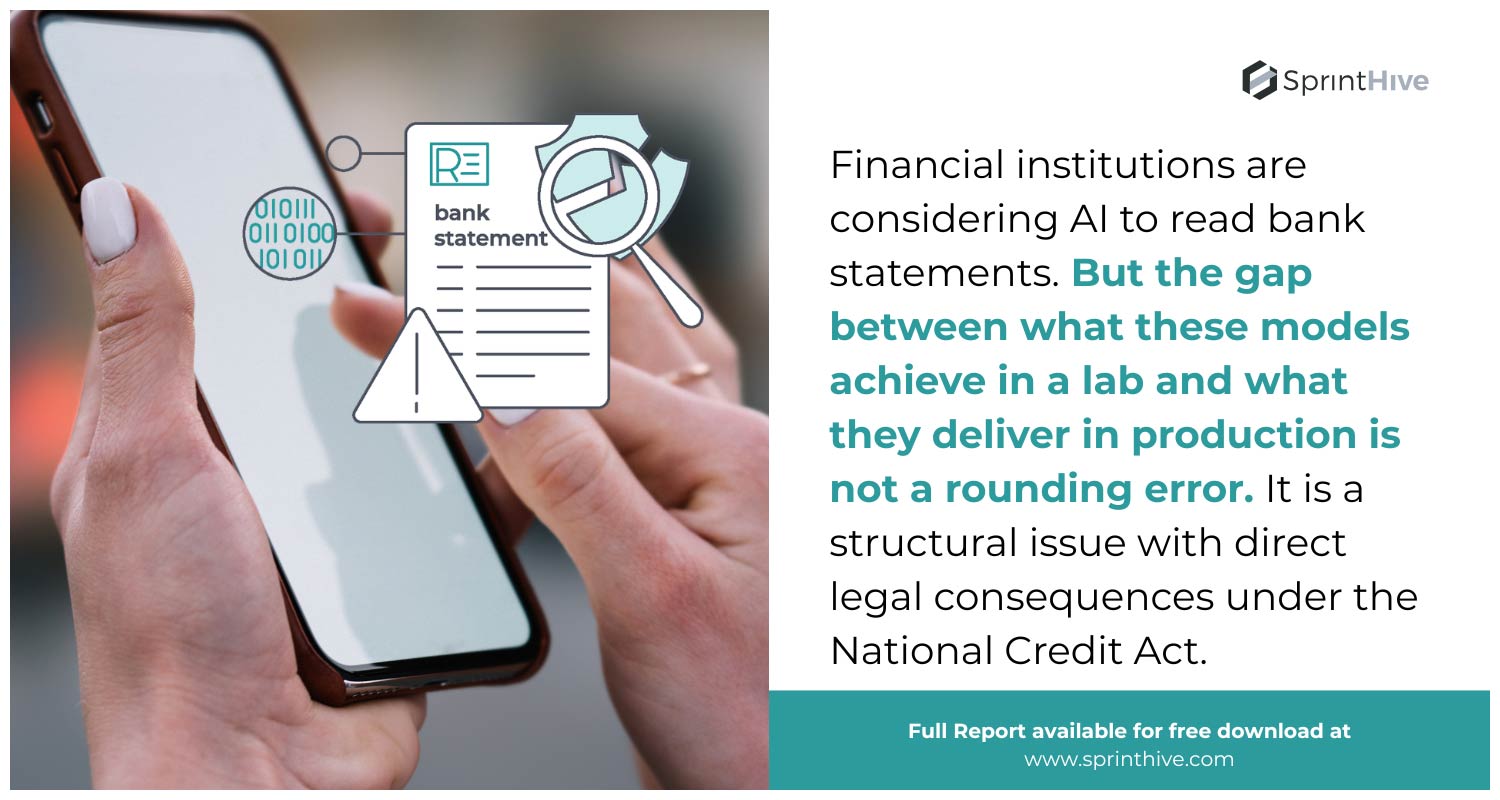
    Every financial institution in South Africa is right now either using AI in its digital onboarding stack, or evaluating or being sold it.

    The universal answer to “can you teach AI to understand bank statements?” is yes. What that “yes” means in practice varies enormously, and for banks, lenders or telecommunications operators, the gap between a confident “yes” and a production-grade “yes” is where the risk lives.

    The technology stack sitting upstream of your fraud controls is not a procurement decision, it is a risk decision. And in a market where every service provider will tell you they use AI for digital customer onboarding, the only question that protects you is the one that asks how.

    The relevant metric in this architecture is not cost per page. It is cost per error

    AI-generated payslips, deepfake onboarding attempts and synthetic identities constructed from real data are now production-level threats. The KPIs that define a head of fraud’s performance need to reflect that reality: prevention ROI alongside detection rates, legitimate customer impact alongside fraud loss, and document processing accuracy as a first-order input to fraud signal quality.

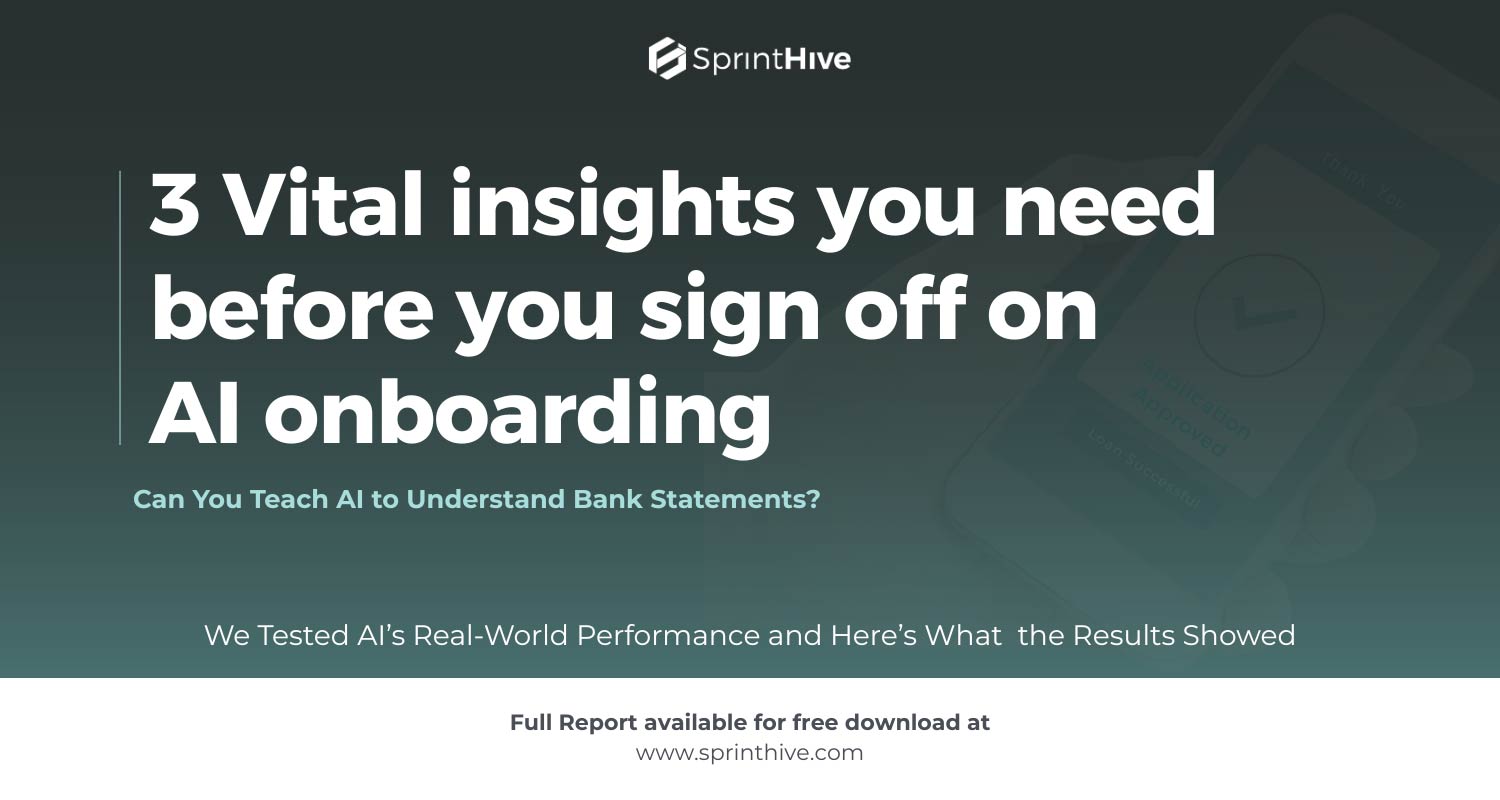
    SprintHive’s 2026 white paper, “Can You Teach AI to Understand Bank Statements?”, tested every major frontier AI model on real South African bank statements from production environments. The findings produced three insights that every head of fraud and chief technology officer should understand before signing off on any AI-powered onboarding infrastructure.

    Insight one: Hallucination is structural, not incidental

    AI models of this type do not retrieve verified facts. They predict statistically likely outputs. When a bank statement is clean and representative, prediction and accuracy look the same. When it is a degraded mobile photograph, a modified PDF or a layout the model has not seen before, the model does not flag uncertainty; rather, it generates a confident wrong answer. In the white paper, every frontier model tested made the same transaction misclassification error on a real South African bank statement, and none of knew they were wrong.

    While OpenAI confirmed in 2025 that hallucination is a permanent property of transformer models, the weakness is not the AI itself but the lack of a secondary verification layer. For fraud detection, a signal is only as good as the data it is generated from. If the AI reading the bank statement is fabricating transaction categories, the anomaly detection layer is working from corrupted input. You are not detecting fraud; you are detecting patterns in hallucinated data.

    Insight two: Frontier model performance and cost

    The white paper found that frontier models take an average of 8.5 minutes per bank statement and cost between R29 and R219 per extraction. At 65 000 statements per month, that is more than R1.9-million for document reading alone, before validation, human review or compliance costs.

    SprintHive also tested whether a custom-trained vision-language model, built specifically on South African bank statement data, could close this gap. It reduced cost and latency compared to frontier models, but it did not solve the core problem. A fraudster probing a system for its response time still has a significant window in which nothing is being checked if any single model is the only line of defence. Real-time fraud decisioning requires a pipeline that balances the contextual intelligence of AI with the speed and certainty of deterministic validation.

    Insight three: Trust requires architecture

    SprintHive trained its own specialist vision-language model exclusively on South African bank statement data. The result showed that even a purpose-built, domain-trained model suffers from the same fabrication patterns and generalisation failures as frontier models when documents drift from training conditions.

    The conclusion was not that AI is the wrong tool. It is that no single model, however well trained, can replace the need for a consensus and validation architecture around it. A custom model is a better candidate agent within a larger system, not a replacement for the system itself. The answer is an architecture where the AI’s output is cross-referenced against verification rules – like verifying that opening balance plus credits minus debits equals closing balance – to catch what any single model will inevitably get wrong.
    A natural response to these findings is to build internally. Your data is proprietary and your formats are known. SprintHive tested this assumption and found it creates a high “maintenance tax”. Bank-specific training improved scores initially but exposed deeper failures when banks updated their layouts. However, for a sufficiently large institution, the choice to build is not a failure of logic but a question of engineering focus.

    Every engineering month spent maintaining a document extraction system is a month not spent on the proprietary fraud models and credit decisioning logic that actually differentiate a financial services provider.
    The National Credit Act (NCA) closes the argument. It is not enough to build something that works in testing. You must demonstrate to the National Credit Regulator (NCR) that it worked correctly on every document, with a full audit trail. Whether you build or buy, the investment isn’t just in the AI – it’s in the validation architecture that makes that demonstration possible.

    Read: Stop fraud before it happens – advanced fraud prevention for financial institutions

    The relevant metric in this architecture is not cost per page. It is cost per error. In a regulated lending environment, under the NCA, with NCR audit scrutiny on every income verification decision, those two numbers lead to very different outcomes.

    For a head of fraud evaluating service providers, this is the question that cuts through the noise: not “do you use AI?” but rather “what happens when your AI is wrong, and how does your system know?”.

    Watch SprintHive CEO Dirk le Roux unpack the white paper or download the full white paper at sprinthive.com.

    • Read more articles by SprintHive on TechCentral
    • This promoted content was paid for by the party concerned

    Follow TechCentral on Google News Add TechCentral as your preferred source on Google


    Dirk le Roux SprintHive
    WhatsApp YouTube
    Share. Facebook Twitter LinkedIn WhatsApp Telegram Email Copy Link
    Previous ArticleThe smartphone market is in big trouble
    Next Article Moody’s flags risk in Eskom grid split

    Related Posts

    Stop fraud before it happens – advanced fraud prevention for financial institutions

    8 April 2025
    Add A Comment

    Comments are closed.

    Company News
    What happens when your onboarding AI gets it wrong? - SprintHive

    What happens when your onboarding AI gets it wrong?

    1 June 2026
    The new 'Big Three' every business needs to survive - Vox

    The new ‘Big Three’ every business needs to survive

    1 June 2026
    Zila Tech rewires Kenyan schools with Google - Digicloud Africa Google

    Zila Tech rewires Kenyan schools with Google

    1 June 2026
    Opinion
    Treasury's crypto crackdown is a betrayal of Mandela's promise - Duncan McLeod

    Treasury’s crypto crackdown is a betrayal of Mandela’s promise

    22 May 2026
    South Africa is sleepwalking into another AI policy failure - Celeste Labuschagne

    South Africa is sleepwalking into another AI policy failure

    20 May 2026
    AI won't fix your culture - it will expose it - Jackie Kennedy

    AI won’t fix your culture – it will expose it

    19 May 2026

    Subscribe to Updates

    Get the best South African technology news and analysis delivered to your e-mail inbox every morning.

    Latest Posts
    Moody's flags risk in Eskom grid split

    Moody’s flags risk in Eskom grid split

    1 June 2026
    What happens when your onboarding AI gets it wrong? - SprintHive

    What happens when your onboarding AI gets it wrong?

    1 June 2026
    The smartphone market is in big trouble

    The smartphone market is in big trouble

    1 June 2026
    The new 'Big Three' every business needs to survive - Vox

    The new ‘Big Three’ every business needs to survive

    1 June 2026
    © 2009 - 2026 NewsCentral Media
    • Cookie policy (ZA)
    • TechCentral – privacy and Popia

    Type above and press Enter to search. Press Esc to cancel.

    Manage consent

    TechCentral uses cookies to enhance its offerings. Consenting to these technologies allows us to serve you better. Not consenting or withdrawing consent may adversely affect certain features and functions of the website.

    Functional Always active
    The technical storage or access is strictly necessary for the legitimate purpose of enabling the use of a specific service explicitly requested by the subscriber or user, or for the sole purpose of carrying out the transmission of a communication over an electronic communications network.
    Preferences
    The technical storage or access is necessary for the legitimate purpose of storing preferences that are not requested by the subscriber or user.
    Statistics
    The technical storage or access that is used exclusively for statistical purposes. The technical storage or access that is used exclusively for anonymous statistical purposes. Without a subpoena, voluntary compliance on the part of your Internet Service Provider, or additional records from a third party, information stored or retrieved for this purpose alone cannot usually be used to identify you.
    Marketing
    The technical storage or access is required to create user profiles to send advertising, or to track the user on a website or across several websites for similar marketing purposes.
    • Manage options
    • Manage services
    • Manage {vendor_count} vendors
    • Read more about these purposes
    View preferences
    • {title}
    • {title}
    • {title}