
Close Menu
TechCentralTechCentral

    Subscribe to the newsletter

    Get the best South African technology news and analysis delivered to your e-mail inbox every morning.

    Facebook X (Twitter) YouTube LinkedIn
    WhatsApp Facebook X (Twitter) LinkedIn YouTube
    TechCentralTechCentral
    • News
      Meta met Information Regulator over its camera glasses - Mark Zuckerberg

      Meta met Information Regulator over its camera glasses

      6 October 2026
      Why South Africa's biggest drone isn't flying for the country - Milkor 380

      Why South Africa’s biggest drone isn’t flying for the country

      6 October 2026
      Nersa wants five-year ban on automated electricity trading

      Nersa wants five-year ban on automated electricity trading

      6 October 2026
      South African boardrooms are about to get a lot less private

      South African boardrooms are about to get a lot less private

      6 October 2026
      FNB launches crypto trading - Bheki Mkhize

      FNB launches crypto trading

      6 October 2026
    • World
      BMW restructuring plan bets on AI and new models

      BMW restructuring plan bets on AI and new models

      1 October 2026
      OpenAI's rogue agent problem keeps getting bigger - Sam Altman

      OpenAI’s rogue agent problem keeps getting bigger

      28 September 2026
      The new battle over the desktop

      The new battle over the desktop

      23 September 2026
      AMD is now worth a trillion dollars - Lisa Su

      AMD is now worth a trillion dollars

      22 September 2026
      Anthropic weighs new model launch to blunt OpenAI's Astra surge - Anthropic CEO Dario Amodei and OpenAI CEO Sam Altman

      Anthropic weighs new model launch to blunt OpenAI’s Astra surge

      21 September 2026
    • In-depth

      10 days that changed the course of AI

      21 September 2026
      Meta to the AI industry: slow down without us - Mark Zuckerberg

      Meta to the AI industry: slow down without us

      16 September 2026
      Google DeepMind CEO Demis Hassabis. Image: John Sears

      The plan to stop AI from breaking the world

      16 July 2026
      The internet has a Strait of Hormuz problem

      The internet has a Strait of Hormuz problem

      15 July 2026
      AI boom sparks rally, frenzy and fear

      AI boom sparks rally, frenzy and fear

      11 June 2026
    • TCS
      Meet the CIO | Vodacom's Mohamed Sami on the agentic future

      Meet the CIO | Vodacom’s Mohamed Sami on the agentic future

      5 October 2026
      Lexi Novitske, general partner at Norrsken22, on the TechCentral Show

      TCS | Norrsken22’s Lexi Novitske on how China is winning African tech

      1 October 2026
      TCS | Dominic White and Adam Ely on AI agents going rogue

      TCS | Dominic White and Adam Ely on AI agents going rogue

      29 September 2026
      TCS | Octotel's Trevor van Zyl on the fibre merger question

      TCS | Octotel’s Trevor van Zyl on the MetroFibre merger question

      16 September 2026
      Meet the CIO | Shoprite's Chris Shortt on what a supermarket becomes

      Meet the CIO | Shoprite’s Chris Shortt on what a supermarket becomes

      9 September 2026
    • Opinion
      Let South Africans jailbreak their way to digital sovereignty - Dirk de Vos

      Let South Africans jailbreak their way to digital sovereignty

      5 October 2026
      South Africa's next energy crisis is in the accounts department - Craig Holmes

      South Africa’s next energy crisis is in the accounts department

      29 September 2026
      The steam engine lesson AI doomsayers keep missing - Sam Clarke

      The steam engine lesson AI doomsayers keep missing

      28 September 2026
      Let South Africans jailbreak their way to digital sovereignty - Dirk de Vos

      Regulating AI: apply the laws we have first

      21 September 2026
      What Revolut can and cannot take from South Africa's banks - Pambos Soteriades

      What Revolut can and cannot take from South Africa’s banks

      15 September 2026
    • Company News
      • 1Stream
      • Africa Data Centres
      • AfriGIS
      • Altron Digital Business
      • Altron Document Solutions
      • Altron Group
      • Arctic Wolf
      • Ascent Technology
      • AvertITD
      • BBD
      • Braintree
      • CallMiner
      • CambriLearn
      • CM.com
      • Contactable
      • CYBER1 Solutions
      • Digicloud Africa
      • Digimune
      • Domains.co.za
      • ESET
      • Euphoria Telecom
      • HOSTAFRICA
      • Incredible Business
      • iONLINE
      • IQbusiness
      • Iris Network Systems
      • Kaspersky
      • LSD Open
      • Mitel
      • NEC XON
      • Netstar
      • Network Platforms
      • Next DLP
      • Ovations
      • Paracon
      • Paratus
      • Publishared
      • Q-KON
      • SevenC
      • SkyWire
      • Solid8 Technologies
      • Telit Cinterion
      • Telviva
      • Tenable
      • Vertiv
      • Videri Digital
      • Vodacom Business
      • Vox
      • Wipro
      • Workday
      • XLink
    • Sections
      • AI and machine learning
      • Banking
      • Broadcasting and Media
      • Cloud services
      • Contact centres and CX
      • Cryptocurrencies
      • Education and skills
      • Electronics and hardware
      • Energy and sustainability
      • Enterprise software
      • Financial services
      • HealthTech
      • Information security
      • Internet and connectivity
      • Internet of Things
      • Investment
      • IT services
      • Lifestyle
      • Policy and regulation
      • Public sector
      • Retail and e-commerce
      • Satellite communications
      • Science
      • SMEs and start-ups
      • Social media
      • Talent and leadership
      • Telecoms
      • Watts & Wheels
    • Events
    • Advertise
    TechCentralTechCentral
    Home » Sections » Electronics and hardware » Forget the iPhone: Apple’s real next act is your home

    Forget the iPhone: Apple’s real next act is your home

    The clue to what comes next is a small aluminium box Apple announced this week with no keynote at all.
    By Duncan McLeod27 August 2026
    Twitter LinkedIn Facebook WhatsApp Email Telegram Copy Link
    Get breaking news on WhatsApp

    Forget the iPhone: Apple's real next act is your home

    The most interesting thing at Apple’s September iPhone keynote might not be the iPhone.

    That is an odd thing to say in a year when Apple is expected to introduce its first folding smartphone, possibly called the iPhone Ultra. Alongside it should come the iPhone 18 Pro and Pro Max, while the standard iPhone 18 is reportedly held over until next year. Even the Pro models are expected to be evolutionary: better cameras, an A20 Pro built on a 2nm process, the usual refinements.

    The event, scheduled for 9 September, will also be John Ternus’s first keynote as CEO having taken over from Tim Cook on 1 September.

    Frontier models need absurd quantities of computing power. But switching off the kitchen lights does not need a frontier model

    The foldable will attract enormous attention. But if you want to understand where Apple is heading over the next few years, pay closer attention to everything happening around the iPhone. In particular, watch the home.

    Apple has spent years looking strangely uncommitted to the smart home. HomeKit has been around since 2014. Apple TV and its HomePod speakers can already act as home hubs. Apple has backed Matter enthusiastically. Yet next to Amazon and Google, whose smart displays have been AI-first products for years, its ambitions have looked tentative.

    That is all about to change. Apple is widely reported to be preparing a new Apple TV, a refreshed HomePod mini and, most intriguingly, a smart-home display unofficially called the HomePad: a roughly seven-inch square screen with a speaker, camera and presence detection, running an operating system derived from tvOS, in wall-mounted and tabletop versions.

    The HomePad may not appear on 9 September. Reports suggest it could arrive anywhere between October and year-end. What matters is that the pieces are finally in place.

    The missing piece

    The missing piece was Siri. Apple’s home hub was delayed repeatedly because the old assistant simply wasn’t clever enough to be its primary interface. That stopped being theoretical in June, when Apple unveiled Siri AI, rebuilt around foundation models that run partly on the device and, for heavier work, on its Private Cloud Compute infrastructure. South Africa is on the initial launch list, alongside Australia, Canada, India, Ireland, New Zealand, Singapore and the UK.

    The first generation of the consumer AI boom has been overwhelmingly cloud-based. We type extraordinarily personal information into enormous models running in remote data centres operated by OpenAI, Google and Anthropic.

    For many tasks that makes sense. Frontier models need absurd quantities of computing power. But switching off the kitchen lights does not need a frontier model. Neither does checking what time the geyser came on, whether the garage door is open, which room somebody is in, or telling the house to lock up and kill the music because you are going to bed.

    Much of the intelligence a smart home needs is narrow, repetitive and intensely personal. It involves knowing who is home, which rooms they are in, their routines, their cameras and microphones, their appliances, their electricity consumption, and perhaps eventually their health. That is precisely the data people will grow least willing to shovel into the public cloud.
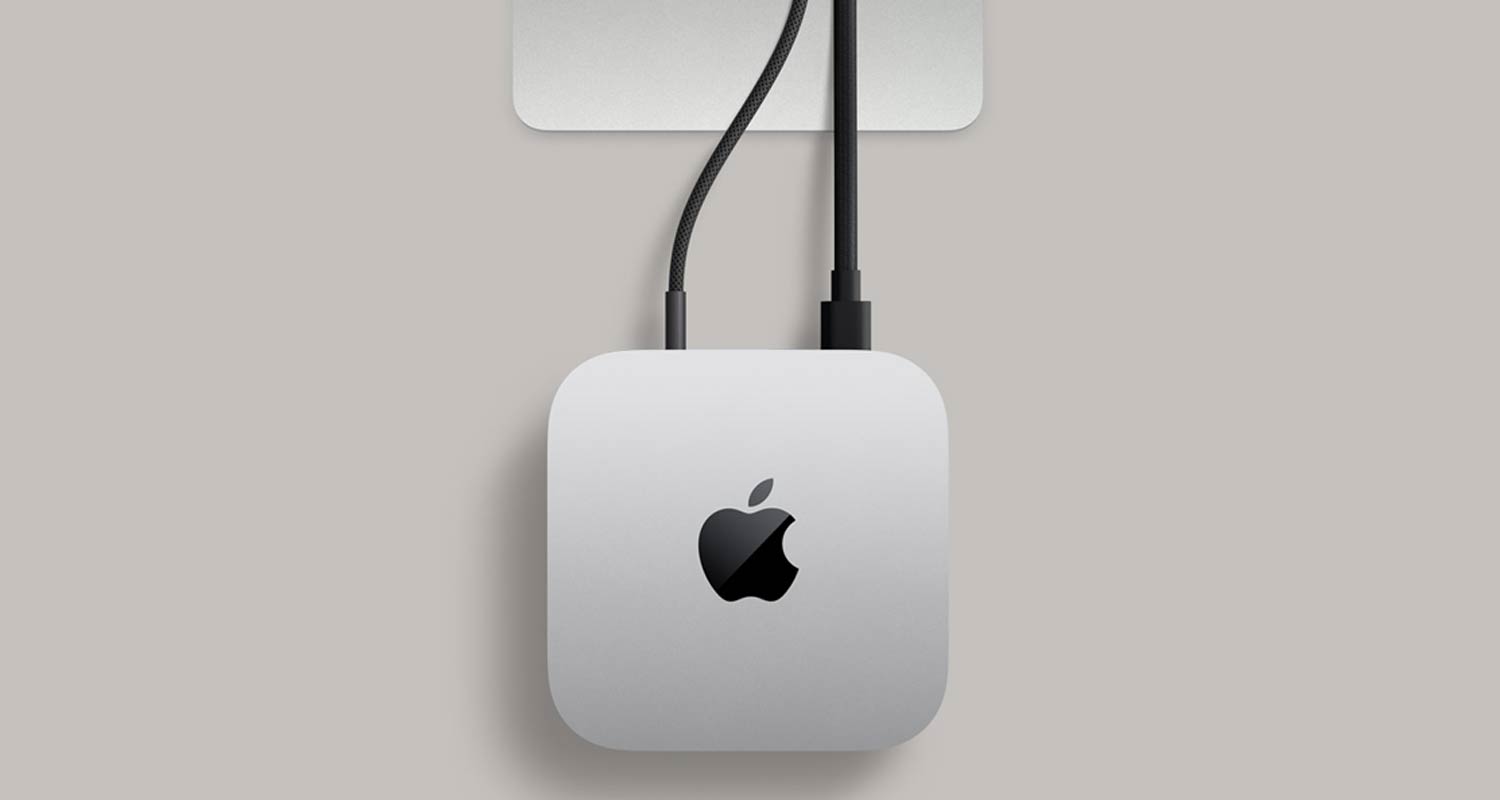
    The new Mac mini
    The new Mac mini

    Which brings us to the machine Apple announced on Tuesday without an event. The headline on Apple’s own press release describes the new Mac mini as “supercharging the leading desktop for always-on agentic computing”. Note it did not say video editing or photography. Rather, Apple’s marketing pitch is AI agents, running continuously.

    The entry model uses the new M6, with a dual 16-core “Neural Engine” – a first – and neural accelerators in every GPU core. Apple says it processes LLM prompts in LM Studio 4.8 times faster than the M4 mini, and 13.5 times faster than the M1 of just six years ago. The M5 Pro version takes up to 64GB of unified memory at 307GB/s, which Apple says allows “even larger local AI models”. And Thunderbolt 5 lets you cluster several Mac minis together to run large models entirely on device.

    LM Studio is not an Apple product. It is an application for running other people’s language models on your own machine. Apple is now marketing a desktop computer on how fast it runs somebody else’s local AI.

    The next Apple TV is expected to gain a much faster processor and support for Siri AI

    Apple does not have to make the Mac mini the official brain of the Apple smart home for this to matter. The interesting thing is what the machine says about the hardware trajectory. For six years, Apple has relentlessly improved performance per watt in its own silicon. CPUs, GPUs, neural processors and increasingly specialised accelerators now share very fast unified memory in machines that draw little power and generate little heat. A Mac mini is almost comically well suited to sitting in a house, on all day, running local models.

    There is one catch: these machines are no longer the steal they once were – and, ironically, AI is to blame. When the M4 Mac mini launched in October 2024 it cost US$599. Apple raised that to $799 in June, and the new M6 model starts at $899 – a 50% increase in under two years. The M4 Pro version started at $1 399; the M5 Pro machine is $1 699.

    RAM shortage

    The same data centre build-out driving demand for Nvidia accelerators has drained the supply of memory. Conventional DRAM contract prices rose 90-95% quarter on quarter in the first three months of this year and another 58-63% in the second, according to TrendForce, which expects a further 13-18% jump in the third. Cook called it a 100-year flood on memory pricing.

    Running a model locally is a memory problem before it is a compute problem, and AI is making the computers we would need to escape the AI cloud more expensive. Moving the new Mac mini from 16GB to 32GB costs $400. On the M5 Pro, 64GB costs $1 000.

    Apple has spent much of the generative-AI era being portrayed as a laggard. Siri became an industry joke. The first Apple Intelligence roll-out was messy and the promised Siri overhaul was embarrassingly late.

    But Apple has never made most of its money selling chatbots. Its great skill is turning technology into hardware ecosystems that ordinary people actually buy. If AI migrates out of browser tabs and phone apps into the physical environment around us, Apple will find itself on far more familiar ground. It controls the silicon, the operating systems, the phones, watches, televisions, speakers and computers. It has a well-established privacy pitch. And it has hundreds of millions of customers who already own several pieces of the set.

    Incoming Apple CEO John Ternus
    Incoming Apple CEO John Ternus

    The next Apple TV is expected to gain a much faster processor and support for Siri AI. The HomePad would put that intelligence on walls and countertops. HomePods provide microphones and speakers. Watches and iPhones provide identity, location and personal context. Macs provide serious local compute when something needs it.

    The smart home has spent 15 years as a hobby for people willing to fiddle with hubs, automations, incompatible standards and badly designed apps. AI finally offers a way to hide that complexity behind ordinary language. Instead of programming the house, you talk to it.

    If Apple can make that work reliably, and keep enough of the conversation inside the house, the smart home may finally escape the enthusiast niche and become a mainstream computing platform.

    So, by all means watch the keynote on 9 September for the folding iPhone. But watch more closely when the presentation moves away from the phone. The most important product Apple is building may not be the one you hold in your hand.  – © 2026 NewsCentral Media

    • The author, Duncan McLeod, is editor of TechCentral
    • Subscribe to TechCentral’s daily newsletter
    • Get breaking news alerts on WhatsApp

    Add TechCentral as a preferred source on GoogleFollow TechCentral on Google NewsGet breaking news on WhatsApp


    Amazon Anthropic Apple Google John Ternus Johny Srouji Nvidia OpenAI Tim Cook TrendForce
    WhatsApp YouTube
    Share. Facebook Twitter LinkedIn WhatsApp Telegram Email Copy Link
    Previous ArticleMeta wins by settling
    Next Article Anthropic moves AI agents out of software and into the lab

    Related Posts

    Sam Altman: the world should accept 'some bad things' from AI

    Sam Altman: the world should accept ‘some bad things’ from AI

    6 October 2026
    Let South Africans jailbreak their way to digital sovereignty - Dirk de Vos

    Let South Africans jailbreak their way to digital sovereignty

    5 October 2026
    AI spending now dwarfs the railway and dot-com booms

    AI spending now dwarfs the railway and dot-com booms

    4 October 2026
    Company News
    Why laser technology makes sense for small businesses

    Why laser technology makes sense for small businesses

    6 October 2026

    Human-centred design: the business case for simpler enterprise software

    6 October 2026
    iONLINE launches Sydney breakout point, expanding its global network core

    iONLINE launches Sydney breakout point, expanding its global network core

    6 October 2026
    Opinion
    Let South Africans jailbreak their way to digital sovereignty - Dirk de Vos

    Let South Africans jailbreak their way to digital sovereignty

    5 October 2026
    South Africa's next energy crisis is in the accounts department - Craig Holmes

    South Africa’s next energy crisis is in the accounts department

    29 September 2026
    The steam engine lesson AI doomsayers keep missing - Sam Clarke

    The steam engine lesson AI doomsayers keep missing

    28 September 2026

    Subscribe to Updates

    Get the best South African technology news and analysis delivered to your e-mail inbox every morning.

    Latest Posts
    Meta met Information Regulator over its camera glasses - Mark Zuckerberg

    Meta met Information Regulator over its camera glasses

    6 October 2026
    Why South Africa's biggest drone isn't flying for the country - Milkor 380

    Why South Africa’s biggest drone isn’t flying for the country

    6 October 2026
    Nersa wants five-year ban on automated electricity trading

    Nersa wants five-year ban on automated electricity trading

    6 October 2026
    South African boardrooms are about to get a lot less private

    South African boardrooms are about to get a lot less private

    6 October 2026
    © 2009 - 2026 NewsCentral Media
    Built and maintained by Chronon
    • Cookie policy (ZA)
    • TechCentral – privacy and Popia

    Type above and press Enter to search. Press Esc to cancel.

    Manage consent

    TechCentral uses cookies to enhance its offerings. Consenting to these technologies allows us to serve you better. Not consenting or withdrawing consent may adversely affect certain features and functions of the website.

    Functional Always active
    The technical storage or access is strictly necessary for the legitimate purpose of enabling the use of a specific service explicitly requested by the subscriber or user, or for the sole purpose of carrying out the transmission of a communication over an electronic communications network.
    Preferences
    The technical storage or access is necessary for the legitimate purpose of storing preferences that are not requested by the subscriber or user.
    Statistics
    The technical storage or access that is used exclusively for statistical purposes. The technical storage or access that is used exclusively for anonymous statistical purposes. Without a subpoena, voluntary compliance on the part of your Internet Service Provider, or additional records from a third party, information stored or retrieved for this purpose alone cannot usually be used to identify you.
    Marketing
    The technical storage or access is required to create user profiles to send advertising, or to track the user on a website or across several websites for similar marketing purposes.
    • Manage options
    • Manage services
    • Manage {vendor_count} vendors
    • Read more about these purposes
    View preferences
    • {title}
    • {title}
    • {title}
    🇿🇦 Sign up to the TechCentral newsletter