
Close Menu
TechCentralTechCentral

    Subscribe to the newsletter

    Get the best South African technology news and analysis delivered to your e-mail inbox every morning.

    Facebook X (Twitter) YouTube LinkedIn
    WhatsApp Facebook X (Twitter) LinkedIn YouTube
    TechCentralTechCentral
    • News
      Post Office on the brink of collapse

      Post Office on the brink of collapse

      13 March 2026
      New policy direction targets South Africa's municipal broadband logjam - Solly Malatsi

      New policy direction targets South Africa’s municipal broadband logjam

      13 March 2026
      How electronic warfare is threatening ships and their crews

      How electronic warfare is threatening ships and their crews

      13 March 2026
      Rand slumps for second week

      Rand slumps for second week

      13 March 2026
      Parliament opens nominations for Icasa council seats

      Parliament opens nominations for Icasa council seats

      13 March 2026
    • World
      Musk launches Macrohard in cheeky nod to Microsoft - Elon Musk

      Musk launches Macrohard in cheeky nod to Microsoft

      12 March 2026
      Europe is building an alternative to Microsoft Office

      Europe is building an alternative to Microsoft Office

      11 March 2026
      Microsoft bets on Anthropic as it loosens ties with OpenAI

      Microsoft bets on Anthropic as it loosens ties with OpenAI

      10 March 2026
      World hit by worst oil shock since the 1970s

      World hit by worst oil shock since the 1970s

      9 March 2026
      iStore prices MacBook Neo at R11 999 in South Africa

      Apple debuts MacBook Neo to challenge Windows PCs, Chromebooks

      5 March 2026
    • In-depth
      The last generation of coders

      The last generation of coders

      18 February 2026
      Sentech is in dire straits

      Sentech is in dire straits

      10 February 2026
      How liberalisation is rewiring South Africa's power sector

      How liberalisation is rewiring South Africa’s power sector

      21 January 2026
      The top-performing South African tech shares of 2025

      The top-performing South African tech shares of 2025

      12 January 2026
      Digital authoritarianism grows as African states normalise internet blackouts

      Digital authoritarianism grows as African states normalise internet blackouts

      19 December 2025
    • TCS
      TCS+ | Vox Kiwi: a wireless solution promising a fibre-like experience - Theo van Zyl

      TCS+ | Vox Kiwi: a wireless solution promising a fibre-like experience

      13 March 2026
      TCS+ | Flipping the narrative on AI in the Global South - Josefin Rosén

      TCS+ | Flipping the narrative on AI in the Global South

      13 March 2026
      TCS | Sink or swim? Antony Makins on how AI is rewriting the rules of work

      TCS | Sink or swim? Antony Makins on how AI is rewriting the rules of work

      5 March 2026
      TCS+ | Bolt ups the ante on platform safety - Simo Kalajdzic

      TCS+ | Bolt ups the ante on platform safety

      4 March 2026
      Watts & Wheels S1E4: 'We drive an electric Uber'

      Watts & Wheels S1E4: ‘We drive an electric Uber’

      10 February 2026
    • Opinion
      South Africa's energy future hinges on getting wheeling right - Aishah Gire

      South Africa’s energy future hinges on getting wheeling right

      10 March 2026
      Hold the doom: the case for a South African comeback - Duncan McLeod

      Apple just dropped a bomb on the Windows world

      5 March 2026
      VC's centre of gravity is shifting - and South Africa is in the frame - Alison Collier

      VC’s centre of gravity is shifting – and South Africa is in the frame

      3 March 2026
      Hold the doom: the case for a South African comeback - Duncan McLeod

      Hold the doom: the case for a South African comeback

      26 February 2026
      The AI fraud crisis your bank is not ready for - Andries Maritz

      The AI fraud crisis your bank is not ready for

      18 February 2026
    • Company Hubs
      • 1Stream
      • Africa Data Centres
      • AfriGIS
      • Altron Digital Business
      • Altron Document Solutions
      • Altron Group
      • Arctic Wolf
      • AvertITD
      • Braintree
      • CallMiner
      • CambriLearn
      • CYBER1 Solutions
      • Digicloud Africa
      • Digimune
      • Domains.co.za
      • ESET
      • Euphoria Telecom
      • HOSTAFRICA
      • Incredible Business
      • iONLINE
      • IQbusiness
      • Iris Network Systems
      • LSD Open
      • Mitel
      • NEC XON
      • Netstar
      • Network Platforms
      • Next DLP
      • Ovations
      • Paracon
      • Paratus
      • Q-KON
      • SevenC
      • SkyWire
      • Solid8 Technologies
      • Telit Cinterion
      • Tenable
      • Vertiv
      • Videri Digital
      • Vodacom Business
      • Wipro
      • Workday
      • XLink
    • Sections
      • AI and machine learning
      • Banking
      • Broadcasting and Media
      • Cloud services
      • Contact centres and CX
      • Cryptocurrencies
      • Education and skills
      • Electronics and hardware
      • Energy and sustainability
      • Enterprise software
      • Financial services
      • HealthTech
      • Information security
      • Internet and connectivity
      • Internet of Things
      • Investment
      • IT services
      • Lifestyle
      • Motoring
      • Policy and regulation
      • Public sector
      • Retail and e-commerce
      • Satellite communications
      • Science
      • SMEs and start-ups
      • Social media
      • Talent and leadership
      • Telecoms
    • Events
    • Advertise
    TechCentralTechCentral
    Home » Opinion » Hilton Tarrant » How Vodacom is outsmarting MTN

    How Vodacom is outsmarting MTN

    By Hilton Tarrant2 June 2015
    Twitter LinkedIn Facebook WhatsApp Email Telegram Copy Link
    News Alerts
    WhatsApp

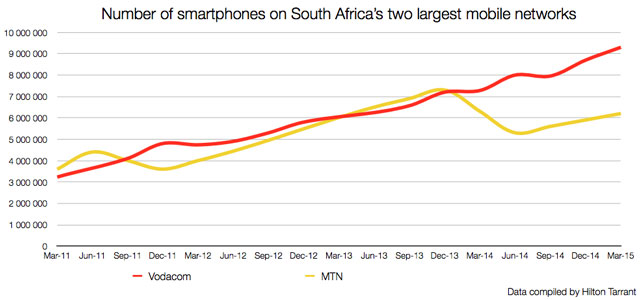
    hilton-tarrant-180In May, Vodacom announced that it had 9,3m smartphones on its network in South Africa (as at end March, the end of its financial year). That is massive, especially considering that a year ago, the number was 7,3m. Total smart devices on its network — which include tablets and dongles — number 11,6m.

    By comparison, MTN had 5,9m smartphones on its South African network as at 31 December 2014. That’s the most recently published number (it doesn’t disclose this data in its quarterly group subscriber updates). MTN is adding about 300 000 smart devices a quarter, so by 31 March, it likely had around 6,2m active.

    But, this still leaves Vodacom around 50% ahead!

    What makes this particularly interesting is that up until the end of 2013, both Vodacom and MTN were neck and neck in terms of number of active smartphones on their networks. In fact, MTN caught up to Vodacom and then surpassed its larger rival in the latter half of 2013.

    What happened last year is unprecedented: MTN announced in August that active smartphones as at 30 June totalled 5,3m, a 2m drop from six months prior. It cited a “change in definition” for this reduction. Attempts to get comment from MTN South Africa last week were unsuccessful (but then again, with tyres burning outside its 14th Avenue head office, call centres and stores shut, it surely has bigger problems).

    So what could’ve led to this massive restatement?

    The clue, I believe, is in the above-average growth evident in MTN’s 2012 and 2013 numbers. It’s no coincidence that the fourth quarter of 2013 marked “peak” BlackBerry in South Africa. Among the local operators, MTN was still aggressively adding BlackBerry subscribers very late in the game. Remember that, following the launch of BlackBerry 10 in 2013, legacy BlackBerry usage (the kind that became popular with all-you-can-eat Internet) cratered. From that point, there were precious few compelling devices that still offered BIS. Plus the market moved on. You simply didn’t need a BlackBerry anymore. Not with the cheap and undeniably better Android devices that began to hit stores.

    So, MTN’s mystery 2m “smartphones” were surely legacy BlackBerry (OS 7) devices. It’s the only plausible answer. Besides, in 2015 (and 2014), it would actually be hard to argue that a three-year-old Curve which was still chugging away on the network would be classed as a “smartphone”.

    Vodacom-Smart-Kicka--SIDE-640
    Vodacom Smart Kicka

    Vodacom’s definition of a smartphone, as per its annual report, is rather generic: “a mobile phone offering advanced capabilities, including access to e-mail and the Internet” (MTN doesn’t publish a definition in its annual report). This means those legacy phones are probably stuck somewhere inside Vodacom’s 9,3m figure, but, it has been far more aggressive in switching users away from those legacy BlackBerry devices. In fact, in late 2013, you could hardly find the promotion of one in its monthly deal sheets (compared to MTN where they’d have pride of place on page 3). I’d guesstimate that Vodacom probably has around a million of the old OS 7 BlackBerry devices left on its network, if that.

    Many of those old BlackBerry die-hards have ended up on Vodacom’s own low-cost Vodafone-branded devices, a strategy that’s becoming more successful over time. In the past year alone, Vodacom has sold “more than 3m low-cost smart devices”. This includes the Smart Kicka (R659 cash) and Smart Tab (R1 179), which sold over a million since launch in the operator’s financial third quarter (September to December 2014). That is an incredible number.

    Out of the 2m total smart devices Vodacom added between March 2014 and March 2015, 1,3m were in the last six months. This speaks to the success of its low-cost own-device strategy. (MTN, by contrast, has tried to emulate this with the “Steppa”, but continual stock-problems have meant that customers simply haven’t been able to get them.)

    It also illustrates something else. With most of the growth coming at the low end (effectively sub-R1 200), the rest of the market is already fairly saturated.

    Practically everyone who can afford a smartphone has one. Vodacom says 43% of the devices on its network are smart (with 15,4m non-smart). These numbers are important, because it’s not as simple as dividing the device total by the active “subscribers” total, given that active subscribers are total active Sim cards, not devices.

    But Vodacom’s detailed numbers back this up: 78% of post-paid users are on “integrated tariffs” (the Smart and Red price plans). You can be sure that smartphone penetration among the remaining 22% of users is high. So, nearly everyone who is on contract has a smartphone. In the (upper-) mid- to high-end of the prepaid market, the same is true.

    Winning here is now about driving the adoption of those sub-US$100 (R1 200) and even sub-$50 (R600) smartphones.

    Why all this focus on smartphones when there are 17m active data users each on Vodacom and MTN? After all, that’s around twice as many as there are smartphones?
    smartphones-mtn-vodacom-640

    Not only is the market ensuring that very soon you won’t be able to buy a feature phone (they simply will no longer exist), but smartphone users use a ton more data than non-smartphone users. To operators, this is gold.

    Already, Vodacom says the average amount of data used per month by its smartphone users is 342MB, growth of 38% from a year earlier.

    Vodafone’s group figures are revealing. Users with iOS and Android devices in its European markets (including the UK, Germany, Italy and Spain) are now using 755MB/month on average. This is 60% more than a year ago (473MB).

    That’s the gap. That’s the potential. From this point, we will double to catch up with average usage in Europe. At the upper end of the market, we already likely compare very favourably.

    Aside from driving smartphone adoption, data bundles (and pricing) are the other big lever that operators have to stimulate usage. In its May reporting, Vodacom’s given us some colour on how successful it’s been. In the past year, it sold 196m data bundles, an increase of 139% over 2014. By the beginning of this year, it was selling an average of 20m data bundles per month! Ninety percent of all usage is now in bundle.

    bundles-devices-640

    Most would argue that data pricing is not quite “there” yet. Still, Vodacom says the average price per megabyte has dropped by 24,1% over the past year, after a 24,8% reduction a year prior. That means the average price users are paying for data has halved since March 2013.

    Many people will balk at this statement, and that’s potentially the problem with averages. Prices have not necessarily halved at the top end. But it’s definitely become a lot cheaper and easier to buy a 60MB data bundle for R6 (or 100MB for R10) at the lower end. Anyone surprised?

    • Hilton Tarrant works at immedia, specialists in native mobile app and Web development
    • This article was first published on Moneyweb and is republished here with permission

    Follow TechCentral on Google News Add TechCentral as your preferred source on Google


    BlackBerry MTN MTN Steppa Smart Kicka Steppa Vodacom Vodacom Smart Kicka
    WhatsApp YouTube
    Share. Facebook Twitter LinkedIn WhatsApp Telegram Email Copy Link
    Previous ArticleCwele edges forward on ICT policy review
    Next Article SA’s online porn secrets revealed

    Related Posts

    Vodacom claims African first with 254Mbit/s 5G uplink test

    Vodacom claims African first with 254Mbit/s 5G uplink test

    12 March 2026
    GSMA warns geopolitics could split global mobile standards - Ralph Mupita

    GSMA warns geopolitics could split global mobile standards

    6 March 2026
    Syria seeks new mobile operator to replace MTN after years of limbo - Ralph Mupita

    Syria seeks new mobile operator to replace MTN after years of limbo

    4 March 2026
    Company News
    Households still under big pressure, Altron Fintech index shows

    Households still under big pressure, Altron Fintech index shows

    13 March 2026
    How AI is changing the way we work - Angela Ho, Obsidian Systems

    How AI is changing the way we work

    12 March 2026
    Domains.co.za introduces complete domain protection service

    Domains.co.za introduces complete domain protection service

    12 March 2026
    Opinion
    South Africa's energy future hinges on getting wheeling right - Aishah Gire

    South Africa’s energy future hinges on getting wheeling right

    10 March 2026
    Hold the doom: the case for a South African comeback - Duncan McLeod

    Apple just dropped a bomb on the Windows world

    5 March 2026
    VC's centre of gravity is shifting - and South Africa is in the frame - Alison Collier

    VC’s centre of gravity is shifting – and South Africa is in the frame

    3 March 2026

    Subscribe to Updates

    Get the best South African technology news and analysis delivered to your e-mail inbox every morning.

    Latest Posts
    Post Office on the brink of collapse

    Post Office on the brink of collapse

    13 March 2026
    New policy direction targets South Africa's municipal broadband logjam - Solly Malatsi

    New policy direction targets South Africa’s municipal broadband logjam

    13 March 2026
    How electronic warfare is threatening ships and their crews

    How electronic warfare is threatening ships and their crews

    13 March 2026
    Rand slumps for second week

    Rand slumps for second week

    13 March 2026
    © 2009 - 2026 NewsCentral Media
    • Cookie policy (ZA)
    • TechCentral – privacy and Popia

    Type above and press Enter to search. Press Esc to cancel.

    Manage consent

    TechCentral uses cookies to enhance its offerings. Consenting to these technologies allows us to serve you better. Not consenting or withdrawing consent may adversely affect certain features and functions of the website.

    Functional Always active
    The technical storage or access is strictly necessary for the legitimate purpose of enabling the use of a specific service explicitly requested by the subscriber or user, or for the sole purpose of carrying out the transmission of a communication over an electronic communications network.
    Preferences
    The technical storage or access is necessary for the legitimate purpose of storing preferences that are not requested by the subscriber or user.
    Statistics
    The technical storage or access that is used exclusively for statistical purposes. The technical storage or access that is used exclusively for anonymous statistical purposes. Without a subpoena, voluntary compliance on the part of your Internet Service Provider, or additional records from a third party, information stored or retrieved for this purpose alone cannot usually be used to identify you.
    Marketing
    The technical storage or access is required to create user profiles to send advertising, or to track the user on a website or across several websites for similar marketing purposes.
    • Manage options
    • Manage services
    • Manage {vendor_count} vendors
    • Read more about these purposes
    View preferences
    • {title}
    • {title}
    • {title}