
Close Menu
TechCentralTechCentral

    Subscribe to the newsletter

    Get the best South African technology news and analysis delivered to your e-mail inbox every morning.

    Facebook X (Twitter) YouTube LinkedIn
    WhatsApp Facebook X (Twitter) LinkedIn YouTube
    TechCentralTechCentral
    • News
      MTN's first AI target? Itself - Charles Molapisi

      MTN’s first AI target? Itself

      11 June 2026
      Anthropic vs OpenAI and the bitter battle for the future of AI - Dario Amodei and Sam Altman

      Anthropic vs OpenAI and the bitter battle for the future of AI

      11 June 2026
      Lost in translation: why AI voice agents fail South Africans

      Lost in translation: why AI voice agents fail South Africans

      11 June 2026
      Pick n Pay stores to double as nationwide e-waste drop-off network

      Pick n Pay stores to double as nationwide e-waste drop-off network

      11 June 2026
      The projects leading Eskom's 32GW renewables charge

      The projects leading Eskom’s 32GW renewables charge

      11 June 2026
    • World
      Trouble at Xbox

      Trouble at Xbox

      11 June 2026
      Meta declares war on Israeli spyware firm

      Meta declares war on Israeli spyware firm

      8 June 2026
      Meta takes on OpenAI and Anthropic in enterprise AI

      Meta takes on OpenAI and Anthropic in enterprise AI

      4 June 2026
      AI demand sparks 'chipflation' warning

      AI demand sparks ‘chipflation’ warning

      4 June 2026
      Astronomers discover exoplanets with magnetic fields

      Strange winds reveal magnetic fields on distant ‘hot Jupiters’

      2 June 2026
    • In-depth
      Every plug-in hybrid on sale in South Africa, ranked by price - Lamborghini Temerario

      Every plug-in hybrid on sale in South Africa, ranked by price

      7 June 2026
      What Wi-Fi 8 will mean for wireless networks

      What Wi-Fi 8 will mean for wireless networks

      1 June 2026
      Alfa's electric rebel - Alfa Romeo Junior Elettrica Veloce

      Alfa’s electric rebel

      29 April 2026
      Africa switches on as Europe dims the lights

      Africa switches on as Europe dims the lights

      9 April 2026
      The biggest untapped EV market on Earth is hiding in plain sight

      The biggest untapped EV market on Earth is hiding in plain sight

      1 April 2026
    • TCS
      Watts & Wheels S1E5: 'A Bentley of the bush and a car that swims'

      Watts & Wheels S1E5: ‘A Bentley of the bush and a car that swims’

      8 June 2026
      TCS | Charge's R1.8-billion bet on an off-grid EV future - Charge chairman Joubert Roux

      TCS | Charge’s R1.8-billion bet on an off-grid EV future

      18 May 2026
      TCS+ | The Up&Up Group on the hidden cost of AI - Jason Harrison

      TCS+ | The Up&Up Group on the hidden cost of AI

      13 May 2026
      Michael Rossouw

      TCS+ | The retirement decision most South Africans get wrong

      6 May 2026
      TCS | The Cape Town start-up listening for TB with AI - Braden van Breda

      TCS | The Cape Town start-up listening for TB with AI

      4 May 2026
    • Opinion

      Clashing judgments leave South Africa’s crypto law unsettled

      2 June 2026
      The author, Pambos Soteriades

      The trap inside South Africa’s banking MVNO boom

      1 June 2026
      The hidden cost of social media age bans is everyone's privacy - Petrus Potgieter

      The hidden cost of social media age bans is everyone’s privacy

      29 May 2026
      Treasury's crypto crackdown is a betrayal of Mandela's promise - Duncan McLeod

      Treasury’s crypto crackdown is a betrayal of Mandela’s promise

      22 May 2026
      South Africa is sleepwalking into another AI policy failure - Celeste Labuschagne

      South Africa is sleepwalking into another AI policy failure

      20 May 2026
    • Company Hubs
      • 1Stream
      • Africa Data Centres
      • AfriGIS
      • Altron Digital Business
      • Altron Document Solutions
      • Altron Group
      • Arctic Wolf
      • Ascent Technology
      • AvertITD
      • BBD
      • Braintree
      • CallMiner
      • CambriLearn
      • CM Telecom
      • Contactable
      • CYBER1 Solutions
      • Digicloud Africa
      • Digimune
      • Domains.co.za
      • ESET
      • Euphoria Telecom
      • HOSTAFRICA
      • Incredible Business
      • iONLINE
      • IQbusiness
      • Iris Network Systems
      • Kaspersky
      • LSD Open
      • Mitel
      • NEC XON
      • Netstar
      • Network Platforms
      • Next DLP
      • Ovations
      • Paracon
      • Paratus
      • Q-KON
      • SevenC
      • SkyWire
      • Solid8 Technologies
      • Telit Cinterion
      • Telviva
      • Tenable
      • Vertiv
      • Videri Digital
      • Vodacom Business
      • Wipro
      • Workday
      • XLink
    • Sections
      • AI and machine learning
      • Banking
      • Broadcasting and Media
      • Cloud services
      • Contact centres and CX
      • Cryptocurrencies
      • Education and skills
      • Electronics and hardware
      • Energy and sustainability
      • Enterprise software
      • Financial services
      • HealthTech
      • Information security
      • Internet and connectivity
      • Internet of Things
      • Investment
      • IT services
      • Lifestyle
      • Motoring
      • Policy and regulation
      • Public sector
      • Retail and e-commerce
      • Satellite communications
      • Science
      • SMEs and start-ups
      • Social media
      • Talent and leadership
      • Telecoms
    • Events
    • Advertise
    TechCentralTechCentral
    Home » In-depth » IBM launches commercial quantum computing – we’re not ready for what comes next

    IBM launches commercial quantum computing – we’re not ready for what comes next

    By The Conversation26 January 2019
    Twitter LinkedIn Facebook WhatsApp Email Telegram Copy Link
    News Alerts
    WhatsApp
    IBM’s Q System One

    IBM recently unveiled what it claimed was the world’s first commercial quantum computer. While the announcement of the Q System One wasn’t scientifically ground-breaking, the fact that IBM sees this as a commercial product that organisations (if not individuals) will want to use is an important breakthrough.

    IBM has taken a prototype technology that has existed in the lab for over 20 years and launched it in the real world. In doing so, it marks an important step towards the next generation of computing technology becoming ubiquitous, something the world isn’t yet ready for. In fact, quantum may well prove to be the most disruptive technology of the information age.

    Quantum computers work by exploiting the weird phenomenon described by quantum physics, like the ability of an object to be, in a very real sense, in more than one place at the same time. Doing so enables them to solve problems in seconds that would take the age of the universe to solve on even the most powerful of today’s supercomputers.

    Quantum computers are very easily disrupted by changes in the environment and take a long time to reset

    The one criticism typically laid against quantum technologies is that they are “too expensive”, and will continue to be so even as they become more readily available. This is certainly the case today. IBM isn’t making its quantum computer available to buy but rather to access over the Internet. But this shows the technology is on its way to becoming affordable in the near future.

    Quantum computers are very easily disrupted by changes in the environment and take a long time to reset. So IBM has developed a protective system to keep the Q System One stable enough to perform tasks for commercial customers, which are likely to include large companies, universities and research organisations that want to run complex simulations. As a result, IBM believes it has a commercially viable product, and is putting its money where its mouth is.

    Rapid growth

    History shows us that technologies can experience rapid growth in use and capability once they become viable commercial products. After conventional digital computers became commercially viable, they experienced an exponential explosion referred to commonly as Moore’s Law. Roughly every two years, computers have doubled in power while their size and costs have fallen by half. This “law” is really just a trend that has been made possible, in part, by market forces.

    The IBM announcement does not guarantee that quantum computers will now experience Moore’s Law-style exponential growth of their own. It does, however, make that explosion likelier and sooner.

    In the long run, this means better, more advanced technology overall, for all of us. Quantum measurement devices are more accurate. Quantum imaging devices can produce better pictures. Quantum batteries can charge faster. Quantum cybersecurity offers better protection. And quantum computers can solve problems no classical computer could ever hope to.
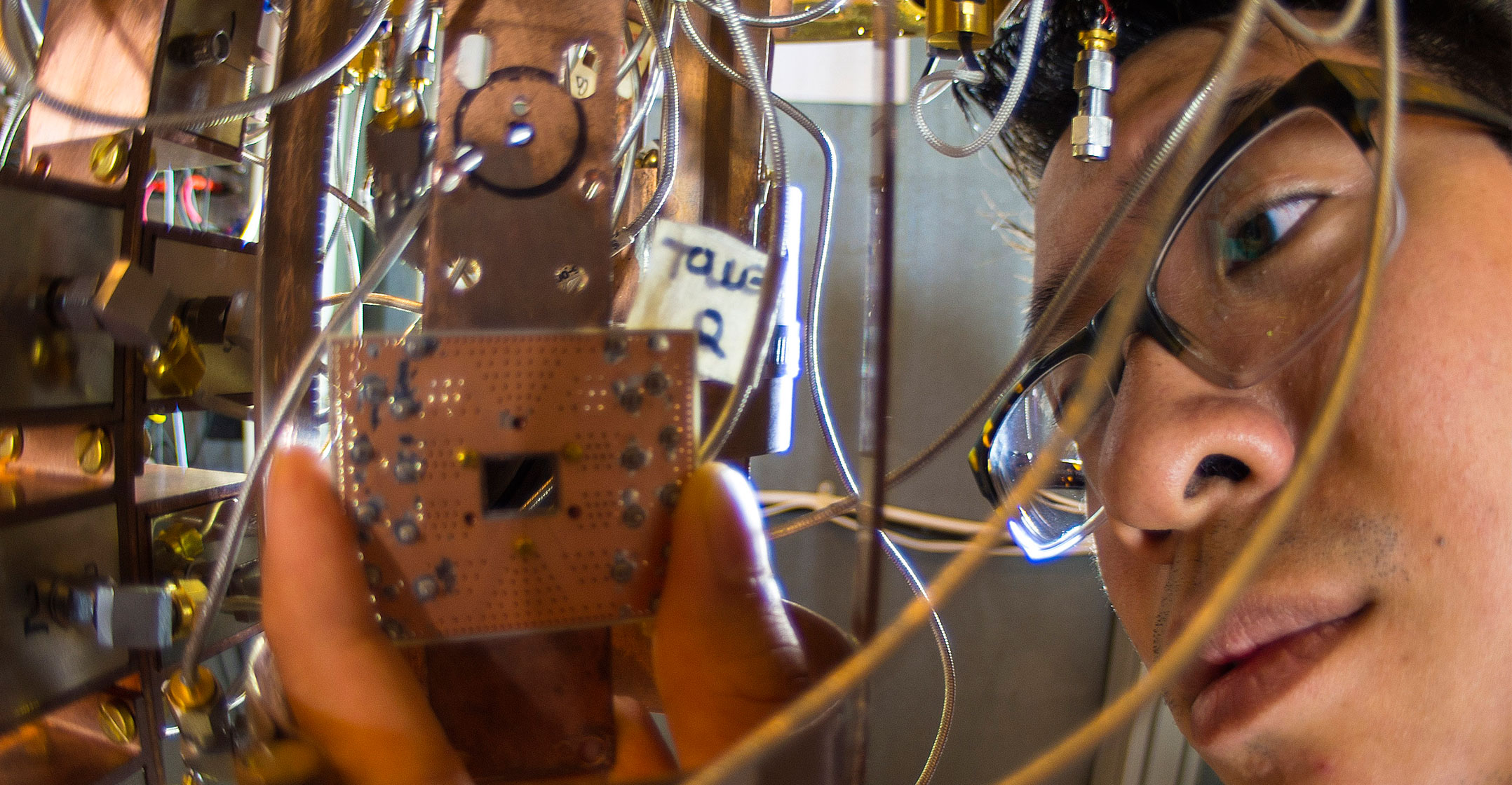
    IBM Research scientist Jerry Chow conducts a quantum computing experiment at IBM’s Thomas J Watson Research Centre

    These are just the tip of the iceberg. In the short to mid-term, however, this also means we have something of an approaching crisis.

    Quantum technologies are disruptive, and more so in cybersecurity than any other field. Once large-scale quantum computers become available (which at the current rate could take another 10 to 15 years), they could be used to access pretty much every secret on the Internet. Online banking, private e-mails, passwords and secure chats would all be opened up. You would be able to impersonate any person or web page online.

    It is quite likely that many tech professionals will see their skills turn obsolete very quickly

    This is because the information locks we use to secure privacy and authentication online are like butter to a quantum computer’s hot knife. Quantum technology is disruptive in many other areas as well. If your business decides not to “go quantum” and your competitor or adversary does, you may well be at a strong disadvantage.

    As the technology landscape realigns itself, it is quite likely that many tech professionals will see their skills turn obsolete very quickly. Simultaneously, companies may find themselves frantic to hire expertise that does not readily exist.

    When geopolitical and market forces realign, it’s common for people in business to say everyone now has to learn a new language. For example, as China has grown in power and influence, it is not uncommon in business communities to hear the phrase “we’ll all have to learn Mandarin now”. Perhaps it’s time for all of us to start learning to speak quantum.The Conversation

    • Written by Carlos Perez-Delgado, lecturer in computing, University of Kent
    • This article is republished from The Conversation under a Creative Commons licence

    Follow TechCentral on Google News Add TechCentral as your preferred source on Google


    Carlos Perez-Delgado IBM top
    WhatsApp YouTube
    Share. Facebook Twitter LinkedIn WhatsApp Telegram Email Copy Link
    Previous ArticleWhy Facebook can’t resist integrating WhatsApp
    Next Article Naspers sees single global classifieds strategy after Avito deal

    Related Posts

    IBM doubles down on quantum computing with $10-billion bet

    IBM doubles down on quantum computing with $10-billion bet

    28 May 2026
    IBM commits $5-billion to secure open-source software

    IBM commits $5-billion to secure open-source software

    28 May 2026
    South Africa Inc must wake up to quantum threat - Phumzile Madonsela

    South Africa Inc must wake up to quantum threat

    7 April 2026
    Company News
    10 benefits to online learning through Richfield

    10 benefits to online learning through Richfield

    11 June 2026
    Why a payments company tracks South Africa's financial pulse - Altron Fintech

    Why a payments company tracks South Africa’s financial pulse

    11 June 2026
    More speakers, free sponsored sessions at Pan African DataCentres event

    More speakers, free sponsored sessions at Pan African DataCentres event

    10 June 2026
    Opinion

    Clashing judgments leave South Africa’s crypto law unsettled

    2 June 2026
    The author, Pambos Soteriades

    The trap inside South Africa’s banking MVNO boom

    1 June 2026
    The hidden cost of social media age bans is everyone's privacy - Petrus Potgieter

    The hidden cost of social media age bans is everyone’s privacy

    29 May 2026

    Subscribe to Updates

    Get the best South African technology news and analysis delivered to your e-mail inbox every morning.

    Latest Posts
    MTN's first AI target? Itself - Charles Molapisi

    MTN’s first AI target? Itself

    11 June 2026
    Anthropic vs OpenAI and the bitter battle for the future of AI - Dario Amodei and Sam Altman

    Anthropic vs OpenAI and the bitter battle for the future of AI

    11 June 2026
    Lost in translation: why AI voice agents fail South Africans

    Lost in translation: why AI voice agents fail South Africans

    11 June 2026
    Pick n Pay stores to double as nationwide e-waste drop-off network

    Pick n Pay stores to double as nationwide e-waste drop-off network

    11 June 2026
    © 2009 - 2026 NewsCentral Media
    • Cookie policy (ZA)
    • TechCentral – privacy and Popia

    Type above and press Enter to search. Press Esc to cancel.

    Manage consent

    TechCentral uses cookies to enhance its offerings. Consenting to these technologies allows us to serve you better. Not consenting or withdrawing consent may adversely affect certain features and functions of the website.

    Functional Always active
    The technical storage or access is strictly necessary for the legitimate purpose of enabling the use of a specific service explicitly requested by the subscriber or user, or for the sole purpose of carrying out the transmission of a communication over an electronic communications network.
    Preferences
    The technical storage or access is necessary for the legitimate purpose of storing preferences that are not requested by the subscriber or user.
    Statistics
    The technical storage or access that is used exclusively for statistical purposes. The technical storage or access that is used exclusively for anonymous statistical purposes. Without a subpoena, voluntary compliance on the part of your Internet Service Provider, or additional records from a third party, information stored or retrieved for this purpose alone cannot usually be used to identify you.
    Marketing
    The technical storage or access is required to create user profiles to send advertising, or to track the user on a website or across several websites for similar marketing purposes.
    • Manage options
    • Manage services
    • Manage {vendor_count} vendors
    • Read more about these purposes
    View preferences
    • {title}
    • {title}
    • {title}