Close Menu
TechCentralTechCentral

    Subscribe to the newsletter

    Get the best South African technology news and analysis delivered to your e-mail inbox every morning.

    Facebook X (Twitter) YouTube LinkedIn
    WhatsApp Facebook X (Twitter) LinkedIn YouTube
    TechCentralTechCentral
    • News
      Skills authority to probe MICT Seta leadership crisis - Buti Manamela

      Skills authority to probe MICT Seta leadership crisis

      21 July 2026
      Home affairs opens visa fast lane - with tech talent a top priority

      Home affairs opens visa fast lane – with tech talent a top priority

      21 July 2026
      Mastercard bets billions on the tech that could eat its lunch - Prakriti Singh

      Mastercard bets billions on the tech that could eat its lunch

      21 July 2026
      From care homes to production lines, the robots are coming

      From care homes to production lines, the robots are coming

      21 July 2026
      Remote work in South Africa hits record high

      Remote work in South Africa hits record high

      21 July 2026
    • World
      Meta AI will now tell parents if their teen is in crisis

      Meta AI will now tell parents if their teen is in crisis

      17 July 2026
      IBM shares crash 25% as AI upends software spending - Arvind Krishna

      IBM shares crash 25% as AI upends software spending

      15 July 2026
      Jony Ive's first OpenAI device: an AI smart speaker - Jony Ive and Sam Altman

      Jony Ive’s first OpenAI device: an AI smart speaker

      15 July 2026
      Stripe, Advent in talks to buy PayPal for $53-billion

      Stripe, Advent in talks to buy PayPal for $53-billion

      15 July 2026
      Memory crisis sends smartphone market into steep decline

      Memory crisis sends smartphone market into steep decline

      13 July 2026
    • In-depth
      The plan to stop AI from breaking the world - Google DeepMind CEO Demis Hassabis. Image: John Sears

      The plan to stop AI from breaking the world

      16 July 2026
      The internet has a Strait of Hormuz problem

      The internet has a Strait of Hormuz problem

      15 July 2026
      AI boom sparks rally, frenzy and fear

      AI boom sparks rally, frenzy and fear

      11 June 2026
      Every plug-in hybrid on sale in South Africa, ranked by price - Lamborghini Temerario

      Every plug-in hybrid on sale in South Africa, ranked by price

      7 June 2026
      What Wi-Fi 8 will mean for wireless networks

      What Wi-Fi 8 will mean for wireless networks

      1 June 2026
    • TCS
      Watts & Wheels S1E7: 'Ferrari's EV breaks the internet'

      Watts & Wheels S1E7: ‘Ferrari’s EV breaks the internet’

      8 July 2026
      TCS+ | How Tracker is turning vehicle data into business strategy - Silvia Schollenberger

      TCS+ | How Tracker is turning vehicle data into business strategy

      1 July 2026
      TCS+ | IBM Bob: an AI-powered 'development partner' for the enterprise - David Spurway

      TCS+ | IBM Bob: an AI-powered development partner for the enterprise

      30 June 2026
      Watts & Wheels S1E6: 'A flawless Alfa and a bakkie that divides'

      Watts & Wheels S1E6: ‘A flawless Alfa and a bakkie that divides’

      17 June 2026
      Watts & Wheels S1E6: 'A flawless Alfa and a bakkie that divides'

      Watts & Wheels S1E5: ‘A Bentley of the bush and a car that swims’

      8 June 2026
    • Opinion
      Selling vapour is corporate suicide in slow motion - Jannie van Zyl

      Selling vapour is corporate suicide in slow motion

      16 July 2026
      Brazil's online gambling crackdown is a lesson for South Africa

      How Amazon outmanoeuvred Starlink in South Africa

      15 July 2026
      The Popia problem with agentic AI - Herman Haasbroek

      The Popia problem with agentic AI

      14 July 2026
      The author, Fanie van Rooyen

      South Africa can still catch the AI wave – here’s how

      7 July 2026
      The author, Fanie van Rooyen

      The AI utopia South Africa can’t afford

      1 July 2026
    • Company Hubs
      • 1Stream
      • Africa Data Centres
      • AfriGIS
      • Altron Digital Business
      • Altron Document Solutions
      • Altron Group
      • Arctic Wolf
      • Ascent Technology
      • AvertITD
      • BBD
      • Braintree
      • CallMiner
      • CambriLearn
      • CM Telecom
      • Contactable
      • CYBER1 Solutions
      • Digicloud Africa
      • Digimune
      • Domains.co.za
      • ESET
      • Euphoria Telecom
      • HOSTAFRICA
      • Incredible Business
      • iONLINE
      • IQbusiness
      • Iris Network Systems
      • Kaspersky
      • LSD Open
      • Mitel
      • NEC XON
      • Netstar
      • Network Platforms
      • Next DLP
      • Ovations
      • Paracon
      • Paratus
      • Q-KON
      • SevenC
      • SkyWire
      • Solid8 Technologies
      • Telit Cinterion
      • Telviva
      • Tenable
      • Vertiv
      • Videri Digital
      • Vodacom Business
      • Wipro
      • Workday
      • XLink
    • Sections
      • AI and machine learning
      • Banking
      • Broadcasting and Media
      • Cloud services
      • Contact centres and CX
      • Cryptocurrencies
      • Education and skills
      • Electronics and hardware
      • Energy and sustainability
      • Enterprise software
      • Financial services
      • HealthTech
      • Information security
      • Internet and connectivity
      • Internet of Things
      • Investment
      • IT services
      • Lifestyle
      • Policy and regulation
      • Public sector
      • Retail and e-commerce
      • Satellite communications
      • Science
      • SMEs and start-ups
      • Social media
      • Talent and leadership
      • Telecoms
      • Watts & Wheels
    • Events
    • Advertise
    TechCentralTechCentral
    Home » Sections » Electronics and hardware » How Lisa Su built AMD into a chip powerhouse
    Lisa Su

    How Lisa Su built AMD into a chip powerhouse

    By Agency Staff6 December 2024

    Advanced Micro Devices CEO Lisa Su has spent most of her decade in the top job at the chip maker keeping a tight rein on expectations.

    Avoiding hype and broad pronouncements has played a big part in reestablishing the creditability of a company that historically struggled to lock down a spot in the front row of the technology industry. Now, as her relentless refrain about making “great products” pays off, she seems ready to embrace the evangelism of some of her counterparts. And that means participating in the artificial intelligence frenzy.

    Get breaking news from TechCentral on WhatsApp. Sign up here

    “I truly believe AI is the most transformational technology that I’ve seen in my career,” Su says in an interview. “It’s faster than anything we’ve ever seen. It’s like we’ve made more progress in the last 18 months than certainly the last 10-plus years.”

    It’s like we’ve made more progress in the last 18 months than certainly the last 10-plus years

    Born in Taiwan and raised in New York, Su made the transition from the engineering labs to corporate leadership at some of the chip business’s most iconic companies, including IBM and Texas Instruments. But it’s the transformation of AMD since 2014 from also-ran to technology leader that’s the defining achievement of her career, so far.

    Now a new opportunity has emerged — as well as a challenge — in the form of AI chips and Nvidia. That has shifted how her company’s progress is judged, just as AMD emerged from the lifelong shadow of rival Intel.

    By all metrics, AMD has improved massively from where it was when she took the job. Under her predecessor, Rory Read, quarterly earnings conference calls focused on cost cutting to keep the company afloat. Now that is a major topic for struggling Intel, which earlier this week ousted CEO Pat Gelsinger.

    ‘Super fun’

    AMD has a market capitalisation of almost US$220-billion, more than twice the value of Intel. Ten years ago, AMD had annual revenue of $5.5-billion. In 2024, it’s on course for five times that amount. Su has spent her earnings announcements this year increasing forecasts for her AI accelerator business sales to more than $5-billion, 10 times the projection being made by Intel.

    Su won’t even consider the idea of a victory lap, or of even privately feeling vindicated.

    “I don’t know that I do that,” she deadpans before reverting to engineer mode. Getting chips back from manufacturing and seeing they work as designed is Su’s idea of something to celebrate. It’s “super fun”, she says.

    Read: AMD throws down gauntlet to Nvidia in AI chip race

    That obsession with the basics marks her as different from her predecessors. On a tour of labs where AMD staffers are testing new chips, engineers confide that her visits — designed to encourage them, she says — seldom if ever happened during her predecessors’ tenures. The visits don’t just keep her in touch with what’s going on. They help keep people on their toes when a mistake could cost hundreds of millions of dollars in lost revenue and delays.

    When asked about her reputation for having zero tolerance for excuses and not shying away from showing her displeasure, she smiles.
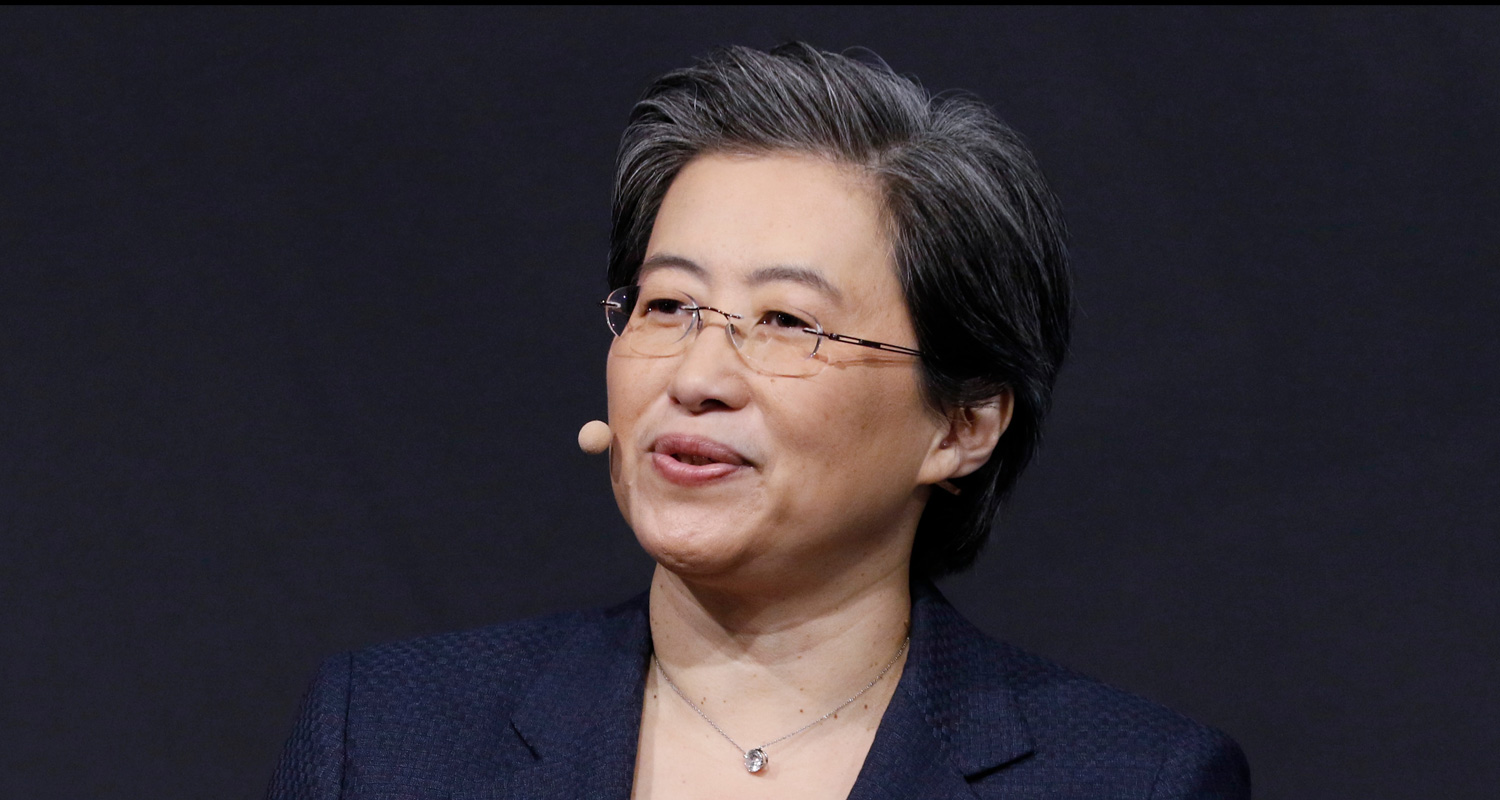
    AMD CEO Lisa Su

    “Well, I like to win, if that’s okay,” she says. “But what I like is when you look at great leaders in the industry, what they really do is they make their teams better than they thought they could be.”

    One man who openly admits to pushing his employees into higher levels of achievement is Jensen Huang, founder and CEO of Nvidia. A distant relative of Su, Huang also spent most of his company’s history in Intel’s shadow, but has now broken loose in one of the most dramatic corporate upswings ever seen.

    Nvidia’s growth makes even AMD’s gains pale by comparison, as does the attention it’s getting from investors. Nvidia’s data centre business alone is on track to pull in more revenue than total sales at AMD and Intel combined this year. It’ll become by far the biggest chip maker and is already the most valuable company in the world.

    AI is going to be in every application, every product, everywhere you go, you’re going to need computing

    Jensen is brilliant and she fully admires him, Su says. But there’s little interest in the family connection and the two only first met at an industry event when they’d become tech executives.

    Over the years they have provided a contrast in public. Huang gives lengthy presentations featuring detailed visionary expositions on the future of technology. Su, by contrast, has grown more slowly into the promotional side of being a tech CEO. For a good chunk of her career in the top job, she focused heavily on emphasising that her company would do what it said and previously struggled with: turn out better products on time.

    That discipline helped AMD first win back creditability and then big customers. Now she finds herself more likely to agree with her rival’s lofty pronouncements. Su is predicting that the market for AI chips will grow at an annual 60% clip and total $500-billion in 2028. That will make one product category roughly the same size as the whole industry right now.

    Everywhere

    That means there’s plenty of room for growth for everyone who, in Su’s catchphrase, makes “great products”. And it means that unlike in the past, AMD’s relatively modest resources won’t be an impediment.

    “We’ve always been in this place where we haven’t necessarily had the same amount of people that other larger companies have, but we’ve certainly punched well above our weight in certain terms of technology capability, in terms of impact on the industry,” she says. “The most exciting part of the computing industry is, how do you enable AI? And our view is AI is going to be everywhere. AI is going to be in every application, every product, everywhere you go, you’re going to need computing. And we’re at that place right now.”  — Ian King and Emily Chang, with Lauren Ellis, (c) 2024 Bloomberg LP

    Don’t miss:

    Intel, AMD team up to confront challenge from ARM

    Follow TechCentral on Google News Add TechCentral as your preferred source on Google


    AMD Intel Jensen Huang Lisa Su Nvidia Pat Gelsinger
    WhatsApp YouTube
    Share. Facebook Twitter LinkedIn WhatsApp Telegram Email Copy Link
    Previous ArticleMPs send Icasa council shortlist to Malatsi
    Next Article Make or break time for the South African Post Office

    Related Posts

    From care homes to production lines, the robots are coming

    From care homes to production lines, the robots are coming

    21 July 2026
    The AI-led industrial revolution has begun - CallMiner Bruce McMahon

    The AI-led industrial revolution has begun

    20 July 2026
    Apple knocks Nvidia off its perch - John Ternus

    Apple knocks Nvidia off its perch

    19 July 2026
    Company News
    Cloud adoption is done. Execution is the new frontier - Cloud on Demand

    Cloud adoption is done. Execution is the new frontier

    21 July 2026
    Data poisoning in AI models: what businesses need to know - Domains.co.za

    Data poisoning in AI models: what businesses need to know

    21 July 2026
    The AI-led industrial revolution has begun - CallMiner Bruce McMahon

    The AI-led industrial revolution has begun

    20 July 2026
    Opinion
    Selling vapour is corporate suicide in slow motion - Jannie van Zyl

    Selling vapour is corporate suicide in slow motion

    16 July 2026
    Brazil's online gambling crackdown is a lesson for South Africa

    How Amazon outmanoeuvred Starlink in South Africa

    15 July 2026
    The Popia problem with agentic AI - Herman Haasbroek

    The Popia problem with agentic AI

    14 July 2026

    Subscribe to Updates

    Get the best South African technology news and analysis delivered to your e-mail inbox every morning.

    Latest Posts
    Skills authority to probe MICT Seta leadership crisis - Buti Manamela

    Skills authority to probe MICT Seta leadership crisis

    21 July 2026
    Home affairs opens visa fast lane - with tech talent a top priority

    Home affairs opens visa fast lane – with tech talent a top priority

    21 July 2026
    Mastercard bets billions on the tech that could eat its lunch - Prakriti Singh

    Mastercard bets billions on the tech that could eat its lunch

    21 July 2026
    From care homes to production lines, the robots are coming

    From care homes to production lines, the robots are coming

    21 July 2026
    © 2009 - 2026 NewsCentral Media
    Built and maintained by Chronon
    • Cookie policy (ZA)
    • TechCentral – privacy and Popia

    Type above and press Enter to search. Press Esc to cancel.

    Manage consent

    TechCentral uses cookies to enhance its offerings. Consenting to these technologies allows us to serve you better. Not consenting or withdrawing consent may adversely affect certain features and functions of the website.

    Functional Always active
    The technical storage or access is strictly necessary for the legitimate purpose of enabling the use of a specific service explicitly requested by the subscriber or user, or for the sole purpose of carrying out the transmission of a communication over an electronic communications network.
    Preferences
    The technical storage or access is necessary for the legitimate purpose of storing preferences that are not requested by the subscriber or user.
    Statistics
    The technical storage or access that is used exclusively for statistical purposes. The technical storage or access that is used exclusively for anonymous statistical purposes. Without a subpoena, voluntary compliance on the part of your Internet Service Provider, or additional records from a third party, information stored or retrieved for this purpose alone cannot usually be used to identify you.
    Marketing
    The technical storage or access is required to create user profiles to send advertising, or to track the user on a website or across several websites for similar marketing purposes.
    • Manage options
    • Manage services
    • Manage {vendor_count} vendors
    • Read more about these purposes
    View preferences
    • {title}
    • {title}
    • {title}