
Every year, technology vendors set aside market development funds (MDF) for the IT channel partners who sell on their behalf. Most of it never does what it was meant to do. The money goes unspent, or it gets spent on activity nobody sees, nobody can prove and nobody reports back.
In December, a global enterprise partner lost R500 000 in funding from one of the world’s largest technology vendors, not because the campaign failed, but because nobody inside the business understood the claim process well enough to get the money out before the window closed. That isn’t an outlier. We’ve watched clients lose MDF payments they’d already earned because the proof of execution was submitted in the wrong format, to the wrong portal, or a week late.
When it is spent well, the result rarely gets presented as what it is: pipeline growth, and the work that built it. That isn’t a budget problem, it’s a visibility problem.
Three seats in the channel, one pool of money
We talk to people in three different seats about MDF, and each one feels it differently.
The channel head at the vendor can’t go direct without undercutting the partners they rely on. MDF is how they get the whole channel selling hard without doing the selling themselves.
The business unit head at the reseller or distributor gets the allocation as an opportunity and a deadline in the same e-mail. The ones who get the most out of it point the money at a named pipeline gap, not the quickest thing to spend it on.
The marketing head or product owner has to execute. For them the budget was never the hard part. Proving it worked, against the vendor’s reporting rules, is.
Three different pressures, same underused pool.
Market development funds sit in an awkward gap inside most channel partner businesses. Sales is wired around pipeline. An activity with no deal attached this quarter reads as a distraction, so the funds sit untouched until a deadline forces the issue. Marketing, once pulled in, runs on a different instinct: protect the brand, get sign-off. That’s a fair instinct. It just doesn’t fit with “we have six days”.
Neither side is wrong. The money doesn’t cleanly belong to either desk. It’s a distraction to one, a risk to the other, and the week disappears in between.
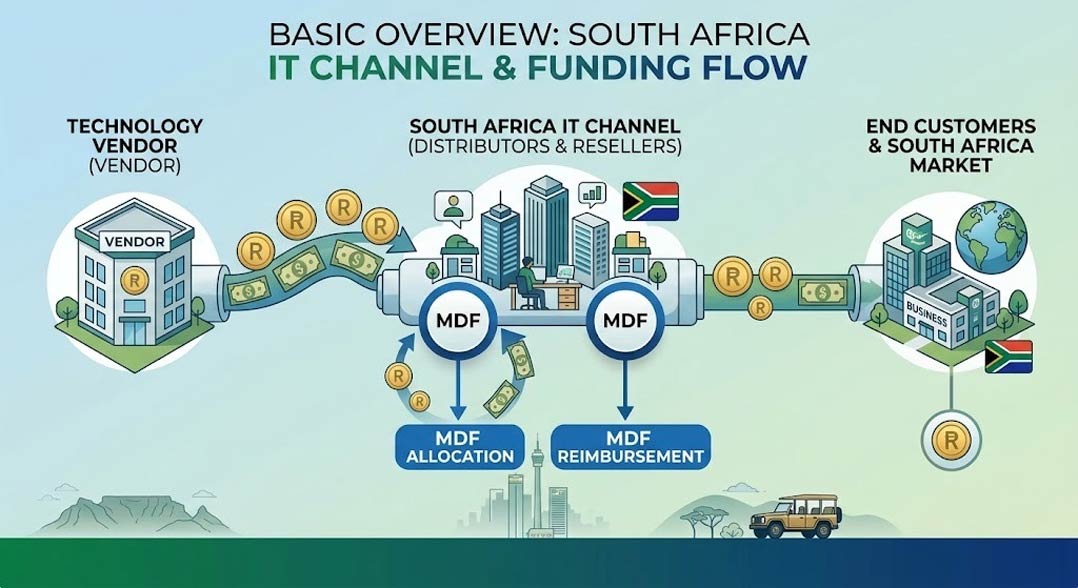
There’s a third problem on top of that. Most resellers and distributors carry 10, 20, sometimes 30 vendor relationships at once. Each one has its own portal, its own claim rules and its own deadline. The vendors who shout loudest get their funds spent. The quieter ones, often with the better programmes, get forgotten until the allocation has already lapsed.
The proof-of-execution deadline arrives faster than you think
To claim MDF, the partner submits a proof of execution: evidence that the money did what it was allocated for, inside a fixed window. The allocation was approved months ago, nothing got planned, and in our experience the warning is often about a week. The partner is usually finding out about the format requirements at the same time. We’ve seen funding declined over a missing logo lock-up, an unstamped attendance register and a campaign report that measured the wrong thing. So the money gets spent properly, badly or not at all.
The last two are the same outcome: unspent MDF doesn’t roll over; it disappears.
More lead time isn’t what changes this. What changes it is having a channel marketing partner that can move at deadline speed and still produce the one thing a proof of execution should prove: that the pipeline grew. That is what a vendor looks at when deciding who moves up a tier, who gets a bigger allocation next cycle and who gets early access to new products and programmes. Execute well under pressure and the deadline works for you. Waste it and the cycle resets at zero.
What market development funds should buy
Across all three seats, the channel businesses getting real value from MDF are buying the same three things:
- Content that compounds: Buyers increasingly find vendors and partners through search and AI tools that summarise and recommend based on what has been published. A well-placed piece on a credible technology platform keeps surfacing both logos long after the campaign ends. Exposure is the by-product of doing the work well, not the goal.
- Leads that mean something, not a name on a spreadsheet: A lead that has been through proper white-space mapping, the exercise of identifying the accounts and segments a vendor has not yet sold into, so that what reaches the sales team is the right person, with buying power or influence, who understands the market they are buying in and is open to a conversation.
- ROI measured as pipeline maturity: This is how vendors judge MDF in the end — not impressions, not raw lead count, but how far the pipeline moved: a shorter gap between a marketing qualified lead and a sales qualified lead, and deals progressing instead of stalling at the top. A properly qualified lead matures faster than someone who clicked an ad. That gap is where most spend gets wasted, and where it should be concentrated instead.
The opportunity in front of the IT channel
MDF was built so vendors and channel partners could grow together. Used well, the return shows up as pipeline that keeps maturing long after the invoice is settled.
The channel doesn’t need more funds. It needs a clearer answer to where the money already allocated should go.
Market development funds: the questions we get asked most
What are market development funds?
Market development funds, or MDF, are budgets that technology vendors allocate to their IT channel partners (resellers, distributors and managed service providers) to fund marketing and demand generation for the vendor’s products. The partner spends the money, then claims it back by proving the activity happened and delivered results.
What is proof of execution in channel marketing?
Proof of execution is the evidence a partner submits to a vendor to claim MDF. It typically includes the deliverable itself, reach or engagement data, and lead or pipeline results, submitted inside a fixed claim window. Vendors increasingly want it to show pipeline movement, not just that a campaign ran.
Do unspent MDF funds roll over?
In most vendor programmes, no. MDF is allocated per quarter or per half-year and expires if it isn’t claimed inside the window. Unspent funds go back to the vendor, and a pattern of unspent MDF can reduce a partner’s allocation in the next cycle.
How do vendors measure MDF ROI?
Vendors that run mature programmes measure MDF against pipeline: how many qualified leads were generated, how quickly they moved from marketing qualified to sales qualified, and how much pipeline value the activity influenced. Impressions and raw lead counts still get reported, but they rarely decide who moves up a partner tier.
What is the difference between MDF and co-op marketing funds?
Co-op funds are usually accrued as a percentage of what a partner has already sold, and are spent on the partner’s own marketing. MDF is allocated ahead of sales, at the vendor’s discretion, to drive growth in a specific product, segment or region. MDF comes with tighter rules on what it can be spent on and how the result must be proven.
What can MDF be spent on in the South African IT channel?
Most vendor programmes allow MDF to fund sponsored content and thought leadership, events and executive roundtables, lead generation and account-based campaigns, and digital media. The common condition is that the vendor’s brand appears alongside the partner’s and that the activity can be tied to pipeline.
About Publishared
Publishared is a South African B2B marketing partner specialising in the IT and technology channel. We help vendors, distributors and resellers show up consistently and credibly in front of the right audiences: through content and thought leadership, executive engagement, media and podcasts, and targeted account campaigns built to prove pipeline, not just presence. To talk through your next MDF campaign, please visit publishared.co.za/contact.
- Publishared is the parent company of NewsCentral Media, publisher of TechCentral. This article is promoted content, supplied by Publishared