Close Menu
TechCentralTechCentral

    Subscribe to the newsletter

    Get the best South African technology news and analysis delivered to your e-mail inbox every morning.

    Facebook X (Twitter) YouTube LinkedIn
    WhatsApp Facebook X (Twitter) LinkedIn YouTube
    TechCentralTechCentral
    • News
      Openserve hits back in fibre ISP row

      Openserve hits back in fibre ISP row

      20 July 2026
      Best network, worst vibes: the puzzle of SA telecoms

      Best network, worst vibes: the puzzle of SA telecoms

      20 July 2026
      Why South Africa is sending Balls to the moon

      Why South Africa is sending spheres to the moon

      20 July 2026
      The rands-and-cents case for electric trucks - William Kelly Watts & Wheels with Wills

      The rands-and-cents case for electric trucks

      20 July 2026
      South Africa's newfound economic resilience

      South Africa’s newfound economic resilience

      20 July 2026
    • World
      Meta AI will now tell parents if their teen is in crisis

      Meta AI will now tell parents if their teen is in crisis

      17 July 2026
      IBM shares crash 25% as AI upends software spending - Arvind Krishna

      IBM shares crash 25% as AI upends software spending

      15 July 2026
      Jony Ive's first OpenAI device: an AI smart speaker - Jony Ive and Sam Altman

      Jony Ive’s first OpenAI device: an AI smart speaker

      15 July 2026
      Stripe, Advent in talks to buy PayPal for $53-billion

      Stripe, Advent in talks to buy PayPal for $53-billion

      15 July 2026
      Memory crisis sends smartphone market into steep decline

      Memory crisis sends smartphone market into steep decline

      13 July 2026
    • In-depth
      The plan to stop AI from breaking the world - Google DeepMind CEO Demis Hassabis. Image: John Sears

      The plan to stop AI from breaking the world

      16 July 2026
      The internet has a Strait of Hormuz problem

      The internet has a Strait of Hormuz problem

      15 July 2026
      AI boom sparks rally, frenzy and fear

      AI boom sparks rally, frenzy and fear

      11 June 2026
      Every plug-in hybrid on sale in South Africa, ranked by price - Lamborghini Temerario

      Every plug-in hybrid on sale in South Africa, ranked by price

      7 June 2026
      What Wi-Fi 8 will mean for wireless networks

      What Wi-Fi 8 will mean for wireless networks

      1 June 2026
    • TCS
      Watts & Wheels S1E7: 'Ferrari's EV breaks the internet'

      Watts & Wheels S1E7: ‘Ferrari’s EV breaks the internet’

      8 July 2026
      TCS+ | How Tracker is turning vehicle data into business strategy - Silvia Schollenberger

      TCS+ | How Tracker is turning vehicle data into business strategy

      1 July 2026
      TCS+ | IBM Bob: an AI-powered 'development partner' for the enterprise - David Spurway

      TCS+ | IBM Bob: an AI-powered development partner for the enterprise

      30 June 2026
      Watts & Wheels S1E6: 'A flawless Alfa and a bakkie that divides'

      Watts & Wheels S1E6: ‘A flawless Alfa and a bakkie that divides’

      17 June 2026
      Watts & Wheels S1E6: 'A flawless Alfa and a bakkie that divides'

      Watts & Wheels S1E5: ‘A Bentley of the bush and a car that swims’

      8 June 2026
    • Opinion
      Selling vapour is corporate suicide in slow motion - Jannie van Zyl

      Selling vapour is corporate suicide in slow motion

      16 July 2026
      Brazil's online gambling crackdown is a lesson for South Africa

      How Amazon outmanoeuvred Starlink in South Africa

      15 July 2026
      The Popia problem with agentic AI - Herman Haasbroek

      The Popia problem with agentic AI

      14 July 2026
      The author, Fanie van Rooyen

      South Africa can still catch the AI wave – here’s how

      7 July 2026
      The author, Fanie van Rooyen

      The AI utopia South Africa can’t afford

      1 July 2026
    • Company Hubs
      • 1Stream
      • Africa Data Centres
      • AfriGIS
      • Altron Digital Business
      • Altron Document Solutions
      • Altron Group
      • Arctic Wolf
      • Ascent Technology
      • AvertITD
      • BBD
      • Braintree
      • CallMiner
      • CambriLearn
      • CM Telecom
      • Contactable
      • CYBER1 Solutions
      • Digicloud Africa
      • Digimune
      • Domains.co.za
      • ESET
      • Euphoria Telecom
      • HOSTAFRICA
      • Incredible Business
      • iONLINE
      • IQbusiness
      • Iris Network Systems
      • Kaspersky
      • LSD Open
      • Mitel
      • NEC XON
      • Netstar
      • Network Platforms
      • Next DLP
      • Ovations
      • Paracon
      • Paratus
      • Q-KON
      • SevenC
      • SkyWire
      • Solid8 Technologies
      • Telit Cinterion
      • Telviva
      • Tenable
      • Vertiv
      • Videri Digital
      • Vodacom Business
      • Wipro
      • Workday
      • XLink
    • Sections
      • AI and machine learning
      • Banking
      • Broadcasting and Media
      • Cloud services
      • Contact centres and CX
      • Cryptocurrencies
      • Education and skills
      • Electronics and hardware
      • Energy and sustainability
      • Enterprise software
      • Financial services
      • HealthTech
      • Information security
      • Internet and connectivity
      • Internet of Things
      • Investment
      • IT services
      • Lifestyle
      • Policy and regulation
      • Public sector
      • Retail and e-commerce
      • Satellite communications
      • Science
      • SMEs and start-ups
      • Social media
      • Talent and leadership
      • Telecoms
      • Watts & Wheels
    • Events
    • Advertise
    TechCentralTechCentral
    Home » News » Mobile money needs closer scrutiny

    Mobile money needs closer scrutiny

    By Editor9 December 2012
    Twitter LinkedIn Facebook WhatsApp Email Telegram Copy Link
    News Alerts
    WhatsApp

    The continent is being hailed as a global cellphone banking and payments innovation hub, but it seems the sector will be coming under increasing regulatory scrutiny as the relationships between cellphone operators and banks are placed under the ­spotlight.

    A survey of players in the African cellphone banking space by the Mail & Guardian over the past two weeks has revealed that there are serious concerns about the anticompetitive nature of exclusive deals between large cellphone operators and established banks. Analysts, stakeholders and competition experts say there is a desperate need to make sure the sector is regulated properly.

    The calls for increased scrutiny of operators have been made in response to the eagerness to roll out cellphone banking, even though they are not making a profit from offering the services.

    They believe that banking will prevent churn — the term for customers switching between cellphone operators depending on their call rates and offerings. The general belief seems to be that it is much harder to switch operators when they are your bank, too.

    In a recent PwC report titled “Telecoms in Africa: Innovating and Inspiring”, MTN Côte d’Ivoire CEO Wim Vanhelleputte said that a cellphone money service was not a standalone profit creator.

    “For us, mobile money is really a retention tool. We know that the loyalty of our customers, when they’re using mobile money services, is 10 times higher than the loyalty of non-users of mobile money because people can easily change Sim cards or change networks. But changing banks is not something they do overnight,” he said.

    “Mobile money is our main way of creating retention among our subscriber base — not just to make ­profits out of transfers, which is secondary for us.”

    It is this attitude towards cellphone banking that is cause for concern for some players and regulators on the continent.

    It is clear why there is such a scramble to get into the cellphone banking space — it is estimated that global cellphone payments will reach US$984bn by 2014 and there will be 900m users by 2015. Presently, 53% of the global population is unbanked and cellphone banking is thus seen as the future of banking.

    Many stakeholders to whom the M&G spoke in the past weeks said exclusive deals between banks, cellphone operators and cellphone banking service providers might lead to anticompetitive outcomes.

    “This is still very much a grey area,” said Glen Gordon of South African cellphone banking service provider IMB. “But we can’t afford to get the regulation of this sector wrong.”

    Competition experts believe that the act of bundling services also needs to be placed under the spotlight to ensure that consumers are not getting a raw deal.

    Brian Richardson from South African cellphone banking platform Wizzit said that because the sector was still so new, the rules were still being written. He said the key to regulating the sector was the concept of interoperability, which would allow consumers to choose a banking platform regardless of the cellphone operator.

    “If your payment channel is linked to your cellphone, you are unlikely to change operators,” said Richardson. “I get lynched at global conferences when I talk about interoperability. The cellphone operators don’t want ­interoperability. I think increasingly this sector will come under greater scrutiny from competition authorities. What is happening at the moment is not morally or ethically right.”

    Gordon mentioned Nigeria’s approach to regulating cellphone banking services as a leading light in how to get it right. In 2009, the Central Bank of Nigeria published its regulatory framework for cellphone payment services. It specified three models: bank-focused, bank-led and third party-led, which prevents operators from leading cellphone payment services. [The main reason for this was competition concerns.] According to the framework, the operators are required to enable subscribers to use any payment system of their choice on their network.

    In November 2010, the Central Bank of Nigeria licensed 16 companies to operate cellphone payment systems in the country and a further seven have since been approved. Nigeria is a market with massive potential because there are 90m cellphone users in the country, but only 22m Nigerians have bank accounts.

    The South African Reserve Bank’s head of strategy and communication, Hlengani Mathebula, said any commercial bank that partnered a cellphone service provider in South Africa would be required to inform the South African Reserve Bank of the intended partnership and provide details.

    “The commercial bank would need to take into account the various legislation and regulations administered by the Reserve Bank, including the Banks Act, National Payment System Act and exchange control regulations in terms of cross-border money transfers.

    “The partnering commercial bank must be comfortable that the partnership conforms to the highest level of security and that sufficient controls are put in place to mitigate any possible risks and prevent any form of criminal activity,” said Mathebula.

    In South Africa, there are a number of stakeholders making a play for the cellphone banking sector.

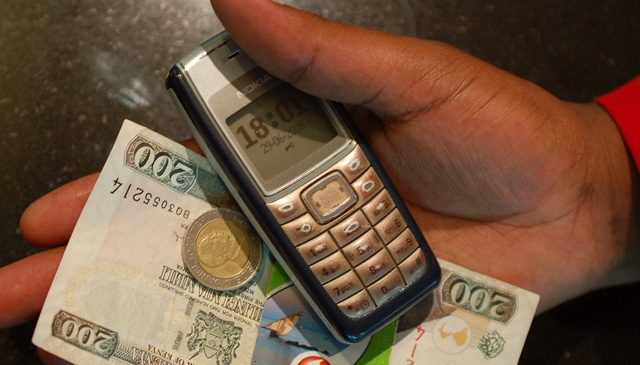
    Two weeks ago, MTN announced its new Mobile Money account, for which it is teaming up with the South African Bank of Athens, Pick n Pay and Boxer stores. The service allows customers to make payments, transfer funds between users, pay for groceries, buy prepaid electricity and airtime and withdraw cash from the stores, all from their cellphone.

    The account is available to MTN customers for free. It works on other cellphone networks, but consumers will have to pay for their transaction costs.

    MTN was asked to comment about the anticompetitive nature of some cellphone banking players in Africa and the comments of Vanhelleputte, but chose to ignore these issues, focusing on the selling points of its new Mobile Money offering in South Africa.

    “The introduction of MTN Mobile Money is a natural extension of our customer value proposition,” said the company. “Due to MTN’s widespread distribution network, we are also able to offer mobile financial services even on the most basic handset.

    “Mobile financial services provide the added benefit to transact beyond normal airtime, because customers have the ability to transfer money to loved ones through Mobile Money, for example. As our proposition evolves, new services will include cross-border money transfers and microfinance through specialist partners.”

    Vodacom’s managing executive of financial services, Carmen Whateley, said Vodacom had never had any intention of rolling out cellphone payment systems as a loss leader.

    Vodacom’s plan was to build new revenue streams, offer increased services to its customers and build alternative distribution channels.

    Whateley said Vodacom planned to open up its cellphone money transfer service, M-Pesa, so consumers could use it on other cellphone networks.

    In South Africa, M-Pesa has not been the success that it was in Kenya. In Kenya there are more than 12m users utilising the service and six million more are serviced in Kenya by competing products.

    In South Africa, Vodacom has managed to sign up a million users since M-Pesa launched in the country in August 2010. However, Whateley said that only a small number of those were active users.

    M-Pesa in Kenya had 9,5m users signed up within three years of its launch.

    Stakeholders in the sector in South Africa argue that the country’s tougher banking regulations have meant that the playing field for M-Pesa in South Africa and Kenya are not comparable. However, ­considering that there are thought to be 13m unbanked South Africans, there is scope for the growth of cellphone banking services. Whateley said research suggested that consumers were looking for a full entry-level banking service, not just a payments service.  — (c) 2012 Mail & Guardian

    • Visit the Mail & Guardian Online, the smart news source
    • Image: Erik Hersman
    Follow TechCentral on Google News Add TechCentral as your preferred source on Google


    Brian Richardson Carmen Whateley Glen Gordon Hlengani Mathebula IMB M-Pesa MTN Vodacom Wim Vanhelleputte Wizzit
    WhatsApp YouTube
    Share. Facebook Twitter LinkedIn WhatsApp Telegram Email Copy Link
    Previous ArticleLooper: making peace with paradox
    Next Article DFA expands to outlying towns

    Related Posts

    Best network, worst vibes: the puzzle of SA telecoms

    Best network, worst vibes: the puzzle of SA telecoms

    20 July 2026
    Amazon Leo all set for South African launch - From left, Maziv CEO Dietlof Mare, communications minister Solly Malatsi, Herotel CEO Van Zyl Botha and Amazon's David Zapolsky

    Amazon Leo all set for South African launch

    15 July 2026
    Industry to Icasa: punish municipalities that stall network roll-out

    Industry to Icasa: punish municipalities that stall network roll-out

    13 July 2026
    Company News
    The AI-led industrial revolution has begun - CallMiner Bruce McMahon

    The AI-led industrial revolution has begun

    20 July 2026
    Sophos firewalls: your business's first line of cyber defence - Vox

    Sophos firewalls: your business’s first line of cyber defence

    20 July 2026
    Paratus again voted Namibia's most reliable internet provider

    Paratus again voted Namibia’s most reliable internet provider

    17 July 2026
    Opinion
    Selling vapour is corporate suicide in slow motion - Jannie van Zyl

    Selling vapour is corporate suicide in slow motion

    16 July 2026
    Brazil's online gambling crackdown is a lesson for South Africa

    How Amazon outmanoeuvred Starlink in South Africa

    15 July 2026
    The Popia problem with agentic AI - Herman Haasbroek

    The Popia problem with agentic AI

    14 July 2026

    Subscribe to Updates

    Get the best South African technology news and analysis delivered to your e-mail inbox every morning.

    Latest Posts
    Openserve hits back in fibre ISP row

    Openserve hits back in fibre ISP row

    20 July 2026
    Best network, worst vibes: the puzzle of SA telecoms

    Best network, worst vibes: the puzzle of SA telecoms

    20 July 2026
    Why South Africa is sending Balls to the moon

    Why South Africa is sending spheres to the moon

    20 July 2026
    The rands-and-cents case for electric trucks - William Kelly Watts & Wheels with Wills

    The rands-and-cents case for electric trucks

    20 July 2026
    © 2009 - 2026 NewsCentral Media
    Built and maintained by Chronon
    • Cookie policy (ZA)
    • TechCentral – privacy and Popia

    Type above and press Enter to search. Press Esc to cancel.

    Manage consent

    TechCentral uses cookies to enhance its offerings. Consenting to these technologies allows us to serve you better. Not consenting or withdrawing consent may adversely affect certain features and functions of the website.

    Functional Always active
    The technical storage or access is strictly necessary for the legitimate purpose of enabling the use of a specific service explicitly requested by the subscriber or user, or for the sole purpose of carrying out the transmission of a communication over an electronic communications network.
    Preferences
    The technical storage or access is necessary for the legitimate purpose of storing preferences that are not requested by the subscriber or user.
    Statistics
    The technical storage or access that is used exclusively for statistical purposes. The technical storage or access that is used exclusively for anonymous statistical purposes. Without a subpoena, voluntary compliance on the part of your Internet Service Provider, or additional records from a third party, information stored or retrieved for this purpose alone cannot usually be used to identify you.
    Marketing
    The technical storage or access is required to create user profiles to send advertising, or to track the user on a website or across several websites for similar marketing purposes.
    • Manage options
    • Manage services
    • Manage {vendor_count} vendors
    • Read more about these purposes
    View preferences
    • {title}
    • {title}
    • {title}