Close Menu
TechCentralTechCentral

    Subscribe to the newsletter

    Get the best South African technology news and analysis delivered to your e-mail inbox every morning.

    Facebook X (Twitter) YouTube LinkedIn
    WhatsApp Facebook X (Twitter) LinkedIn YouTube
    TechCentralTechCentral
    • News
      South Africa's stablecoin silence is becoming a policy failure

      South Africa’s stablecoin silence is becoming a policy failure

      6 February 2026
      Every electric car you can buy in South Africa in early 2026, ranked by price

      Every electric car you can buy in South Africa in early 2026, ranked by price

      6 February 2026
      From stocks to crypto, markets reel as AI doubts grow

      From stocks to crypto, markets reel as AI doubts grow

      6 February 2026
      South Africa deepens China ties as US trade tensions escalate

      South Africa deepens China ties as US trade tensions escalate

      6 February 2026
      Big changes at Lesaka as Bank Zero deal nears completion - Lincoln Mali

      Big changes at Lesaka as Bank Zero deal nears completion

      6 February 2026
    • World
      AI won't replace software, says Nvidia CEO amid market rout - Jensen Huang

      AI won’t replace software, says Nvidia CEO amid market rout

      4 February 2026
      Apple acquires audio AI start-up Q.ai

      Apple acquires audio AI start-up Q.ai

      30 January 2026
      SpaceX IPO may be largest in history

      SpaceX IPO may be largest in history

      28 January 2026
      Nvidia throws AI at the weather

      Nvidia throws AI at weather forecasting

      27 January 2026
      Debate erupts over value of in-flight Wi-Fi

      Debate erupts over value of in-flight Wi-Fi

      26 January 2026
    • In-depth
      How liberalisation is rewiring South Africa's power sector

      How liberalisation is rewiring South Africa’s power sector

      21 January 2026
      The top-performing South African tech shares of 2025

      The top-performing South African tech shares of 2025

      12 January 2026
      Digital authoritarianism grows as African states normalise internet blackouts

      Digital authoritarianism grows as African states normalise internet blackouts

      19 December 2025
      TechCentral's South African Newsmakers of 2025

      TechCentral’s South African Newsmakers of 2025

      18 December 2025
      Black Friday goes digital in South Africa as online spending surges to record high

      Black Friday goes digital in South Africa as online spending surges to record high

      4 December 2025
    • TCS
      TCS+ | How Cloud On Demand is helping SA businesses succeed in the cloud - Xhenia Rhode, Dion Kalicharan

      TCS+ | Cloud On Demand and Consnet: inside a real-world AWS partner success story

      30 January 2026
      Watts & Wheels S1E3: 'BYD's Corolla Cross challenger'

      Watts & Wheels S1E3: ‘BYD’s Corolla Cross challenger’

      30 January 2026
      Watts & Wheels S1E3: 'BYD's Corolla Cross challenger'

      Watts & Wheels S1E2: ‘China attacks, BMW digs in, Toyota’s sublime supercar’

      23 January 2026

      TCS+ | Why cybersecurity is becoming a competitive advantage for SA businesses

      20 January 2026
      Watts & Wheels S1E3: 'BYD's Corolla Cross challenger'

      Watts & Wheels: S1E1 – ‘William, Prince of Wheels’

      8 January 2026
    • Opinion
      South Africa's skills advantage is being overlooked at home - Richard Firth

      South Africa’s skills advantage is being overlooked at home

      29 January 2026
      Why Elon Musk's Starlink is a 'hard no' for me - Songezo Zibi

      Why Elon Musk’s Starlink is a ‘hard no’ for me

      26 January 2026
      South Africa's new fibre broadband battle - Duncan McLeod

      South Africa’s new fibre broadband battle

      20 January 2026
      AI moves from pilots to production in South African companies - Nazia Pillay SAP

      AI moves from pilots to production in South African companies

      20 January 2026
      South Africa's new fibre broadband battle - Duncan McLeod

      ANC’s attack on Solly Malatsi shows how BEE dogma trumps economic reality

      14 December 2025
    • Company Hubs
      • Africa Data Centres
      • AfriGIS
      • Altron Digital Business
      • Altron Document Solutions
      • Altron Group
      • Arctic Wolf
      • AvertITD
      • Braintree
      • CallMiner
      • CambriLearn
      • CYBER1 Solutions
      • Digicloud Africa
      • Digimune
      • Domains.co.za
      • ESET
      • Euphoria Telecom
      • Incredible Business
      • iONLINE
      • IQbusiness
      • Iris Network Systems
      • LSD Open
      • NEC XON
      • Netstar
      • Network Platforms
      • Next DLP
      • Ovations
      • Paracon
      • Paratus
      • Q-KON
      • SevenC
      • SkyWire
      • Solid8 Technologies
      • Telit Cinterion
      • Tenable
      • Vertiv
      • Videri Digital
      • Vodacom Business
      • Wipro
      • Workday
      • XLink
    • Sections
      • AI and machine learning
      • Banking
      • Broadcasting and Media
      • Cloud services
      • Contact centres and CX
      • Cryptocurrencies
      • Education and skills
      • Electronics and hardware
      • Energy and sustainability
      • Enterprise software
      • Financial services
      • Information security
      • Internet and connectivity
      • Internet of Things
      • Investment
      • IT services
      • Lifestyle
      • Motoring
      • Public sector
      • Retail and e-commerce
      • Satellite communications
      • Science
      • SMEs and start-ups
      • Social media
      • Talent and leadership
      • Telecoms
    • Events
    • Advertise
    TechCentralTechCentral
    Home » Sections » Science » A new generation of telescopes could transform our knowledge of the universe
    A new generation of telescopes could transform our knowledge of the universe

    A new generation of telescopes could transform our knowledge of the universe

    By The Conversation19 October 2024

    In recent decades, we’ve learnt huge amounts about the universe and its history. The rapidly developing technology of telescopes – both on Earth and in space – has been a key part of this process, and those that are due to start operating over the next two decades should push the boundaries of our understanding of cosmology much further.

    All observatories have a list of science objectives before they switch on, but it is their unexpected discoveries that can have the biggest impact. Many surprise advances in cosmology were driven by new technology, and the next telescopes have powerful capabilities.

    Still, there are gaps, such as a lack of upcoming space telescopes for ultraviolet and visible-light astronomy. Politics and national interests have slowed scientific progress. Financial belts are tightening at even the most famous observatories.

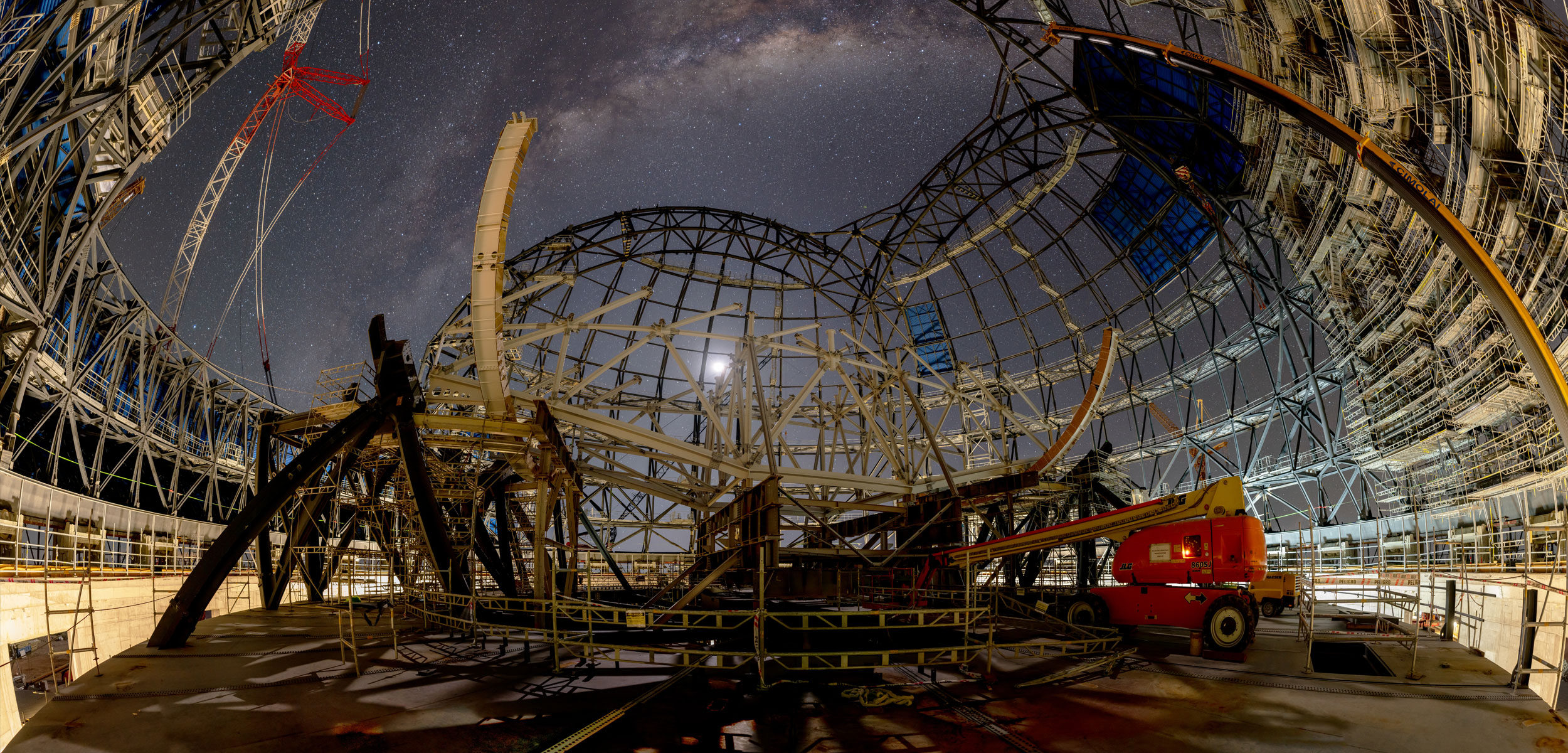
    The ELT will house a mirror the size of four tennis courts, under a huge dome in the Atacama Desert

    The biggest new telescopes are being built in the mountains of Chile. The Extremely Large Telescope (ELT) will house a mirror the size of four tennis courts, under a huge dome in the Atacama Desert.

    Reflecting telescopes like ELT work by using a primary mirror to collect light from the night sky, then reflecting it off other mirrors to a camera. Larger mirrors collect more light and see fainter objects.

    Another ground-based telescope under construction in Chile is the Vera C Rubin telescope. Rubin’s camera is the largest ever built: the size of a small car and weighing about 3t. Its 3 200 megapixels will photograph the whole sky every three days to spot moving objects. Over the course of 10 years, these photographs will be combined to form a massive timelapse video of the universe.

    Astronomy used to be a physically demanding job, requiring travel to remote telescopes in dark sites –- but many astronomers began working from home long before Covid. In the late 20th century, major ground observatories started to put in place technology to allow astronomers to control telescopes for observations at night, even when they were not there in person. Remote observing is now commonplace, carried out via the internet.

    Expect the unexpected

    The view of any telescope on the ground is limited, though, even if it’s on top of a mountain. Launching telescopes into space can get around these limitations.

    The Hubble Space Telescope’s operational history began when the space shuttle lifted it above the atmosphere on 25 April 1990. Hubble got the full 1960s sci-fi treatment: a rocket to launch it, gyroscopes to point it and electronic cameras instead of photographic film. But one plan fell through: for Hubble to host a commuting astronaut-astronomer, working decidedly away from home.

    Read: Canada to invest R3.7-billion in SKA telescope project

    Hubble was designed to take a census of the Milky Way and its neighbouring galaxies. Its successor, the James Webb Space Telescope, would study even more distant galaxies.

    Both telescopes have revolutionised our understanding of the universe, but in ways nobody foresaw. Hubble’s original plans mention none of the discoveries now seen as its greatest hits: plumes of water erupting from Jupiter’s moon Europa, the vortex around black holes, invisible dark matter that holds the universe together and the dark energy that is pulling it apart.

    Webb, launched on 25 December 2021, now spends a third of its time looking at planets around other stars that weren’t even known about when it was designed.

    The stated goal of an expensive telescope is usually just a sales pitch to space agencies, governments and – shhh… — taxpayers. The Webb telescope should achieve its original science goals, but astronomers have always known that seeing further, finer or in more colours can achieve so much more. The unexpected discoveries by telescopes are often more significant than the science objectives stated at the outset.

    Taking the long view

    For scientists, it’s a relief that telescopes go beyond their brief, because Hubble and Webb both took more than 25 years from napkin to launch. In that time, new scientific questions arise.

    Building a large space telescope typically takes about two decades. The Chandra and XMM-Newton space telescopes took 23 years and 15 years to build, respectively. They were designed to observe x-rays coming from hot gas around black holes and galaxy clusters, and were launched very close together in 1999.

    They were followed by Japan’s Hitomi X-ray satellite, which took 18 years to build, and the German eRosita instrument on Russia’s Spektr-RG space observatory, which took 20 years.

    Read: Webb telescope captures ‘stunning’ images of 19 spiral galaxies

    Similar timescales apply to the European Space Agency’s Hipparcos and Gaia space telescopes, which have mapped all the stars in the Milky Way. The Cobe and Planck missions to study the microwave-light afterglow of the Big Bang also took two decades. Precise dates depend how you count, and a few exceptions have been “faster, better, cheaper”, but national space agencies are generally risk averse and slow when developing these projects.
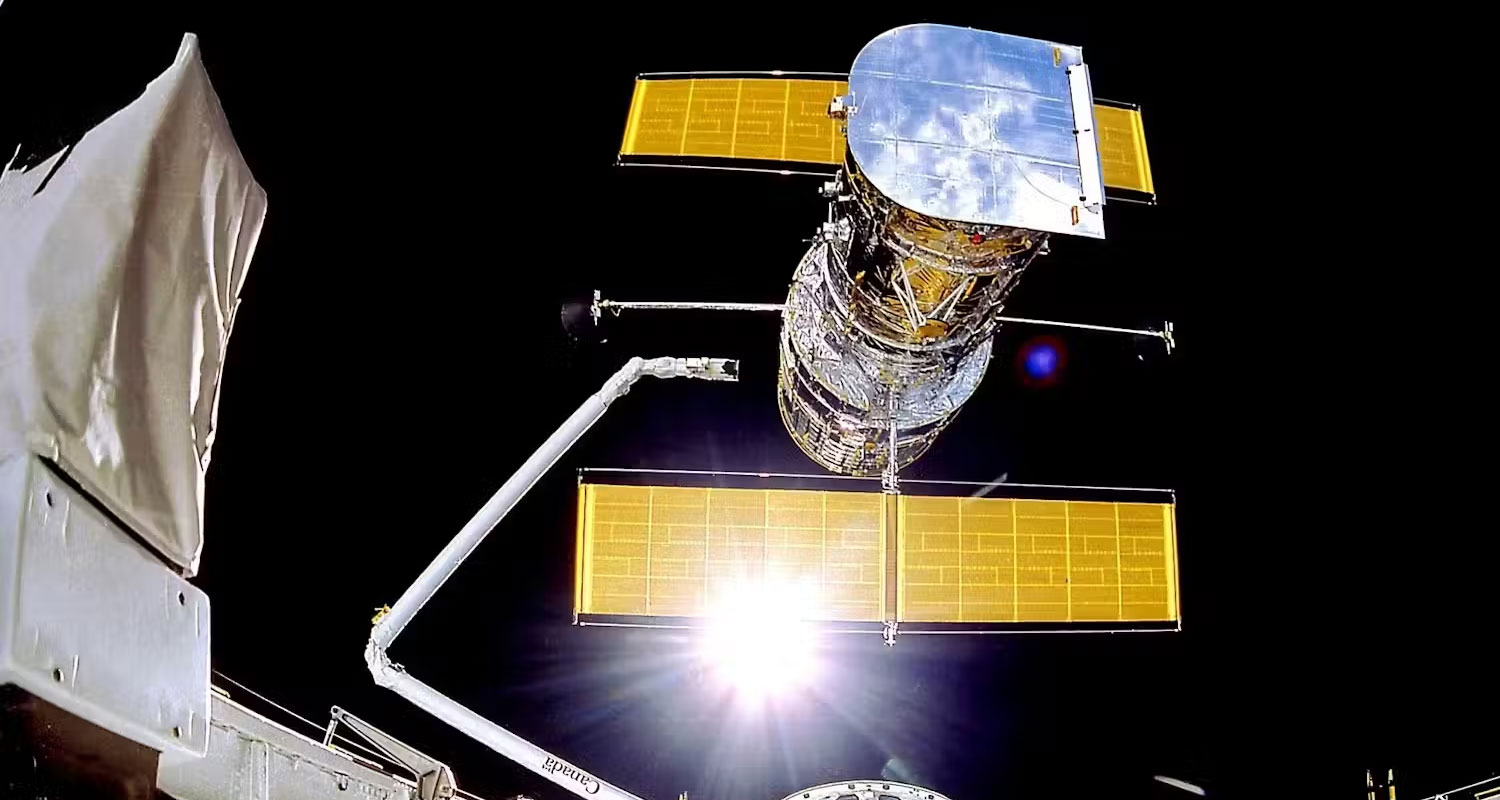
    The Hubble Space Telescope being deployed from the space shuttle in April 1990. Nasa/Smithsonian Institution/Lockheed Corporation
    The Hubble Space Telescope being deployed from the space shuttle in April 1990. Nasa/Smithsonian Institution/Lockheed

    The latest space telescopes are therefore millennials. They were designed at a time when astronomers had measured the universe’s newborn expansion following the Big Bang, and also its old-age, accelerating expansion. Their main goal now is to fill the gap –- because, surprisingly, interpolations from early times to late times don’t meet in the middle.

    The measured rates for the expansion of the universe are inconsistent, as are results for the clumpiness of matter in the cosmos. Both measurements create challenges for our theories of how the universe evolved.

    Observing the middle age of the universe requires telescopes operating at long wavelengths, because light from distant galaxies is stretched by the time it reaches us. So, Webb has infrared zoom cameras, while the European Space Agency’s Euclid space telescope, launched in 2023, and Nasa’s Nancy Grace Roman telescope, which is set to launch in 2026, both have infrared wide-angle views.

    Three buses come along at once

    Most stars shine in ultraviolet and infrared colours that are blocked by the Earth’s atmosphere, as well as the colours our eyes evolved to see.

    Extra colours are useful. For example, we can weigh stars on the other side of our galaxy because massive stars are bright in infrared, while smaller ones are faint – and they stay that way throughout their lifetimes. However, we know where stars are being born because only young stars emit ultraviolet light.

    In addition, independent measurements of the same thing are vital for rigorous science. Infrared telescopes, for example, can work together and have already made surprising discoveries. But it’s not great for diversity that the Webb, Euclid and Roman space telescopes all see infrared colours.

    Read: The South African telescope that transformed our understanding of the cosmos

    Hubble’s visible light camera has just been switched off due to budget cuts. Nasa will not swing back to ultraviolet wavelengths until the 2030s, with the Ultraviolet Explorer and Habitable Worlds Observatory.

    Earthly politics gets in the way, too. Data from China’s Hubble-class space telescope, Xuntian, is unlikely to be shared internationally. And in protest at Russia’s invasion of Ukraine, in February 2022 Germany switched off its eRosita x-ray instrument that had been operating perfectly, in collaboration with Russia, a million miles from Earth.

    Chandra and XMM-Newton were launched to study x-rays from hot gas around black holes. ESO, Esa/Hubble, M Kornmesser, CC BY
    Chandra and XMM-Newton were launched to study x-rays from hot gas around black holes. ESO, Esa/Hubble, M Kornmesser, CC BY

    Cheap commercial launches may save the day. Euclid was to have lifted off on a Russian Soyuz rocket from a European Space Agency spaceport in French Guiana. When Russia ended operations there in tit-for-tat reprisals, Euclid’s launch was successfully switched at the last minute to a SpaceX Falcon 9 rocket.

    If large telescopes can also be folded inside shoebox-size “cubesat” satellites, the lower cost would make it viable for them to fail. Tolerating risk creates a virtuous circle that makes missions even cheaper.

    Telescopes are also being tried in innovative locations such as giant helium balloons and aeroplanes. One day, they might also be deployed on the moon, where the environment is advantageous for certain types of astronomy.

    But perhaps the most unusual telescope technology, which may bring the most unexpected discoveries, is gravitational wave detectors. Gravitational waves are not part of the electromagnetic spectrum, so we can’t see them. They are distortions, or “ripples”, in spacetime caused by some of the most violent and energetic processes in the universe. These might include a collision between two neutron stars (dense objects formed when massive stars run out of fuel), or a neutron star merging with a black hole.
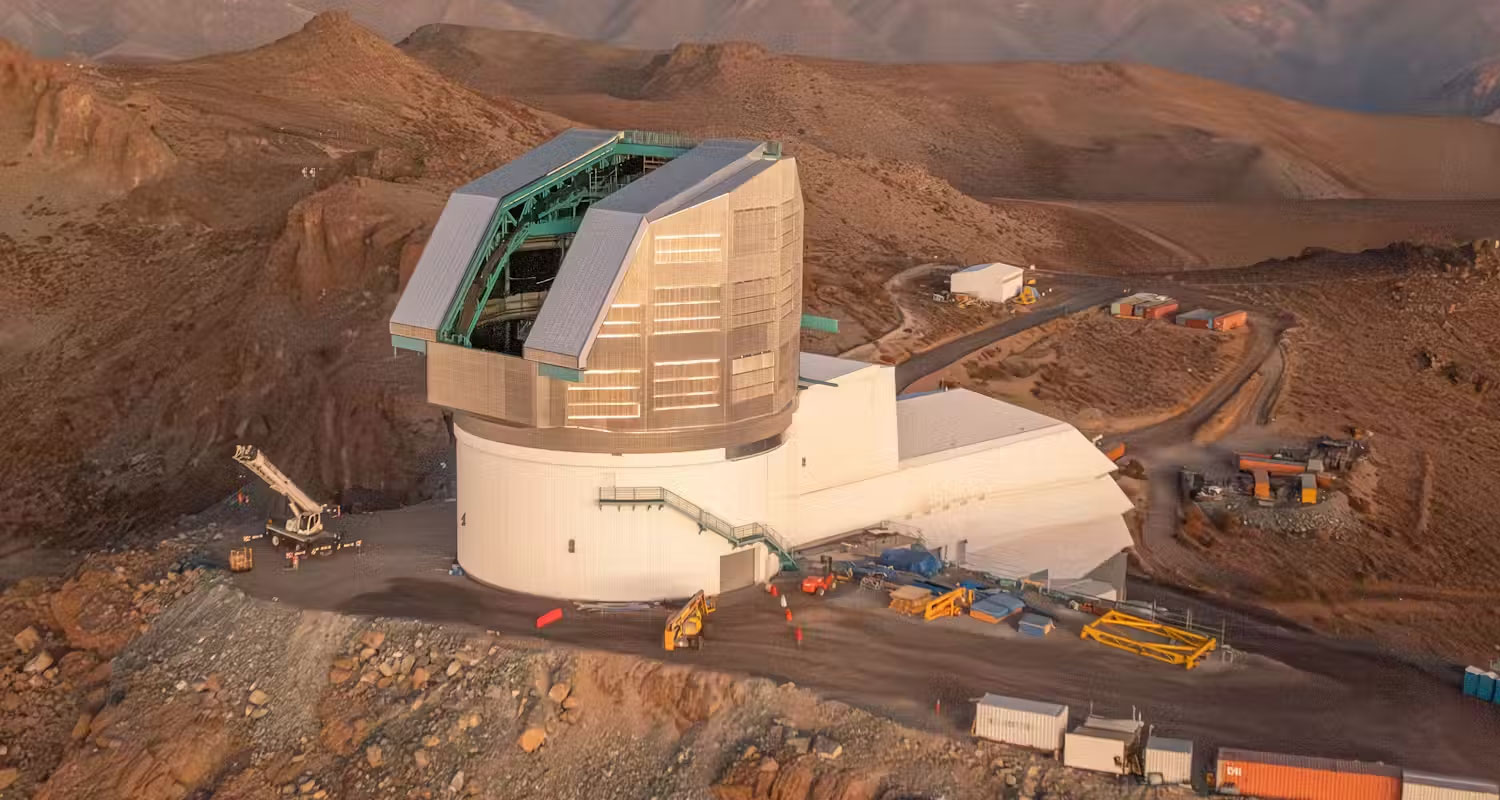
    The Rubin Observatory is located on the Cerro Pachón mountain in northern Chile. Rubin Observatory/NSF/AURA/A Pizarro D

    If telescopes are our eyes, gravitational wave detectors are our ears. But again, current gravitational wave detectors on Earth are mere dry runs for the ones astronomers will ultimately deploy in space.

    Asked what the next generation of observatories will discover, I have no idea. And that’s a good thing. The best science experiments shouldn’t just tell us about the things we expect to find, but also about the unknown unknowns.The Conversation

    Main image: Taken on 3 April 2024, the image shows progress on ESO’s Extremely Large Telescope (ELT). The giant structure is 80m high and 88m wide and will protect the world’s biggest eye on the sky from the extreme environment of Chile’s Atacama Desert. Image: B Häußler/ESO

    Get breaking news from TechCentral on WhatsApp. Sign up here.

    • The author, Richard Massey, is professor of extragalactic astrophysics (dark matter and cosmology), Durham University
    • This article is republished from The Conversation under a Creative Commons licence

    Don’t miss:

    In space, no one can hear Musk’s rivals scream


    ELT Extremely Large Telescope Hubble Space Telescope Richard Massey
    WhatsApp YouTube Follow on Google News Add as preferred source on Google
    Share. Facebook Twitter LinkedIn WhatsApp Telegram Email Copy Link
    Previous ArticleWestern car giants risk being left behind by China’s EV industry
    Next Article Why are we so obsessed with Elon Musk?

    Related Posts

    Saving the Hubble telescope is worth paying for

    18 June 2023

    Hubble reveals huge star’s explosion in blow-by-blow detail

    10 November 2022

    James Webb telescope to reveal the secrets of the universe

    11 July 2022
    Company News
    The skills gap is a thinking gap: why South African employers can't find problem solvers

    The skills gap is a thinking gap: why SA employers can’t find problem solvers

    6 February 2026
    Vox Kiwi Wireless: fibre-like broadband for South African homes

    Vox Kiwi Wireless: fibre-like broadband for South African homes

    5 February 2026
    NEC XON achieves an African first with full Fortinet accreditation - Ian Kruger

    NEC XON achieves an African first with full Fortinet accreditation

    5 February 2026
    Opinion
    South Africa's skills advantage is being overlooked at home - Richard Firth

    South Africa’s skills advantage is being overlooked at home

    29 January 2026
    Why Elon Musk's Starlink is a 'hard no' for me - Songezo Zibi

    Why Elon Musk’s Starlink is a ‘hard no’ for me

    26 January 2026
    South Africa's new fibre broadband battle - Duncan McLeod

    South Africa’s new fibre broadband battle

    20 January 2026

    Subscribe to Updates

    Get the best South African technology news and analysis delivered to your e-mail inbox every morning.

    Latest Posts
    South Africa's stablecoin silence is becoming a policy failure

    South Africa’s stablecoin silence is becoming a policy failure

    6 February 2026
    Every electric car you can buy in South Africa in early 2026, ranked by price

    Every electric car you can buy in South Africa in early 2026, ranked by price

    6 February 2026
    From stocks to crypto, markets reel as AI doubts grow

    From stocks to crypto, markets reel as AI doubts grow

    6 February 2026
    South Africa deepens China ties as US trade tensions escalate

    South Africa deepens China ties as US trade tensions escalate

    6 February 2026
    © 2009 - 2026 NewsCentral Media
    • Cookie policy (ZA)
    • TechCentral – privacy and Popia

    Type above and press Enter to search. Press Esc to cancel.

    Manage consent

    TechCentral uses cookies to enhance its offerings. Consenting to these technologies allows us to serve you better. Not consenting or withdrawing consent may adversely affect certain features and functions of the website.

    Functional Always active
    The technical storage or access is strictly necessary for the legitimate purpose of enabling the use of a specific service explicitly requested by the subscriber or user, or for the sole purpose of carrying out the transmission of a communication over an electronic communications network.
    Preferences
    The technical storage or access is necessary for the legitimate purpose of storing preferences that are not requested by the subscriber or user.
    Statistics
    The technical storage or access that is used exclusively for statistical purposes. The technical storage or access that is used exclusively for anonymous statistical purposes. Without a subpoena, voluntary compliance on the part of your Internet Service Provider, or additional records from a third party, information stored or retrieved for this purpose alone cannot usually be used to identify you.
    Marketing
    The technical storage or access is required to create user profiles to send advertising, or to track the user on a website or across several websites for similar marketing purposes.
    • Manage options
    • Manage services
    • Manage {vendor_count} vendors
    • Read more about these purposes
    View preferences
    • {title}
    • {title}
    • {title}