Close Menu
TechCentralTechCentral

    Subscribe to the newsletter

    Get the best South African technology news and analysis delivered to your e-mail inbox every morning.

    Facebook X (Twitter) YouTube LinkedIn
    WhatsApp Facebook X (Twitter) LinkedIn YouTube
    TechCentralTechCentral
    • News
      Africa's most popular phones have a tracking problem

      Africa’s most popular phones have a tracking problem

      24 July 2026
      Vodacom taps UJ, AWS to build its AI talent pipeline - Vodacom Group CEO Shameel Joosub

      Vodacom taps UJ, AWS to build its AI talent pipeline

      24 July 2026
      Intel is back in the game - Intel CEO Lip-Bu Tan. Laure Andrillon/Reuters

      Intel is back in the game

      24 July 2026
      Fat bonuses at Telkom despite group missing own targets - Serame Taukobong

      Fat bonuses at Telkom despite group missing own targets

      23 July 2026
      Massive changes coming to Amazon Prime Video - Jeff Bezos

      Massive changes coming to Amazon Prime Video

      23 July 2026
    • World
      Meta AI will now tell parents if their teen is in crisis

      Meta AI will now tell parents if their teen is in crisis

      17 July 2026
      IBM shares crash 25% as AI upends software spending - Arvind Krishna

      IBM shares crash 25% as AI upends software spending

      15 July 2026
      Jony Ive's first OpenAI device: an AI smart speaker - Jony Ive and Sam Altman

      Jony Ive’s first OpenAI device: an AI smart speaker

      15 July 2026
      Stripe, Advent in talks to buy PayPal for $53-billion

      Stripe, Advent in talks to buy PayPal for $53-billion

      15 July 2026
      Memory crisis sends smartphone market into steep decline

      Memory crisis sends smartphone market into steep decline

      13 July 2026
    • In-depth
      The plan to stop AI from breaking the world - Google DeepMind CEO Demis Hassabis. Image: John Sears

      The plan to stop AI from breaking the world

      16 July 2026
      The internet has a Strait of Hormuz problem

      The internet has a Strait of Hormuz problem

      15 July 2026
      AI boom sparks rally, frenzy and fear

      AI boom sparks rally, frenzy and fear

      11 June 2026
      Every plug-in hybrid on sale in South Africa, ranked by price - Lamborghini Temerario

      Every plug-in hybrid on sale in South Africa, ranked by price

      7 June 2026
      What Wi-Fi 8 will mean for wireless networks

      What Wi-Fi 8 will mean for wireless networks

      1 June 2026
    • TCS
      TCS | How Optasia lends billions to people banks can't see - Salvador Anglada

      TCS | How Optasia lends billions to people banks can’t see

      23 July 2026
      The rands-and-cents case for electric trucks - William Kelly Watts & Wheels with Wills

      The rands-and-cents case for electric trucks

      20 July 2026
      Watts & Wheels S1E7: 'Ferrari's EV breaks the internet'

      Watts & Wheels S1E7: ‘Ferrari’s EV breaks the internet’

      8 July 2026
      TCS | Pick n Pay's Enrico Ferigolli on Penny, the AI that shops for you

      TCS | Pick n Pay’s Enrico Ferigolli on Penny, the AI that shops for you

      2 July 2026
      TCS+ | How Tracker is turning vehicle data into business strategy - Silvia Schollenberger

      TCS+ | How Tracker is turning vehicle data into business strategy

      1 July 2026
    • Opinion
      Selling vapour is corporate suicide in slow motion - Jannie van Zyl

      Selling vapour is corporate suicide in slow motion

      16 July 2026
      Brazil's online gambling crackdown is a lesson for South Africa

      How Amazon outmanoeuvred Starlink in South Africa

      15 July 2026
      The Popia problem with agentic AI - Herman Haasbroek

      The Popia problem with agentic AI

      14 July 2026
      The author, Fanie van Rooyen

      South Africa can still catch the AI wave – here’s how

      7 July 2026
      The author, Fanie van Rooyen

      The AI utopia South Africa can’t afford

      1 July 2026
    • Company Hubs
      • 1Stream
      • Africa Data Centres
      • AfriGIS
      • Altron Digital Business
      • Altron Document Solutions
      • Altron Group
      • Arctic Wolf
      • Ascent Technology
      • AvertITD
      • BBD
      • Braintree
      • CallMiner
      • CambriLearn
      • CM Telecom
      • Contactable
      • CYBER1 Solutions
      • Digicloud Africa
      • Digimune
      • Domains.co.za
      • ESET
      • Euphoria Telecom
      • HOSTAFRICA
      • Incredible Business
      • iONLINE
      • IQbusiness
      • Iris Network Systems
      • Kaspersky
      • LSD Open
      • Mitel
      • NEC XON
      • Netstar
      • Network Platforms
      • Next DLP
      • Ovations
      • Paracon
      • Paratus
      • Q-KON
      • SevenC
      • SkyWire
      • Solid8 Technologies
      • Telit Cinterion
      • Telviva
      • Tenable
      • Vertiv
      • Videri Digital
      • Vodacom Business
      • Vox
      • Wipro
      • Workday
      • XLink
    • Sections
      • AI and machine learning
      • Banking
      • Broadcasting and Media
      • Cloud services
      • Contact centres and CX
      • Cryptocurrencies
      • Education and skills
      • Electronics and hardware
      • Energy and sustainability
      • Enterprise software
      • Financial services
      • HealthTech
      • Information security
      • Internet and connectivity
      • Internet of Things
      • Investment
      • IT services
      • Lifestyle
      • Policy and regulation
      • Public sector
      • Retail and e-commerce
      • Satellite communications
      • Science
      • SMEs and start-ups
      • Social media
      • Talent and leadership
      • Telecoms
      • Watts & Wheels
    • Events
    • Advertise
    TechCentralTechCentral
    Home » Sections » Nobel Prize 2025: scientists honoured for turning quantum weirdness into tech reality

    Nobel Prize 2025: scientists honoured for turning quantum weirdness into tech reality

    The three winners secured 2025 Nobel Prize in Physics for "experiments that revealed quantum physics in action".
    By Agency Staff7 October 2025
    Twitter LinkedIn Facebook WhatsApp Email Telegram Copy Link
    News Alerts
    WhatsApp
    Nobel Prize 2025: scientists honoured for turning quantum weirdness into tech reality
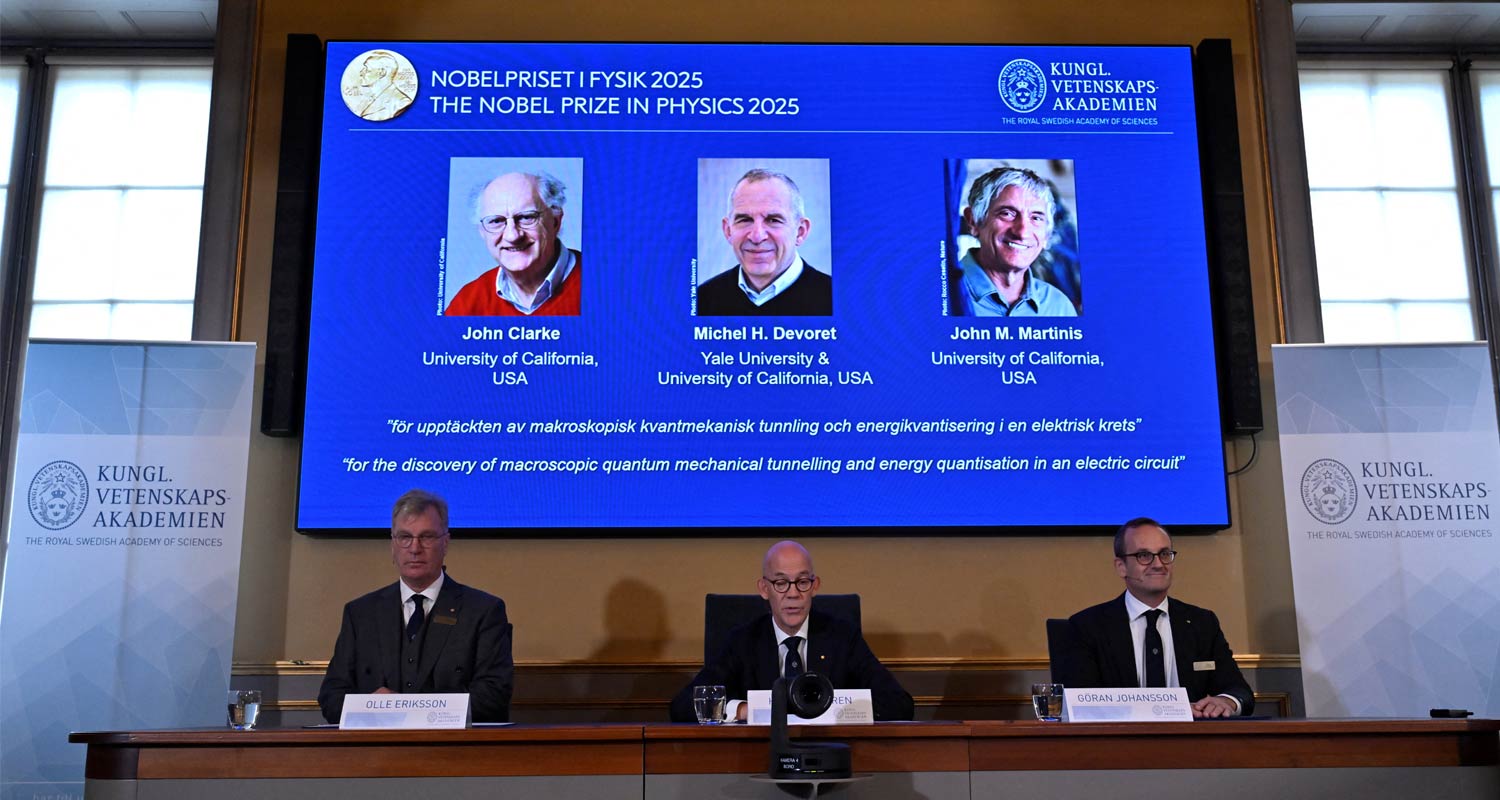
    John Clarke, MichelDevoret and John Martinis have been announced as this year’s Nobel Prize winners in Physics. Image: Christine Olsson via Reuters

    US-based scientists John Clarke, Michel Devoret and John Martinis have won the 2025 Nobel Prize in Physics for “experiments that revealed quantum physics in action”, paving the way for the development of the next generation of digital technologies.

    “My feelings are that I’m completely stunned. Of course it had never occurred to me in any way that this might be the basis of a Nobel Prize,” Clarke told the Nobel press conference by telephone on Tuesday.

    “I’m speaking on my cellphone and I suspect that you are, too, and one of the underlying reasons that the cellphone works is because of all this work.”

    The Nobel prizes were established through the will of Alfred Nobel, who amassed a fortune from his invention of dynamite

    Quantum mechanical behaviours are well studied at the level of the incredibly small — atoms and subatomic particles — but are often seen as bizarre and unintuitive compared with classical physics and its far larger scale.

    The Nobel winners carried out experiments in the mid-1980s with an electronic circuit built of superconductors and demonstrated that quantum mechanics could also influence everyday objects under certain conditions.

    “It is wonderful to be able to celebrate the way that century-old quantum mechanics continually offers new surprises. It is also enormously useful, as quantum mechanics is the foundation of all digital technology,” Olle Eriksson, chair of the Nobel Committee for Physics, said.

    Quantum technology is already ubiquitous, with transistors in computer microchips an everyday example.

    Quantum technology

    “This year’s Nobel Prize in Physics has provided opportunities for developing the next generation of quantum technology, including quantum cryptography, quantum computers and quantum sensors,” the Royal Swedish Academy of Sciences, which awards the prize, said in a statement.

    British-born Clarke is a professor at the University of California, Berkeley, in the US.

    Devoret, born in France, is a professor at Yale University and the University of California, Santa Barbara, also in the US, where Martinis is also a professor.

    Read: IBM sets sights on practical quantum computing by 2029

    Martinis, an American, headed Google’s Quantum Artificial Intelligence Lab until 2020. At Google, Martinis was part of the research team who in 2019 said they had achieved “quantum supremacy”, in which a computer harnessing the properties of subatomic particles did a far better job of solving a problem than the world’s most powerful supercomputer.

    Devoret, besides his professorship, is also the chief scientist of Google Quantum AI.

    The Nobel physics prize is awarded by the Royal Swedish Academy of Sciences and includes a prize sum totalling 11 million Swedish crowns (R20.6-million) that is shared among the winners if there are several, as is often the case.

    Hans Ellegren, permanent secretary of the Royal Swedish Academy of Sciences, announcing this year's Nobel Prize winners in Physics. Tom Little/Reuters
    Hans Ellegren, permanent secretary of the Royal Swedish Academy of Sciences, announcing this year’s Nobel Prize winners in Physics. Tom Little/Reuters

    The Nobel prizes were established through the will of Alfred Nobel, who amassed a fortune from his invention of dynamite. Since 1901, with occasional interruptions, the prizes have annually recognised achievements in science, literature and peace. Economics was a later addition.

    Physics was the first category mentioned in Nobel’s will, likely reflecting the prominence of the field during his time. Today, the Nobel Prize in Physics remains widely regarded as the most prestigious award in the discipline.

    Past winners of the Nobel physics prize include some of the most influential figures in the history of science, such as Albert Einstein, Pierre and Marie Curie, Max Planck, and Niels Bohr, himself a pioneer of quantum theory.

    The peace prize, which will be announced on Friday, is awarded in a separate ceremony in Oslo

    Last year’s prize was won by US scientist John Hopfield and British-Canadian Geoffrey Hinton for breakthroughs in machine learning that spurred the artificial intelligence boom, a development about which both have also expressed concerns.

    In keeping with tradition, physics is the second Nobel to be awarded this week, after two American and one Japanese scientist won the medicine prize for breakthroughs in understanding the immune system. The chemistry prize is due next, on Wednesday.

    The science, literature and economics prizes are presented to the laureates by the Swedish king at a ceremony in Stockholm on 10 December, the anniversary of Alfred Nobel’s death, followed by a lavish banquet at city hall.

    Read: From Beijing to Stellenbosch: quantum signal travels 12 900km

    The peace prize, which will be announced on Friday, is awarded in a separate ceremony in Oslo.  — Niklas Pollard, Simon Johnson and Johan Ahlander, with Marie Mannes, Greta Rosen Fondahn, Supantha Mukherjee and Terje Solsvik, (c) 2025 Reuters

    Get breaking news from TechCentral on WhatsApp. Sign up here.

    Follow TechCentral on Google News Add TechCentral as your preferred source on Google


    John Clarke John Martinis Michel Devoret Nobel Prize Nobel Prize 2025 Nobel Prize in Physics Nobel Prize in Physics 2025
    WhatsApp YouTube
    Share. Facebook Twitter LinkedIn WhatsApp Telegram Email Copy Link
    Previous ArticleCrypto hits checkout counters in South Africa
    Next Article The one area where the SABC is actually thriving

    Related Posts

    Public urged to speak on e-toll plans

    18 September 2015
    Company News
    Why Europe is turning to South Africa for cross-border innovation - BBD Software

    Why Europe is turning to South Africa for cross-border innovation

    24 July 2026
    Green dashboards, stalled change: the CIO's blind spot - Change Logic Marchant van den Heever

    Green dashboards, stalled change: the CIO’s blind spot

    24 July 2026
    Why Africa's cloud needs more than one path - Africa Data Centres

    Why Africa’s cloud needs more than one path

    23 July 2026
    Opinion
    Selling vapour is corporate suicide in slow motion - Jannie van Zyl

    Selling vapour is corporate suicide in slow motion

    16 July 2026
    Brazil's online gambling crackdown is a lesson for South Africa

    How Amazon outmanoeuvred Starlink in South Africa

    15 July 2026
    The Popia problem with agentic AI - Herman Haasbroek

    The Popia problem with agentic AI

    14 July 2026

    Subscribe to Updates

    Get the best South African technology news and analysis delivered to your e-mail inbox every morning.

    Latest Posts
    Africa's most popular phones have a tracking problem

    Africa’s most popular phones have a tracking problem

    24 July 2026
    Vodacom taps UJ, AWS to build its AI talent pipeline - Vodacom Group CEO Shameel Joosub

    Vodacom taps UJ, AWS to build its AI talent pipeline

    24 July 2026
    Intel is back in the game - Intel CEO Lip-Bu Tan. Laure Andrillon/Reuters

    Intel is back in the game

    24 July 2026
    Why Europe is turning to South Africa for cross-border innovation - BBD Software

    Why Europe is turning to South Africa for cross-border innovation

    24 July 2026
    © 2009 - 2026 NewsCentral Media
    Built and maintained by Chronon
    • Cookie policy (ZA)
    • TechCentral – privacy and Popia

    Type above and press Enter to search. Press Esc to cancel.

    Manage consent

    TechCentral uses cookies to enhance its offerings. Consenting to these technologies allows us to serve you better. Not consenting or withdrawing consent may adversely affect certain features and functions of the website.

    Functional Always active
    The technical storage or access is strictly necessary for the legitimate purpose of enabling the use of a specific service explicitly requested by the subscriber or user, or for the sole purpose of carrying out the transmission of a communication over an electronic communications network.
    Preferences
    The technical storage or access is necessary for the legitimate purpose of storing preferences that are not requested by the subscriber or user.
    Statistics
    The technical storage or access that is used exclusively for statistical purposes. The technical storage or access that is used exclusively for anonymous statistical purposes. Without a subpoena, voluntary compliance on the part of your Internet Service Provider, or additional records from a third party, information stored or retrieved for this purpose alone cannot usually be used to identify you.
    Marketing
    The technical storage or access is required to create user profiles to send advertising, or to track the user on a website or across several websites for similar marketing purposes.
    • Manage options
    • Manage services
    • Manage {vendor_count} vendors
    • Read more about these purposes
    View preferences
    • {title}
    • {title}
    • {title}