Close Menu
TechCentralTechCentral

    Subscribe to the newsletter

    Get the best South African technology news and analysis delivered to your e-mail inbox every morning.

    Facebook X (Twitter) YouTube LinkedIn
    WhatsApp Facebook X (Twitter) LinkedIn YouTube
    TechCentralTechCentral
    • News
      Nedbank hires MTN's former tech chief as group CIO - Nikos Angelopoulos

      Nedbank hires MTN’s former tech chief as group CIO

      31 July 2026
      Eskom's diesel bill falls 86% as breakdowns hit eight-year low

      Eskom’s diesel bill falls 86% as breakdowns hit eight-year low

      31 July 2026
      Ramaphosa signs off on taking the grid away from Eskom

      Ramaphosa signs off on taking the grid away from Eskom

      31 July 2026
      Microsoft just had the biggest day in stock market history

      Microsoft just had the biggest day in stock market history

      31 July 2026
      MTN Nigeria's growth engine stalled in second quarter - Karl Toriola

      MTN Nigeria’s growth engine stalled in second quarter

      31 July 2026
    • World
      Meta AI will now tell parents if their teen is in crisis

      Meta AI will now tell parents if their teen is in crisis

      17 July 2026
      IBM shares crash 25% as AI upends software spending - Arvind Krishna

      IBM shares crash 25% as AI upends software spending

      15 July 2026
      Jony Ive's first OpenAI device: an AI smart speaker - Jony Ive and Sam Altman

      Jony Ive’s first OpenAI device: an AI smart speaker

      15 July 2026
      Stripe, Advent in talks to buy PayPal for $53-billion

      Stripe, Advent in talks to buy PayPal for $53-billion

      15 July 2026
      Memory crisis sends smartphone market into steep decline

      Memory crisis sends smartphone market into steep decline

      13 July 2026
    • In-depth
      The plan to stop AI from breaking the world - Google DeepMind CEO Demis Hassabis. Image: John Sears

      The plan to stop AI from breaking the world

      16 July 2026
      The internet has a Strait of Hormuz problem

      The internet has a Strait of Hormuz problem

      15 July 2026
      AI boom sparks rally, frenzy and fear

      AI boom sparks rally, frenzy and fear

      11 June 2026
      Every plug-in hybrid on sale in South Africa, ranked by price - Lamborghini Temerario

      Every plug-in hybrid on sale in South Africa, ranked by price

      7 June 2026
      What Wi-Fi 8 will mean for wireless networks

      What Wi-Fi 8 will mean for wireless networks

      1 June 2026
    • TCS
      TCS+ | Why South African workers must become supervisors of digital labour - Accelera Digital Group Cliff de Wit

      TCS+ | Why South African workers must become supervisors of digital labour

      31 July 2026
      TCS | Rapid deployment rules can't work without municipalities: ACT - Nomvuyiso Batyi

      TCS | Icasa’s rules skip the real bottleneck: ACT

      30 July 2026
      TCS+ | iStore Business on why Apple makes sense for SMEs - Sudesh Pillay and Tamia Nontsikelelo

      TCS+ | iStore Business on why Apple makes sense for SMEs

      30 July 2026
      TCS+ | A smarter approach to cloud for South African businesses - Joel Chacko and Jonathan Oaker

      TCS+ | A smarter approach to cloud for South African businesses

      28 July 2026
      TCS | How Optasia lends billions to people banks can't see - Salvador Anglada

      TCS | How Optasia lends billions to people banks can’t see

      23 July 2026
    • Opinion
      The author, Jannie van Zyl

      Selling vapour is corporate suicide in slow motion

      16 July 2026
      Brazil's online gambling crackdown is a lesson for South Africa

      How Amazon outmanoeuvred Starlink in South Africa

      15 July 2026
      The Popia problem with agentic AI - Herman Haasbroek

      The Popia problem with agentic AI

      14 July 2026
      The author, Fanie van Rooyen

      South Africa can still catch the AI wave – here’s how

      7 July 2026
      The author, Fanie van Rooyen

      The AI utopia South Africa can’t afford

      1 July 2026
    • Company Hubs
      • 1Stream
      • Africa Data Centres
      • AfriGIS
      • Altron Digital Business
      • Altron Document Solutions
      • Altron Group
      • Arctic Wolf
      • Ascent Technology
      • AvertITD
      • BBD
      • Braintree
      • CallMiner
      • CambriLearn
      • CM Telecom
      • Contactable
      • CYBER1 Solutions
      • Digicloud Africa
      • Digimune
      • Domains.co.za
      • ESET
      • Euphoria Telecom
      • HOSTAFRICA
      • Incredible Business
      • iONLINE
      • IQbusiness
      • Iris Network Systems
      • Kaspersky
      • LSD Open
      • Mitel
      • NEC XON
      • Netstar
      • Network Platforms
      • Next DLP
      • Ovations
      • Paracon
      • Paratus
      • Q-KON
      • SevenC
      • SkyWire
      • Solid8 Technologies
      • Telit Cinterion
      • Telviva
      • Tenable
      • Vertiv
      • Videri Digital
      • Vodacom Business
      • Vox
      • Wipro
      • Workday
      • XLink
    • Sections
      • AI and machine learning
      • Banking
      • Broadcasting and Media
      • Cloud services
      • Contact centres and CX
      • Cryptocurrencies
      • Education and skills
      • Electronics and hardware
      • Energy and sustainability
      • Enterprise software
      • Financial services
      • HealthTech
      • Information security
      • Internet and connectivity
      • Internet of Things
      • Investment
      • IT services
      • Lifestyle
      • Policy and regulation
      • Public sector
      • Retail and e-commerce
      • Satellite communications
      • Science
      • SMEs and start-ups
      • Social media
      • Talent and leadership
      • Telecoms
      • Watts & Wheels
    • Events
    • Advertise
    TechCentralTechCentral
    Home » In-depth » One person, one e-ballot?

    One person, one e-ballot?

    By Craig Wilson10 January 2013
    Twitter LinkedIn Facebook WhatsApp Email Telegram Copy Link
    News Alerts
    WhatsApp
    South Africa's chief electoral officer, Mosotho Moepya
    South Africa’s chief electoral officer, Mosotho Moepya

    The Independent Electoral Commission (IEC) will conclude a study in the coming weeks in which it investigates the various forms of electronic voting and registration systems used worldwide, from electronic ballots to telephonic and Internet-based voting.

    However, South Africa’s complicated political history means it’s unlikely the voting process will go paperless in time for the next national polls in 2014, or even in 2019.

    Internationally, countries such as Australia, Canada, Estonia and Norway are embracing online voting. The Economist reported recently that Ireland, which spent US$66m embracing electronic ballot devices a decade ago, has scrapped its electronic voting project and returned to paper ballots. Electronic or machine-based voting, it appears, is growing in popularity in developing countries, but falling out of favour in developed ones, some of which are moving to online voting solutions instead.

    “You have to look at the socioeconomic features of the countries where [electronic solutions] are used,” says the IEC’s chief electoral officer, Mosotho Moepya. “You have to ask, what are the problems that countries are trying to resolve by moving from one system to another?”

    Moepya tells TechCentral in an exclusive interview that in the interests of thoroughness, the IEC has even looked at countries that have moved from one form of electronic voting to another. “We’re interested in the whole range of solutions,” he says, but adds that when considering paperless solutions, one must ask whether there is really a problem that paperless voting will solve.

    One of the big challenges facing alternative polling and registration systems in South Africa is trust. Moepya cites the example of micro lenders, who often keep debtors’ ID books until loans have been repaid. “If we say anyone can register to vote for anyone else with their ID, we could encounter all sorts of problems.”

    The IEC has to ensure it doesn’t interfere in any way with people’s right to vote. “People must register and vote in person. We ask you to come in person so there’s no argument tomorrow about it having been you. Many young South Africans think that in this age of technology they should be able to register from home. The problem with that is people can impersonate others.”

    Other potential pitfalls of electronic solutions are the difficulties they present for auditors and the security risks, perceived or actual. “There is also the issue of access,” says Moepya. “If there’s one area where we are all equal, it is when we vote. We have the same ballot, the same candidates and the same ID book. The minute you begin to say people in Sandton and Waterkloof and Hout Bay can vote from home while the rest must stand in the sun, you have a problem.”
    Ballot-paper-280
    Here to stay for now

    Moepya says the IEC has to tread carefully because there are “constitutional matters” at stake, too. “Whatever form of voting we contemplate must work anywhere in South Africa without reservations.

    “We have 22 000 voting stations in SA, 5% of which still have no electricity or telephone lines. The kinds of technology we’re talking about require these. It can be mitigated with mobile technology and portable solutions, but because we have such unequal infrastructure availability it becomes more difficult to say we can serve everyone equally using different methods. We have looked at this, but we are unconvinced.”

    Another obstacle to the uptake of electronic systems is education, or a lack thereof. “One must look at a system of voting that doesn’t get to a point that requires a certain level of education. One needs to take the low level of literacy into consideration when you design a system. Electronic voting does introduce an element of sophistication that may not be in line with where we are as a nation.”

    Beyond the social implications of changing voting systems, there are also the costs to consider. The cost of changing systems is “fearsome”, Moepya says. “It could run into tens of billions of rand.” There is also the danger that the investment will quickly become outdated as technology advances.

    Ultimately, it’s the need to ensure the electoral system treats everyone the same that may hold back any moves to introduce electronic or Internet voting.

    Moepya says South Africa already has one of the most secure electoral systems in on the continent. This is thanks, in part, to the national population register that makes it more difficult for South Africans to impersonate others or vote more than once.

    “There’s security in our ballot papers, too. People have been convicted for trying to reproduce ballot papers fraudulently.”

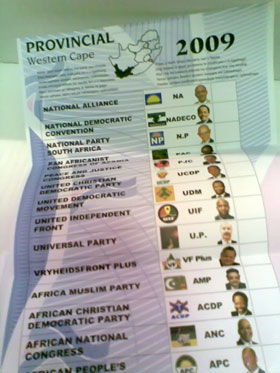
    Overt security features include watermarks, logos and micro-printing of tiny text. “I can assure you, next year you’ll be presented with a beautiful ballot when you come to vote,” Moepya says.

    The results of the IEC study into electronic voting solutions will be presented in March.  — (c) 2013 NewsCentral Media

    • Ballot paper photo: Warrenski/Flickr

    Follow TechCentral on Google News Add TechCentral as your preferred source on Google


    IEC Independent Electoral Commission Mosotho Moepya
    WhatsApp YouTube
    Share. Facebook Twitter LinkedIn WhatsApp Telegram Email Copy Link
    Previous ArticleThe trouble with 4K TV
    Next Article Corporate shot in the arm for Windows Phone

    Related Posts

    South Africa's TikTok election is coming

    South Africa’s TikTok election is coming

    7 May 2026
    South Africa headed to the polls in November

    IEC investigates electronic voting to modernise South Africa’s elections

    11 March 2025
    From Trump to TikTok: how digital platforms bend the rules of politics

    IEC results portal goes blank in apparent glitch

    31 May 2024
    Company News
    Domains.co.za launches self-hosted n8n VPS hosting

    Domains.co.za launches self-hosted n8n VPS hosting

    31 July 2026
    Smarter.tech '26 shows why smarter technology begins with context - Obsidian Systems

    Context is the missing piece in enterprise AI: Obsidian

    31 July 2026
    Huawei launches 12 intelligent transport solutions in South Africa - Sam Tang

    Huawei launches 12 intelligent transport solutions in South Africa

    30 July 2026
    Opinion
    The author, Jannie van Zyl

    Selling vapour is corporate suicide in slow motion

    16 July 2026
    Brazil's online gambling crackdown is a lesson for South Africa

    How Amazon outmanoeuvred Starlink in South Africa

    15 July 2026
    The Popia problem with agentic AI - Herman Haasbroek

    The Popia problem with agentic AI

    14 July 2026

    Subscribe to Updates

    Get the best South African technology news and analysis delivered to your e-mail inbox every morning.

    Latest Posts
    Nedbank hires MTN's former tech chief as group CIO - Nikos Angelopoulos

    Nedbank hires MTN’s former tech chief as group CIO

    31 July 2026
    Eskom's diesel bill falls 86% as breakdowns hit eight-year low

    Eskom’s diesel bill falls 86% as breakdowns hit eight-year low

    31 July 2026
    Ramaphosa signs off on taking the grid away from Eskom

    Ramaphosa signs off on taking the grid away from Eskom

    31 July 2026
    TCS+ | Why South African workers must become supervisors of digital labour - Accelera Digital Group Cliff de Wit

    TCS+ | Why South African workers must become supervisors of digital labour

    31 July 2026
    © 2009 - 2026 NewsCentral Media
    Built and maintained by Chronon
    • Cookie policy (ZA)
    • TechCentral – privacy and Popia

    Type above and press Enter to search. Press Esc to cancel.

    Manage consent

    TechCentral uses cookies to enhance its offerings. Consenting to these technologies allows us to serve you better. Not consenting or withdrawing consent may adversely affect certain features and functions of the website.

    Functional Always active
    The technical storage or access is strictly necessary for the legitimate purpose of enabling the use of a specific service explicitly requested by the subscriber or user, or for the sole purpose of carrying out the transmission of a communication over an electronic communications network.
    Preferences
    The technical storage or access is necessary for the legitimate purpose of storing preferences that are not requested by the subscriber or user.
    Statistics
    The technical storage or access that is used exclusively for statistical purposes. The technical storage or access that is used exclusively for anonymous statistical purposes. Without a subpoena, voluntary compliance on the part of your Internet Service Provider, or additional records from a third party, information stored or retrieved for this purpose alone cannot usually be used to identify you.
    Marketing
    The technical storage or access is required to create user profiles to send advertising, or to track the user on a website or across several websites for similar marketing purposes.
    • Manage options
    • Manage services
    • Manage {vendor_count} vendors
    • Read more about these purposes
    View preferences
    • {title}
    • {title}
    • {title}