Close Menu
TechCentralTechCentral

    Subscribe to the newsletter

    Get the best South African technology news and analysis delivered to your e-mail inbox every morning.

    Facebook X (Twitter) YouTube LinkedIn
    WhatsApp Facebook X (Twitter) LinkedIn YouTube
    TechCentralTechCentral
    • News
      Africa Bitcoin Corporation board quits in shareholder clash - Stafford Masie

      Africa Bitcoin Corporation board quits in shareholder clash

      12 October 2026
      Capitec is setting traps for scammers' mule accounts - Andrew Baker

      Capitec is setting traps for scammers’ mule accounts

      12 October 2026
      Sars to pay Microsoft and IBM R2.75-billion in sole-source deals

      Sars to pay Microsoft and IBM R2.75-billion in sole-source deals

      12 October 2026
      Microsoft president says milk faces more regulation than AI - President Cyril Ramaphosa with Microsoft president and vice chairman Brad Smith

      Microsoft president says milk faces more regulation than AI

      12 October 2026
      Xiaomi wants to sell South Africans a lot more than phones - Tianshi Lv

      Xiaomi wants to sell South Africans a lot more than phones

      12 October 2026
    • World
      AI is now holding up the world economy, says IMF

      AI is now propping up the world economy, says IMF

      12 October 2026
      SpaceX takes aim at US wireless carriers with spectrum acquisition

      Starlink is coming for your mobile operator

      9 October 2026
      The AI PC is finally here. It's just very expensive - Jensen Huang, Satya Nadella

      The AI PC is finally here. It’s just very expensive

      8 October 2026
      The memory crunch is making Samsung fabulously rich

      The memory crunch is making Samsung fabulously rich

      8 October 2026
      SpaceX to borrow $40-billion to buy Nvidia chips

      SpaceX to borrow $40-billion to buy Nvidia chips

      7 October 2026
    • In-depth

      10 days that changed the course of AI

      21 September 2026
      Meta to the AI industry: slow down without us - Mark Zuckerberg

      Meta to the AI industry: slow down without us

      16 September 2026
      Google DeepMind CEO Demis Hassabis. Image: John Sears

      The plan to stop AI from breaking the world

      16 July 2026
      The internet has a Strait of Hormuz problem

      The internet has a Strait of Hormuz problem

      15 July 2026
      AI boom sparks rally, frenzy and fear

      AI boom sparks rally, frenzy and fear

      11 June 2026
    • TCS
      W&W | LDV's Gerhard Moolman on electric bakkies, fleet orders and 'school fees'

      W&W | LDV’s Gerhard Moolman on electric bakkies and fleets

      9 October 2026
      TCS | Frogfoot sees bigger fibre deals coming - TechCentral Show guests Abraham van der Merwe and Shane Chorley

      TCS | Frogfoot sees bigger fibre deals coming

      8 October 2026
      Meet the CIO | Vodacom's Mohamed Sami on the agentic future

      Meet the CIO | Vodacom’s Mohamed Sami on the agentic future

      5 October 2026
      Lexi Novitske, general partner at Norrsken22, on the TechCentral Show

      TCS | Norrsken22’s Lexi Novitske on how China is winning African tech

      1 October 2026
      TCS | Dominic White and Adam Ely on AI agents going rogue

      TCS | Dominic White and Adam Ely on AI agents going rogue

      29 September 2026
    • Opinion
      When a machine can choose, who does it become? Fanie van Rooyen

      When a machine can choose, who does it become?

      9 October 2026
      Let South Africans jailbreak their way to digital sovereignty - Dirk de Vos

      Let South Africans jailbreak their way to digital sovereignty

      5 October 2026
      South Africa's next energy crisis is in the accounts department - Craig Holmes

      South Africa’s next energy crisis is in the accounts department

      29 September 2026
      The steam engine lesson AI doomsayers keep missing - Sam Clarke

      The steam engine lesson AI doomsayers keep missing

      28 September 2026
      Let South Africans jailbreak their way to digital sovereignty - Dirk de Vos

      Regulating AI: apply the laws we have first

      21 September 2026
    • Company News
      • 1Stream
      • Africa Data Centres
      • AfriGIS
      • Altron Digital Business
      • Altron Document Solutions
      • Altron Group
      • Arctic Wolf
      • Ascent Technology
      • AvertITD
      • BBD
      • Braintree
      • CallMiner
      • CambriLearn
      • CM.com
      • Contactable
      • CYBER1 Solutions
      • Digicloud Africa
      • Digimune
      • Domains.co.za
      • ESET
      • Euphoria Telecom
      • HOSTAFRICA
      • Incredible Business
      • iONLINE
      • IQbusiness
      • Iris Network Systems
      • Kaspersky
      • LSD Open
      • Mitel
      • NEC XON
      • Netstar
      • Network Platforms
      • Next DLP
      • Ovations
      • Paracon
      • Paratus
      • Publishared
      • Q-KON
      • SevenC
      • SkyWire
      • Solid8 Technologies
      • Telit Cinterion
      • Telviva
      • Tenable
      • Vertiv
      • Videri Digital
      • Vodacom Business
      • Vox
      • Wipro
      • Workday
      • XLink
    • Sections
      • AI and machine learning
      • Banking
      • Broadcasting and Media
      • Cloud services
      • Contact centres and CX
      • Cryptocurrencies
      • Education and skills
      • Electronics and hardware
      • Energy and sustainability
      • Enterprise software
      • Financial services
      • HealthTech
      • Information security
      • Internet and connectivity
      • Internet of Things
      • Investment
      • IT services
      • Lifestyle
      • Policy and regulation
      • Public sector
      • Retail and e-commerce
      • Satellite communications
      • Science
      • SMEs and start-ups
      • Social media
      • Talent and leadership
      • Telecoms
      • Watts & Wheels
    • Events
    • Advertise
    TechCentralTechCentral
    Home » Editor's pick » The cellphones of the 1980s

    The cellphones of the 1980s

    By Editor5 January 2015
    Twitter LinkedIn Facebook WhatsApp Email Telegram Copy Link
    Get breaking news on WhatsApp

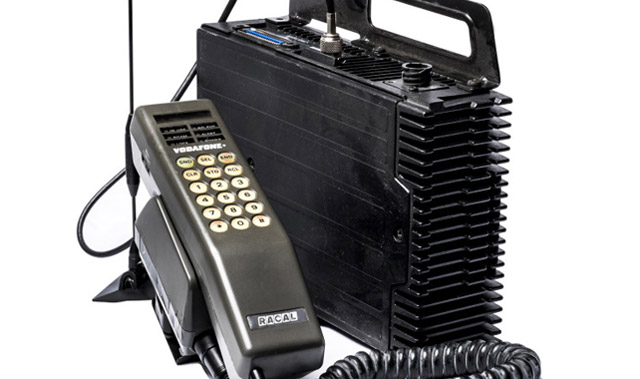
    The Vodafone VM1 weighed almost 5kg
    The Vodafone VM1 weighed almost 5kg

    Imagine a cellphone that weighs almost 5kg, is the size of a briefcase and costs R75 000 in today’s money? Believe it or not, that’s what early adopters had to put up with in the early days on mobile in the 1980s.

    To commemorate the first-ever mobile phone call 30 years ago — on 1 January 1985 — Vodafone in the UK, on whose network the call was made, has released a list of the first phones it sold to consumers.

    They included the VM1, a 1985 model that weighed in at 4,9kg. It cost £1 475, or £4 141 when adjusted for inflation.

    The VM1 was classed as a mobile phone, but it couldn’t actually be used outside of a car. The heavy base unit was bolted into the boot of the car or the rear parcel shelf, according to Vodafone. The phone itself was mounted in the front of the vehicle, in front of the dashboard or in the armrest.

    The VM1 was fitted with an aerial drilled into the roof of the car, the company said. An additional glass mount aerial could be stuck out of the rear screen of the car to help pick up greater reception.

    Michael Douglas with a Motorola 8000X in Wall Street
    Michael Douglas with a Motorola 8000X in Wall Street

    Although the VM1 was the first product that company sold, the Transportable Vodafone VT1 became available simultaneously close to the January 1985 launch of the network. It weighed 200g less than the VM1 — 4,7kg — and would have to be charged for 10 hours to provide 30 minutes of talktime. It could be charged in or out of the car depending on the kit the user bought to go with it, Vodafone said.

    The Transportable Vodafone VT1
    The Transportable Vodafone VT1

    “Most customers opted to buy a VM1 above a Transportable if they were frequently in their car, as this was more convenient.”

    The first mobile phone that bears a resemblance to modern devices was the Motorola 8000X, introduced by Vodafone in March 1985. Christened “The Brick” by its users, it was used by Michael Douglas in the 1987 Hollywood hit Wall Street. It cost £2 995, which translates into £8 409 (more than R150 000) in today’s money.
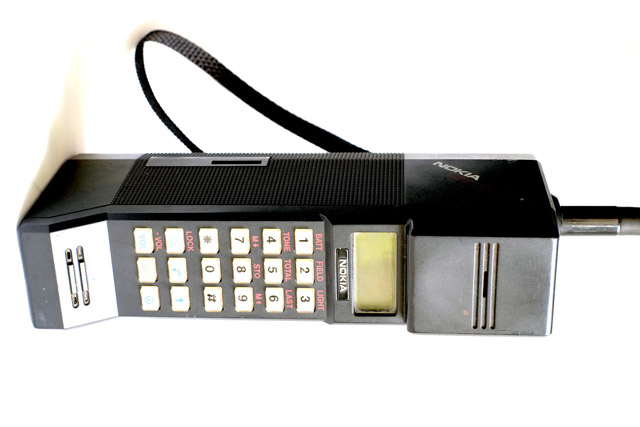
    Nokia Cityman 1320
    Nokia Cityman 1320

    Other early mobiles included the £1 875 (£5 264 adjusted) VPI Citiphone, which played “God Save the Queen” if its user pressed 001 on the keypad and and Chopin’s “Funeral March” if it malfunctioned. There was the Nokia Cityman 1320, Nokia’s first portable phone, introduced in the late 1980s. The Cityman, which weighed 0,75kg, would have set back an early adopter almost £5 000 (R90 000) in today’s money.  — © 2015 NewsCentral Media

    Add TechCentral as a preferred source on GoogleFollow TechCentral on Google NewsGet breaking news on WhatsApp


    Motorola Nokia Vodafone
    WhatsApp YouTube
    Share. Facebook Twitter LinkedIn WhatsApp Telegram Email Copy Link
    Previous ArticleOld Hollywood battles the tech upstarts
    Next Article Plans for Africa-led mission to the moon

    Related Posts

    Meet the CIO | Vodacom's Mohamed Sami on the agentic future

    Meet the CIO | Vodacom’s Mohamed Sami on the agentic future

    5 October 2026
    Vodacom squeezes more 4G and 5G capacity out of cramped sites

    Vodacom squeezes more 4G and 5G capacity out of cramped sites

    29 September 2026
    Vodacom's Safaricom deal struck down by Kenyan high court

    Vodacom’s Safaricom deal struck down by Kenyan high court

    15 September 2026
    Company News
    Why fintechs need an insurance partner they can trust - Hollard Insurance

    Why fintechs need an insurance partner they can trust

    8 October 2026
    Reusable KYC means the end of 'please upload your ID' - Contactable

    Reusable KYC means the end of ‘please upload your ID’

    8 October 2026
    Eliminating the 'toggle tax': how CRM integration changes customer experience - Martie de Beer

    Eliminating the ‘toggle tax’: how CRM integration changes customer experience

    8 October 2026
    Opinion
    When a machine can choose, who does it become? Fanie van Rooyen

    When a machine can choose, who does it become?

    9 October 2026
    Let South Africans jailbreak their way to digital sovereignty - Dirk de Vos

    Let South Africans jailbreak their way to digital sovereignty

    5 October 2026
    South Africa's next energy crisis is in the accounts department - Craig Holmes

    South Africa’s next energy crisis is in the accounts department

    29 September 2026

    Subscribe to Updates

    Get the best South African technology news and analysis delivered to your e-mail inbox every morning.

    Latest Posts
    Africa Bitcoin Corporation board quits in shareholder clash - Stafford Masie

    Africa Bitcoin Corporation board quits in shareholder clash

    12 October 2026
    Capitec is setting traps for scammers' mule accounts - Andrew Baker

    Capitec is setting traps for scammers’ mule accounts

    12 October 2026
    Sars to pay Microsoft and IBM R2.75-billion in sole-source deals

    Sars to pay Microsoft and IBM R2.75-billion in sole-source deals

    12 October 2026
    Microsoft president says milk faces more regulation than AI - President Cyril Ramaphosa with Microsoft president and vice chairman Brad Smith

    Microsoft president says milk faces more regulation than AI

    12 October 2026
    © 2009 - 2026 NewsCentral Media
    Built and maintained by Chronon
    • Cookie policy (ZA)
    • TechCentral – privacy and Popia

    Type above and press Enter to search. Press Esc to cancel.

    Manage consent

    TechCentral uses cookies to enhance its offerings. Consenting to these technologies allows us to serve you better. Not consenting or withdrawing consent may adversely affect certain features and functions of the website.

    Functional Always active
    The technical storage or access is strictly necessary for the legitimate purpose of enabling the use of a specific service explicitly requested by the subscriber or user, or for the sole purpose of carrying out the transmission of a communication over an electronic communications network.
    Preferences
    The technical storage or access is necessary for the legitimate purpose of storing preferences that are not requested by the subscriber or user.
    Statistics
    The technical storage or access that is used exclusively for statistical purposes. The technical storage or access that is used exclusively for anonymous statistical purposes. Without a subpoena, voluntary compliance on the part of your Internet Service Provider, or additional records from a third party, information stored or retrieved for this purpose alone cannot usually be used to identify you.
    Marketing
    The technical storage or access is required to create user profiles to send advertising, or to track the user on a website or across several websites for similar marketing purposes.
    • Manage options
    • Manage services
    • Manage {vendor_count} vendors
    • Read more about these purposes
    View preferences
    • {title}
    • {title}
    • {title}
    🇿🇦 Sign up to the TechCentral newsletter