Close Menu
TechCentralTechCentral

    Subscribe to the newsletter

    Get the best South African technology news and analysis delivered to your e-mail inbox every morning.

    Facebook X (Twitter) YouTube LinkedIn
    WhatsApp Facebook X (Twitter) LinkedIn YouTube
    TechCentralTechCentral
    • News
      Eskom developing bitcoin mining plan but needs Nersa's nod - Agnes Mlambo

      Eskom developing bitcoin mining plan but needs Nersa’s nod

      22 April 2026
      Eskom to decide fate of older coal stations by September - Dan Marokane

      Eskom to decide fate of older coal stations by September

      22 April 2026
      Capitec bets big on AI - and keeps hiring

      Capitec bets big on AI – and keeps hiring

      22 April 2026
      Capitec blows up MVNO pricing with free on-net calls - Graham Lee

      Capitec blows up MVNO pricing with free on-net calls

      22 April 2026
      After mobile, Capitec Connect eyes home broadband push

      After mobile, Capitec Connect eyes home broadband push

      22 April 2026
    • World
      More organic compounds detected on Mars - Nasa Curiosity rover

      More organic compounds detected on Mars

      21 April 2026
      Adobe bets on AI agents to fend off cheaper rivals

      Adobe bets on AI agents to fend off cheaper rivals

      16 April 2026
      Google poised to lose ad crown to Meta

      Google poised to lose ad crown to Meta

      14 April 2026
      Grand Theft Data - hackers hit Rockstar Games - Grand Theft Auto

      Grand Theft Data – hackers hit Rockstar Games

      14 April 2026
      UK PM Keir Starmer declares war on doomscrolling

      UK PM Keir Starmer declares war on doomscrolling

      13 April 2026
    • In-depth
      Africa switches on as Europe dims the lights

      Africa switches on as Europe dims the lights

      9 April 2026
      The biggest untapped EV market on Earth is hiding in plain sight

      The biggest untapped EV market on Earth is hiding in plain sight

      1 April 2026
      The R18-billion tech giant hiding in plain sight - Jens Montanana

      The R16-billion tech giant hiding in plain sight

      26 March 2026
      The last generation of coders

      The last generation of coders

      18 February 2026
      Sentech is in dire straits

      Sentech is in dire straits

      10 February 2026
    • TCS

      TCS+ | ‘The ISP for ISPs’: Vox’s shift to wholesale aggregator

      20 April 2026
      TCS | Werner Lindemann on how AI is rewriting the infosec rulebook

      TCS | Werner Lindemann on how AI is rewriting the infosec rulebook

      15 April 2026
      TCS | Donovan Marsh on AI and the future of filmmaking

      TCS | Donovan Marsh on AI and the future of filmmaking

      7 April 2026
      TCS+ | Vodacom Business moves to crack the SME tech gap - Andrew Fulton, Sannesh Beharie

      TCS+ | Vodacom Business moves to crack the SME tech gap

      7 April 2026
      TCS | MTN's Divysh Joshi on the strategy behind Pi - Divyesh Joshi

      TCS | MTN’s Divyesh Joshi on the strategy behind Pi

      1 April 2026
    • Opinion
      The conflict of interest at the heart of PayShap's slow adoption - Cheslyn Jacobs

      The conflict of interest at the heart of PayShap’s slow adoption

      26 March 2026
      South Africa's energy future hinges on getting wheeling right - Aishah Gire

      South Africa’s energy future hinges on getting wheeling right

      10 March 2026
      Hold the doom: the case for a South African comeback - Duncan McLeod

      Apple just dropped a bomb on the Windows world

      5 March 2026
      R230-million in the bag for Endeavor's third Harvest Fund - Alison Collier

      VC’s centre of gravity is shifting – and South Africa is in the frame

      3 March 2026
      Hold the doom: the case for a South African comeback - Duncan McLeod

      Hold the doom: the case for a South African comeback

      26 February 2026
    • Company Hubs
      • 1Stream
      • Africa Data Centres
      • AfriGIS
      • Altron Digital Business
      • Altron Document Solutions
      • Altron Group
      • Arctic Wolf
      • Ascent Technology
      • AvertITD
      • BBD
      • Braintree
      • CallMiner
      • CambriLearn
      • CYBER1 Solutions
      • Digicloud Africa
      • Digimune
      • Domains.co.za
      • ESET
      • Euphoria Telecom
      • HOSTAFRICA
      • Incredible Business
      • iONLINE
      • IQbusiness
      • Iris Network Systems
      • Kaspersky
      • LSD Open
      • Mitel
      • NEC XON
      • Netstar
      • Network Platforms
      • Next DLP
      • Ovations
      • Paracon
      • Paratus
      • Q-KON
      • SevenC
      • SkyWire
      • Solid8 Technologies
      • Telit Cinterion
      • Telviva
      • Tenable
      • Vertiv
      • Videri Digital
      • Vodacom Business
      • Wipro
      • Workday
      • XLink
    • Sections
      • AI and machine learning
      • Banking
      • Broadcasting and Media
      • Cloud services
      • Contact centres and CX
      • Cryptocurrencies
      • Education and skills
      • Electronics and hardware
      • Energy and sustainability
      • Enterprise software
      • Financial services
      • HealthTech
      • Information security
      • Internet and connectivity
      • Internet of Things
      • Investment
      • IT services
      • Lifestyle
      • Motoring
      • Policy and regulation
      • Public sector
      • Retail and e-commerce
      • Satellite communications
      • Science
      • SMEs and start-ups
      • Social media
      • Talent and leadership
      • Telecoms
    • Events
    • Advertise
    TechCentralTechCentral
    Home » In-depth » The cloud under the ocean

    The cloud under the ocean

    By The Conversation5 November 2015
    Twitter LinkedIn Facebook WhatsApp Email Telegram Copy Link
    News Alerts
    WhatsApp
    A submarine cable system coming ashore in Fiji
    A submarine cable system coming ashore in Fiji

    Recently, a New York Times article on Russian submarine activity near undersea communications cables dredged up Cold War politics and generated widespread recognition of the submerged systems we all depend upon.

    Not many people realise that undersea cables transport nearly 100% of transoceanic data traffic. These lines are laid on the very bottom of the ocean floor. They’re about as thick as a garden hose and carry the world’s Internet, phone calls and even television transmissions between continents at the speed of light. A single cable can carry tens of terabits of information per second.

    While researching my book The Undersea Network, I realised that the cables we all rely on to send everything from e-mail to banking information across the seas remain largely unregulated and undefended. Although they are laid by only a few companies (including the American company SubCom and the French company Alcatel-Lucent) and often funnelled along narrow paths, the ocean’s vastness has often provided them protection.

    The fact that we route Internet traffic through the ocean — amid deep-sea creatures and hydrothermal vents — runs counter to most people’s imaginings of the Internet. Didn’t we develop satellites and Wi-Fi to transmit signals through the air? Haven’t we moved to the cloud? Undersea cable systems sound like a thing of the past.

    The reality is that the cloud is actually under the ocean. Even though they might seem behind the times, fibre-optic cables are actually state-of-the-art global communications technologies. Since they use light to encode information and remain unfettered by weather, cables carry data faster and cheaper than satellites. They crisscross the continents too — a message from New York to California also travels by fibr-optic cable. These systems are not going to be replaced by aerial communications anytime soon.

    The biggest problem with cable systems is not technological — it’s human. Because they run underground, underwater and between telephone poles, cable systems populate the same spaces we do. As a result, we accidentally break them all the time. Local construction projects dig up terrestrial lines. Boaters drop anchors on cables. And submarines can pinpoint systems under the sea.

    Most of the recent media coverage has been dominated by the question of vulnerability. Are global communications networks really at risk of disruption? What would happen if these cables were cut? Do we need to worry about the threat of sabotage from Russian subs or terrorist agents?

    The answer to this is not black and white. Any individual cable is always at risk, but likely far more so from boaters and fishermen than any saboteur. Over history, the single largest cause of disruption has been people unintentionally dropping anchors and nets. The International Cable Protection Committee has been working for years to prevent such breaks.
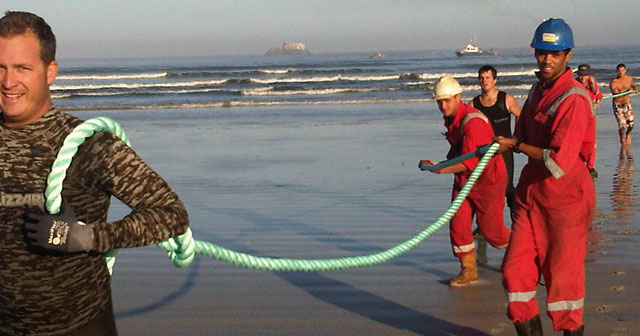
    The Wacs cable coming ashore in 2011 north of Cape Town (image: Aki Anastasiou)
    The Wacs cable coming ashore in 2011 north of Cape Town (image: Aki Anastasiou)

    As a result, cables today are covered in steel armour and buried beneath the seafloor at their shore-ends, where the human threat is most concentrated. This provides some level of protection. In the deep sea, the ocean’s inaccessibility largely safeguards cables — they need only to be covered with a thin polyethylene sheath. It’s not that it’s much more difficult to sever cables in the deep ocean, it’s just that the primary forms of interference are less likely to happen. The sea is so big and the cables are so narrow, the probability isn’t that high that you’d run across one.

    Sabotage has actually been rare in the history of undersea cables. There are certainly occurrences (though none recently), but these are disproportionately publicised. The World War 1 German raid of the Fanning Island cable station in the Pacific Ocean gets a lot of attention. And there was speculation about sabotage in the cable disruptions outside Alexandria, Egypt in 2008, which cut 70% of the country’s Internet, affecting millions. Yet we hear little about the regular faults that occur, on average, about 200 times each year.

    Redundancy provides some protection
    The fact is it’s incredibly difficult to monitor these lines. Cable companies have been trying to do so for more than a century, since the first telegraph lines were laid in the 1800s. But the ocean is too vast and the lines simply too long. It would be impossible to stop every vessel that came anywhere near critical communications cables. We’d need to create extremely long, “no-go” zones across the ocean, which itself would profoundly disrupt the economy.

    Fewer than 300 cable systems transport almost all transoceanic traffic around the world. And these often run through narrow pressure points where small disruptions can have massive impacts. Since each cable can carry an extraordinary amount of information, it’s not uncommon for an entire country to rely on only a handful of systems. In many places, it would take only a few cable cuts to take out large swathes of the Internet. If the right cables were disrupted at the right time, it could disrupt global Internet traffic for weeks or even months.

    The thing that protects global information traffic is the fact that there’s some redundancy built into the system. Since there is more cable capacity than there is traffic, when there is a break, information is automatically rerouted along other cables. Because there are many systems linking to the US, and a lot of Internet infrastructure is located here, a single cable outage is unlikely to cause any noticeable effect for Americans.

    Any single cable line has been and will continue to be susceptible to disruption. And the only way around this is to build a more diverse system. But as things are, even though individual companies each look out for their own network, there is no economic incentive or supervisory body to ensure the global system as a whole is resilient. If there’s a vulnerability to worry about, this is it.The Conversation

    • Nicole Starosielski is assistant professor of media, culture and communication at New York University
    • This article was originally published on The Conversation

    Follow TechCentral on Google News Add TechCentral as your preferred source on Google


    Nicole Starosielski Wacs
    WhatsApp YouTube
    Share. Facebook Twitter LinkedIn WhatsApp Telegram Email Copy Link
    Previous ArticleCrimson Peak takes high-gothic crown
    Next Article MTN toys with idea of dual-Sim phones

    Related Posts

    Bandwidth bonanza: the undersea cables that connect SA to the world

    Bandwidth bonanza: the undersea cables that connect South Africa to the world

    12 July 2024
    Starlink is already at capacity in some African cities

    Subsea cable cuts hit Africa again, causing major disruption

    12 May 2024
    Severed West African internet cables repaired

    Severed West African internet cables repaired

    30 April 2024
    Company News
    How AnyDesk is redefining remote access for African enterprises

    How AnyDesk is redefining remote access for African enterprises

    22 April 2026
    Centracom's Pindrop takes the pain out of wholesale fibre

    Centracom’s Pindrop takes the pain out of wholesale fibre

    22 April 2026
    Conversational AI is rewriting the customer service playbook - CallMiner

    Conversational AI is rewriting the customer service playbook

    22 April 2026
    Opinion
    The conflict of interest at the heart of PayShap's slow adoption - Cheslyn Jacobs

    The conflict of interest at the heart of PayShap’s slow adoption

    26 March 2026
    South Africa's energy future hinges on getting wheeling right - Aishah Gire

    South Africa’s energy future hinges on getting wheeling right

    10 March 2026
    Hold the doom: the case for a South African comeback - Duncan McLeod

    Apple just dropped a bomb on the Windows world

    5 March 2026

    Subscribe to Updates

    Get the best South African technology news and analysis delivered to your e-mail inbox every morning.

    Latest Posts
    Eskom developing bitcoin mining plan but needs Nersa's nod - Agnes Mlambo

    Eskom developing bitcoin mining plan but needs Nersa’s nod

    22 April 2026
    Eskom to decide fate of older coal stations by September - Dan Marokane

    Eskom to decide fate of older coal stations by September

    22 April 2026
    How AnyDesk is redefining remote access for African enterprises

    How AnyDesk is redefining remote access for African enterprises

    22 April 2026
    Capitec bets big on AI - and keeps hiring

    Capitec bets big on AI – and keeps hiring

    22 April 2026
    © 2009 - 2026 NewsCentral Media
    • Cookie policy (ZA)
    • TechCentral – privacy and Popia

    Type above and press Enter to search. Press Esc to cancel.

    Manage consent

    TechCentral uses cookies to enhance its offerings. Consenting to these technologies allows us to serve you better. Not consenting or withdrawing consent may adversely affect certain features and functions of the website.

    Functional Always active
    The technical storage or access is strictly necessary for the legitimate purpose of enabling the use of a specific service explicitly requested by the subscriber or user, or for the sole purpose of carrying out the transmission of a communication over an electronic communications network.
    Preferences
    The technical storage or access is necessary for the legitimate purpose of storing preferences that are not requested by the subscriber or user.
    Statistics
    The technical storage or access that is used exclusively for statistical purposes. The technical storage or access that is used exclusively for anonymous statistical purposes. Without a subpoena, voluntary compliance on the part of your Internet Service Provider, or additional records from a third party, information stored or retrieved for this purpose alone cannot usually be used to identify you.
    Marketing
    The technical storage or access is required to create user profiles to send advertising, or to track the user on a website or across several websites for similar marketing purposes.
    • Manage options
    • Manage services
    • Manage {vendor_count} vendors
    • Read more about these purposes
    View preferences
    • {title}
    • {title}
    • {title}