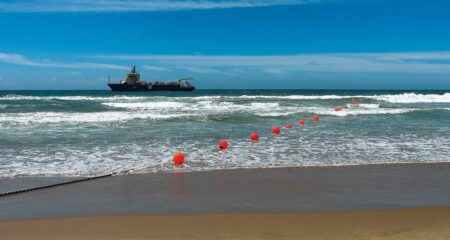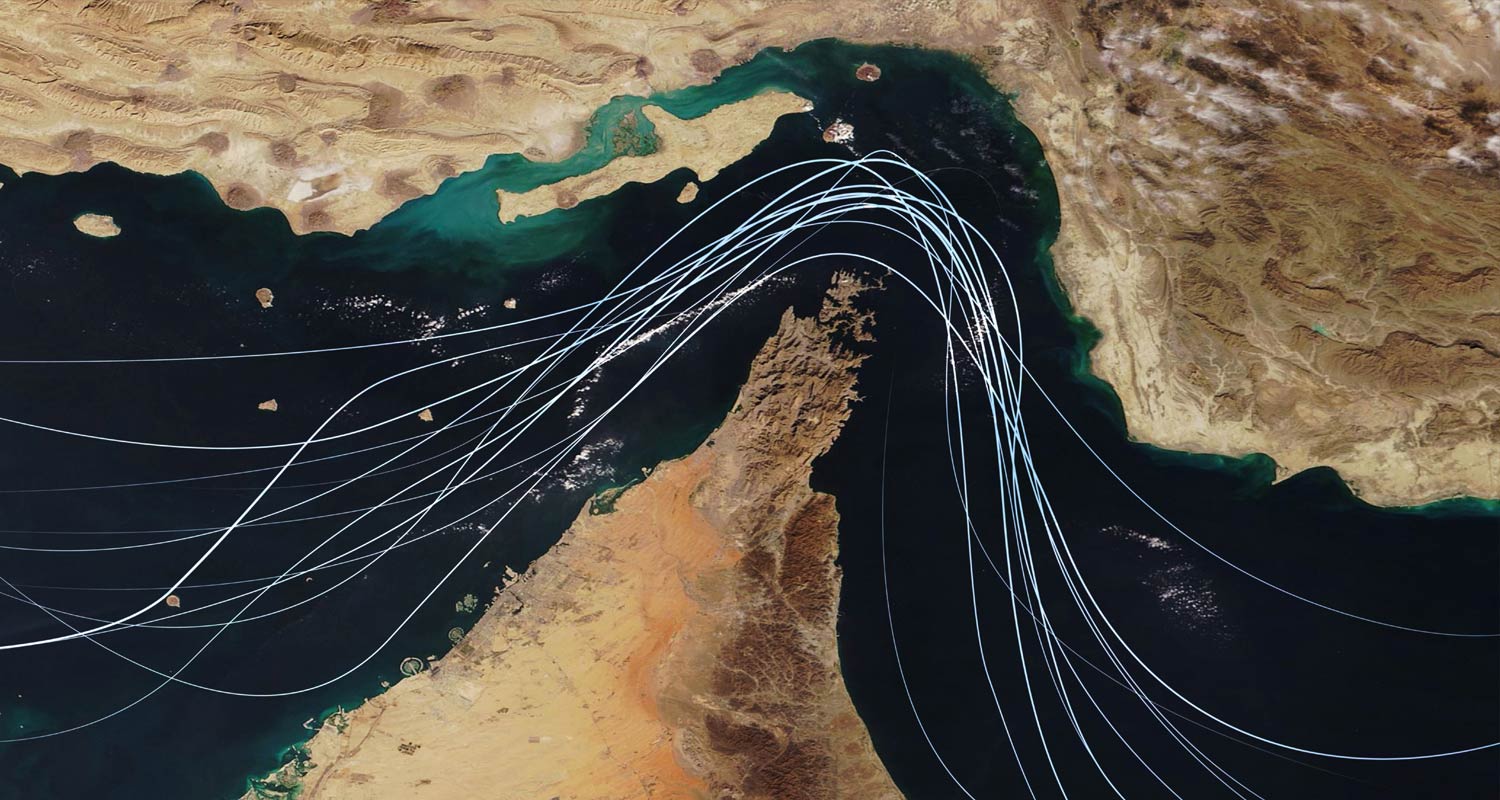
Iran is signalling that it wants to extract rent from the global data traffic flowing through the Strait of Hormuz, with state-aligned media floating a model under which the world’s largest technology companies would pay licensing fees, submit to Iranian jurisdiction and hand maintenance of subsea cables to Iranian firms.
The proposals were published in recent days by Islamic Revolutionary Guard Corps-linked outlets Tasnim and Fars and reported by Rest of World.
They outline initial licensing and annual renewal fees for foreign companies operating on the seabed under the strait; a requirement that the likes of Meta, Amazon and Microsoft formally operate under Iranian law; and exclusive Iranian control over the maintenance and repair of the cables that run beneath Hormuz.
Tasnim described the strait as a “strategic centre for legitimate wealth creation”, arguing the Islamic Republic has been deprived of the sovereign benefits of the communications infrastructure crossing its territorial waters.
It is worth stressing that this is, for now, an idea aired in IRGC-aligned media rather than a formal government position.
The wider region is heavily exposed. About 17 submarine cables pass through the Red Sea alone, carrying the vast majority of data between Europe, Asia and Africa, with further cables threading Hormuz – a separate choke point at the mouth of the Gulf – to serve Iran, Iraq, Kuwait, Bahrain and Qatar. Newly pledged infrastructure projects, including high-density AI data centres planned for various parts of the Gulf region, are also at risk.
Precedent
US President Donald Trump’s tour of the region last May produced US$2.2-trillion in investment pledges, anchored by Stargate UAE – a planned 5GW AI campus in Abu Dhabi by OpenAI, G42, Oracle, Nvidia and SoftBank that would be the largest outside the US – and a $5-billion Amazon commitment to a Riyadh hub with Saudi Arabia’s Humain.
According to Rest of World, the security framework wrapped around those deals, including the January 2026 Pax Silica initiative aimed at keeping advanced chips out of Chinese hands, was never designed to protect physical infrastructure from Iranian missiles or Houthi drones.
Read: South Africa is rapidly becoming a hyperconnected country
Iran’s move has precedent in Egypt. Egypt occupies a critical bottleneck in global internet infrastructure, holding a monopoly over the shortest, most direct route for undersea cables between Europe and Asia – through the Red Sea and across its land to the Mediterranean. State-owned Telecom Egypt has been accused of overcharging for capacity, with the high transit fees pushing up operational costs for international service providers.
Iran’s threat to go in a similar direction opens the door to an explosion of comparable regimes at other global undersea cable choke points, with the risk being a resultant rise in the cost of communications the world over.

When the transmission of data through undersea cables in areas such as the Bab al-Mandeb Strait is disrupted, terrestrial fibre networks are often used as a failover. According to Steve Song, founder of Village Telco and the man behind a map of subsea cables serving the African content, this makes the accurate mapping of terrestrial fibre just as important as the mapping of undersea cables.
“When people talk about the disruption of undersea cables off the coast of Côte d’Ivoire, they never focus on the fact that terrestrial infrastructure played a critical role in the restoration of services in the region. When we talk about the 2Africa cable, nobody mentions the 400km terrestrial fibre segment through Egypt that is necessary due to insecurity in the Red Sea.
“Often, and increasingly, terrestrial fibre routes are absolutely critical to fibre infrastructure resiliency, yet the available information about them, unlike undersea cables, is often very limited,” said Song.
Read: The lessons Seacom learnt from its massive 2024 outage
If choke-point states can both tax the data crossing their territory and, when it suits them, disrupt it, then alternative routes stop being a technical convenience and become a strategic necessity. For any single state – Egypt, Iran or the next one to follow – levying a toll on the data beneath its waters looks like a rational way to convert geography into revenue. But if every choke point does the same, the cumulative effect will be a costlier and more fragmented internet. – © 2026 NewsCentral Media
Get breaking news from TechCentral on WhatsApp. Sign up here.