
Close Menu
TechCentralTechCentral

    Subscribe to the newsletter

    Get the best South African technology news and analysis delivered to your e-mail inbox every morning.

    Facebook X (Twitter) YouTube LinkedIn
    WhatsApp Facebook X (Twitter) LinkedIn YouTube
    TechCentralTechCentral
    • News
      Rural South Africa does not need six towers to have a choice - Nomvuyiso Batyi, CEO of the Association of Comms & Technology

      Rural South Africa does not need six towers to have a choice

      4 September 2026
      icasa

      Icasa to investigate what South Africans pay to communicate

      4 September 2026
      Warren Wheatley, CEO of Africa Bitcoin Corporation

      Share manipulation behind Africa Bitcoin debarments, FSCA says

      4 September 2026
      OpenAI logo signage, illustrating the launch of the GPT-6 Astra model

      OpenAI chases Anthropic’s enterprise lead with GPT-6 Astra

      4 September 2026
      Uber retreats from key African markets

      Uber retreats from key African markets

      3 September 2026
    • World
      'This is not circular': Jensen Huang defends $3.5-billion MediaTek deal

      ‘This is not circular’: Jensen Huang defends $3.5-billion MediaTek deal

      2 September 2026
      AI-generated music banned from Australian charts

      AI-generated music banned from Australian charts

      26 August 2026
      Traders brace for a R4.5-trillion swing in Nvidia's value

      Traders brace for a R4.5-trillion swing in Nvidia’s value

      25 August 2026
      Russia building its own Starlink - and faster than expected - Vadym Skibitskyi

      Russia building its own Starlink – and faster than expected

      11 August 2026
      Meta AI will now tell parents if their teen is in crisis

      Meta AI will now tell parents if their teen is in crisis

      17 July 2026
    • In-depth
      Google DeepMind CEO Demis Hassabis. Image: John Sears

      The plan to stop AI from breaking the world

      16 July 2026
      The internet has a Strait of Hormuz problem

      The internet has a Strait of Hormuz problem

      15 July 2026
      AI boom sparks rally, frenzy and fear

      AI boom sparks rally, frenzy and fear

      11 June 2026
      Every plug-in hybrid on sale in South Africa, ranked by price - Lamborghini Temerario

      Every plug-in hybrid on sale in South Africa, ranked by price

      7 June 2026
      What Wi-Fi 8 will mean for wireless networks

      What Wi-Fi 8 will mean for wireless networks

      1 June 2026
    • TCS
      Winstone Jordaan on building a national EV charging network

      Winstone Jordaan on building a national EV charging network

      2 September 2026
      Watts & Wheels S1E8: 'Tesla lands in Africa, just not here'

      Watts & Wheels S1E8: ‘Tesla lands in Africa, just not here’

      24 August 2026
      TCS | Herotel CEO Van Zyl Botha on beating Starlink to South Africa

      TCS | Herotel CEO Van Zyl Botha on beating Starlink to South Africa

      14 August 2026
      Meet the CIO | Discovery's Derek Wilcocks on AI, guardrails and growth

      Meet the CIO | Derek Wilcocks on how AI personalised Vitality

      13 August 2026
      TCS | Money just became native to the internet - Steven Boykey Sidley

      TCS | Money just became native to the internet – Steven Boykey Sidley

      12 August 2026
    • Opinion
      The fragile joint in the Capitec machine - Pambos Soteriades

      The R197-billion market the banks can’t reach

      25 August 2026
      South African tech's compounding debt problem - Jannie van Zyl

      Management consulting as we know it is over

      21 August 2026
      South African tech's compounding debt problem - Jannie van Zyl

      The most dangerous customer is the quiet one

      10 August 2026
      South African tech's compounding debt problem - Jannie van Zyl

      South African tech’s compounding debt problem

      29 July 2026
      The fragile joint in the Capitec machine - Pambos Soteriades

      Best network, worst vibes: the puzzle of SA telecoms

      20 July 2026
    • Company Hubs
      • 1Stream
      • Africa Data Centres
      • AfriGIS
      • Altron Digital Business
      • Altron Document Solutions
      • Altron Group
      • Arctic Wolf
      • Ascent Technology
      • AvertITD
      • BBD
      • Braintree
      • CallMiner
      • CambriLearn
      • CM.com
      • Contactable
      • CYBER1 Solutions
      • Digicloud Africa
      • Digimune
      • Domains.co.za
      • ESET
      • Euphoria Telecom
      • HOSTAFRICA
      • Incredible Business
      • iONLINE
      • IQbusiness
      • Iris Network Systems
      • Kaspersky
      • LSD Open
      • Mitel
      • NEC XON
      • Netstar
      • Network Platforms
      • Next DLP
      • Ovations
      • Paracon
      • Paratus
      • Q-KON
      • SevenC
      • SkyWire
      • Solid8 Technologies
      • Telit Cinterion
      • Telviva
      • Tenable
      • Vertiv
      • Videri Digital
      • Vodacom Business
      • Vox
      • Wipro
      • Workday
      • XLink
    • Sections
      • AI and machine learning
      • Banking
      • Broadcasting and Media
      • Cloud services
      • Contact centres and CX
      • Cryptocurrencies
      • Education and skills
      • Electronics and hardware
      • Energy and sustainability
      • Enterprise software
      • Financial services
      • HealthTech
      • Information security
      • Internet and connectivity
      • Internet of Things
      • Investment
      • IT services
      • Lifestyle
      • Policy and regulation
      • Public sector
      • Retail and e-commerce
      • Satellite communications
      • Science
      • SMEs and start-ups
      • Social media
      • Talent and leadership
      • Telecoms
      • Watts & Wheels
    • Events
    • Advertise
    TechCentralTechCentral
    Home » In-depth » What’s really going on in SA’s mobile market

    What’s really going on in SA’s mobile market

    By Hilton Tarrant21 October 2016
    Twitter LinkedIn Facebook WhatsApp Email Telegram Copy Link
    News Alerts
    WhatsApp

    smartphone-640

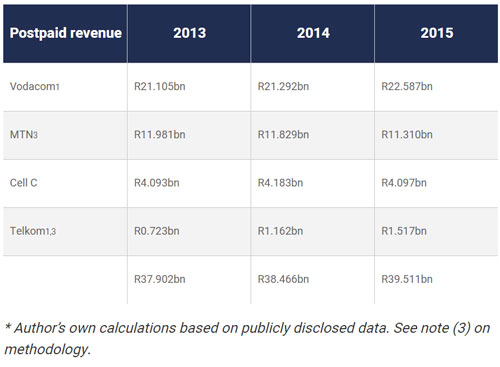
    R39,5bn. That’s the amount South Africans spent on cellphone contracts in 2015¹. This analysis of the market is possible for the first time after the publication of a transaction circular by Blue Label Telecoms, which detailed (in some respects, at least) the operational and financial performance of Cell C since 2013.

    But the post-paid market is, not surprisingly, barely growing.

    For one, the broader mobile market is obviously mature (Sim penetration is comfortably north of 160%). But, there’s a structural limitation to the number of customers that can actually afford a post-paid contract (in other words, they need to be economically active and pass credit and affordability assessments).

    There are two ways of looking at this. The number of subscribers only tells half the story. Besides, an analysis of post-paid subscriber growth is almost impossible given that we only have a solitary data point for Cell C, namely a breakdown of subscribers as at 30 June 2016. Following the money sketches a far better picture.

    Remember that the broader mobile market (handsets excluded) is effectively in deflation. Tariffs aren’t going up (across the board) by the rate of inflation². With the pressures of competition as well as the shift to bundled offers (for voice, data and in the context of post-paid, integrated tariff plans), prices have been going down over time. At best, they’re holding steady.
    sa-mobile-640

    This summary shows that the post-paid market — measured by revenue — grew by just 1% between 2013 and 2014 and 3% between 2014 and last year. And while post-paid remains less competitive (by definition) than the prepaid market, some trends are very clear over the past 24-36 months. Chiefly, Vodacom has managed to grow post-paid revenue strongly (6%) between April 2014 to March 2015 and April 2015 to March this year. It’s done exceptionally well over time to retain and grow its contract customer base which, by revenue, is now twice as large as its next biggest competitor (MTN). In fact, Vodacom owns 57% of the South African post-paid market by revenue.

    MTN has done poorly in recent years, with a nearly R700m decline in its post-paid business between 2013 and 2015. It has been growing this base after some setbacks in 2013/2014, but it’s been forced to hunt for customers at the lower end of this segment. Its average revenue per user trend over the 36-month period illustrates this perfectly, with a drop from nearer the R200 mark in 2013 to the mid-R160 level in 2015.

    Cell C’s post-paid base, despite a strong focus on contract buyouts and product innovation, is almost exactly flat across the 36 months (it grew by 2% in 2014 but slipped by 2% in 2015).

    Don’t discount the impact of Telkom’s mobile division starting to find its feet. It has managed to double post-paid revenue over the past three years and will easily be half the size of Cell C’s post-paid business in 2016 (about R2bn), given its FreeMe products which have aggressively up-ended the market.

    Based on 2015 data, post-paid revenue market shares are: Vodacom 57%; MTN 29%; Cell C 10%; and Telkom Mobile 4%.

    We don’t have any data to quantify the impact of mobile virtual network operators (MVNOs) like FNB Connect and Afrihost Mobile. Anecdotally, it seems as if there is a fair amount of switching, particularly at the higher end of the market. But, given the numbers of subscribers involved — less than 500 000 — this isn’t material, yet.
    sa-mobile-2-640

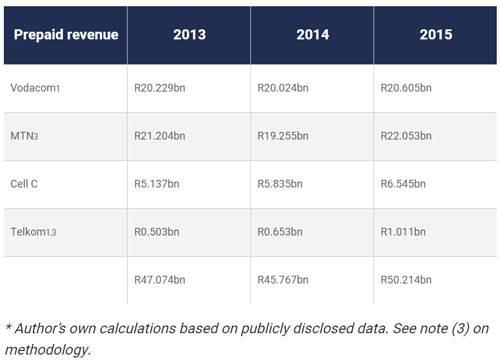
    By comparison, the prepaid market is a R50bn one, meaning South Africans spend, on average, R4,2bn on “pay-as-you-go” per month, or about R140m/day. And while there was a 3% decline in total revenue between 2013 and 2014, there was strong growth (10%) between 2014 and 2015.

    At this point, prepaid is about 56% of the total market, with post-paid at 44%. In other words, for every R100 spent on mobile telephony in South Africa, R56 is on prepaid, while R44 is on contract (subscriptions included, but excluding handsets).

    Vodacom’s prepaid business is pretty flat over the 36-month period summarised above with only 2% growth between 2013 (April 2013 to March 2014) and 2015 (April 2015 to March 2016).

    MTN’s done well to recover from a horrible year in 2014, with a 15% jump between 2014 and 2015 (after a 9% decline the prior year). Effectively all of Cell C’s revenue growth over this period has been in the prepaid space and it has grown this segment of income by more than 25% (14% and then 12%). Telkom has more than doubled prepaid revenue over the 36 months, but this is off a very low base.

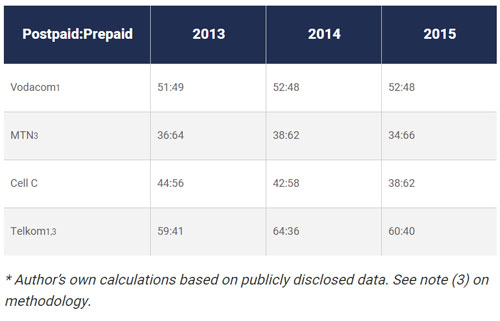
    Looking at relative sizes of post-paid and prepaid businesses at each of the operators is interesting, and all four are very different in make-up.
    sa-mobile-3-640

    Vodacom’s two segments are roughly evenly split and have remained fairly constant over time. MTN has seen a shift to prepaid becoming effectively two-thirds of its business and Cell C seems to be headed in the same direction. Telkom has the majority of its revenue in post-paid. While it is a (relatively) new entrant, the FreeMe packages should further entrench this split.

    Operators (understandably) don’t disclose profits of these various segments. But, post-paid is more profitable than prepaid and — importantly — has far lower churn rates (this shouldn’t be a surprise to anyone). And when you look at earnings and margin data provided by the operators through the lens of this post-paid/prepaid split, you’ll be able to clearly reconcile why Vodacom is managing to grow earnings (and margins), MTN’s are in decline and Telkom’s mobile unit is — at last — profitable (Cell C’s financials are skewed by its mountain of debt).

    1. Data for MTN and Cell C is for the calendar year, while Vodacom and Telkom figures run from 1 April 2015 to 31 March 2016 (their financial year).
    2. Sure, operators made upward adjustments to their base contract subscriptions over the past 12 months, but this is one of the very few levers they have. Tariffs are regulated by Icasa and these cannot be changed summarily.
    3. A note on methodology: Vodacom provides detailed disclosure of post-paid and prepaid revenue (with in- and out-of-bundle splits) and Cell C’s split is available in the Blue Label circular. MTN discloses total service revenue as well as average revenue per user (Arpu) and subscriber numbers per quarter, which means the calculation isn’t too much of a stretch. Telkom provides service revenue and average Arpu (but subscribers as at year-end). This necessitates some adjustment to its split.
    • Hilton Tarrant works at immedia. This article was originally published on Moneyweb and is republished here with permission

    Follow TechCentral on Google News Add TechCentral as your preferred source on Google


    Cell C Icasa MTN Telkom Vodacom
    WhatsApp YouTube
    Share. Facebook Twitter LinkedIn WhatsApp Telegram Email Copy Link
    Previous ArticleMicrosoft shares soar to record high
    Next Article Vodacom speeds up 3G uploads

    Related Posts

    icasa

    Icasa to investigate what South Africans pay to communicate

    4 September 2026
    Rural South Africans should not have to trade competition for coverage - Paul Colmer

    Rural South Africans should not have to trade competition for coverage

    3 September 2026
    If it quacks like a duck: Kganyago on regulating fintechs - Reserve Bank governor Lesetja Kganyago

    If it quacks like a duck: Kganyago on regulating fintechs

    1 September 2026
    Company News
    How to build a security operations centre that actually works - Kaspersky

    How to build a security operations centre that actually works

    3 September 2026
    Paratus Uganda first to market with Starlink service

    Paratus Uganda first to market with Starlink service

    2 September 2026
    Solid8 brings AlgoSec Horizon to Southern Africa - Simone Santana

    Solid8 brings AlgoSec Horizon to Southern Africa

    1 September 2026
    Opinion
    The fragile joint in the Capitec machine - Pambos Soteriades

    The R197-billion market the banks can’t reach

    25 August 2026
    South African tech's compounding debt problem - Jannie van Zyl

    Management consulting as we know it is over

    21 August 2026
    South African tech's compounding debt problem - Jannie van Zyl

    The most dangerous customer is the quiet one

    10 August 2026

    Subscribe to Updates

    Get the best South African technology news and analysis delivered to your e-mail inbox every morning.

    Latest Posts
    Rural South Africa does not need six towers to have a choice - Nomvuyiso Batyi, CEO of the Association of Comms & Technology

    Rural South Africa does not need six towers to have a choice

    4 September 2026
    icasa

    Icasa to investigate what South Africans pay to communicate

    4 September 2026
    Warren Wheatley, CEO of Africa Bitcoin Corporation

    Share manipulation behind Africa Bitcoin debarments, FSCA says

    4 September 2026
    OpenAI logo signage, illustrating the launch of the GPT-6 Astra model

    OpenAI chases Anthropic’s enterprise lead with GPT-6 Astra

    4 September 2026
    © 2009 - 2026 NewsCentral Media
    Built and maintained by Chronon
    • Cookie policy (ZA)
    • TechCentral – privacy and Popia

    Type above and press Enter to search. Press Esc to cancel.

    Manage consent

    TechCentral uses cookies to enhance its offerings. Consenting to these technologies allows us to serve you better. Not consenting or withdrawing consent may adversely affect certain features and functions of the website.

    Functional Always active
    The technical storage or access is strictly necessary for the legitimate purpose of enabling the use of a specific service explicitly requested by the subscriber or user, or for the sole purpose of carrying out the transmission of a communication over an electronic communications network.
    Preferences
    The technical storage or access is necessary for the legitimate purpose of storing preferences that are not requested by the subscriber or user.
    Statistics
    The technical storage or access that is used exclusively for statistical purposes. The technical storage or access that is used exclusively for anonymous statistical purposes. Without a subpoena, voluntary compliance on the part of your Internet Service Provider, or additional records from a third party, information stored or retrieved for this purpose alone cannot usually be used to identify you.
    Marketing
    The technical storage or access is required to create user profiles to send advertising, or to track the user on a website or across several websites for similar marketing purposes.
    • Manage options
    • Manage services
    • Manage {vendor_count} vendors
    • Read more about these purposes
    View preferences
    • {title}
    • {title}
    • {title}