Close Menu
TechCentralTechCentral

    Subscribe to the newsletter

    Get the best South African technology news and analysis delivered to your e-mail inbox every morning.

    Facebook X (Twitter) YouTube LinkedIn
    WhatsApp Facebook X (Twitter) LinkedIn YouTube
    TechCentralTechCentral
    • News
      Digital authoritarianism grows as African states normalise internet blackouts

      Digital authoritarianism grows as African states normalise internet blackouts

      19 December 2025
      Starlink satellite anomaly creates debris in rare orbital mishap

      Starlink satellite anomaly creates debris in rare orbital mishap

      19 December 2025
      TechCentral's South African Newsmakers of 2025

      TechCentral’s South African Newsmakers of 2025

      18 December 2025
      Malatsi buries Post Office's long-dead monopoly

      Malatsi buries Post Office monopoly the market ignored

      18 December 2025
      China races to crack EUV as chip war with the West intensifies

      China races to crack EUV lithography as chip war with the West intensifies

      18 December 2025
    • World
      Trump space order puts the moon back at centre of US, China rivalry - US President Donald Trump

      Trump space order puts the moon back at centre of US, China rivalry

      19 December 2025
      Warner Bros slams the door on Paramount

      Warner Bros slams the door on Paramount

      17 December 2025
      X moves to block bid to revive Twitter brand

      X moves to block bid to revive Twitter brand

      17 December 2025
      Oracle’s AI ambitions face scrutiny on earnings miss

      Oracle’s AI ambitions face scrutiny on earnings miss

      11 December 2025
      China will get Nvidia H200 chips - but not without paying Washington first

      China will get Nvidia H200 chips – but not without paying Washington first

      9 December 2025
    • In-depth
      Black Friday goes digital in South Africa as online spending surges to record high

      Black Friday goes digital in South Africa as online spending surges to record high

      4 December 2025
      Canal+ plays hardball - and DStv viewers feel the pain

      Canal+ plays hardball – and DStv viewers feel the pain

      3 December 2025
      Jensen Huang Nvidia

      So, will China really win the AI race?

      14 November 2025
      Valve's Linux console takes aim at Microsoft's gaming empire

      Valve’s Linux console takes aim at Microsoft’s gaming empire

      13 November 2025
      iOCO's extraordinary comeback plan - Rhys Summerton

      iOCO’s extraordinary comeback plan

      28 October 2025
    • TCS
      TCS+ | Africa's digital transformation - unlocking AI through cloud and culture - Cliff de Wit Accelera Digital Group

      TCS+ | Cloud without culture won’t deliver AI: Accelera’s Cliff de Wit

      12 December 2025
      TCS+ | How Cloud on Demand helps partners thrive in the AWS ecosystem - Odwa Ndyaluvane and Xenia Rhode

      TCS+ | How Cloud On Demand helps partners thrive in the AWS ecosystem

      4 December 2025
      TCS | MTN Group CEO Ralph Mupita on competition, AI and the future of mobile

      TCS | Ralph Mupita on competition, AI and the future of mobile

      28 November 2025
      TCS | Dominic Cull on fixing South Africa's ICT policy bottlenecks

      TCS | Dominic Cull on fixing South Africa’s ICT policy bottlenecks

      21 November 2025
      TCS | BMW CEO Peter van Binsbergen on the future of South Africa's automotive industry

      TCS | BMW CEO Peter van Binsbergen on the future of South Africa’s automotive industry

      6 November 2025
    • Opinion
      Netflix, Warner Bros deal raises fresh headaches for MultiChoice - Duncan McLeod

      Netflix, Warner Bros deal raises fresh headaches for MultiChoice

      5 December 2025
      BIN scans, DDoS and the next cybercrime wave hitting South Africa's banks - Entersekt Gerhard Oosthuizen

      BIN scans, DDoS and the next cybercrime wave hitting South Africa’s banks

      3 December 2025
      Your data, your hardware: the DIY AI revolution is coming - Duncan McLeod

      Your data, your hardware: the DIY AI revolution is coming

      20 November 2025
      Zero Carbon Charge founder Joubert Roux

      The energy revolution South Africa can’t afford to miss

      20 November 2025
      It's time for a new approach to government IT spend in South Africa - Richard Firth

      It’s time for a new approach to government IT spend in South Africa

      19 November 2025
    • Company Hubs
      • Africa Data Centres
      • AfriGIS
      • Altron Digital Business
      • Altron Document Solutions
      • Altron Group
      • Arctic Wolf
      • AvertITD
      • Braintree
      • CallMiner
      • CambriLearn
      • CYBER1 Solutions
      • Digicloud Africa
      • Digimune
      • Domains.co.za
      • ESET
      • Euphoria Telecom
      • Incredible Business
      • iONLINE
      • IQbusiness
      • Iris Network Systems
      • LSD Open
      • NEC XON
      • Netstar
      • Network Platforms
      • Next DLP
      • Ovations
      • Paracon
      • Paratus
      • Q-KON
      • SevenC
      • SkyWire
      • Solid8 Technologies
      • Telit Cinterion
      • Tenable
      • Vertiv
      • Videri Digital
      • Vodacom Business
      • Wipro
      • Workday
      • XLink
    • Sections
      • AI and machine learning
      • Banking
      • Broadcasting and Media
      • Cloud services
      • Contact centres and CX
      • Cryptocurrencies
      • Education and skills
      • Electronics and hardware
      • Energy and sustainability
      • Enterprise software
      • Financial services
      • Information security
      • Internet and connectivity
      • Internet of Things
      • Investment
      • IT services
      • Lifestyle
      • Motoring
      • Public sector
      • Retail and e-commerce
      • Satellite communications
      • Science
      • SMEs and start-ups
      • Social media
      • Talent and leadership
      • Telecoms
    • Events
    • Advertise
    TechCentralTechCentral
    Home » Sections » A giant piece of space junk is hurtling towards Earth

    A giant piece of space junk is hurtling towards Earth

    By The Conversation7 May 2021
    Twitter LinkedIn Facebook WhatsApp Email Telegram Copy Link
    News Alerts
    WhatsApp

    A large piece of space debris, possibly weighing several tons, is currently on an uncontrolled re-entry phase (that’s space-speak for “out of control”), and parts of it are expected to crash down to Earth over the next few weeks.

    If that isn’t worrying enough, it is impossible to predict exactly where the pieces that don’t burn up in the atmosphere might land. Given the object’s orbit, the possible landing points are anywhere in a band of latitudes “a little farther north than New York, Madrid and Beijing and as far south as southern Chile and Wellington, New Zealand”.

    The debris is part of the Long March 5B rocket that recently successfully launched China’s first module for its proposed space station. The incident comes roughly a year after a similar Chinese rocket fell to Earth, landing in the Atlantic Ocean but not before it reportedly left a trail of debris in the African nation of Ivory Coast.

    The debris is part of the Long March 5B rocket that recently successfully launched China’s first module for its proposed space station

    At the time, experts noted this was one of the largest pieces of human-made debris ever to fall to Earth. We cannot say with certainty what fate awaits this latest piece of space junk.

    Australia already holds the record in the category of “who can be hit by the biggest piece of space junk”. In 1979, the 77-ton US space station SkyLab disintegrated over Western Australia, peppering the area around the southern coastal town of Esperance with fragments.

    Dangerous

    At the time, the event was met with excitement and a sense of light-heartedness, and many pieces were collected by space enthusiasts. Esperance shire council flippantly issued Nasa with a fine for littering, and a US radio station later raised enough money to pay the debt.

    Although there have been no recorded deaths or serious injuries from people being hit by space debris, that’s no reason to think it’s not dangerous. Just one year before SkyLab’s demise, a Soviet remote sensing (spy) satellite, Cosmos 954, plummeted into a barren region of Canada’s Northwest Territories, spreading radioactive debris over several hundred square kilometres.

    With the Cold War at its height, the sensitivity of the nuclear technology on board Cosmos 954 led to an unfortunate delay in locating and cleaning up the wreckage, because of the distrust between the Soviet Union and the Canadian/US recovery effort.
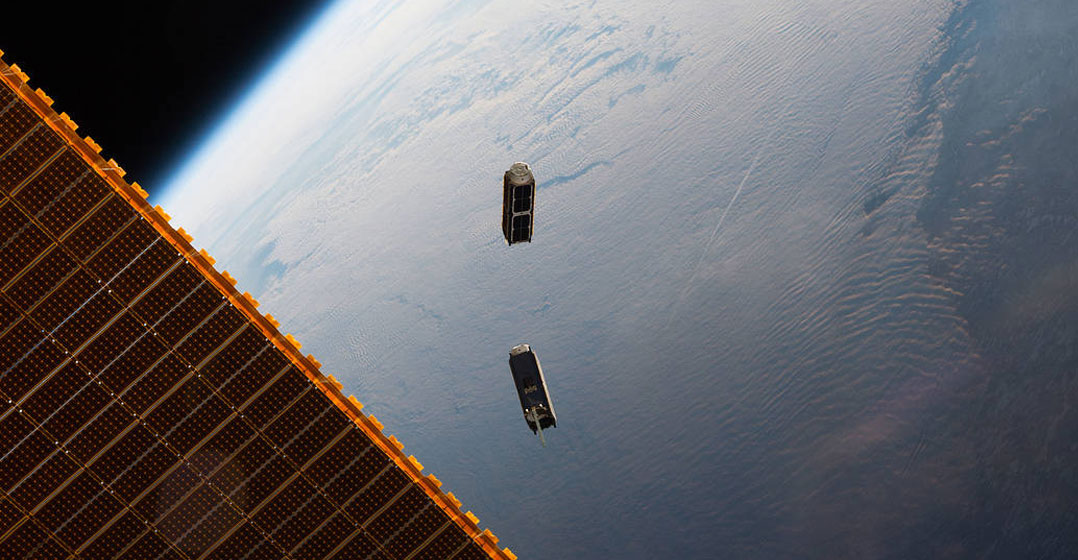
    Two CubeSats, part of a constellation built and operated by Planet Labs to take images of Earth, were launched from the International Space Station on 17 May 2016. Image: Nasa

    The clean-up operation took months but located only a portion of the debris. Canada billed the Soviet Union more than C$6-million, having spent millions more, but was ultimately paid only C$3-million.

    Since the late 1970s, pieces of space debris have fallen to Earth regularly and are viewed with increasing concern. Of course, more than 70% of Earth is covered by oceans, and only a minuscule fraction of the remaining 30% is covered by your house. But for anyone falling foul of the extremely long odds, the consequences would be truly disastrous.

    It was just a quirk of fate that Cosmos 954 did not land on Toronto or Quebec City, where the radioactive fallout would have necessitated a large-scale evacuation. In 2007, pieces of debris from a Russian satellite narrowly missed a Chilean passenger plane flying between Santiago and Auckland. As we send more objects into space, the chances of a calamitous crash-landing will only increase.

    Who pays?

    International law sets out a compensation regime that would apply in many circumstances of damage on Earth, as well as when satellites collide in space. The 1972 Liability Convention, a UN treaty, imposes liability on “launching states” for damage caused by their space objects, which includes an absolute liability regime when they crash to Earth as debris.

    In the case of the Long March 5B, this would impose potential liability on China. The treaty has only been invoked once before (for the Cosmos 954 incident) and therefore may not be regarded as a powerful disincentive. However, it is likely to come into play in the future in a more crowded space environment, and with more uncontrolled re-entries. Of course, this legal framework applies only after the damage occurs.

    Other international guidelines regarding debris mitigation and long-term sustainability of space activities set out voluntary standards intended to limit the probability of collisions in space, and minimise the breakup of satellites either during or after their missions.

    Comprehensively tracking every satellite’s movement and functionality is even harder than it sounds

    Some satellites can be moved into a graveyard orbit at the end of their operational life. While this works well for certain specific orbits at a relatively high altitude, it is impractical and hazardous to start moving the vast majority of satellites around between orbital planes.

    Most of the millions of pieces of space junk are destined either to orbit in an uncontrollable manner for many years or, if they are in low-Earth orbit, to gradually descend towards the Earth, hopefully burning up in the atmosphere before contact with terra firma.

    Management system

    A globally coordinated space traffic management system will be vital to avoid collisions that would result in loss of control of satellites, leaving them to tumble helplessly in orbit or fall back to Earth.

    Comprehensively tracking every satellite’s movement and functionality is even harder than it sounds, because it would inevitably require countries to be willing to share information they often currently regard as confidential matters of national security.

    But ultimately, global cooperation is essential if we are to avoid an unsustainable future for our space activities. In the meantime, don’t forget to gaze upwards every now and then — you might spot some of the most spectacular litter on the planet.The Conversation

    • Written by Steven Freeland, professorial fellow, Bond University, and emeritus professor of international law, Western Sydney University
    • This article is republished from The Conversation under a Creative Commons licence


    SkyLab Steven Freeland top
    Subscribe to TechCentral Subscribe to TechCentral
    Share. Facebook Twitter LinkedIn WhatsApp Telegram Email Copy Link
    Previous ArticleInside Richard Branson’s Hyperloop
    Next Article Taiwan’s economy is thriving on a diet of chips

    Related Posts

    18GW in unplanned breakdowns cripple Eskom

    2 November 2021

    Nersa kicks the Karpowership can down the road

    13 September 2021

    If you think South African load shedding is bad, try Zimbabwe’s

    13 September 2021
    Company News
    Why TechCentral is the most powerful platform for reaching IT decision makers

    Why TechCentral is the most powerful platform for reaching IT decision makers

    17 December 2025
    Business trends to watch in 2026 - Domains.co.za

    Business trends to watch in 2026

    17 December 2025
    MTN Zambia launches world's first 4G cloud smartphone solution - Huawei

    MTN Zambia launches world’s first 4G cloud smartphone solution

    17 December 2025
    Opinion
    Netflix, Warner Bros deal raises fresh headaches for MultiChoice - Duncan McLeod

    Netflix, Warner Bros deal raises fresh headaches for MultiChoice

    5 December 2025
    BIN scans, DDoS and the next cybercrime wave hitting South Africa's banks - Entersekt Gerhard Oosthuizen

    BIN scans, DDoS and the next cybercrime wave hitting South Africa’s banks

    3 December 2025
    Your data, your hardware: the DIY AI revolution is coming - Duncan McLeod

    Your data, your hardware: the DIY AI revolution is coming

    20 November 2025

    Subscribe to Updates

    Get the best South African technology news and analysis delivered to your e-mail inbox every morning.

    Latest Posts
    Digital authoritarianism grows as African states normalise internet blackouts

    Digital authoritarianism grows as African states normalise internet blackouts

    19 December 2025
    Starlink satellite anomaly creates debris in rare orbital mishap

    Starlink satellite anomaly creates debris in rare orbital mishap

    19 December 2025
    Trump space order puts the moon back at centre of US, China rivalry - US President Donald Trump

    Trump space order puts the moon back at centre of US, China rivalry

    19 December 2025
    TechCentral's South African Newsmakers of 2025

    TechCentral’s South African Newsmakers of 2025

    18 December 2025
    © 2009 - 2025 NewsCentral Media
    • Cookie policy (ZA)
    • TechCentral – privacy and Popia

    Type above and press Enter to search. Press Esc to cancel.

    Manage consent

    TechCentral uses cookies to enhance its offerings. Consenting to these technologies allows us to serve you better. Not consenting or withdrawing consent may adversely affect certain features and functions of the website.

    Functional Always active
    The technical storage or access is strictly necessary for the legitimate purpose of enabling the use of a specific service explicitly requested by the subscriber or user, or for the sole purpose of carrying out the transmission of a communication over an electronic communications network.
    Preferences
    The technical storage or access is necessary for the legitimate purpose of storing preferences that are not requested by the subscriber or user.
    Statistics
    The technical storage or access that is used exclusively for statistical purposes. The technical storage or access that is used exclusively for anonymous statistical purposes. Without a subpoena, voluntary compliance on the part of your Internet Service Provider, or additional records from a third party, information stored or retrieved for this purpose alone cannot usually be used to identify you.
    Marketing
    The technical storage or access is required to create user profiles to send advertising, or to track the user on a website or across several websites for similar marketing purposes.
    • Manage options
    • Manage services
    • Manage {vendor_count} vendors
    • Read more about these purposes
    View preferences
    • {title}
    • {title}
    • {title}